

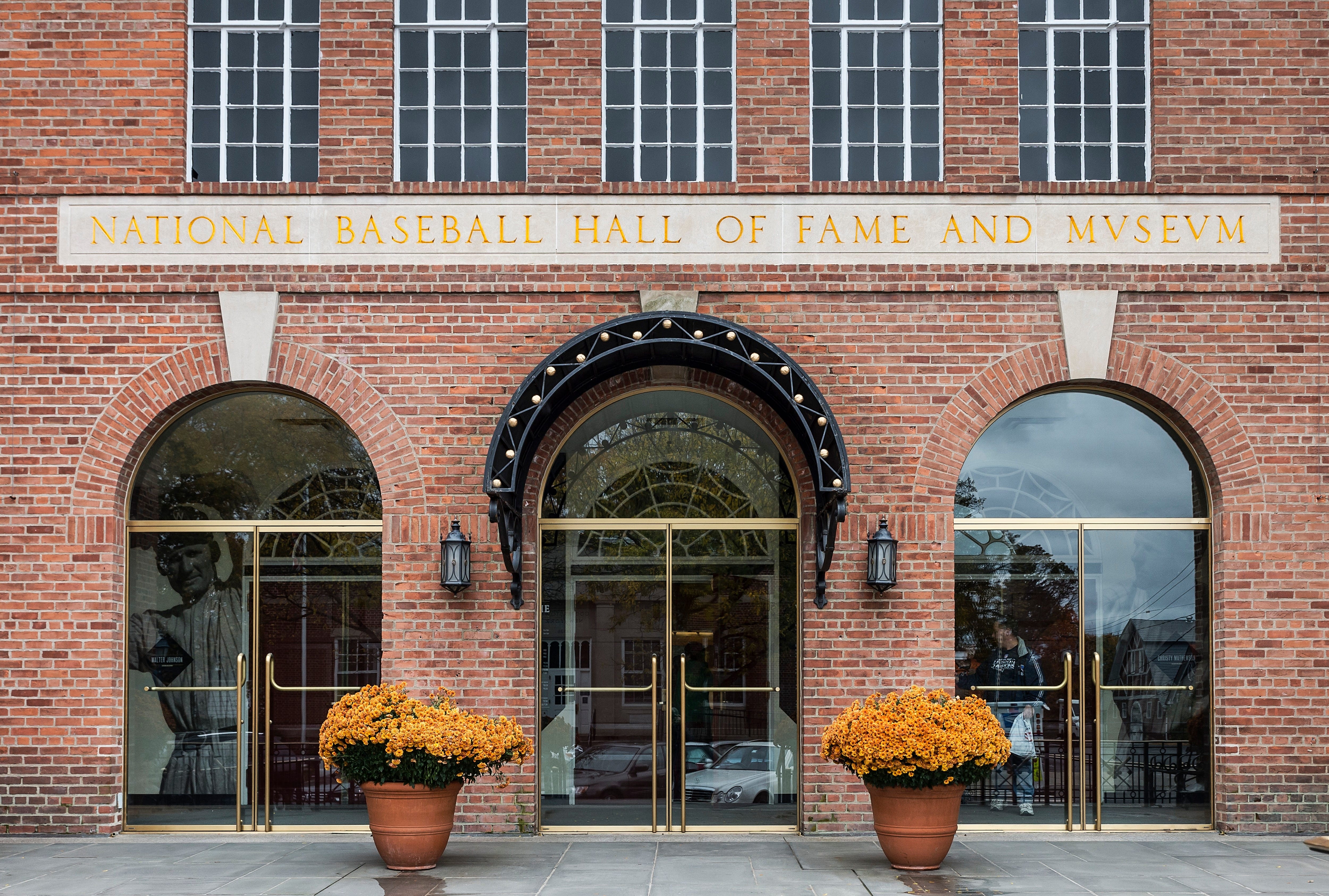

What does the Baseball Hall of Fame mean to you?
“I do believe that heaven is about as high as you can go, and I think right below that is Cooperstown.”
— Duane Kuiper
Long before the Baseball Hall of Fame was a museum or a plaque room, it was an idea. It was an idea before the American League was even founded. It was an idea before a few of the game’s marketers tried to convince a proud nation that baseball was sketched out in the dirt of Cooperstown by a Civil War hero.
It was an idea before the sacrifice fly.
Well, to be precise, the Baseball Hall of Fame was always more than one idea. For some, the Hall of Fame was individual. Personal. From the very start, some players towered over the rest because of their play, or their personality, or even one moment of brilliance that forever glowed in the mind.
“Poor Old (Hoss) Radbourn,” Jim McGuire wrote in 1901. “He became one of the great pitchers after he got tired of fielding. But if he had not pitched a ball thereafter, he would have earned a place in our baseball hall of fame by his home run … right in the trademark, he smashed it so hard that it flew over the left field fence and the long game was ended.”
McGuire was referring to Old Hoss’ home run in the bottom of the 18th inning to beat the Detroit Wolverines 1-0. That was 1882. It was, statisticians believe, the first walk-off homer to settle a 1-0 game in baseball history.
For Deacon McGuire, that was enough to put him in the hall of fame.
In 1912, Cy Young created his own hall of fame with 20 players he considered the greatest of them all. They were: Hal Chase; Ty Cobb; Fred Clarke; Eddie Collins; Jimmy Collins; Lou Criger; Bill Dineen; Charley Gibson; Bill Hutchinson; Walter Johnson; Napoleon Lajoie; Bill Lange; Christy Mathewson; Kid Nichols; Amos Rusie; Tris Speaker; Oscar Stanage; Honus Wagner; Bobby Wallace; Ed Walsh.
That’s some list. We can go over it on another day.
For others, the hall of fame meant something else: It was something you earned by doing something extraordinary. For many years, every pitcher who threw a perfect game — and, later, a no-hit, no-run game — was said to be the newest member of the baseball hall of fame. This was the biggest use of the “hall of fame” phrase.
But when Hugh Chalmers decided to give out a car to the player with the highest batting average, newspapers across America trumpeted that he was creating his own baseball hall of fame. For years, the winner of the MVP was said to be entering the hall of fame.
But, really, any odd achievement could get you into the hall. Here is one of my favorites — from Owensboro, Kentucky, in 1921:
“George Smiley, centerfielder of the Knoxville team in the Appalachian League, earned a place in baseball’s hall of fame yesterday when he made an unassisted triple play against Jellico. With a man on first and second, a drive that had the earmarks of a sure hit was laced over second. Smiley came in fast, caught the drive, stepped on the just vacated second bag, and touched the runner from first. This is believed here to be the first unassisted triple play which an outfielder ever made.”
And then there was the baseball hall of fame as an expression of the loftiest ideal, the highest high for a baseball player.
“John Clarkson,” the Detroit Free Press wrote in 1909, “whose name will be perpetuated in the baseball hall of fame as long as the game remains America’s leading sport …”
“Tommy ‘The Wee’ Leach — as he is called, is one of the greatest ball tossers that has ever donned a uniform and has surely earned a place in baseball’s hall of fame,” the Lansing State Journal wrote in 1910.
“Christy Mathewson, whose card of admission to the baseball hall of fame bears the inscription, ‘Introduced by the Spit Ball,’ played golf at Westchester Golf Club …” the Buffalo Post reported.
The point is that the Hall of Fame has always meant so many things to so many people, and that was long before a couple of dreamers named Alexander Cleland and Stephen Clark decided to juice tourism in the small village of Cooperstown, New York, by building a baseball museum. They hoped it might draw “hundreds of visitors a year.”
We now, as a baseball community across the world, spend countless hours every year arguing about the museum — well, not so much the museum part but the Hall of Fame part.
What does the Baseball Hall of Fame mean?
I reached out to more than 100 baseball fans — inside and outside the game —and asked them that very question. Here are a few of their responses … and the directions they sent me in.
What does the Hall of Fame mean to you?
“If baseball wasn’t invented in Cooperstown, it should have been.”
— John Thorn
“It reminds me of a small-town America that — until the shrinking of the minor leagues, the advent of big league broadcasts, and the rise of the NFL — was fixated on baseball. I wish it still was, and in Cooperstown it still is.”
— Dan Okrent
“A schlep.”
— Jane Leavy
On Tuesday, the Hall of Fame will announce its newest members — it seems likely that both Carlos Beltran and Andruw Jones will get elected, but we’ll find out soon enough — and I find myself doing what I do every year around this time: Reading the explanation essays from voters. These essays have changed so much over the 32 years that I have been a member of the Baseball Writers Association of America.
In those long-ago days, the essays were mostly confident, assured, cocky even. Voters would tell you exactly why they thought Orlando Cepeda or Ron Santo or Steve Carlton was or was not a Hall of Famer. They wrote about the gut, the instinct that drove them. Behind almost all of those essays was an implicit conviction: “I have been covering baseball for a long time, I understand this game, I FEEL this game, and I know a Baseball Hall of Famer when I see one.”
You got the sense that voting for the Hall of Fame was fun.
Today’s essays, at least the ones I’ve read, have little of that. Instead, they feel … conflicted? Edgy? Defensive? Torn? You can’t blame them. What used to be a choice of the baseball heart is now a moral quandary. How much should I dock Carlos Beltran for his role in the Astros’ sign-stealing scandal? Is 3,000 hits, 696 home runs and more than 2,000 RBI enough for Alex Rodriguez, even when he was suspended for using performance-enhancing drugs? Do Omar Vizquel’s almost 2,900 hits and mind-blowing defense matter more or less than the ugly domestic abuse and sexual harassment allegations leveled against him? Does Curt Schilling, one of the greatest postseason pitchers in the game’s history, deserve my vote when he says so many hateful things, including about journalists?
You get the sense that voting for the Hall of Fame is no fun at all.
I blame Cooperstown. OK, “blame” is not the right verb, but I do believe that it is Cooperstown — so filled with myth and charm and beauty — that gives the Baseball Hall of Fame a gravitas and grandeur and fairy tale melody that no other sports Hall of Fame matches. The Pro Football Hall of Fame sits by the side of a highway. The Hockey Hall of Fame is in a mall.
But the Baseball Hall of Fame — which is indeed a schlep from anywhere, as Jane Leavy says — stands forever inside 1952 America, where you can get a club sandwich at the diner, a milkshake on the corner, and any baseball book you could ever want at the dusty used bookstore.
It is that — I believe — that makes the Baseball Hall of Fame something more than the countless sports Halls of Fame in every town in America. The Baseball Hall of Fame silently makes an impossible promise: It promises to take you back to a quieter, calmer, sweeter, and less complicated America.
An America that never existed except as an idea.
But what is the Baseball Hall of Fame if not an idea?
"What does the Hall of Fame mean to you?
“My first thought — more than about any player — is about Cooperstown, the actual town. … It just feels warm to me, more so than a cornfield in Iowa does.”
— Jon Weisman
What does the Hall mean to you?
“I like the Hall. Of course I do. It is the closest thing we have to Valhalla in our overwhelming American religionization of sport … I do have a problem with the fact that Bonds and Clemens, Pete Rose, etc., are not in the place. … I don't like the sanctimonious morality of the place. It's too much like organized religion. Recognize what happened on the field. Load in the caveats, for sure, but say what happened. These guys not only were stars; they were the biggest stars. It's like going to Disneyland and finding that Mickey Mouse and Donald Duck aren't there.”
— Leigh Montville
“The Hall of Fame conjures up two feelings in me, both diverse. The joy it conjures up comes from knowing it’s something I’ve followed since I was a little boy, which is well over 70 years ago. … The sadness it conjures up is how so many years later, I still carry the pain that Ron Santo of the Chicago Cubs, one of my idols for a team I idolize, and a man I got to know well, had to pass away before given the honor that I feel he so richly deserved to experience while he was still alive.”
— Joe Mantegna
“I love it as a living museum of baseball.
I am less interested in the ‘ranking of greatness’ aspect.”
— Matt the Electrician
Alexander Cleland and Stephen Clark, the men who willed the Baseball Hall of Fame into existence, were not baseball fans. At all. They basically knew nothing about the game. As the story goes, Cleland — a Scottish immigrant who had spent his life working as a social worker helping immigrants chase their American dreams — was in Cooperstown walking by some construction at the little ballpark, Doubleday Field. He asked what was going on.
They told him that Cooperstown was where baseball was invented.
And they told him that the centennial anniversary of that invention was coming up.
So he went to his boss, Clark, and basically said: “I have this idea.”
They had no clue what they were tapping into. They had no concept of the power of this idea, the power of a place that would not only celebrate people’s childhoods but, in a very real way, fortify and sanctify and empower people’s childhoods. “Yes,” this building would say, “that hero of yours — Rogers Hornsby or Reggie Jackson or Greg Maddux or Sandy Koufax or Roberto Clemente or Ichiro Suzuki — yes, that player was one of the greatest of them all. You were so lucky to see him play!”
What power is in that idea!
But here’s the hard part: There are only so many people you can put in the Hall of Fame before it begins to lose that power. And all baseball childhoods long to be fortified and sanctified. Someone who grew up in the South, rooting for Dale Murphy, or in New York, rooting for Don Mattingly, or in Los Angeles, rooting for Maury Wills, they want their memories confirmed, too.
A whole generation of people grew up knowing — not thinking but KNOWING — that Barry Bonds was the greatest hitter who ever lived, the hitter who was so good he broke the game. Those home runs into McCovey’s Cove, they were real. Those terrified managers who ordered their pitchers to walk him were real. Those impossible numbers — 500 homers and 500 stolen bases, a .609 on-base percentage one year, 73 homers in a season, 120 intentional walks in a season — those were real.
But he’s not a Hall of Famer? Because he cheated?
Yes. Because he cheated. Because the Baseball Hall of Fame must be everything, everywhere, all at once — a museum, a plaque room, a moral court, a time machine, a nostalgia confetti popper, and a keeper of the flame. If you put Bonds in — or Roger Clemens or Mark McGwire or Sammy Sosa or Pete Rose or Curt Schilling — you tarnish and sully Baseball Heaven.
And if you point out that Baseball Heaven is already filled with cheaters and gamblers and drug users, you tarnish and sully Baseball Heaven.
And the circle goes round and round.
What does the Hall of Fame mean to you?
“Order in a world of chaos.”
— Molly Knight
“Preserving History. Honoring Excellence. Connecting Generations.”
— Josh Rawitch
“The concept that greatness is and should be permanent.”
— Bill James
Josh said a lot more than just the Hall of Fame mission statement. He added this:
“If you’re an adult, it is where your childhood memories come rushing back in indescribable ways. If you’re still a child — visiting quite often with your teammates and family — it’s where you create memories that will literally stay with you when you’re old and gray. And if you’re old and gray, it’s quite often a place you’ve wanted to visit your whole life, hearing about it every time you turn on a game. And when you finally make it, it still somehow lives up to and often exceeds your expectations.
I was 27 years old when I first went to Cooperstown. I’ve been back many, many times since then. I’m moved every single time. It’s a feeling, you know? I know the history. I see the cracks. I understand the contradictions, the biases, the flaws. I know it isn’t really Valhalla, and I know the Hall of Fame plaque room is not filled with saints … just as I know that baseball wasn’t really invented in Cooperstown.
But that feeling insists on breaking through in Cooperstown. As Bill says, greatness is and should be permanent. It’s a beautiful and rare thought. The world keeps spinning, and memories fade, and so little feels permanent.
But it’s different in Cooperstown.
People might or might not remember Bob Hope, but they remember Mickey Mantle.
People might or might not remember Warren Harding, but they remember Babe Ruth.
People might or might not remember Mae West, but they remember Jackie Robinson.
They always will, I think.
"An America that never existed except as an idea."
I'm ever so glad you included that thought.
Because - as Mr. Posnanski will be acutely aware - 1950s America was the America of Jim Crow, HUAC, and the Termination Policy. The 'simpler, sweeter' America reified by some depended very much on who you were.
And I know, he's writing about baseball here. But in these times when hateful ideas are not just being spoken by politicians but are being put into bloody practice on American streets, in many ways in the name of that America that never existed, it's important to keep in mind the story of the past that we choose to tell. To not accept the curated, whitewashed lies.
Anyway, Mr. Posnanski's thoughts about baseball are as incisive and fascinating as always. He thinks a lot about dreams, and so do I. I'm very glad to have baseball (among other things) as a pleasant thing to think about when the clamour becomes too much.
I just also think - and again, appreciate very much that this was signposted here - that especially when we talk about the past, in these fractious times, we must be sure to do so with honesty.
i'm also weary of the character question. cobb and speaker fixed a game, they're in, jackson is not. beltran is going in and he was the architect of the greatest scandal since PEDs. scores and scores of greenie consumers are in, the steroid guys are not. well, some are, just not clemens or bonds or sheffield. i think greenies distorted the game more than roids. jones was a domestic abuser, he's going in. vizquel is not. either repeal the character clause or take it seriously.