


Last week, I offered up a basic explanation of FROGs. To summarize, while everyone talks about the Greatest of All Time, I’m trying to introduce a wider lens toward greatness. FROG stands for Flagship Representative of Greatness.
I like to think of FROGs as Knights of the Round Table of sport, the people who expand the definition of greatness.
I put up a poll a couple of weeks ago asking readers to name one GOAT in various sports. At last check, we got 4,311 responses. I have used those results to not only say who you think is the GOAT — I don’t think there will be too many surprises there — but also to determine who are the FROGs.
It actually proved pretty easy to choose the FROGs based on your votes — In each sport, there’s a pretty clear cutoff line between the top group and the next group. I will say that in each sport, there are a different number of FROGs.
First in the series: Golf
In all — once I removed all the misspellings and such — you named 43 different people as the greatest golfer of all time. These include women (who will have their own FROG survey), fictional characters (Happy Gilmore) and celebrities (Larry David). Most of the random choices got one or two votes.
Here is a word cloud of your choices of those golfers who received the most support:
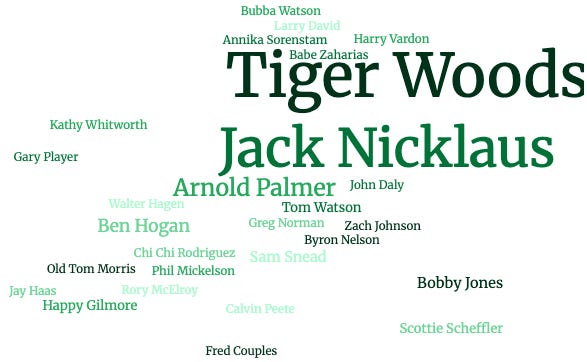
Fun right? You can see by the size of the names that Tiger Woods was your choice as the golf GOAT, followed closely by Jack Nicklaus. I imagine that doesn’t surprise anyone. This has been the talk in golf for a couple of decades now, Jack vs. Tiger, Tiger vs. Jack, 18 majors vs. unparalleled dominance, impossible consistency vs. unthinkable supremacy against deeper fields, on and on.
The GOAT conversation is pretty worn out, I think.
BUT the FROG conversation is only beginning. You see all the golfers who got some support. I wouldn’t have guessed there were multiple people who would list Zach Johnson, Jay Haas, John Daly or Old Tom Morris as the greatest golfer of all time, but here we are. Larry David is on here. Happy Gilmore, too.
The question is: How many golfers sit at the round table? How many FROGs does golf have?
For your responses, the answer is clear: There are five golf FROGs.
And they are:
Tiger Woods
Of course. Tiger, I think, is unique in sports history in this way: He singlehandedly made his sport a must-watch for millions and millions of new fans around the world. Yes, others have had similar reach — Jordan and Ali come to mind — but I’d argue it’s way different with Woods because the minute he stopped being a factor, those fans left. He is, more than anyone I can think of, larger than his sport.
Jack Nicklaus
Of course. Nicklaus fans will tell you that the most impressive statistic of his career is not his 18 major championships — a record that truly might not be broken in any of our lifetimes — but his 18 runner-up finishes in majors.
He also missed one major championship cut (ONE!) in 16 years, between 1969 and 1984, which is both mind-boggling and utterly offensive to Jack himself. “Really, we’re talking cuts now?” he said dismissively in 1993 when told that he had not missed a Masters cut since 1967. “I’m not playing to make cuts. I’m playing to win.” He was 53 years old at the time.
Arnold Palmer
While Tiger took golf popularity to unthinkable heights, it was Arnie who basically invented golf as a spectator sport. He just looked so good on TV. The late Frank Chirkinian, the father of television golf, told me that the problem with broadcasting golf at the beginning was that it was too large a canvas, the course was too big, the ball was too small, the field was too massive, and viewers had no idea where to focus their attention.
Arnie changed all that. You couldn’t take your eyes off him. His wild swing. His famed comebacks. His occasional collapses. His rabid Arnie’s Army fans. It was all so compelling, so fun, so interesting. Arnie won just seven majors, so there are several non-FROGs with, perhaps, better resumes. But being a FROG is not specifically about statistics or achievements. It’s about representing greatness.
Ben Hogan
He created an archetype — the golf ascetic who spends countless hours on a practice range seeking not only excellence but perfection.
Hogan won the U.S. Open in 1950, just months after nearly dying in an automobile accident. He won the closest thing to a Grand Slam as possible when he took the Masters, U.S. Open and Open Championship in 1953 (he didn’t play in the PGA Championship that year because it was the same week as the Open).
But I think his most lasting legacy is what he called “the secret” — a move he insisted unlocked the golf swing. That’s what he was after all those years, when he practiced and practiced while the other top golfers thought him a madman. Golfers have been looking for the secret ever since, and while Hogan on different occasions, talked about the secret being “pronation” or something else, most golf believers think he took the secret with him to the grave. “It’s in the dirt,” he sometimes said about the secret, meaning that golfers had to dig it out themselves.
Bobby Jones
Bobby Jones is the ghost at the table, the ghost of golf’s past, the constant reminder of what golf is supposed to be all about. I imagine he finished ahead of stars like Tom Watson, Sam Snead, Walter Hagen and Scottie Scheffler because golf fans think about him every year when the Masters, his tournament, rolls around.
But Jones represents golf as more than a sport. He represents golf as a calling.
He had unparalleled success — he was twice given a ticker tape parade in New York for his golfing victories — but he preferred to talk about sportsmanship and honor and the glory of golf. The romance surrounding the Masters, whether you love it or find it cloying, is the purest essence of Bobby Jones’ golf dream.


WALTER HAGEN
I can't argue with your Golf FROG list, but I'm afraid Walter Hagen suffers from Otto Graham Syndrome, which I would define as one whose pure greatness is lost only because of the ignorance of today's fans. (And I don't mean ignorance in a bad way, just the fact that people can't appreciate what they don't know, and so many are so uninformed. How is it that Otto Graham is so often left out of the GOAT conversation? It's because fans today simply aren't aware of everything he did. Contrary to common perception, the NFL did not begin in 1967. But I digress...)
WALTER HAGEN almost singlehandedly turned golf and the PGA Tour into a professional spectator sport. It was he who first realized that if you were good enough you could win enough prize money by playing enough tournaments to make a living at professional golf. "“All the professionals … should say a silent thanks to Walter Hagen each time they stretch a check between their fingers. It was Walter who made professional golf what it is,” Gene Sarazen famously said.
Hagen won 45 tournaments on the PGA Tour at a time when there weren't half as many tournaments as there are today. He's credited with 11 Majors before the Masters even existed, and historians argue that total should really be 16 because The Western Open was considered the fourth major at the time (Hagen won 5.)
He once beat his big rival Bobby Jones 12-and-11 in a famous 36-hole match. That's not a typo... 12 & 11!
He traveled the world to Africa and India and Asia and Australia giving exhibitions and exposing the game of golf to the far reaches of the globe where many people had never seen the game before.
The same year that Babe Ruth famously made his $80,000 salary, more than the President Hoover and explained "I had a better year than the president did", Walter Hagen actually made more money than Babe Ruth!
He is to pro golf what Red Grange was to pro football... and so much more. But for some reason, so much of his significance is lost to history.
I can't argue with Tiger-Nicklaus-Jack-Hogan-Jones, but Walter Hagen deserves a special spot on this list of golf's FROGs!
Love that we can vote Sam Snead in to FROG status, because if the man with most perfect, most aesthetically pleasing, most graceful swing ever isn't a Flagship Representative of Greatness, then I don't know what is.