

Some days are harder than others. Today is one of those hard days.
So let’s just scribble down some random thoughts about baseball.
The American League MVP race — much like the American League itself — is a pretty uninspiring collage of meh. At the moment, Kansas City’s Bobby Witt Jr. leads all AL position players with 6.4 combo WAR. This is because BW is such an extraordinary baseball force — great hitting, great fielding, great baserunning and so on.
I don’t think the voters are going to pick a shortstop hitting .280/.360/.448 for a last-place team as MVP.
So, who else? There’s Yordan Álvarez, of course — I guess he’s the most obvious position player choice. He leads the league in batting and on-base percentage; he’s second in homers and RBI; he’s top ten in doubles and runs, and so on. He’s also in freefall; he’s hitting less than .200 the last two weeks as the Astros try to be the sole survivor of the gruesome American League West.
Yordan is also a designated hitter. Only one full-time DH has ever won the MVP award — and Shohei Ohtani had to go 50-50 to win that one (in his three other MVP years, he also pitched). Álvarez is not having THAT kind of year. By Baseball Reference WAR, he trails Detroit rookie Kevin McGonigle, whose OPS is more than 200 points lower than Yordan’s. Defense does matter.
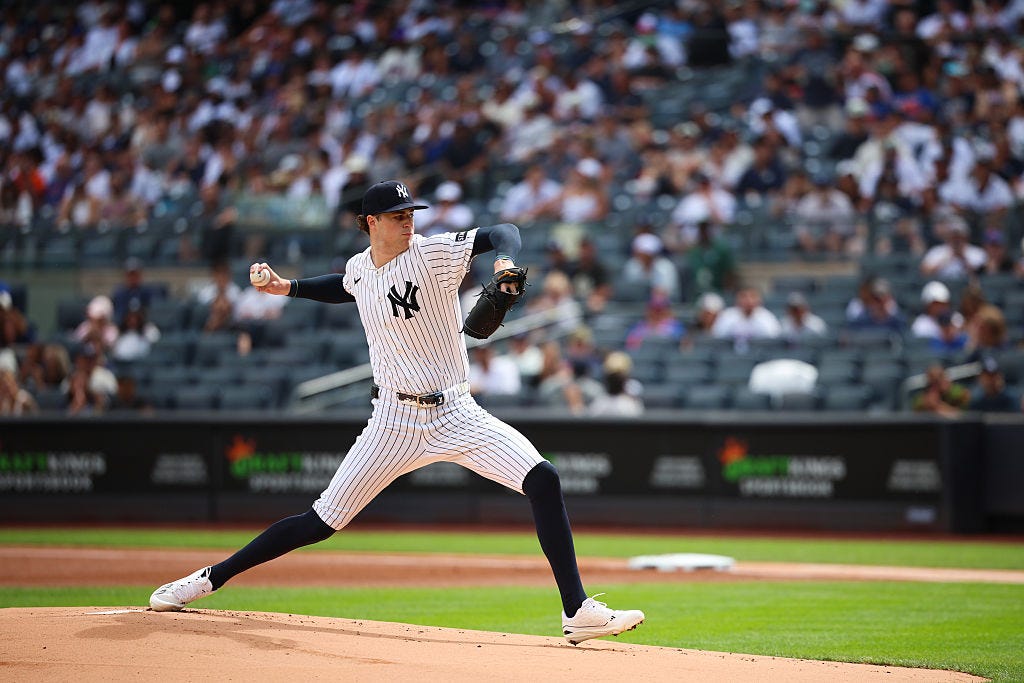
In any case, the lack of viable position player MVP candidates has some folks thinking that the true most valuable player in the American League this year is Yankees starter Cam Schlittler. He is the combo WAR leader at the moment, though only by a couple of decimal points, which doesn’t really mean anything. I guess more to the point, he leads the American League in starts, innings, WHIP and ERA — he has a fantastic 1.95 ERA — and he’s second in strikeouts. It’s a dominant pitching season.
If you want to make an emotional argument, you could argue that no player in the American League has meant more to his team than Schlittler has meant to the Yankees. They’ve been without Aaron Judge most of the year. They tried pretty much everybody at shortstop. Their rotation is filled with 30-somethings trying to make it through the day without breaking something in their elbows. They’re going to the playoffs and are probably the favorite to win the pennant. Schlittler is the glue.
But we, as a society, seem to have moved on from the idea that pitchers can be MVPs. The last pitcher to win an MVP award was Clayton Kershaw in 2014. Only one pitcher — ONE — has received a first-place MVP vote in the dozen years since then. And he received just one first-place vote. Can you name that pitcher?
While you’re thinking about that, it’s probably worth saying that the role of pitchers has changed so much that the MVP case for them does get harder. I mentioned that Schlittler leads the American League in innings pitched, and that’s true, but he leads with 184⅔ innings. The Yankees will obviously want him to start Game 1 of whatever playoff series they are in, so my guess is he gets two more starts this year — that means he probably won’t even get to 200 innings. That would make only the third time in American League history that the innings-pitched leader didn’t throw 200 innings, and one of those was the COVID season.*
*That’s assuming that Kansas City’s Michael Wacha doesn’t get to 200 innings. He got a shot — he’s at 182 innings and might have three starts left.
Still, Schlittler’s dominance does put him right there as an MVP candidate.
Right, Aaron Judge?
“He’s definitely pitching like an MVP,” Judge told reporters. “But they’ve got a Cy Young for a reason — best pitcher in the game. So he’s got my vote, definitely, for the Cy Young.”
Yikes. Judge really doesn’t like pitchers, does he? I can respect that, though he does have the facts wrong — the Cy Young Award was most definitely not created as a pitching replacement for the MVP. Quite the opposite. It was created because Ford Frick was fuming that voters kept denying Philadelphia ace Robin Roberts the MVP. It particularly annoyed Frick in 1952, when Roberts won 28 games and pitched 330 innings, and the voters gave the award to Hank Sauer, who led the league in homers and RBI for a mediocre Cubs team. When Cy Young died three years later, Frick came up with the idea of an award for pitchers to be named for Young.
Bob Feller, among others, was strongly against the idea because he felt sure it would keep voters from choosing pitchers as MVP. So, Frick had it written into the MVP rules that pitchers should absolutely be considered, and in 1955, the first year of the Cy, Don Newcombe swept the Cy Young and MVP. In 1963, Sandy Koufax swept. In 1968, both leagues gave the MVP to pitchers — Bob Gibson and Denny McLain respectively.
Anyway, I certainly don’t expect Aaron Judge to be a baseball history geek like I am, but it’s definitely odd that he would shoot down his own teammates’ MVP case.
I know it doesn’t matter much in the big picture, but I do find it striking that at a moment when everyone is screaming about how small-market teams have no shot, the first two teams to clinch spots in the postseason are Milwaukee and Tampa Bay. I mentioned this on the socials and got a couple of responses fighting back against the idea that Tampa Bay is a small market. I’ll let you fight amongst yourselves over that one.
I’d rather focus on a response I got from several folks about the nature of the postseason — it’s probably best summed up in this one sentence:
“The big-market, high-payroll teams will always have an advantage in the playoffs because fewer players play, fewer pitchers pitch, it will come down to the big stars and only the big teams can afford the big stars.”
First, I should say: I have absolutely no idea if any of this is true. It sounds reasonable enough, I suppose. But that’s the trap, right? I mean absolutely no disrespect at all to the people who sent me some version of this response, but it reminds me of Bill James’ classic bit about bullshit.
“There was a Kansas football game a year ago; some Texas-based football team, much better than Kansas, came to Lawrence and struggled through the first quarter — KU with, like, a 7-3 lead at the end of the first quarter. The rest of the game, KU lost, like, 37-0, or something. The announcer had an immediate explanation for it: The Texas team flew in the day before, they spent the night sleeping in a strange hotel; it takes them a while to get their feet on the ground.
“It’s pure bullshit, of course, but he was paid to say that … if it had happened the other way, and KU had lost the first quarter, 24-0, and then ‘won’ the rest of the game 17-14 (thus losing 38-17) … if that had happened, we both know that the announcer would have had an immediate explanation for why THAT had happened. … Bullshit is without limit.”
Let’s assume for a moment that it IS true that big-payroll teams have an advantage come playoff time because their high-priced talent will play a bigger role. The fix would be super easy, wouldn’t it? Simply make the regular season matter more. There are dozens of ways to do that. I really do wish that Tampa Bay and Milwaukee, should they finish with the best record in their respective leagues, would get more than a first-round bye. But, heck, you know me. I’d put them right in the World Series.
Who is all in on a massive Guardians-White Sox September series with the American League Central on the line? Yep, the series starts tonight in Cleveland — three games, a half-game separating the two teams in the standings. Sean Newcombe v. Gavin Williams tonight! Let’s go!
OK, yeah, some of that might have been performative enthusiasm — but it’s kind of cool, right? I don’t get the charge out of so-so teams fighting for playoff spots that a lot of people do, but the White Sox have been a pretty fun story, and, look, they have to find six American League teams for the playoffs, or else it will be an empty October.
Look, three of these five teams likely will be in the playoffs (and one will actually get a bye!):
White Sox, 76-73, lost 100 games each of the last three seasons
Guardians, 76-74, nobody on the team has more than 15 home runs
Astros, 75-75, their “ace” Peter Lambert was granted his release after he didn’t make the opening-day roster and then re-signed to a minor-league deal.
Blue Jays, 75-75, second-lowest scoring team in the league, ahead only of the California Angels. Vlad Guerrero Jr. hit his first home run in Toronto YESTERDAY.
Rangers, 74-76, unless you’re in the greater Dallas area, you probably have not thought about them once all season.
This is what baseball does to give us an October crapshoot. As baseball fans, our best choice is to embrace the madness.
Speaking of the madness …
If the season ended today — and time is running out on the season — these would be the two first-round wildcard matchups (matchups of two actual wildcard teams):
American League: New York Yankees vs. Boston Red Sox
National League: Philadelphia Phillies vs. Chicago Cubs
I mean, for pure adrenaline rush baseball, you can’t do any better than that, can you? Yankees-Red Sox, Phillies-Cubs in best-of-three showdowns? That’s like Five Hour Energy drink baseball. It will definitely get the heart pumping.
It looks like batters will hit fewer doubles per game this season than in any season since 1991, and fewer triples per game in any season since, well, ever. We’ve all watched baseball become a three-outcome game — home runs, strikeouts and walks — and that has grown a bit more extreme this year as batters are walking a touch more, maybe because of the challenge system.
There’s really no arguing that the game has lost some of its texture and variety. It’s still the best game. But I think we’d all like a few more doubles and triples.
How does that happen? There are a lot of ideas about rule changes or field changes. I don’t really see much momentum inside the game for any of them, though. And I don’t see batters TRYING to hit more doubles and triples. Why do that when home runs are better?
There is one rule change that I have decided to put my energy behind (whatever that’s worth) … I wrote about checked swings last year, and I’m now more convinced than ever that changing the checked swing rule so that it matches up more with the historic norms (meaning giving the batter much more leeway on checked swings) could make a real difference. I’ll talk about this more later. For now, I’ve reposted last year’s checked swing story in the JoeBlogs Archives.
I've lost track of when WAR matters and when it doesn't.
I mean, you can't argue that Salvy Perez is a HOFer regardless of WAR and then argue that Yordan Alvarez shouldn't be MVP because of it.
Even my favorite writers now are twisting in the wind when deciding when WAR matters and when it doesn't.
As a Mizzou grad I do appreciate that the great Lawrence resident Bill James had the Jayhawks get blown out in his hypothetical scenarios. It made them feel realistic.