

First, you should know—maybe you already know—that there is no definition of a checked swing in baseball’s rules, and there never has been. This is kind of mind-boggling when you think about how absurdly detailed baseball rules are. There are THIRTEEN different definitions of what constitutes a balk, not to mention the five clarifying comments that go along with them. There’s an entire paragraph—147 words!—painstakingly going over the rules if there happens to be an ambidextrous pitcher.
Oh, just for fun—a continuation of something I did 10 years ago:
“Stairway to Heaven:” 341 words
Hamlet’s soliloquy: Also 341 words!
Declaration of Independence: 329 words
The Gettysburg Address: 272 words
“Freebird:” 172 words
MLB rule 5.07(f) on ambidextrous pitchers: 147 words
Robert Frost’s “The Road Not Taken:” 143 words
What Crash Davis believes: 86 words
Preamble to the Constitution: 52 words
“God Bless America:” 28 words.
Al Michaels’ Olympic call: 6 words.
Sure, the baseball rulebook tends to go long on its definitions. Heck, the MLB definition of pitcher wins is 711 words long, which is 56 more than the Old Testament uses to tell the entire creation story.
So, the fact that Baseball has NO definition of what constitutes a swing—I mean, NOTHING—is actually one of the bananas things about this wonderful game. This is all the rulebook has to say about a swinging strike:
A STRIKE is a legal pitch when so called by the umpire, which:
(a) Is struck at by the batter and is missed.
That’s it. That’s the whole thing. A swinging strike is simply an umpire’s judgment call, based entirely on whether he believes the batter “struck at the ball.” Nothing else comes into play. As Sam Miller writes in his terrific piece titled, “What if All Checked Swings Were Just Balls,” the idea of what constitutes a checked swing has changed dramatically over the years. Check out these “checked swings” against Sandy Koufax in the 1965 World Series.
The best part of those is that nobody even questions that Don Mincher held up his swing—Vin Scully talks about how he held up, Koufax seems untroubled by the ball calls, this is how the game was played for a long time. Any effort to hold up the swing was granted, and a ball was called.
This all dates back to the very beginning of baseball. The early game was built for the batter… the pitcher was merely the trigger. Batters could demand a pitch in the exact location they wanted… not unlike what Shoeless Joe asks of Ray when they’re facing each other in “Field of Dreams.” Even after that became tedious, the batter was STILL allowed to ask for either a high pitch or a low pitch. And there were no balls in the early days of baseball; hitters could wait for as long as they wanted to get the pitch that met their eye.
As Peter Morris writes in his brilliant “A Game of Inches:”
Of all the things that is necessary to understand about early pitching, perhaps the most important is this: almost everyone except the pitchers themselves viewed them as intruders in a game that was supposed to put fielders against hitters.… The history of early pitching is a saga of legislative attempts to restore baseball to the way it had once been but would never be again—when the pitcher’s role was to give the batter something to hit.
So it makes sense that, in the early days, the batter's intention was the only thing that mattered. Maybe he started, yes, but if he stopped at any point during the swing, then his intention was not to swing. The benefit of the doubt ALWAYS went to the batter. And it was that way for a long while.
Now? Well, no.
The checked swing didn’t just change overnight, though. It has been a gradual change… my theory is that it is directly related to the absolutely ridiculous checked-swing appeal process that we’ve all just come to accept. Even Peter Morris himself wasn’t sure when catchers could start appealing to the third- or first-base umpire, but that certainly goes back to the 1970s, and probably earlier. Sam Miller screenshot this photo of Johnny Bench “holding up” his swing during the 1975 World Series—believe it or not, this was actually appealed to the first base ump who ruled no swing:
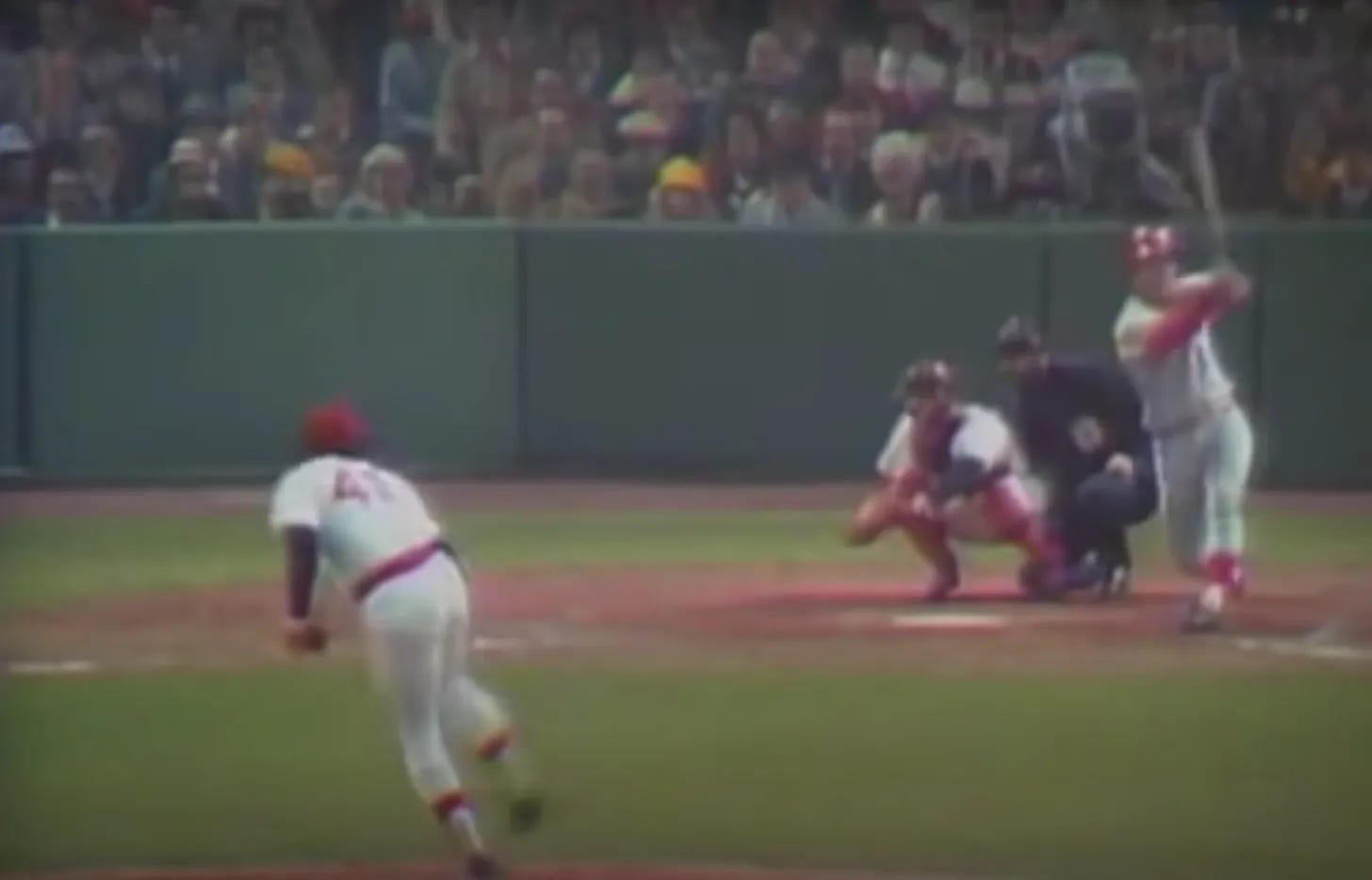
Anyway, as appeals happened more and more, I think the modern idea of the checked swing came into vogue. After all, why would you ask the first- or third-base umpire if the batter went around? What special insight could they possibly offer into the batter’s intention from 100 feet away? None, obviously. But the base umpire might have a better angle at seeing whether the bat crossed the first- or third-base foul line (or crossed the front of the plate).
So THAT became the measure of a swing.
It stopped being about intention.
And instead, it became about: Did you or did you not hold up before the bat made it past the foul line?
This is an entirely made-up rule that nobody voted on, nobody really agreed on and doesn’t fit at all into the historical context of baseball. It’s just a thing we all accepted. And, honestly, it makes the game worse. Here we all are complaining about how there are too many strikeouts in the game and not enough balls put into play, and at the same time we’re basically telling batters that just pondering a swing is enough to get you a strike.
So what can be done about this? You can’t just say, “OK, checked swings are no longer strikes,” without defining what makes up a checked swing. And this is where it gets interesting and fun: Baseball is FINALLY making an effort to define the checked swing. And they’re doing it with fun animated graphics, just like they are with ABS challenges.
How does it work? Well, using the Statcast cameras, baseballs draw a line somewhere (more on that in a second), and if the bat crosses that line, then it’s a strike. If it doesn’t cross that line, it’s a ball. That’s the whole thing.
As for the line… if it were me, I’d be much more liberal with it. I’d make the line a straight line from the pitcher’s mound to home plate. In order for a swing to be called, I’d want the bat to have to go more than halfway… and that mound-to-plate line would constitute a 90-degree angle.
I’m not sure what a rule change this dramatic would do to the game… but I’m optimistic that it would make the game better in a lot of ways. Pitchers would be against it, obviously, but that’s OK: Pitchers have had a pretty nice run, and I’d love to see a change that balances things out a bit for the hitter. I’d institute this rule change, like, immediately.