

I’ll start off with some BIG FAN announcements and then let’s get into some Johan Santana-Félix Hernandez Hall of Fame talk!
So, you might know — I’m fairly sure I mentioned this — that BIG FAN comes out on May 19, less than three months away. BIG FAN is a book that Mike Schur and I wrote about what it means to be a fan. I love it so much. We traveled all over the place to write about fans at, oh, the World Darts Championship in London and Wrestlemania in Las Vegas, and a hockey game in Montreal and the Indigenous Stickball World Series in Philadelphia, Mississippi, and a Liverpool match at Anfield and a chess tournament in St. Louis and an opening football Sunday at the Buffalo Wild Wings in Dallas.
Which Buffalo Wild Wings in Dallas?
You’ll have to wait for the book to come out for that one.
We went to a lot more places than that; I’m trying to keep some of that quiet for now to add to the surprise. What I feel sure about is that you’ll get the biggest kick out of this book. I know this because Mike and I had the best possible time, and you’re just like us! As for the announcements:
We changed the title! This is just a little insider info for you folks, but the original title of the book was: BIG FAN: Two Friends, 81,589 Miles, and the Wild, Wonderful Sports We Love.
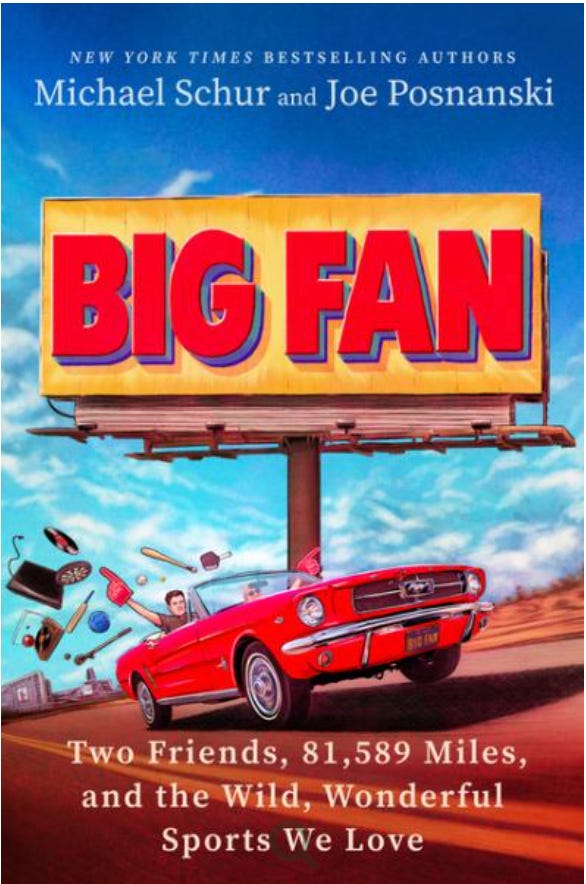
But NOW the title is: BIG FAN: Two Friends, 82,490 Miles, and the Wild Wonderful Sports We Love.
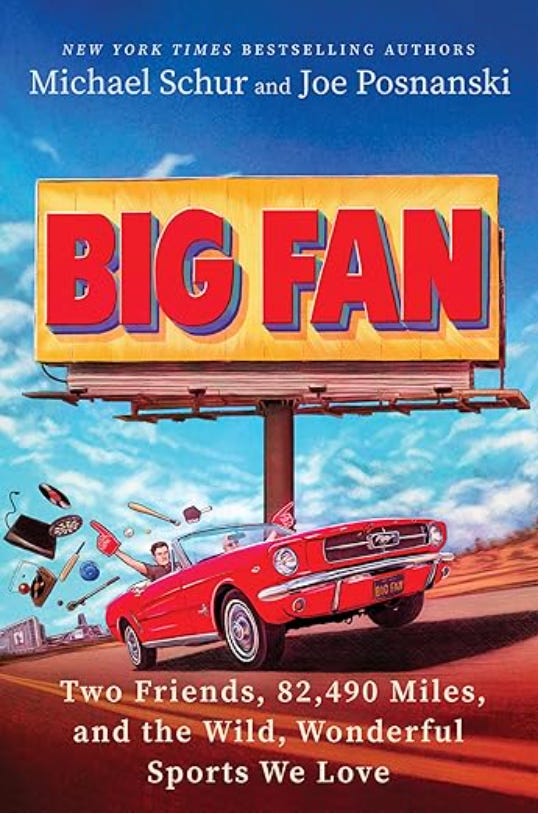
Yes, that’s right, they found 901 new miles to add to the book's title.
Mike and I will be narrating the audiobook! In fact, we’re just about to do that.
We are going to announce the first leg of our tour in the next few days — we’re both really pumped to come see you.
We’re signing many, many, many copies of this book so that, even if you don’t catch us on tour, you can preorder signed copies for yourself or to give out as gifts or to analyze and deconstruct our handwriting as part of your evil plan to take over the world. You can preorder signed copies from our good friend Barnes (and also Noble), a-Books-A-Million (please read in a comical Italian accent), and you folks in Canada can go to Indigo, which is not only a great bookstore but also easily the most obscure color in Roy G. Biv.
And if you want more than just our signatures on the book; you can go to our friends at Joseph-Beth — there, you are guaranteed to get a book signed by the both of us, but you will also have a chance to get a one-of-a-kind copy with a special message (such as my three favorite Tampa Bay Rays) and special guest stars (like an autograph from Kristin Bell* or a thought from one of our family members).
OK, enough of my yakking … let’s talk some Johan and King Félix …
Someone asked me the other day: If I had only one Hall of Fame vote, and I could only give it to Johan Santana or King Félix Hernández, who would I choose?
Before I tell you my answer — and talk a little bit about my Strength of Seven Idea — let me show you the resume of the two pitchers:
Johan: 139-78, 3.20 ERA, 3.44 FIP, 1,988 Ks, 51.1/45.6 bWAR/fWAR, two Cy Young Awards; 2.72 Cy Young Shares.*
King Félix: 169-136, 3.42 ERA, 3.52 FIP, 2,524 Ks, 49.9/54.0 bWAR/fWAR, one Cy Young Award, 2.46 Cy Young Shares.
*The other day, I talked about MVP Shares and Cy Young Shares and credited Baseball Reference because that’s where I find them. Pal Tom Tango wrote in to remind me that those Shares, like so many baseball innovations, was invented by Bill James.
So, looking at the resume, it’s close.
I actually don’t think it’s close. I mean, I would vote for both as Hall of Famers, but if forced to only choose one, I’d choose Johan every single day of the week.
And this led me down the Strength of Seven rabbit hole.
What does that even mean? Well, here’s what I did: I went to Baseball Reference and Fangraphs, rolled the Wayback Machine back to the 1960s, and looked to see who was the best pitcher in baseball, by WAR, from 1960-66. It will not surprise you to find that even though Reference and Fangraphs calculate pitcher WAR very differently, the answer in both cases was Sandy Koufax.
So, the Strength of Seven proposition is this: That makes Sandy Koufax a Hall of Famer. The rest of the career will determine his place in baseball lore, but as far as the Hall of Fame goes? Yeah, for me, if you’re unquestionably the best pitcher in baseball for a seven-year period, that’s enough for me.
Now, does leading the league in both bWAR and fWAR over a seven-year period make a pitcher UNQUESTIONABLY the best? We can argue about that one later. For now, I’m going to say: Yes, yes it does.
Then I did the next seven-season period — 1961-67. And, what do you know? Koufax again. So Koufax appears two times on this list. Keep that in mind.
The next seven-year block — 1962-68 — gives us our first test. Baseball Reference calculates that Juan Marichal was the best pitcher; Fangraphs has Bob Gibson. Now, of course, both of those pitchers are first-class Hall of Famers, but what I decided to do with split decisions is not count them. The key for me is that word: “Unquestionable.” This is the Hall of Fame. As you will see a bit later, there are some great pitchers not in the Hall of Fame who were top in either fWAR or bWAR over a seven-year span, but NOT BOTH.
I think you have to be both.
OK, so I’m going to run through some of the pitchers who qualify as Strength of Seven Hall of Famers, and then we’ll get to Johan and King Félix.
Juan Marichal (1 SoS block): Marichal was obviously an all-time great, but he happened to get overshadowed by Koufax on one side of his career and Gibson on the other.
Bob Gibson (3 SoS blocks): He had all three SoS blocks between 1964 and 1972. Everybody knows about Gibson’s 1.12 ERA in 1968, but he was basically just as good in 1969, even though he didn’t get any Cy Young votes.
Tom Seaver (2 SoS blocks): Baseball Reference loves Seaver more than Fangraphs — bWAR had Seaver as the leader in the 1967, 1968, and 1971 blocks. But Fangraphs gave those blocks to Gibson, Ferguson Jenkins, and Bert Blyleven. Again ALL these guys are in the Hall of Fame and deservedly so, but as you’ll see when we start getting into the 1980s, unanimity will become important.
NO SoS blocks FROM 1971-1982! This was stunning to me. Baseball Reference and Fangraphs did not agree on a single Strength of Seven pitcher for more than a decade. I already mentioned Blyleven and Seaver splitting the 1971 Block. Here are the rest:
1972-78: Phil Niekro (bWAR); Bert Blyleven (fWAR)
1973-79: Phil Niekro (bWAR); Bert Blyleven (fWAR)
1974-80: Phil Niekro (bWAR); Bert Blyleven (fWAR)
1975-81: Phil Niekro (bWAR); Steve Carlton (fWAR)
1976-82: Phil Niekro (bWAR); Steve Carlton (fWAR)
Whoa. Baseball Reference was going with Phil Niekro’s titanic inning totals and good run prevention; Fangraphs was generally going with Bert Blyleven’s high strikeouts, low walks (for the time), and general ability to keep the ball in the ballpark. It’s funny because Blyelven became known for throwing gopherballs, but early in his career, he finished top 10 in lowest home run percentage three times in the 1970s.
Steve Carlton (2 SoS blocks): Lefty was the best pitcher in baseball in both blocks from 1977-84 … which is probably why he thought he could keep pitching forever. He could not. After 1985, he went 16-37 with a 5.21 ERA for five teams. It is, alas, one of the most painful endings to a Hall of Fame career in baseball history.
This system is finally going to anoint Dave Stieb, right? RIGHT?
Yeah, I thought so too. But the answer is: No. Baseball Reference did its part in recognizing Stieb’s singular greatness. But Fangraphs was more dubious.
1979-85: Dave Stieb (bWAR); Steve Carlton (fWAR)
1980-86: Dave Stieb (bWAR); Steve Carlton (fWAR)
1981-87: Dave Stieb (bWAR); Fernando Valenzuela (fWAR)
1982-88: Dave Stieb (bWAR); Dwight Gooden (fWAR)
Sigh - no clean sweep for Stieb and, as such, no SoS Hall of Fame pass. I mean, sure, you could say: “Wait a minute, Stieb has FOUR Baseball Reference blocks as the best pitcher in baseball, that’s gotta make him a Hall of Famer.” And I wouldn’t disagree with you. But we set the rules at the start, and the rules state that you have to be a unanimous choice. Carlton had built such a huge lead in fWAR that even though he was one of the worst pitchers in baseball in ‘85 and ‘86, he still had enough cushion to take the Fangraphs crown. Fernando and Gooden came along and topped Stieb the other two years.
Roger Clemens (6 SoS blocks): The Rocket dominated from 1983-1994.
Greg Maddux (6 SoS blocks): Mad Dog dominated from 1989-2000.
Pedro Martinez (1 SoS block): See Randy Johnson.
Randy Johnson (3 SoS blocks): See Pedro Martinez. These two guys were neck-and-neck for a decade.
Johan Santana (1 SoS block): We’ll come back to him at the end.
Roy Halladay (2 SoS blocks): Halladay and Santana split a couple of blocks in the 2000s as well.
Justin Verlander (1 SoS block): I expected Verlander to have more that just one, but one is enough for the Hall of Fame.
Clayton Kershaw (3 SoS blocks): I wonder what hat he will wear for the Hall of Fame. I’m guessing Dodgers.*
*This is a specific gag for one specific friend who is utterly obsessed with what hats people wear to the Hall of Fame. He will not shut up about Carlos Beltran wearing a Mets hat into the Hall. I keep telling him that Beltran put up his most value with the Mets, he associates with the Mets, it’s his decision. My friend ain’t buying it.
Max Scherzer (5 SoS blocks): It’s funny when you think about the four great pitchers of their generation — Verlander, Kershaw, Greinke (yes, I’m throwing him in), and Scherzer — and realize that Mad Max has more Strength of Seven blocks than the other three combined.
Zack Wheeler (2 SoS blocks): Yes, that’s right: Zack Wheeler was the best pitcher in baseball by both bWAR and fWAR from 2018 to last year. I don’t know exactly what to make of that other than to say it’s another sign that starting pitching doesn’t mean anything close to what it once did. That’s not a knock on Wheeler, who has been great. But over those eight seasons, he has only won 92 games and averaged only 168 innings per year. Part of that is the COVID year, sure, but even taking that year out, he isn’t anywhere close to 200 innings a year. It’s just a different time.
OK, so now we go back to the whole point: As you can see, Johan Santana gets the Strength of Seven Hall pass while King Félix does not — and I agree with that. I believe Santana was very clearly the best pitcher in baseball over at least one seven-year block, and I don’t think Hernández ever was. He MIGHT have been the best pitcher from 2008-2014 — he did have the most fWAR — but he didn’t get the sweep (Kershaw led in bWAR).
Plus, Santana’s one block doesn’t fully tell his story. Yes, he swept both WARs from 2004-2010 … but he led the league in bWAR in the previous two blocks. He was edged out — and I do mean EDGED OUT — by Halladay in fWAR both years:
2002-2008: Halladay 37.2 fWAR; Santana 36.9 fWAR
2003-2009: Halladay 37.2 fWAR; Santana 37.0 fWAR
So, those are basically ties — you really could give Santana both of those blocks, too.
As I’ve written quite a few times in recent months, I believe more and more that the Hall of Fame should focus more on peak greatness. That’s not to say it shouldn’t reward longevity and the fullness of careers; of course, it should. But if a player is the best in the game over a sustained period of time, and I think seven years is plenty, then I think they should be in Cooperstown.
Bill James for the Hall of Fame!
My other random thoughts:
1. Pretty amazing that Koufax tops the '61-67 list, considering he literally wasn't even active the last of those seasons, but he was STILL the best pitcher in baseball. Domination, homes.
2. Along those lines: it would be easy to miss, but Fangraphs has Doc Gooden as the best pitcher in baseball from 1982-1988. He was not in the Majors in 1982. OR 1983. That's simply how magic he was in those first two years, in particular.
3. Bill James published a thing in the waning days of his Bill James Online site about coming up with a score to assess the likelihood of a given player winning a Cy Young award at SOME point in his career. The all-time leader was Juan Marichal... who never won one. In a weird, weird quirk of his career, basically all his best seasons just so HAPPENED to align with someone else having a season the voters thought was even BETTER. What a bummer.
4. For those who are curious, if you're in the "we know neither WAR is PERFECT, so split the difference," the winners of the stretches Joe mentions would have been:
1962-68 - Gibson 40.0/40.2 vs. Marichal 43.9/37.5: MARICHAL
1972-78 - Phil Niekro 50.0/38.4 vs. Bert Blyleven 45.9/47.8: BLYLEVEN
1973-79 - Phil Niekro 51.9/36.5 vs. Bert Blyleven 44.3/45.3: BLYLEVEN
1974-80 - Phil Niekro 50.9/37.4 vs. Bert Blyleven 36.0/38.4: NIEKRO
1975-81 - Phil Niekro 44.7/31.7 vs. Steve Carlton 33.1/34.9: NIEKRO
1976-82 - Phil Niekro 41.1/31.1 vs. Steve Carlton 36.3/39.6: CARLTON
1979-85: Dave Stieb 40.0/28.8 vs. Steve Carlton 32.4/38.4: CARLTON
1980-86: Dave Stieb 38.5/28.0 vs. Steve Carlton 28.3/34.6: STIEB
1981-87: Dave Stieb 35.8/26.2 vs. Fernando Valenzuela 31.2/34.3: VALENZUELA
1982-88: Dave Stieb 35.5/26.4 vs. Dwight Gooden 29.2/32.5: STIEB (by 0.1!)
2002-08: Roy Halladay 38.3/37.3 vs. Johan Santana 42.5/36.9: SANTANA
2003-09: Roy Halladay 37.9/37.3 vs. Johan Santana 43.1/37.0: SANTANA
(Baseball-Reference WAR is listed first, and all this with the caveat that I only checked the two players Joe listed, whereas it COULD be true that a player who finished third by EITHER measure actually was the strongest by both COMBINED... but I'm not gonna work that hard.)
5. MAN does Baseball-Reference WAR just LOVE those 300-inning seasons. I don’t think it gets it right all the time, I really don’t. I just don’t think Phil Niekro was worth 50 WAR in seven years throwing junk. And there are lots of reasons to believe B-R WAR less than Fangraphs: it’s less stable, it’s possible that it’s double-counting park effects (with a separate park effect, in addition to the defensive adjustment), that it’s SO chaotic in the 1960s and ‘70s… so I take it with a grain of salt, and think that maybe 2/3 to Fangraphs makes more sense. Nonetheless, I think it’s really interesting how those results of a combined WAR show up.