


Something very interesting is happening, as Aaron Judge makes his bid for home run immortality. He hit another home run on Monday night — that’s 43 in his team’s first 104 games.
Here’s how that compares with some of the greatest home run seasons ever:
Barry Bonds’ 73-homer season (2001): 45 homers through 104 games
Mark McGwire’s 70-homer season (1998): 44 homers through 104 games
Sammy Sosa’s 66-homer season (1998): 37 homers through 104 games
Roger Maris’ 61-homer season (1961): 40 homers through 104 games
Babe Ruth’s 60-homer season (1927): 34 homers through 104 games
Aaron Judge (2022): 43 homers through 104 games
So, you can see, Judge is pretty much right there with all of them, even Bonds. And he’s been bombing home runs at such a rapid pace lately — 12 in his last 14 games — that at this point anything seems possible.
Let’s talk about that 12-homers-in-14-games thing for a moment, before getting to the main point here: Best I can tell, 19 different players have hit at least 12 home runs over a 14-game stretch (in the same season). Some are surprising. Doug DeCinces did it in 1982. Rudy York did it in 1937, his rookie year.
Troy Tulowitzki did it in 2010, and that was kind of wild because as of Sept. 3, he had hit 13 home runs in 96 games. He then hit 12 over his next 13 games.
But most of the hitters on the list are exactly the guys you would expect to see there — Hank Greenberg and Mike Schmidt and Willie Mays and Ralph Kiner and Ryan Howard and so on.
Four players have done it twice. It’s a good trivia question because three of them are obvious and the fourth is not obvious but is also not like “What, that makes no sense at all, I never would have guessed that one.”
Obvious player No. 1: Barry Bonds.
Bonds actually hit FOURTEEN home runs over 14 games in 2001. This was May of that wild season; Bonds homered in 10 of the 14 games, twice homered two times and homered three times against Atlanta. In that Atlanta series, he homered six times in three games.
Bonds also hit 12 homers in 14 games in 1999.
Obvious player No. 2: Mark McGwire
McGwire did it in 1998 and 1999.
Obvious player No. 3: Sammy Sosa
The only player to hit 60 home runs three times — he pulled off 12-homers-in-14-games in 1998 and 2001.
The not-so-obvious player: Albert Belle
Right? He might not have been your first thought, but once you heard that it’s Belle you probably went: “Oh, yeah, sure, that makes sense.” He did it 1995 and 1998.
JoeBlogs is a reader-supported venture. Free and paid versions are available. The best way to support us here is by taking out a paid subscription. And hey, we do have a lot of fun, so I hope you’ll come along.
Joe
Judge is the first player to do it this season, which brings us closer to the main point of this thread. One of the joys of baseball, at least in my experience, used to be following the home run leader and imagining the possibilities. I am too young* to remember 1969, when Reggie Jackson had 37 home runs at the All-Star Break, but if I had been old enough I would have been losing my mind.
*I cannot tell you how happy I felt to type the words “I am too young …” They almost never come up anymore.
I have vague memories of 1976, when Dave Kingman had 30 home runs at the break, and more than vague memories of 1979, when Kingman had 29. The first thing I would do every morning in 1979 was rip open the sports pages, turn to the boxscores, and look to see if Kingman hit another home run (he mostly didn’t; he ended up with 48). There were other exciting seasons — George Foster in 1977, George Bell in 1987, Kevin Mitchell in 1989, Cecil Fielder in 1990.
If only they could go on a home run hot streak …
If only they could hit 50 homers in a season …
If only they could maybe challenge Ruth’s 60 or Maris’ 61 …
It was one of the most exciting possibilities in all of sports.
McGwire and Sosa and Bonds wrecked that feeling. Well, first they inspired that feeling; people gripe about it now, but I don’t know that there has been anything in baseball the last 50 years that was more exciting than the McGwire-Sosa home run chase of 1998. It was a daily party. People would fill the stadium just to watch McGwire take batting practice (and it was worth it; McGwire’s batting practices were like the Happily Ever After laser show at Magic Kingdom). People couldn’t get enough of Sosa’s chest-thumping joy. It was like “Hamilton” in the early years.
Then, two things happened. One, the show lasted too long. If it had been a one-year extravaganza, that would have been one thing. But in 1999, McGwire and Sosa each hit 60-plus home runs again. Then Barry Bonds joined the party and whacked 73 home runs. You know that 1950s trope about a parent catching their kid smoking and then locking said kid in a closet and making them smoke a whole pack. Well, that has to be the one of the dumbest ideas I’ve ever heard.
But yeah, it was a bit like that. We got locked in a closet and were forced to watch so many home runs that they kind of lost their meaning.
You already know the other thing that happened.
So, for the last 20 or so years, watching players hit home runs has lost much of its joy. Sure, it’s still thrilling in the moment to see Shohei Ohtani or Giancarlo Stanton or Mookie Betts or Vladimir Guerrero Jr. mash a home run. But when too many of them leave the park, our spider senses start tingling. Wait, are we going back to the PED days? Is the ball juiced? Aren’t all these hitters just launch-angle golems who hit homers and strike out? Can’t we just have games with balls in play? Where have you gone, Tony Gwynn? A nation turns its lonely eyes to you.
And I wonder: Has Aaron Judge comes to save us?
That’s a hard thing for me, as a Yankee loather, to say, but there seems something oddly nostalgic about Judge’s home run chase. Maybe I’m wrong, but to me it feels OK to believe again.
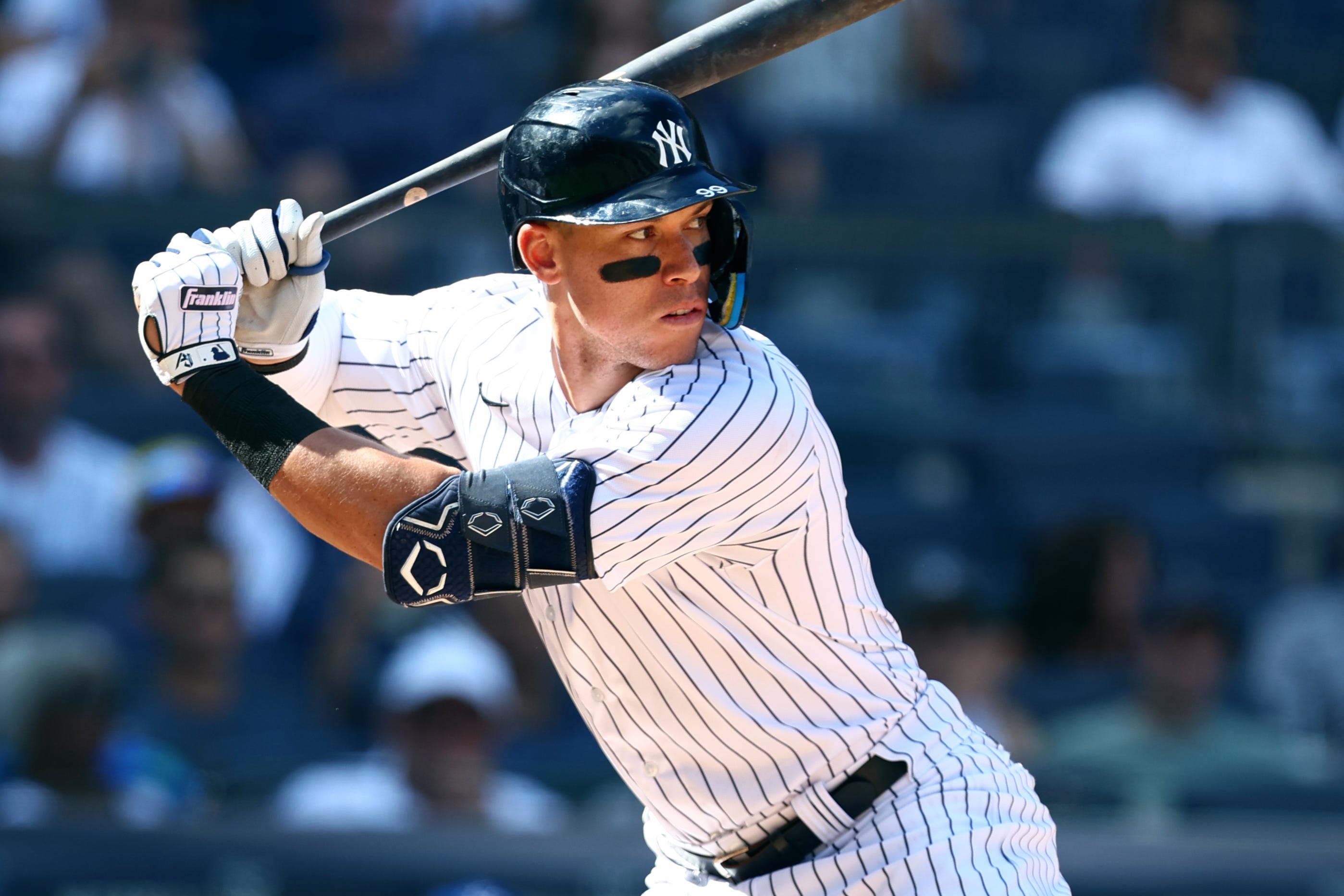
I think it comes down to a couple of things.
One, home runs are somewhat down across baseball in 2022. It’s a complicated thing, because home runs were WAY down back in April and early May, then home runs were flying out of the park for a while, and then things settled back down again. All in all, teams are hitting 1.08 home runs per game, which is high compared to pre-1994 baseball but just about average since 1994, and quite a bit lower than the last six seasons.
To give you an idea, in 2019 teams averaged 1.39 homers per game.
That’s, about 1,500 fewer home runs over the full season.
So, home runs are a little bit down, and maybe that makes what Judge is doing feel a bit more authentic. He’s leading the American League in home runs by 13. He’s in his own stratosphere.
Two, Aaron Judge is so absurdly gigantic. As Michael Schur often says, the guy is bigger than Gronk.
Rob Gronkowski: 6-foot-6, 265 pounds
Aaron Judge: 6-foot-7, 282 pounds
Aaron Judge is, pretty much by all measures, the biggest every-day player in the history of baseball. There have basically been five every-day players who stood at least 6-foot-7.
There was Frank Howard, who clubbed 382 home runs, most of them in the 1960s, when pitchers dominated the game,
There was Richie Sexson, who hit 306 home runs for five teams in the 1990s and 2000s. There was Tony Clark, who hit 251 home runs for six teams over almost that exact same time span and is now the executive director of the MLB Players Association. And there was Walt Bond, who had what Casey Stengel called tree power (“Everything he hits is in the trees,” Stengel said) and who died at 29 of leukemia.
None of them, not even Howard, was within 30 pounds of Judge.
As such, Judge has always been a curiosity. He was a late first-round pick out of Fresno State, and scouts were decidedly mixed on him. They saw the raw power, but they also saw a whole lot of swing-and-miss in his game. Maybe, some thought, he was TOO big. It took him a little while to get to the big leagues; he wasn’t an every-day player in the majors until he was 25 — as such, Judge is older than you think. He’s actually older than Bryce Harper, who has played in twice as many big-league games, and he’s not even a full year younger than Mike Trout.
But that size, that power — with Judge there has always been this asterisk attached to his name, this possibility that he would put things together and do things that no player has ever done, because he’s bigger and stronger than all the other players.
In other sports, players have come along — Gretzky in hockey, Marino and LT in football, Magic in basketball, I’m sure you can think of others — who redefine what is possible.
Aaron Judge has always had this potential inside him.
And now he’s doing it.
There’s no telling how this ends up. Assuming he stays healthy and they don’t move the walls back at Yankee Stadium — will he hit 50 home runs? Certainly. Will he hit 60? It looks likely. Will he hit 70? It’s not out of the question. Heck, if he can keep hitting 12 home runs every 14 games, he’ll hit 90.
I don’t think he’ll do that. But, hey, even if he is a Yankee, it’s kind of fun to think about. And it’s nice to once again have fun thinking about home run possibilities.

I’m all for having a new home run hero, and Judge seems to be a great guy to be that. But, dammit, does it HAVE to be a #%?!#ing Yankee?
The one that is always forgotten... Matt Williams in 1994. He had 43 when the strike hit. He needed 18 in about 40 games to tie Maris. Very doable. Everyone remembers that the strike took away the World Series. It took away Gwynn's attempt at .400. But it also took away Williams' chase for Maris. Can you imagine final day of the season where Gwynn needed a 2 for 4 to get to .400 and WIlliams was sitting on 60 HR? But, it's baseball so we can't have nice things.