


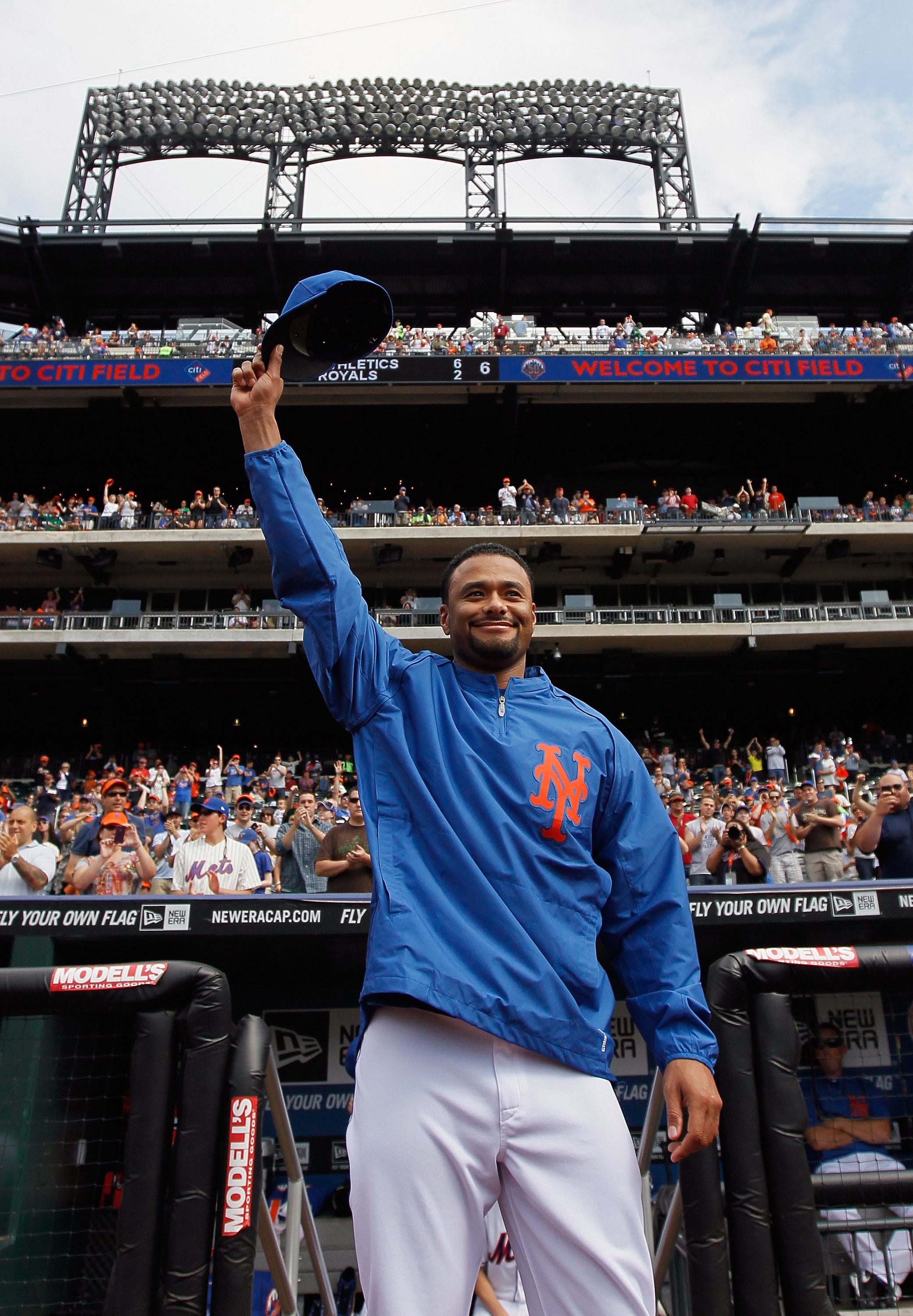
On June 1, 2012, the great Johan Santana pitched the only no-hitter in New York Mets history.
There are many similarities between Santana then and Clayton Kershaw now.
Both were superstar lefthanded pitchers with multiple Cy Young awards.
Both had won pitching’s Triple Crown.
Santana was 33, Kershaw is 34
Both were coming off significant arm injuries that brought their futures into question.
You’d say Santana’s injury was more severe than Kershaw’s, certainly. Santana had missed the entire 2011 season after having shoulder surgery. Kershaw’s elbow problems of 2021 did not require surgery, but they did push him to not even pick up a baseball for three months after the season ended.
And both were going for particularly significant achievements. Kershaw going for a perfect game does not need any further explanation; there have been only 23 of them, and the most famous (at least in the regular season) is probably the one that Kershaw’s hero, Sandy Koufax, threw in 1965.
As for Santana — the fact that no Mets pitcher had ever thrown a no-hitter was a huge deal among the fan base. Several former Mets — in particular franchise legends Tom Seaver, Nolan Ryan and Dwight Gooden — had thrown no-hitters only after they left New York.
There had been so many near-Mets-no-hitters — Tom Glavine in 2004, Terry Leach in 1982, Seaver on a couple different occasions — and so many no-hitters thrown AGAINST the Mets, that people considered this to be some kind of curse.
And then came Santana. The truth is, it shouldn’t have even been all that close to a no-hitter. In the sixth inning of that Mets-Cardinals game, Carlos Beltran ripped a ball just over third base that was absolutely fair, it very clearly (at least on replay) hit the foul line. As John McEnroe might say (if he weren’t a Mets fan) “Chalk flew up.”
Third base umpire Adrian Johnson was in position to make the correct call, but he missed it just the same. “I saw the ball hitting outside the line, just foul,” he told reporters afterward.
Beltran grounded out to third after that, and the no-hitter watch was on.
It’s important to understand that the Mets had been very, very careful with Santana because of his shoulder issues. Only three times in his first 10 starts had they allowed him to throw 100 pitches. Before this game, they gave him an extra day of rest. Santana had been pitching beautifully, so much better than the Mets could have expected — he had a 2.75 ERA and a 60-12 strikeout-to-walk ratio.
But now, he was poised to do what no Mets pitcher had ever done. Mets manager Terry Collins dithered and vacillated. Through seven innings, Santana already had thrown 107 pitches — which was really at the very top of his limit. Collins knew it was reckless to let him go out and pitch the eighth. But he did anyway. and Santana pitched around his fifth walk of the game.
His count was up to 122 pitches.
And now Collins was in full-fledged panic mode. Remember in the 2015 World Series when Collins couldn’t decide whether or not to take Matt Harvey out of the game before the ninth inning? Well, that’s not quite right — he DID decide to take Harvey out, but then Harvey insisted on going back in, and the crowd chanted Harvey’s name, and he sent Harvey out for the ninth with a 2-0 lead. Harvey walked Lorenzo Cain, Cain stole second, and then Eric Hosmer doubled … that did not end well for Collins or the Mets.
This time, he went over to Santana and, it seems to me, tried to get permission from him to get out the hook. Santana wasn’t budging.
“I told Terry there was no way he was taking me out of that game,” Santana later said. “No chance.”
Santana went out for the ninth and he got his no-hitter — Matt Holliday lined out to center, Allen Craig hit a short fly to left and David Freese struck out on Santana’s legendary change-up. That was it. The no-hitter. The celebration raged. The papers pointed out that the Met’s no-hitter drought had lasted 8,019 games.
But it was a different number that stood out: Santana had thrown 134 pitches.
“There are plenty of baseball people who’ll wonder about the risk the Mets took with Santana Friday night,” Bob Klapisch wrote in The Record. “But no one was willing to debate the trade-off.
“For one night — one beautiful, historic night, the one that liberated Mets’ fans from 50 years of waiting, it was all worth it. Every last pitch.”
Well, there was at least one person willing to debate the trade-off — Terry Collins. He was all torn up. Yes, of course, he felt great about the no-hitter, great about the history, but he could not help but think that he’d just done something irreversible.
“I’m very excited for him,” Collins said, “but if in five days his arm is bothering him, I’m not going to feel very good. You just don’t jeopardize the whole organization, this season, for one inning. So we’ll wait five days and see how it is.”
They actually waited seven days before pitching Santana again. They said that pushing him back was simply a precaution because he’d thrown so many pitches. The shoulder seemed fine. But when Santana pitched on June 8 against the Yankees, he got absolutely pounded — five innings, six runs, four homers.
“No-No to Oh No!” was the Record headline.
Santana came back for his next start and got ripped by the Tampa Bay Rays. He insisted that his shoulder was fine, and sure enough he was very good in his next three starts, allowing just two runs in 20 innings.

JoeBlogs is a reader-supported venture. Free and paid versions are available. The best way to support us here is by taking out a paid subscription. And hey, we do have a lot of fun, so I hope you’ll come along.
Joe

Then, however, it all fell apart. Facing a dreadful Cubs team on July 6, he gave up a career-high 13 hits in 4 2/3 innings. The Braves roughed him up in his next start, and Santana uncharacteristically blamed the umpire for squeezing him on a couple of calls. On July 20, he lasted only three innings against the Dodgers, and the Mets considered putting him on the disabled list.
“I’m OK!” Santana insisted.
“We’ll see what we might do to get some energy back in his arm,” Collins said doubtfully.
The Mets did put him on the DL, and were hopeful when Santana returned on Aug. 11. “I’m very confident he’s going to be able to get through the next six weeks,” Collins told reporters before the game.
He was wrong. It was perhaps Santana’s worst start ever — 1 1/3 innings, eight hits, eight runs, and no answers. After it was over, he walked to the other side of the bench, away from his teammates, and stared sadly into space.
He made one more start — Aug. 17 at Washington. He lasted five innings and gave up six runs, four of them on a grand slam by Mike Morse. His season was over. And, it turns out, so was his career. He never pitched again in the big leagues.
Now, here’s the thing: In the wake of the Kershaw game, you might think the lesson here is that Collins blew it by letting Santana throw 134 pitches that day. But I don’t think that’s clear. What Santana did that day will live on forever in the minds of Mets fans. Maybe his career would have lasted longer had he been pulled earlier in that game … but it’s also possible that it would not have. And anyway, he threw the Mets’ first-ever no-hitter.
“A lot of people blame the no-hitter on being the end of my career,” Santana would say. “But I don’t look at it that way. Because your career can end in one pitch in the beginning of your career or 10 years later or 20 years later.”
And I think that’s right. The risk is always there. And so is the opportunity. I believe Dave Roberts made the right choice with Kershaw because I believe it’s what Kershaw wants — he’s a team player from K to W, and he wants to protect that elbow and pitch all season and make another run at the World Series. Pulling him after seven innings might give him a better chance of doing that. I think we can respect that choice.
I believe Johan Santana wanted something else. He wanted history, and he was willing to risk the rest to make it happen. There’s certainly nothing wrong with that choice either.

I do not understand how Santana did not get more HOF consideration. His peak was so good, it deserved more than a one-year stint on the ballot. His Baseball Reference page is pretty incredible.
"He’s a team player from K to W"
I love this line (even if the W has been heavily devalued as a stat these days).