

Sixteen years ago, almost to the day, I first saw Lionel Messi play. This was in South Africa, in what turned out to be the only one of his six World Cups when he did not score a goal. Messi was just 23 years old, already viewed by most as the best player in the world, but still seen in his own country as a bit of an enigma. Argentinian fans couldn’t figure out why he couldn’t put the ball in the net in the World Cup.
The reason, as a soccer novice, seemed fairly simple to me: He kept getting turned away by brilliant defense and goalkeeping. That’s all. Even my inexperienced eye could pick up that he was unlike anyone else with the way he moved through traffic, and kept the ball glued to his feet, and unleashed breathtaking shots on goal even when utterly surrounded (which he always was). The goal would come, I felt sure. As a soccer writer, I could only summon analogies from my own worlds, and Messi seemed to me a great hitter who kept smashing scorching line drives right at fielders.
Heck, the local paper showed that Messi had more shots, more shots on goal, more assists, and more solo runs than anyone else.
But what I did not fully appreciate until I went to South Africa is that most of the world doesn’t watch soccer the way many of us watch baseball. Goals are not the inevitable result of patience, consistency, and relentlessness, the way that hits are. No, goals are holy things. They are small miracles. The goal scorer is a magician who either makes the elephant disappear or doesn’t. There’s no in between.
And Leo Messi did not score a goal that time, and a reputation began forming, an ugly reputation that he could not make the elephant disappear in the biggest tournament on earth.
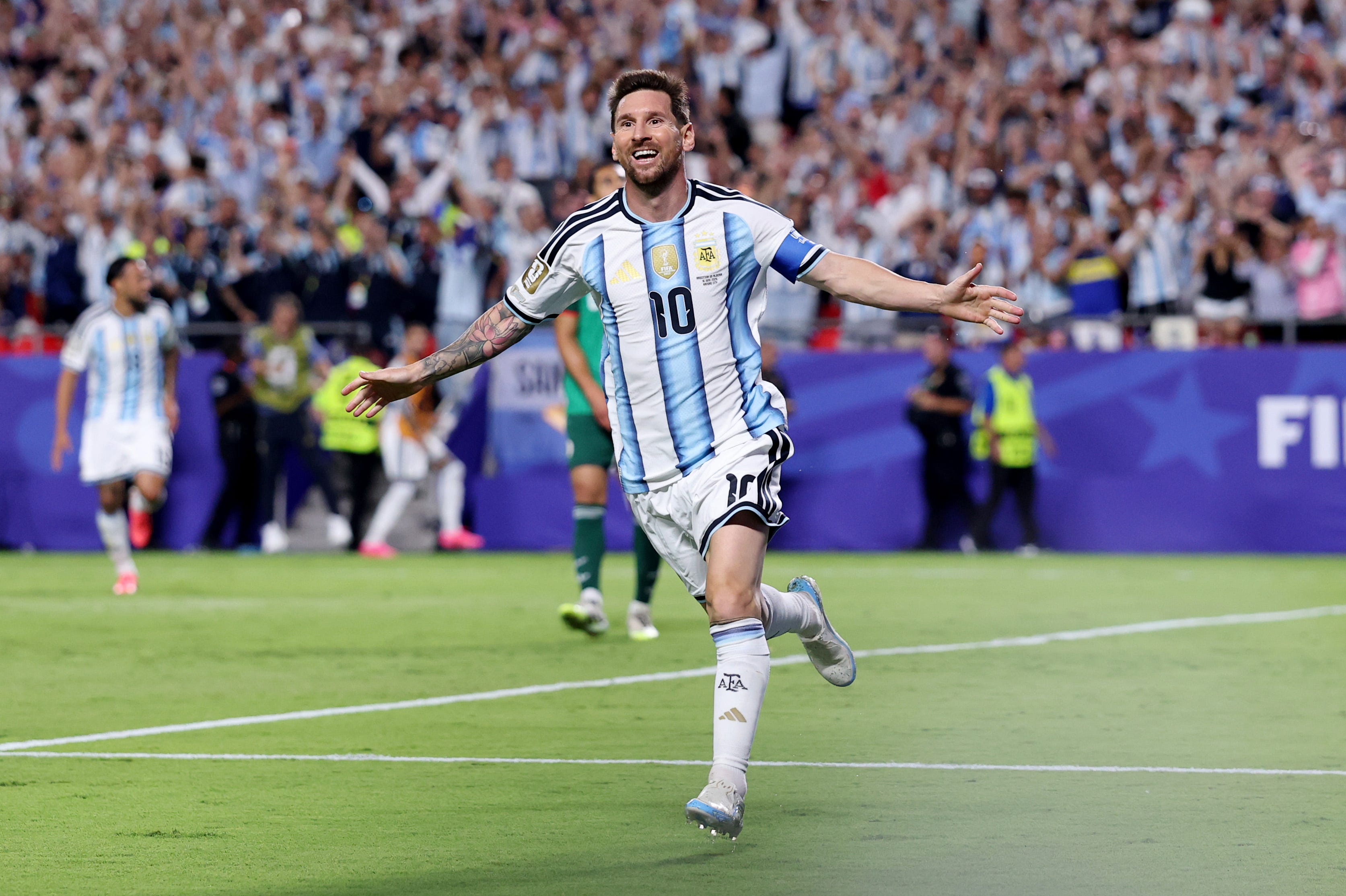
I thought about that again on Tuesday when Messi scored three glorious goals in Argentina’s World Cup match against Algeria in Kansas City. He’s almost 39 now, universally acknowledged to stand with Pele on top of the sport’s history, and that ugly reputation is long gone. It’s laughable even. Messi led Argentina to the World Cup in 2022 — scoring two goals in the final against France. And with his hat trick on Tuesday, he has now matched Miroslav Klose for most in the men’s World Cup.
I have been trying to think of an athlete who turned around a negative reputation as completely as Messi has. It would be like Clayton Kershaw, who has (fairly or unfairly) been branded a postseason dud, suddenly, late in his career, pitching like Koufax in the World Series. It would be like Greg Norman, late in his career, winning the Grand Slam. It would be like Jim Kelly’s Buffalo Bills winning three Super Bowls in a row after their four Super Bowl losses.
The thing about Messi, though, is that the reputation that he could not rise to the moment in the World Cup always seemed utterly ridiculous. What I remember most about watching him in South Africa was how inadequate I felt writing about him. I feel like when I write about baseball, football, basketball, golf, tennis, even hockey and many Olympic sports, I have a lifetime of experience and history to fall back on. I certainly don’t know everything about anything, but I have a feel for those games because I’ve watched them all my life, and I’ve read about them all my life, and I’ve played most of them myself.
But I grew up in an America where soccer was invisible, an unfortunate thing for us because my father played semi-professionally in Poland and wanted me to know the game. I can remember being very young and kicking the ball with my father in the backyard. I remember him teaching me how to trap the ball by waiting for it to hit the ground and stopping it just right before it bounced back up.
We soon stopped, though, because Americans didn’t play soccer in the 1970s. Americans played baseball. The soccer ball went into the garage. We got baseball gloves, and Dad threw me ground balls, and he managed my Little League team and told me to be like Brooks Robinson.
I’d certainly come to understand soccer a bit better by the time I went to the World Cup, but I didn’t feel like I knew enough, certainly to explain the feeling of watching Lionel Messi play.
Here’s part of what I wrote:
I knew most of this Lionel Messi stuff before I got here. I read stories about him. I watched some highlights of him playing. I understood, on that surface level, just how good a player he is.
But then… I saw him play. Not highlights. Not a few of his greatest shots. Full games. And I saw him in context, with the World Cup buzzing, with vuvuzelas blowing, against the background of other players, excellent players, good players, OK players, who are trying to do the very same things that he is doing.
Only they cannot. Messi simply does things — little things and big things — that other players here cannot do. He gets a ball in traffic, is surrounded by two or three defenders, and he somehow keeps the ball close even as they jostle him and kick at the ball. He takes long and hard passes up around his eyes and somehow makes the ball drop softly to his feet, like Keanu Reeves making the bullets fall in The Matrix.
He cuts in and out of traffic — Barry Sanders, only with a soccer ball moving with him — sprints through openings that seem only theoretical, races around and between defenders who really are running even if it only looks like they are standing still. He really does seem to make the ball disappear and reappear, like it’s a Vegas act.
You can see me — or at least I can see me — searching my scope of understanding to try and understand Messi. Barry Sanders. The Matrix. At another point, I compared him to Peyton Manning (for his vision) and Tommie Frazier (for that incredible run he had in the Nebraska-Florida Fiesta Bowl), and Albert Pujols (for the way he towered over everyone else in a sport that is defined, mostly, by failure).
But I don’t think I ever got quite it because the genius of Messi is its own wonder. The world has it right, I think; scoring a goal really is closer to magic than sport. If you think about soccer in the most basic way, you might see the mathematical improbability of it all. Take this ball. Put it in that net. But you can’t use your hands. And there will be 10 very fast, very strong, and very skilled players trying to stop you. They will slide at you and bump you and kick you and the ball. And the 11th player, the last one trying to stop you, yeah, that player can use their hands. Also, you are not allowed to just run behind all those players and call for the ball because that’s offside.
Impossible. That’s all that is.
Well, not impossible. There are ways to score. If you get fouled near the goal, they’ll give you a penalty kick. If the ball goes over the end line, they’ll put the ball in the corner and let you set up a play. Sometimes, in the chaos, the other team will mistakenly put the ball in their own net. Sometimes, in the chaos, the ball will deflect into the goal. Sometimes, in the chaos, the goalkeeper will fail to save a fairly easy shot.
The chaos plays a pretty significant role in most goals, I think.
And that’s the part of what makes Messi so inexplicable to me: He is order in chaos. None of his three goals on Tuesday were especially chaotic. In the first one, he got the ball about 40 yards from the goal, he dribbled forward as only he can — with the ball just staying with him like an obedient dog — and as he approached three defenders waiting for him at the top of the box, he unleashed a curving shot that crashed through the diving goalkeeper’s fingers and bent into the left corner of the goal.
The second had only a touch of chaos — Argentina’s Alexis Mac Allister sent a low, hard shot toward the goal, the goalkeeper blocked it but could not cover it up, the ball bounced back into the box where Messi waited. If you watch the replay, it looks like everyone else on the pitch is frozen, and only Messi anticipated the ball rebounding the way it did. He gently, almost lovingly, rolled the ball into the open net.
And then third, Messi dribbled the ball through the midfield, found a teammate on the left side, kept running, got the ball back at the top of the box, where three players waited. He did some sort of jujitsu move to get himself open, and he rifled a shot into the lower right corner of the net.
All of these goals seemed so simple that it would make you think that anyone can do it.
And that’s the greatest magic trick of all. Because nobody can do it, not like Messi, even after all these years.
I never got into soccer at all. I have of course heard of Messi and his greatness but I’ve never watched him play, just too many other sports I will watch before soccer. I did read and enjoy Joe’s post, which made me wonder…Is Posnanski the Messi of sports writing… or is Messi the Posnanski of soccer?
No one else could write about soccer and keep my attention for 10 seconds
I would say “John Elway,” but…