

On my way to Los Angeles now — on Thursday, at 7:30 p.m., Mike Schur and I will introduce and talk about A League of Their Own at the Aero Theater in Santa Monica. You can get tickets here — we’d love to see you out there.
And for the last couple of weeks, I’ve been counting down the 75 best baseball movies as voted on by a panel of baseball fans, from actors Joe Mantegna and Richard Kind to baseball movie junkies like actor Ellen Adair and writer Noah Gittell, to people I thought would be funny to add like YouTube star Ryan George and magicians Joshua Jay and Jamy Ian Swiss and the staff at the Baseball Hall of Fame.
Here’s our countdown so far:
So we’re at the Top 5 now — today we’re revealing Nos. 5-3, and then tomorrow, to celebrate the movie conversation, we’ll have the final two. I’ve said this before — the top two movies are SUPER CLOSE — so close that the final result depends on the method you use. Voter and co-founder of the MIT Sloan Sports Analytics Conference Daryl Morey was pretty insistent that I use the Condorcet method, which matches each of the top 15 movies against the others and gives us a win-loss record.
So here we go …
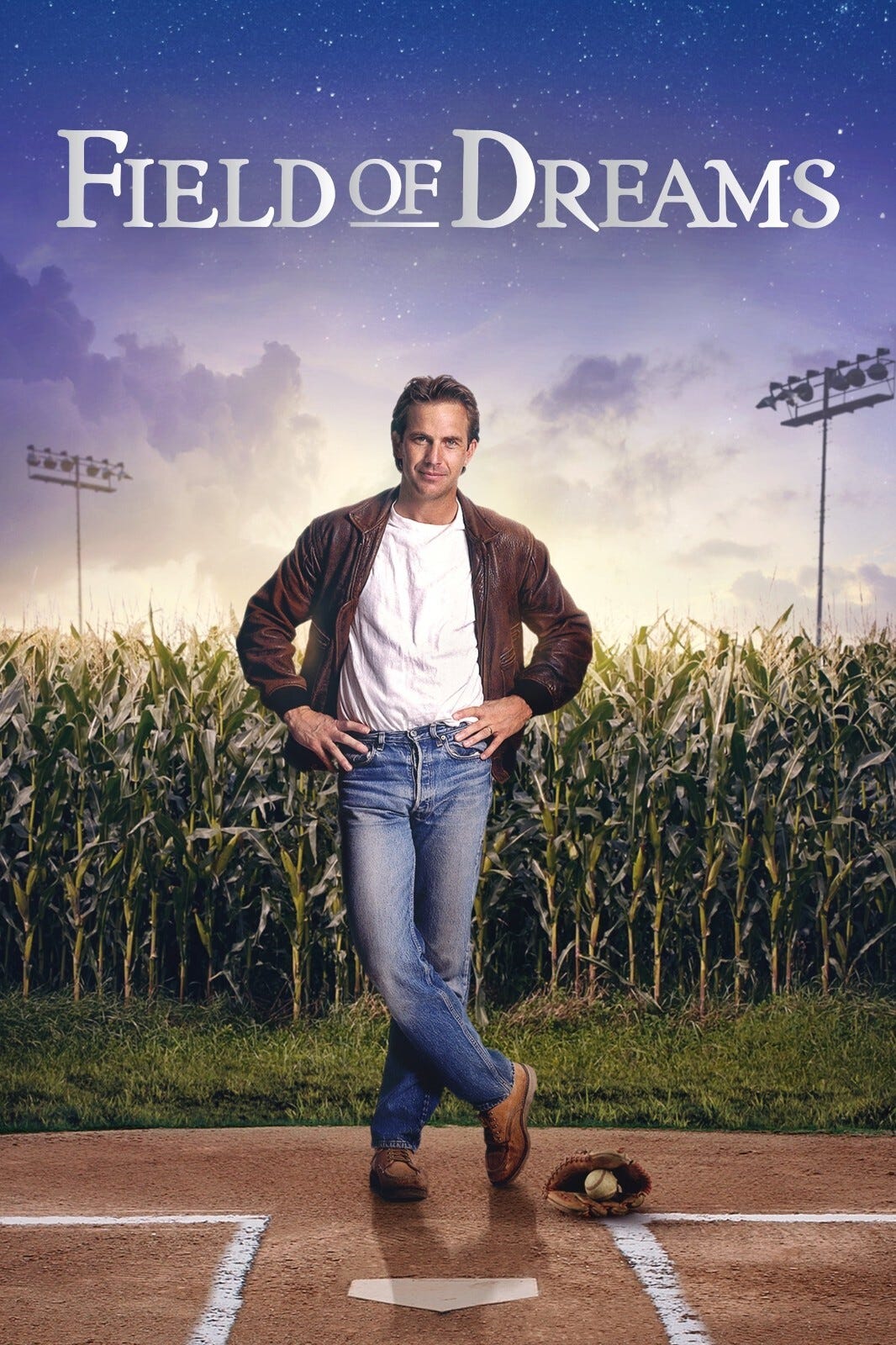
No. 5: Field of Dreams
Condorcet W-L: 10-4
We all know that there are people, like me, who love Field of Dreams and people like, well, I could name a dozen off the top of my head, who abhor it. My first serious girlfriend hated Field of Dreams. I’m not saying that’s why we broke up.
I wrote an essay many years ago called Why Field of Dreams Rules.
Here is that essay edited and reworked for our countdown.
My Dad’s favorite baseball movie is Field of Dreams. Of course, he never calls it that. He calls it, “You know that one, that movie … the one with the corn … you know the one I’m talking about, come on with the corn … with the guy from, you know, the guy from the baseball thing … come on, you know, the other guy was in it, the guy in From Here to Eternity … the one, oh, come on, stop it, you know the one I mean.”
I have inherited this inability to recall simple titles and names from my father, and I have never quite forgiven him for this.
But he loves Field of Dreams. My parents came to America about two years before I was born. Best I can tell, the things they knew about America included: Elvis; Ray Charles; the Rockettes; Broadway; Connie Francis; Rickey Nelson; the Statue of Liberty; McDonald’s burgers; and Paul Newman movies.
The stuff they did not know about America included everything else.
They tell this wonderful story about going to dinner in a New York nightclub one evening, just after arriving in America, when suddenly, unexpectedly, Neil Sedaka began to perform. Neil Sedaka! No words can describe how amazed they were by this. I suppose it would be like going to France and finding that your waiter is Victor Wembanyama. They so deeply loved America; it was this place where you could go to dinner and then suddenly, for no reason at all, Neil Sedaka just shows up to sing Laughter in the Rain.
My father learned baseball because he wanted, more than anything, to be an American — and that meant learning baseball and teaching his sons baseball. Along the way, he fell in love with the game too.
And he loves Field of Dreams.
Do I get why some people hate Field of Dreams? Of course I do. It wasn’t always this way, though. When Field of Dreams came out, it was something of a phenomenon. It was nominated for a Best Picture Academy Award, this in the days when only five movies were nominated. Roger Ebert, by far the most influential critic of the time, gave it four out of four stars. Over the years, it made dozens of best-ever lists. The American Film Institute in 2008 listed it as the sixth-best fantasy movie ever.
But in recent years, it has become fashionable to savage FoD. Some years ago, libertarian pundit Matt Welch wrote that “Field of Dreams is worse than Enver Hoxha.” Enver Hoxha was the monstrous communist leader of Albania.
That’s probably the harshest criticism I’ve seen, but there are plenty of others who have come at the movie hard. And, like I say, I understand. Field of Dreams is corny, and it’s trite, and the acting is over the top, and it has Shoeless Joe hitting right-handed (which is like having Abraham Lincoln delivering the “famous Toledo Address”), and it doesn’t include any Negro Leaguers among the ghosts, and the music is a series of melodic paper cuts, and it has a whole lot of the gooey baseball poetry that makes many nauseous.
“The thrill of the grass,” Shoeless Joe Jackson says.
“That’s my wish, Ray Kinsella,” Burt Lancaster says. “That’s my wish. And is there enough magic floating around in the moonlight for you to make that wish come true?”
“Oh yeah,” Ray’s father, John, says when asked if there’s a heaven. “Heaven’s where dreams come true.”
I don’t kid myself. Field of Dreams has problems. And yes, this feels like a good excuse — apologies for how long this one movie will run — to include Nick Offerman’s breakdown of the movie from the PosCast almost a decade ago:
I made a quick list of just absolutely ridiculous things about this film. First of all, Kevin Costner is ostensibly an Iowa farmer. He wears no belt.
The first time he hears the voice, he’s out wandering in a shoulder-high cornfield, in the middle of the field, with a shovel — just wandering through the field with a shovel, which makes absolutely no sense. Then he goes to the seed store, where he asks some of the older farmers if they had heard voices in the cornfield. They look at him like he’s crazy, and he just buys one bag of corn seed at harvest time. I’ll let you do the math on that.
Then, Shoeless Joe shows up out on the ballfield, and Kevin Costner runs out. Fortunately, a dozen — at least — baseball bats and a huge bag of baseballs are sitting out by the unprotected backstop, so that if it were to be a dewy evening, let alone if, God forbid, it rained, all of the equipment would be ruined. Shoeless Joe asks him to pitch to him, he’s got enough bats and balls to field two college teams, yet he takes the mound with no mitt. No mitt? You put in lights in your cornfield and you have no mitt?…
Finally, the whole plot is predicated on the fact that this crazy farmer had this vision, plowed under a bunch of his corn to build a baseball field in his cornfield. And everybody says, “you’re crazy, you’re hearing voices, what’s the matter with you? You’re plowing under your cash crop? You’re going to lose your farm.”
I based my math on the dimensions of Wrigley Field, and determined — being generous to the filmmakers — the baseball diamond would encompass two acres. The average size of an Iowa corn farm is 345 acres. It’s absolutely ridiculous that it would have any impact on his profits to the point where they’d lose the farm.
While we’re at it, we should include John Mulaney’s breakdown of Field of Dreams at the Oscars — he was giving out the award for achievement in sound:
What about that moment in Field of Dreams when we hear “If you build it, he will come.” And then Costner does it, he builds a baseball field. I guess he doesn’t build it, he mows down corn, and then there is a field, and then he’s like, ‘I’m going to watch ghosts play baseball.’ And the banks is like, ‘You want to pay your mortgage?’ And he’s like, ‘Naw, I’m gonna watch ghosts play baseball.’
And then he finds James Earl Jones, who wrote “The Boat Rocker,” which I thought was a real book deep into my twenties, and he’s like ‘People will come Ray,’ — he’s the only one with a financial plan.
But what’s weird is Timothy Busfield pushes little Gabby Hoffman off the bleachers, and she falls down, and she’s unconscious, then Burt Lancaster is Moonlight Graham and he comes up and pats her on the back a couple of times, and he’s like ‘Hot dog stuck in the throat!’ And then he can’t go back in the game, cause I guess there’s a rule in ghost baseball that if you leave the field at any point and become an elderly ghost and do the Heimlich maneuver, you can’t return to the field.
FoD is deeply weird and deeply flawed.
It’s also my father’s favorite movie.
Some years ago, I got an email from Dwier Brown, who played John Kinsella in Field of Dreams. He wrote a book about the experience and the impact it has had on his life after so many years of being a struggling actor playing unfulfilling roles.
He wrote:
“In the previous five years I had been killed over a dozen times. In films and on TV, I have been shot to death six times, died of a heart attack, been lynched and knifed and, in the Thorn Birds, run over by a wild pig (which I affectionately called being “boared to death.”). On stage I had been stabbed, died of old age and, in an amazing tour de force of death, had my neck broken and died of an aneurism in the same play.”
He began to despair about his career and life. And then one day he watched Frank Capra’s “It’s a Wonderful Life,” and he prayed for the chance to play just once in a movie like that, a movie that was unabashedly hopeful and openhearted and meaningful. Not long after that, he got the part in Field of Dreams.
Is Field of Dreams a meaningful film? I think it is, yes. It gets harder and harder in an ever-more cynical world to allow yourself to be open and vulnerable. People can forgive many things, but few can forgive being made the fool. That’s the biggest part of the hurt and anger I hear in people’s voices when they talk about the Mark McGwire-Sammy Sosa home run chase of 1998. They tricked us. They fooled us. They made us believe in something that wasn’t real — or at least wasn’t as real as we wanted. They stole something from us. They made us colder and more cynical.
We become less open to those things in life that are audaciously and unapologetically sweet.
As Mulaney so hilariously explains, Field of Dreams is one of the strangest movies ever made. Think of the plot for a minute. A man in a cornfield hears a voice. The voice tells him to build a baseball diamond so that the ghost of Shoeless Joe Jackson can come back and play baseball again. The voice then tells him to go find a famous and reclusive writer (in the book, it is J.D. Salinger; in the movie it is Terence Mann) and take him to a baseball game. The voice then tells him to go find a dead ballplayer who only got to play one inning of one game.
“Ray,” Annie says, “this is a very nonspecific voice you had out there, and he’s starting to piss me off.”
None of it should make sense.
But somehow, for those of us who choose to believe, it does make sense. For those of us willing to let lines like Burt Lancaster’s “Win one for me one day, boys,” or James Earl Jones’ “People will come, Ray” speech or John’s “I’d like that,” about having a catch without cringing, well, there’s a feeling of wonder that comes and smiles so big they hurt the face.
Comedian Alex Edelman calls Field of Dreams his favorite baseball movie because, he says, it’s the one baseball movie that doesn’t rely on the game-winning home run to provide the magic. I think there’s something to that.
Before I wrote the original version of this essay, I watched the movie again — and two scenes stuck out to me. The first was the scene where James Earl Jones wanders around that small Minnesota town to learn about Moonlight Graham, the town doctor. He comes upon two old men, one of whom talks a bit about Moonlight’s wife, Alicia.
The script has him saying this: “Alicia. She moved to South Carolina after he passed. She passed a few years later. She always wore blue. I bet you didn’t know that.”
Here’s what he actually said in the movie: “Alicia. She moved to South Carolina after he passed. She passed a few years later. She always wore blue. The shopkeepers in town would stock blue hats because they knew if Doc walked by he’d buy one. When they cleaned out his office, they found boxes of blue hats that he never got around to give her. I bet you didn’t know that.”
I think the spell of FoD is in the difference between the script and what actually appears on camera.
The second scene was the final scene, the most famous scene, the one where Ray, hopelessly fumbles around for a way to talk with his dead father and then tearfully says: “Hey Dad. You wanna have a catch.” And John says: “I’d like that.” And they throw the baseball around while music blares and the camera spins around them and, in the background, you see all the cars coming toward the field.
And I know how over-the-top it all is.
And yet, there I am, 10-years old, there with my Dad in our postage-stamp-sized Cleveland backyard. Dad has just come home from another grueling day at the factory, and he’s covered in grease and oil, and he’s exhausted, and he could use a shower, and he could use a comfy couch, but he’s here instead, and he’s got a Kent cigarette dangling from his mouth, and he’s wearing a baseball cap that is two sizes too small, and he’s wearing his K-Mart canvas sneakers with holes in them and a plastic baseball glove he picked up from a wiffleball set. And he throws a pop-up that looks like it will never come down.
The sky is so blue it hurts just to look at it.
I’m circling under the ball uneasily.
There’s a thrill in the grass. I catch the ball and fall down.
This field. This game. It’s a part of our past.
“Good catch!” my Dad shouts.
It reminds us of all that once was good, and it could be again.
I don’t have any excuse for letting Field of Dreams do this to me. But I’m happy it does.
No. 4: Moneyball
