

I just so happened to be watching the Mets broadcast on the very day that announcer Ralph Kiner said the twelve most perfect words ever uttered at a baseball game or, probably, anywhere else:
It’s Father’s Day.
So …
To all you fathers out there.
Happy Birthday.
I think now of a baseball story. A Father’s Day story. It’s a day late, I know, but it’s a father’s right to be a day late now and again. That’s really what Father’s Day should be about. The girls often ask me: “What do you want for Father’s Day?” I never have a good answer. I suspect the answer is: “Let me be a day late now and again.”
Steve Palermo grew up in Worcester, Mass., about forty-five minutes from Fenway Park. Stevie was surrounded by Red Sox fans, of course, none of them bigger than his father, Vincent. Stevie liked the Red Sox, too, of course he did, but he was built differently from the rest. What he really liked was baseball. And order.
“Have you ever thought about being a big-league umpire?” a relative asked after watching Stevie umpire a local semi-pro game.
“Every minute of every day,” Stevie said.
He became a big-league umpire. A darn good one. Sometimes, he’d bring Vincent with him to Fenway, and his father would wander about like a child, awestruck that he was standing so close to Yaz and Fred Lynn and the rest. Once Jjm Rice brought the father and son a tray of coffee as they wandered the clubhouse.
Vinny was struck speechless.
“Jimmy,” Steve immediately said, “I don’t care how much coffee you bring us, you’re still not getting that pitch on the outside corner.
No, Vincent Palermo could not quite fathom his son’s life. Once, Yankees manager Billy Martin walked by.
“Stevie, do you know who that is?” Vinny whispered.
“Know who he is?” Stevie said, laughing. “Dad, I yelled at him last night.”
Oh, Steve Palermo loved being an umpire. You probably know the terrible way it ended. One night, he and friends were eating at Campisi’s Egyptian Restaurant in Dallas when a bartender shouted that two women were getting mugged. Steve and his friends did not hesitate; they raced out to help. Stevie was shot in the back. His legs went numb. Doctors told him he would never walk again, and he would never umpire again.
They were wrong about the walking. He willed himself to walk again.
But, no, he never umpired.
His last twenty-five years were filled with pain, great pain, but he tried desperately to find joy too, because Stevie was a joyful man, a storyteller, a baseball fan, a person who believed that a ball is a ball and a strike is a strike, and the game only works if we can tell the difference.
But that’s not the story I think of now.
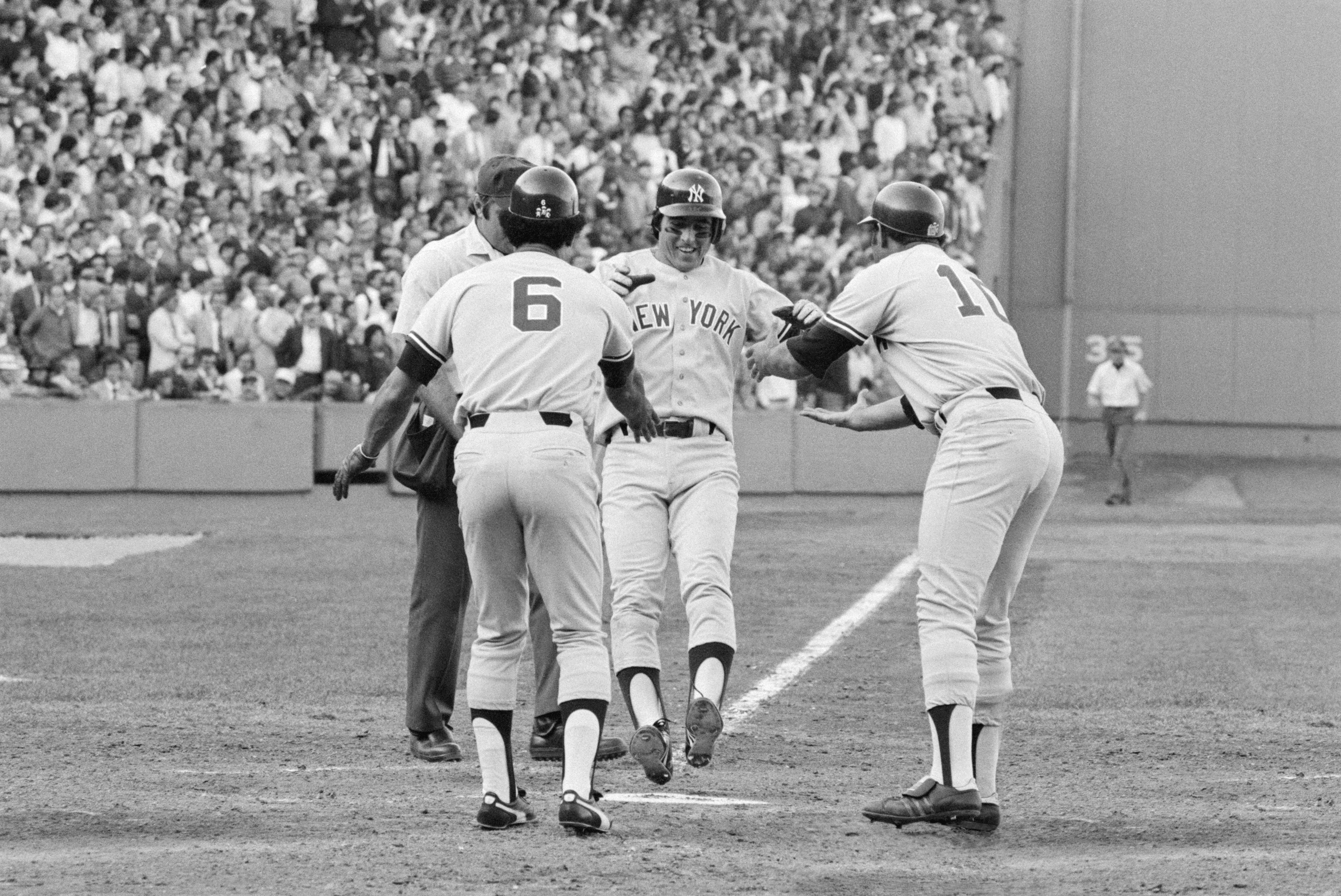
No, the story I think of happened on October 2, 1978, at Fenway Park. The Yankees and Red Sox played a one-game playoff for the championship of the American League East. The Red Sox led 2-0 in the bottom of the seventh. The Yankee put two runners on when light-hitting Bucky Dent — Bucky *@#$%& Dent — stepped to the plate. On the first pitch from Boston’s Mike Torrez, he checked his swing for a ball. It was a 1978 check swing; today it would be called a strike.
On the second pitch, he fouled a ball off his foot and collapsed to the ground in pain. The trainer came out and worked on his shin.
On the third pitch, he hit a high fly ball to left field that went over the Green Monster.
If you watch the play closely, you can see an umpire standing down the left-field line, looking up at the spot, and spinning his right hand and index finger, declaring it a home run.
That umpire is Steve Palermo.
Contrary to what most people believe, that home run did not end up being the game-winning hit. No, it put the Yankees ahead, but it was actually Reggie Jackson’s homer in the eighth that was the mathematical difference between the Yankees’ five runs and the Red Sox’s four. No matter. Through the years, Red Sox fans could accept that Reggie Jackson might hit a home run. But Bucky *@#$%& Dent? No.
Later that night, Steve Palermo went back to Worcester to see his father, Vincent. You can imagine how despondent Vinny was; they sat quietly together for a long time.
Finally, Vinny spoke:
“You couldn’t have called that ball foul?” he asked.
The story could end there. It’s a beautiful punch line. But I like the real ending better. Steve said, “Dad, that ball was fair by 20 feet.” Vinny nodded and looked down at the table, and another long silence passed between father and son. Then Vincent Palermo spoke again.
He said: “So?”
As a Red Sox fan the last month of the season sucked.
Not the most team of teams as the saying with them was "25 players, 25 cabs".
I put most of the blame on Don Zimmer, who left Butch Hobson continue to play 3rd with bone chips in his elbow and 43 errors, and management who couldn't find a have decent replacement for him.
The best line from that game was when Bob Bailey stuck out looking on 3 Goose Gossage fastball pitches that were all gas, he came back to the bench and said, "One of them sounded low".
Too soon.