



First, here’s your weekly BIG FAN update:
The BIG FAN Tour — for our book about what it means to be a fan — is coming next month. Mike and I are planning to have a special guest — or special guests — join us at each stop to moderate or just offer their own perspective on fandom. We are talking with some very cool folks. We’ll see how it all goes.
And here’s our first announcement. We’ll be at The Strand in New York City on Monday, May 18, and we’ll be joined by Seth Meyers!
I’m told that there are only a handful of tickets left, so if you’d like to join us, you might want to grab your ticket as soon as possible.
We should soon have some guest star confirmations for Boston, St. Louis, Kansas City, and Los Angeles. And, yes, we’re talking about adding new cities, too.
As always, it would be great if you preordered the book. You will hear authors talk all the time about how important preorders are to a book's success; it really is true. I’m so proud of this one; I think it’s nothing but pure joy on the page. I really believe it will make you happy, and not just because Mike made me go to a pickleball tournament or because we opened up 1978 O-Pee-Chee baseball cards in a Virginia warehouse that contains the world’s largest collection of sports cards.
The reviews are now beginning to trickle in, and they’re very kind. Kirkus calls it a “treat for the sports fanatic.” Booklist calls it “entertaining, humorous, and thought-provoking.” And my wife Margo calls the book “bigger than I was expecting.”
Oh, and finally, we have now just about finished the audiobook. Mike and I narrate, and it also features such great voices as Nick Offerman, Ellen Adair, Cord Jefferson … and our daughters, Ivy Schur and Katie Posnanski, who read the chapter they co-wrote about what it means to be a Taylor Swift fan.
Thanks for sticking with me through all that. Now, let’s talk again about the thing that is obsessing me about baseball these days: The ABS System.
The ABS Scorecard:
Total challenges: 286. Challenges have been successful 155 times (54%).
Batter challenges have been successful 49% of the time.
Fielder challenges (almost always catchers) have been successful 59% of the time.
Here were Tuesday night’s challenges:
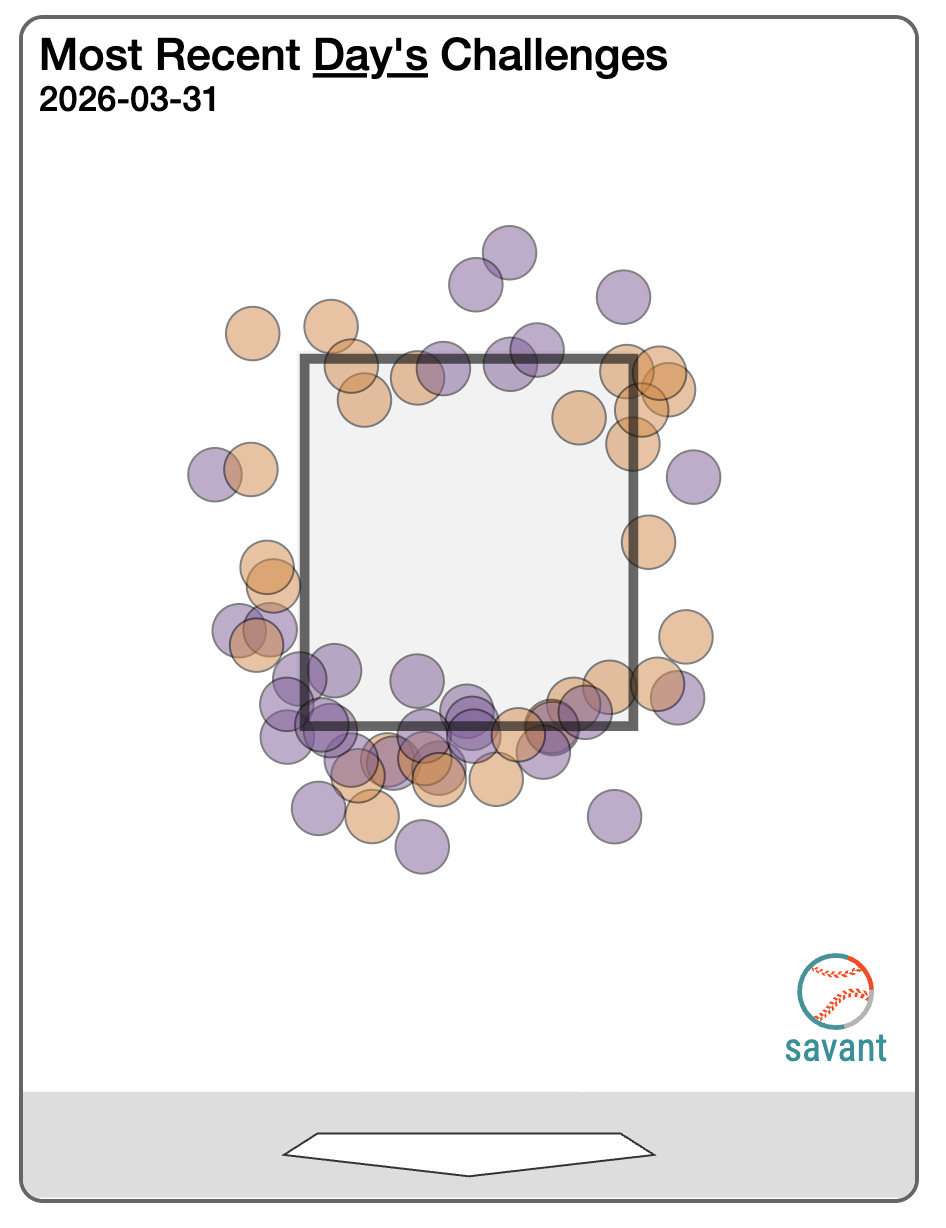
The worst challenge was by Cincinnati’s Dane Myers, who challenged that purple pitch in the lower part of the zone. It was called a strike, he challenged; it was a strike by more than three inches.
The worst call was against the Yankees’ Trent Grisham — it’s that super high pitch more than three inches above the zone. Home plate umpire Alonzo Márquez called it a strike.
Let’s talk about C.B. Bucknor making one of the worst calls in MLB history (this video calls it THE worst call in MLB history, which it might be, but I think that could be recency bias. I mean, just as a starting point, C.B. Bucknor has been in baseball for a long time).
In the Rays-Brewers game, Jake Bauers lined a shot to the right side, and Tampa Bay second baseman Ben Williamson made a diving stab for the ball. He was only able to knock it down. He jumped back up and made a wild throw to nobody as Bauers ran through the bag.
I was actually semi-watching this game live — watching it with no sound while I worked on my next book — and I saw the Rays walking over with the ball to tag Bauers. And then I saw a close-up of Bucknor and thought, “Oh no. Really? C.B. Bucknor again?”*
*In case you missed it, C.B. Bucknor missed TWENTY ball-strike calls the last time he was behind the plate:
When Bauers was called out, I assumed that Bucknor had ruled that he had tried to head to second base after the throw-away … but the replay clearly showed that he did not do that at all. So I actually couldn’t even figure out what the call was.
It was even dumber than I could have imagined.
He had ruled that Bauers missed first base.
Now, I’m being completely serious when I say this: I do not believe that in the history of baseball ANYBODY in that precise situation — running all out down the first base line, trying to beat a throw, with no first baseman or other fielder in the way — has ever missed first base. It’s a pretty big bag. It’s bigger now, in fact, than it used to be. It’s unclear why or how the runner even COULD miss first base in that situation.
But Bucknor ruled that Bauers missed first base.
I knew instantly — just as you did, if you were watching — that Bucknor was definitely wrong.
Look: I’m no C.B. Bucknor fan. I mean, I don’t have anything against him other than the fact that countless people in the game have told me that he’s the worst umpire in the business; heck, Carlos Marmol told him to retire THREE YEARS AGO. But I don’t have anything personal against him, so when he said that Bauers missed first base, I found myself quietly hoping that Bauers ALMOST missed first, you know, just to make the call a little bit less embarrassing.
No such luck. On replay, you see that Bauers stepped SQUARELY on the bag, like right in the middle, like it was unmissable. Utterly unmissable.
Of course, replay instantly overturned the call because that’s the world we live in. Egregious mistakes by umpires are now baked into the system. C.B. Bucknor incomprehensibly says that the guy missed the base; the guy clearly didn’t miss the base. The game goes on.
This — the replay challenge — has been part of baseball for a good while now, but the Automated Ball Strike system is new, and I thought it would have a pretty big impact on the game.
I’m now realizing it is forever changing the game.
There’s no going back from here.
The funny thing is, it is changing the game in a different way from what I expected. I thought about the ABS system as the first stage of robo-umpiring — where balls and strikes are called by cameras, lasers, artificial intelligence, and whatever else is in the Statcast™ stew. And, yeah, we might be heading there soon.
But what is really happening, at least for now, is that baseball is being umpired more and more by the players themselves.
The players never had any say whatsoever in how a baseball game was officiated. The very word “umpire” comes from the old French word “nonper,” which literally meant “an odd number, not even.” The whole point of the umpire is that in a dispute between two people, the umpire was not even; he was above the others, and his word was to be treated as law.
That was put in concrete terms in the very first National League constitution in 1876:
“The umpire is the sole judge of play and is entitled to the respect of the spectators, and any person hissing or hooting at, or offering any insult or indignation at him, must promptly be ejected from the grounds.”
Umpires had a nice century-plus run as the sole judge of play. No, they couldn’t eject every single person who hissed or hooted; that would have often meant ejecting an entire stadium of people. And, particularly in the early days of the game, they were under constant assault, often physical assault from players and fans.
But their calls were final.
“Yesterday that might have been a ball,” the umpire says in the post-credit scene of “A League of Their Own.” “Tomorrow it might be a ball. But today, it’s a strike.”
That was the attitude of the umpires. How many ball and strike calls do you think they missed over 150 years? It’s incalculable even if you don’t include Eric Gregg’s missed calls in that Livan Hernandez game. And yet, even a complaint from the dugout or batter could be met with an automatic ejection.
And now, all of a sudden, players can do more than complain about a ball-strike call. They can immediately challenge it, say in front of everyone, “No! You are wrong!” And then the umpire has no choice but to stand there as an animation magically appears on the scoreboard — and on television sets everywhere — that shows, more often than not (at least so far), that, yes, the umpire WAS wrong.
And the umpire has to sheepishly take back the ball-strike call.
Here’s the thing that it all exposes: Umpires are just guessing on the close ones. I don’t care how good an umpire you are — and I do believe these umpires are, for the most part, absolutely terrific at what they do — there’s no human way to determine if a pitch is a millimeter off the plate or a millimeter on the plate. It’s not possible.
Sure, some of the missed calls have indeed been egregious — as a big league umpire in today’s world, you simply cannot miss pitches that are balls or strikes by three inches — but those will likely get cleaned up over time. The millimeter calls will never get cleaned up because eyesight and judgment are just not that precise.
For now, MLB is letting the players have their say by challenging, and that has been fun — challenges now seem to be among the most popular parts of the game. But there are only two incorrect ABS challenges per team, so challenges have to be used sparingly and judiciously, and the obvious question is: “Why? If you know with almost perfect certainty whether a pitch is a ball or a strike, why would you ever let the home plate umpire guess?”
The answer, I think, is that MLB doesn’t really know in what direction they want the game to go. They know — they HAVE to know — that the Day of the Umpire has passed, and that the game will be officiated very differently in the years ahead. And I have been saying for a while now that ABS for every pitch is coming.
But maybe not. Maybe, instead, the game will turn more and more umpiring duties over to the players themselves. Maybe they will continue to say, “Yes, the umpires are imperfect, but we’re sticking with them because they’re a part of baseball, and it’s YOUR JOB to correct them when they mess up. If you don’t correct them, that’s on you.”
In other words, C.B. Bucknor will be out there again tonight, whether you like it or not. Your mission, should you choose to accept it, will be to fix his mistakes.
So if I'm being honest, I find all of the ABS talk exasperating. I don't mind it in the games—kind of—but I do not give a shit about the strategy of it, about the stats of it, about the What It All Means of it.
It reminds me of how we're all supposed to care about the box office for movies now, as if that has a single thing to do with sitting in a seat and being entertained. "You gotta pay that catcher, he's really good at ABS challenges" is a sentence that's coming, and it makes me want to scream.
As for the games themselves, my objection is the same one Joe has voiced about watching the NFL: delayed reaction sucks the joy out of the game. Is it a catch? Is it a touchdown? Is it a walk? Is it a strikeout? Boy, I can't wait to find out in the near future, not in the moment when I saw it happen (or not). Overall is it better than seething about a bad call? I guess?
Fun Fact re umpiring in the 19th century: In the 1860s, Western gunfighter and U.S. Marshal "Wild Bill" Hickok famously umpired a baseball game in Kansas City while wearing his guns, which helped keep the peace.