

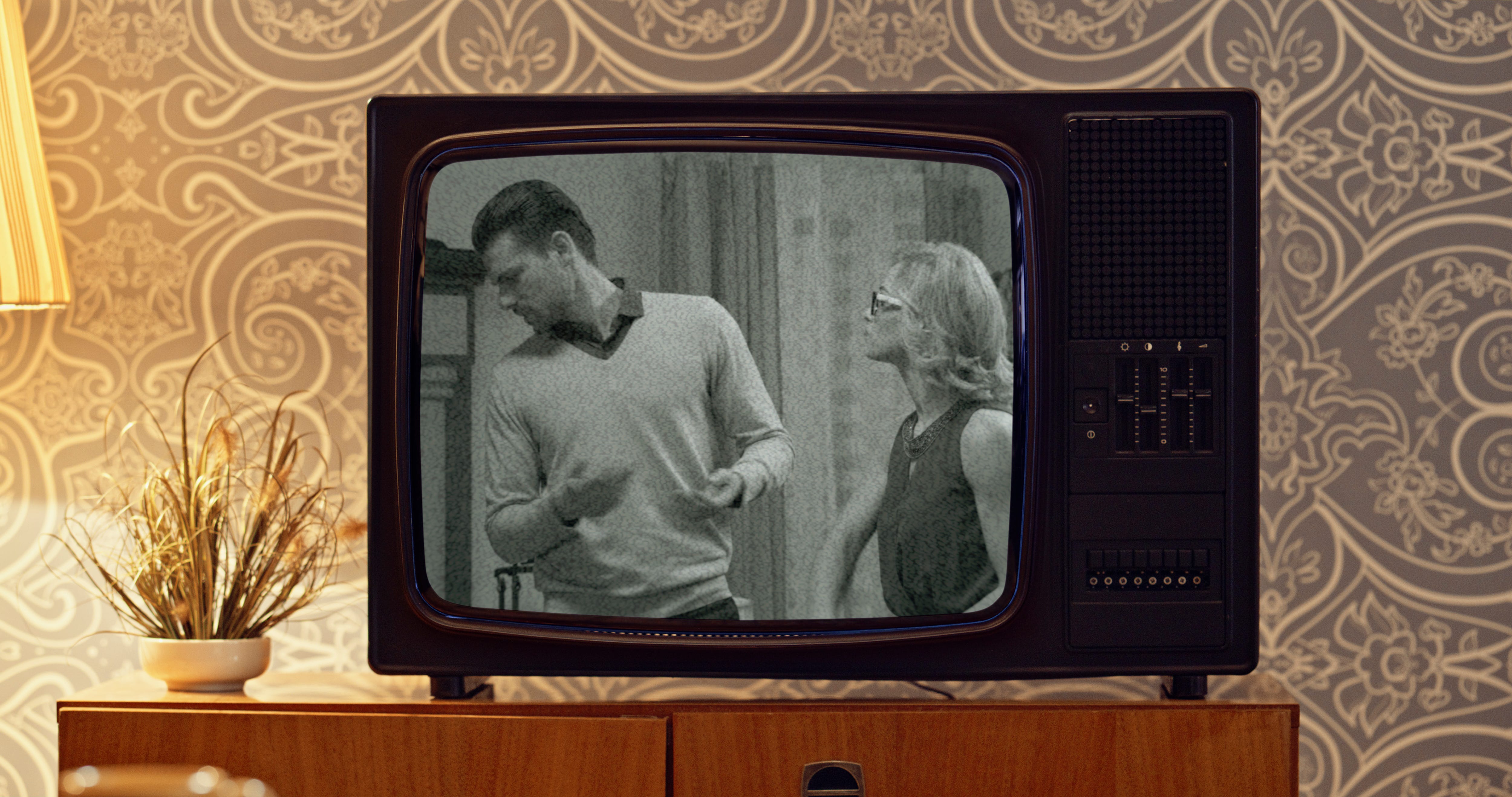

The Ed Sullivan Show is on television that night, just like it is on every Sunday night in those days. Ethel Merman sings her curtain-dropping song “Some People” from the Broadway show “Gypsy.” She also performs a duet with Broadway legend Gordon MacRae, who played Curly in “Oklahoma.”
The King Toys, a comedy acrobat team, perform too, along with the dancer José Greco, and the folk group “The Serendipity Singers” who sing their hit “Don’t Let the Rain Come Down (Crooked Little Man).”
There was a crooked man, and he had a crooked smile
Had a crooked sixpence and he walked a crooked mile
Had a crooked cat, and he had a crooked mouse
They all lived together in a crooked little house
Two comedians from very different eras tell jokes. Myron Cohen was a salesman in New York’s garment district who always had a joke for his customers. Flip Wilson was an Air Force veteran who got his start in comedy by playing a drunk in the audience who would come out between acts and perform before people even knew he was performing. They are the past and future of American comedy.
This is closer to the end than the beginning of The Ed Sullivan Show. The variety show is still hugely popular as 1967 begins, but it has lost much of the power it had in the late 1950s and early 1960s when it introduced America to Elvis and Bob Dylan and the Rolling Stones, Little Stevie Wonder and the Supremes and, most of all, The Beatles.
America’s attention is turning. In the late 1960s, Sullivan will try to keep the audience by turning to rock and roll. Jimi Hendrix will play “Hey Joe” on the show in 1969. Janis Joplin sang “Piece of My Heart” that same year. But the clock is ticking. The show will last only four more years.
On a very special Bonanza, a lovesick youth (played by 16-year-old Beau Bridges) harbors inner tension that leads to tragedy. Lassie protects a mountain lion cub from a wolf. Walt Disney presents the first of a three-part Civil War adventure called “Willie and the Yank,” about a young Confederate officer posing as a Union soldier to get through Northern lines. Johnny Carson, who has only just started hosting The Tonight Show, welcomes a jazz singer and golfer named Don Cherry. Cherry had a big hit in the 1950s called “Band of Gold.” He also was in contention at the famous 1960 U.S. Open, where he finished tied with Ben Hogan for ninth, four shots behind Arnold Palmer.
Later, there will be another Don Cherry, a hockey Don Cherry.
House Minority Leader Gerald Ford appears on “Meet the Press” to demand that the administration be more transparent about what’s really happening in Vietnam.
Walking down the steps this morning, I felt a brief but painful twinge in my right knee.
The number one song in America — the one playing nonstop on all the radios in all the homes and cars across this nation of 198 million people — is “I’m a Believer” by The Monkees.
Neil Diamond wrote the song when he was one of the Brill Building Songwriters of the 1960s. The Brill Building, at 1619 Broadway in New York, had small offices, each with an upright piano, and inside, Carole King wrote “Will You Still Love Me Tomorrow,” Neil Sedaka wrote “Breaking Up is Hard to Do,” Barry Mann and Cynthia Weil wrote “You’ve Lost That Lovin’ Feelin’,” and Jeff Barry wrote a whole bunch of silly, happy songs with made up words like “Da Doo Ron Ron,” and “Do Wah Diddy Diddy,” and song about a girl named “Skooby-Doo” — this before the cartoon dog Scooby Doo.
Neil Diamond was younger than most of the other songwriters, and he was hoping to capture some of that happiness and joy that sold in the mid-1960s. He wanted to write a song about someone who had been cynical about love and then, in a flash, love reveals itself. The phrase “Then I saw her face/Now I’m a believer” is what grabbed him.
The Monkees hopped on the song because The Monkees were a television show band that needed to constantly feed the beast with new, happy songs. The Monkees were formed not for the music but for the sitcom; the producers wanted to create a funny show about a Beatles-like band, kind of like a weekly version of the movie “A Hard Day’s Night.”
The casting call was one of the most famous in rock and roll history: Stephen Stills, Danny Hutton (later the lead singer of “Three Dog Night”), Paul Williams, and, yes, you probably knew this, Charles Manson auditioned.
Anyway, Mickey Dolenz, Davy Jones, Michael Nesmith, and Peter Tork were cast because they all could act, all had television charisma, and, yes, secondarily, they all had some musical talent. They were supposed to be controlled. They were supposed to be corporate.
The funny thing is that a few months after January 8, 1967, The Monkees — whose popularity in America rivaled the Beatles — go rogue. They fire producer Don Kirshner. They demand to choose their own songs and control their own recording sessions. They record an album with songs mostly written by the band itself, called “Headquarters” — an album without even one poppy single on it — and then they go on tour where they perform the songs live with no backing tracks.
They then play in the movie “Head” — co-written by Jack Nicholson! — which is angry and pointed and meant to prove that they are not some manufactured cotton candy band but real people and real artists with real ambitions.
I drove to work this morning in my little candy-apple red car. I wore my fedora with a feather on the side. I wonder how many people I passed thought, “That guy is a tool,” and how many thought, “That guy is living his best life.”
Three people are rescued from a mine on Whiskey Island in Cleveland. Five hundred thousand anti-Red Guard protesters march on Peking. You can buy a mink jacket for $789. Lyndon Johnson gives his State of the Union address.
“I have to come here tonight,” he begins, “to report to you that this is a time of testing for our nation.”
A Sears Kenmore Wringer Washer will cost you $98 unless you want the aromatic, suds-saving feature, which adds $100.
Twenty percent of college students admit in a poll that they cheated at least once on a test in their freshman year.
Teenagers — mostly girls — rush the stage of the Loews State Theater in New York to get to the psychedelic rock band “Blues Magoos.” “It wasn’t bad,” the stage manager says. “They’re good kids. Just enthusiastic.”
Sugar reaches a 35-year low price. Japan worries that American automakers will soon invade and dominate its car market. You can get a pool table for less than $400 if you shop well, and Florsheim shoes for less than $20.
Kids play outside, almost always unsupervised. Most families have one income and one television — mostly black-and-white televisions. Gas is 32 cents a gallon. Many homes have a telephone party line, meaning they share the telephone with other families.
The top movie in America is “Follow Me Boys,” starring Fred MacMurray as a one-time saxophone player who settles down in a small town and becomes a Scoutmaster to help the boys stay off the street. It is the last Disney movie released in Walt Disney’s lifetime. Another big hit is “The Professionals,” a Western starring Burt Lancaster and Lee Marvin as mercenaries hired to rescue a rancher’s wife from a Mexican bandit.
I purposely set up everything to sleep in this morning. I set no alarm. Margo was careful not to wake me up when she left this morning to tutor kids. Westley, our dog, was instructed to leave me be, and he followed through — probably because he’s also old and tired and uninterested in getting up early himself.
I set everything up so I could sleep in all day if I wanted.
I woke up at 6:22 a.m. anyway.
John Unitas and the Baltimore Colts take on the Philadelphia Eagles in something called “The Playoff Bowl.” This is a consolation game for the two NFL teams that missed the championship. It is, purportedly, for second place. Vince Lombardi calls it a “Loser’s Bowl for Losers.” The Colts win 20-14.
Jackie Gleason flips the opening coin in the game.
Dick Young writes, “Next time Jackie Gleason tosses kickoff for the Second Place Bowl, they should give him an assistant to bend over and read it.”
The first NFL-AFL Championship game is a week away between the Green Bay Packers and Kansas City Chiefs. Nobody seems to have any doubt that the Packers will win and win handily. There are some calling it “The Super Bowl.”
“We peasants have been bombarded with the Super Bowl propaganda for some time,” Cleveland’s E.M. Gingerich writes in a letter to the editor. “It never sounded too good to me. It reminded me too much of Super Suds and stuff like that. I wonder why nobody suggested stuff like the Lettuce Bowl or the Greenback Bowl or the Gold Bowl.”
South Carolina is put on probation for violations involving financial aid to athletes — apparently, their head football coach, Marvin Bass, provided three players with cash, meal tickets, and books for their classes. The school also created a secret fund used to entertain high school coaches.
Oscar Robertson scores 21 points and adds 17 assists as the Cincinnati Royals beat the Baltimore Bullets in an NBA game.
The headline in multiple papers: “Royals Riddle Bullets.”
The Harlem Globetrotters try to sign Gale Sayers. The Cincinnati Reds talk about moving Pete Rose from second base to the outfield. Joe Pepitone, in an effort to get in the best possible shape for the 1967 Yankees season, works out with the football Giants. A San Francisco newspaper columnist calls Vince Lombardi, “The Benito Mussolini of fun.”
In College Park, Maryland — with 1:15 left and Maryland leading N.C. State 60-55 in a college basketball game — N.C. State coach Norm Sloan says something so upsetting to referee George Conley that Conley just takes the ball, walks off the court, and declares the game over. Neither Sloan nor Conley reveals what is said, but it must be bad. Conley was a Kentucky State Senator for a decade. He’s probably heard some pretty ugly insults.
“Integration is no problem in sports,” David Condon writes in the Chicago Tribune. “More than 25 percent of the players in the National Football League are Negroes.”
Most newspapers still insist on calling Muhammad Ali “Cassius Clay.”
On my kitchen table this morning was an advanced reader of BIG FAN, the book I wrote with Mike Schur that will come out on May 19. Next to it were notes for the Why We Love Baseball young reader edition that will come out in 2027, along with notes for the still-secret baseball book that will also come out in 2027.
When the dust clears, that will make an even dozen books.
On my phone were texts from our two daughters, Elizabeth and Katie. Elizabeth is teaching theater to preschool and elementary children and is about to sign for her first apartment. Katie just got back from studying abroad in London and is back at Wake Forest for her spring junior semester.
Margo kissed me on the forehead on her way out the door, the way 19th-century characters do in the movies. This year, we will have been married for 28 years.
Westley, our old dog, finally came into the room to greet the day. He just stared at me for a long time as if to say, “We’ve a lot of stuff, haven’t we, buddy?”
I think all the time these days about the poem from Saigyö that Roger Kahn quotes in “The Boys of Summer.”
Did I ever dream
I should pass this way again
As an old man?
I have lived such a long time—
Nakayama of the Night
I was nineteen on this day and had finished Air Force Basic Training and Tech School and was home in Milwaukee on leave before heading overseas. I watched everything you wrote about today, watched the Ice Bowl, watched the “Super Bowl “, got married, shipped out. It was the end of youth. Thanks for these great memories.
Really wonderful, Joe.