

Hi everybody! Before we get into today’s Hall of Fame post, I wanted to tell you about a free newsletter my friend Dan McGinn has started: The Future We Already Know. Every day, he will offer a bite-sized signal, stat, or sign that points to where the world is heading.


It’s Hall of Fame Day!
Lots to talk about. I’ll hop into the comments throughout the day to answer questions and talk about what might happen — predictions, memories, surprises, arguments, Mark Buehrle chatter. It should be fun!
Tonight, at 7 p.m. Eastern, Molly Knight and I will have a live video talk about the Hall of Fame results and what to make of them.
Yesterday, I wrote What Does the Hall of Fame Mean where I posed that very question to a whole bunch of people in and out of baseball. I got a lot of wonderful responses I haven’t used yet, but hope to use over the next few weeks:
Here’s one of my favorites — from the one and only Flula Borg:
“To me, the Hall of Fame of Baseball is where very old shoes are stored, at least for all athletes except for Joe Jackson, who was only wearing socks, I believe? Also, the Hall of Fame for me is confusion, as I do not really understand why some players are inside and some are outside. Also, the voting system is very confusing. Also, who is allowed to be a voter is confusing. But to be fair, it is all better than the Basketball Hall of Fame, which allows truly anyone that has either played in or attended a high school, college, or professional game to be immediately inducted.”
Time for me release my personal ballot — I always do this on Hall of Fame Day. This year, like every year, I voted for the maximum 10 players. Here they are along with a quick first-thought-that-comes-to-mind.
Bobby Abreu: Borderline case for me, but the numbers are striking.
Carlos Beltrán: The Hall of Famer I followed from Day 1.
Cole Hamels: Almost 60 bWAR and those postseason heroics.
Félix Hernández: Might change the way the Hall of Fame views starters.
Andruw Jones: Defensive dynamo with 400 home runs.
Dustin Pedroia: I personally think he’s a better candidate than Jeff Kent.
Andy Pettitte: Voters seem to be swinging his way despite PED issues.
Manny Ramirez: Until Judge, he might be the best right-handed hitter I ever saw.
Alex Rodriguez: Hate the sin, love the sinner.
Chase Utley: Was he as great a defensive player as his numbers suggest?
We’ll talk some more about these guys and all the others in the chat.
OK, get your scuba gear on, because it’s time for a Hall of Fame deep dive — specifically, I want to talk about the two Hall of Fame entry doors for players, and how there really are multiple Halls of Fame.
You know the basics, I suspect. There are two ways for a player to be elected into the Baseball Hall of Fame.
By the Baseball Writers Association of America (BBWAA)
By a committee formed by the Baseball Hall of Fame.
What does it look like? Well, here are a few numbers: There are currently 352 members of the Baseball Hall of Fame. Tonight, that number will almost certainly grow when Carlos Beltrán and, likely, Andruw Jones are voted in.
Of those, only 142 — only about 39% — were elected by the BBWAA. This number might surprise you. The BBWAA vote is by far the most hyped part of the Hall of Fame. Today has become a minor baseball holiday. Sportswriters, through the years, have taken the brunt of criticism from fans who believe their favorite player belongs in the Hall of Fame.
But the BBWAA has only voted in 142 players.
And the other 210? Well, they were all voted in by various Hall of Fame committees. Not all of them are players. The 210 includes:
40 executives and pioneers
23 managers
10 umpires
We can talk about all of those Hall of Famers later. For now, we’re focusing on players.
So in all, there are 279 players in the Hall:
142 voted in by the BBWAA
137 voted in by the many Hall of Fame committees
Right away, this should give you pause whenever you want to talk about the Baseball Hall of Fame as one stable and dependable marker of greatness. It’s not that. It’s not even close to that. The Hall of Fame — and I say this with great love — is a total mess with no defining standards and no clear definitions. It has blown with the wind for 90 years and continues to do so to this day.
The fact that we care about it so much points to what I wrote about on Monday: the power of the idea and the endless charm and mythology of Cooperstown, New York.
It didn’t have to be this way. As Bill James has written many times, including in his indispensable Whatever Happened to the Hall of Fame, the Hall of Fame founders and framers gave almost no thought at all to how they would choose the players for the Hall of Fame. This could have gone any number of ways.
They turned over the task to the Baseball Writers Association because in 1936, when the first vote was held, there was no other plausible choice. There was no television. There was little baseball on the radio. There were precious few sports magazines beyond The Sporting News (which was mostly written by newspaper writers in the BBWAA).
Newspapers were everything, and if you wanted this new Hall of Fame to have any legitimacy, you had to give the BBWAA at least one set of keys.
It’s striking now how the decisions the Hall of Fame made willy-nilly in those early days — and yes, willy-nilly is a delightful phrase — entirely shaped the Hall of Fame we know now. For example, they just decided on 75% as the percentage needed for election. As far as I can tell, they picked the number out of thin air. They wanted a high bar, and 75% seemed a high bar. I think it was all vibes.
They could have chosen 66.6% — that’s what it takes to override a veto in Congress.
They could have chosen 80% or 90%.
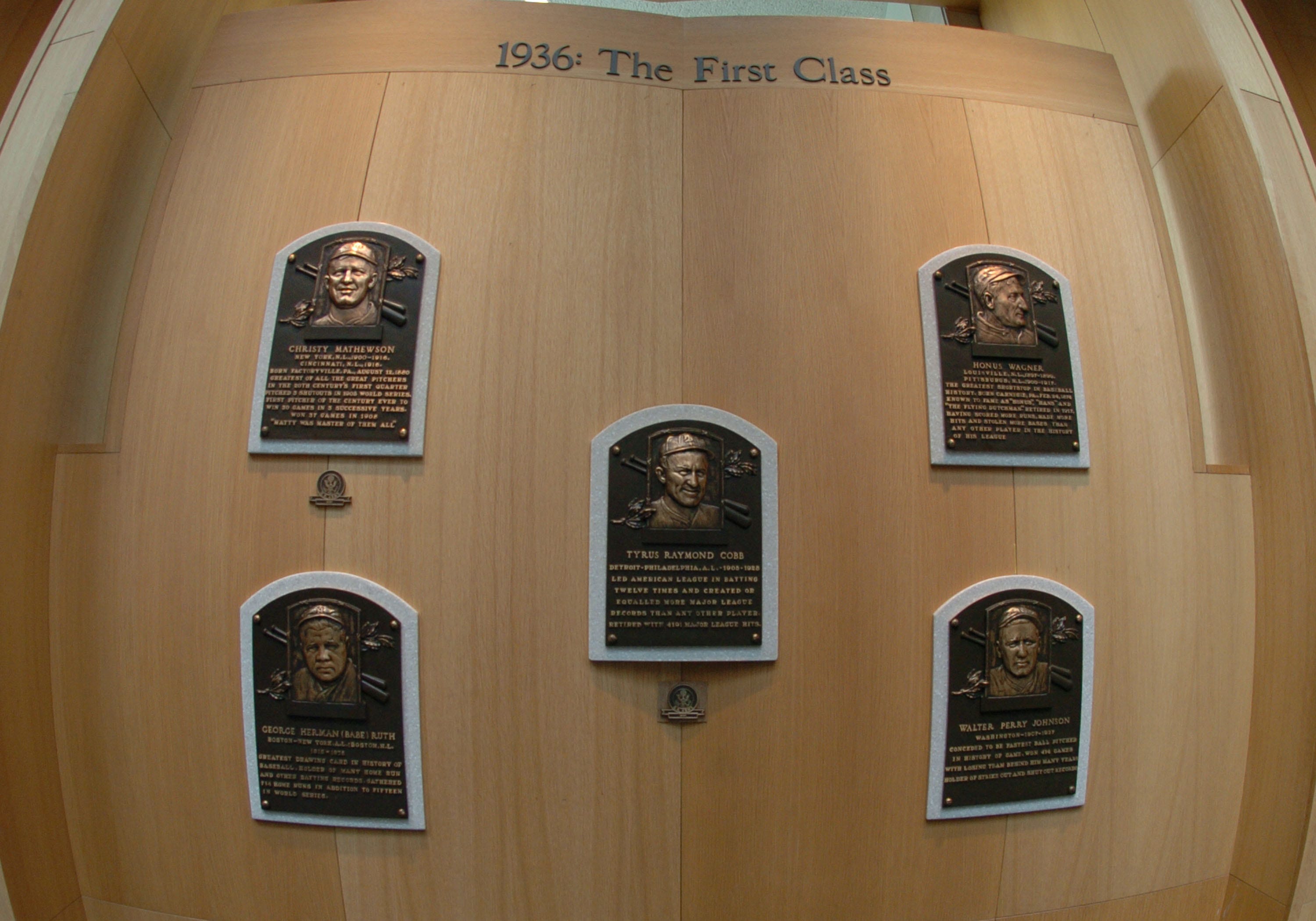
But they chose 75%, and it worked beautifully in the first election. While the BBWAA wasn’t really sure of the rules — everyone was eligible, apparently, including active players and 19th Century players and so on — they voted five players in on that first ballot, and they are the famous five: Cobb, the Babe, Honus Wagner, Mathewson, and the Big Train.
That was great. Those were the right five. The Hall of Fame was off and running.
Well, not “running.” They were off and jogging. Off and walking. Over the next two years, the BBWAA voted in four more titans — Lajoie, Speaker, Cy Young, and Pete Alexander. Commissioner Kenesaw Mountain Landis wanted to see some non-players elected, and he created the Centennial Committee to elect contributors and pioneers like Ban Johnson, Connie Mack, John McGraw, and Henry Chadwick.
It wasn’t well-planned, but there seemed to be a cohesive theme.
Things began to change in 1939. That year, the BBWAA chose to elect Lou Gehrig in a special election, and they voted in George Sisler, Eddie Collins, and hit-’em-where-they-ain’t Wee Willie Keeler. Then the BBWAA essentially said to the Hall of Fame: “OK, our work here is done: See you in three years!”
I don’t think it’s even possible that the BBWAA could have read the situation more poorly. They chose to delay the next election by three years, even though there was a staggering backlog of great players waiting in line. Fans were not happy. The Hall was not happy. The great players were not happy.
Landis, in an effort to fill the void, expanded the scope of the Centennial Committee and elected three 19th-century players: Cap Anson, Buck Ewing and Old Hoss Radbourn.
The BBWAA then asked Landis if he would, please, limit his committee to 19th-century players, leaving the 20th century to the writers. Landis agreed. But Landis couldn’t keep that promise for two reasons.
The BBWAA was moving way, way, way too slowly.
As Vitruvius says in The Lego Movie: “Because I died.”*
*I love that line so much.
When the BBWAA voted again in 1942, they elected only one player: Rogers Hornsby. As Bill James wrote: “Damned big of them, don’t you think?”
But (as Bill himself has pointed out), the BBWAA's failure to vote in more players was more the fault of the process than the writers’ high standards. The math worked against them. There were dozens and dozens of viable Hall of Fame candidates roaming the land — forty-four future Hall of Famers received at least one vote in 1942 — and the voting rules were confusing. Were the sportswriters supposed to vote for active players? Nineteenth century players? Players who were also executives? Nobody knew.
Basically, the only way for someone to get 75% of the vote in that environment was for that someone to be Rogers Hornsby.
And it took four ballots before even Hornsby was elected.
But nobody was looking at the math. All anybody saw was that the BBWAA didn’t think anyone was good enough for the Hall of Fame. And that made people mad. Very mad.
And things only got worse the next time the writers voted. In 1945, they didn’t elect anyone. Not Lefty Grove. Not Frankie Frisch. Not Mickey Cochrane or Rube Waddell or anybody else.
Well, something had to be done. Just before he died, Landis constructed a new committee that he called the “Permanent Committee,” and he gave them the power to pretty much do whatever they wanted.
So they did. In 1945, they voted in NINE players — almost as many as the BBWAA had voted in over the previous decade (13). It’s a doozy of a class — Roger Bresnahan, Hugh Duffy, Jim O’Rourke. They didn’t just stay in the previous century either: Bresnahan played his whole career in the 20th century. They also demanded that the BBWAA have a vote every year, and not only that, that they hold two elections — a nominating vote and a final vote — to be SURE they elected some players.
Then in 1946, the walls came tumbling down. The writers held their two votes … and didn’t even come close to electing a player. Frank Chance topped the voting with 57%. Jimmie Foxx and Paul Waner didn’t even make the final vote. It was a an absolute catastrophe.
And the permanent committee responded by electing TEN players, including Chance. They voted in all three players in the famous poem — Tinker, Evers AND Chance. They voted in a bunch of players that the BBWAA had waffled over — Eddie Plank, Ed Walsh, Clark Griffith, Rube Waddell.
And they voted in Tommy McCarthy, arguably the weakest player in the Hall of Fame.
Once you vote Tommy McCarthy into the Baseball Hall of Fame, there’s no turning back, no putting that genie back in the bottle. Every single player you think belongs in the Hall of Fame — every Dale Murphy, Don Mattingly, Lou Whitaker, Steve Garvey, Dwight Evans, Dwight Gooden, Dan Quisenberry, Bobby Grich, Luis Tiant, Dave Stieb, on and on infinitum — was a greater baseball player than Tommy McCarthy.
And that was that. From that day on, the BBWAA was no longer shaping the Hall of Fame. I know most writers obsess over their Hall of Fame picks. I certainly do. And that’s great. But we’re window dressing. Since 1946, the BBWAA has voted in the inarguable choices — Mays and Aaron and Musial and Williams and Mantle and Schmidt and Brett and Bench and Ryan and Maddux and Ichiro and the rest — and made an occasional statement by voting in gems of slightly lesser water like Todd Helton or Scott Rolen and Larry Walker or passing on Barry Bonds and Roger Clemens (which the Hall of Fame’s Joe Morgan specifically asked us to do).
But that’s it. Sure, the BBWAA vote can be staggeringly confusing, I admit, and it’s fun to talk about. We will vote for some PED users but not others. We will withhold our vote from some people because of off-the-field issues, but readily forgive others. We will rally behind certain players and entirely ignore others with seemingly the same statistical records.
But let’s not kid anybody: The BBWAA is not driving this bus. The Hall of Fame, through the years, has assembled more than a dozen different kinds of committees — the Veteran’s Committee, a committee of Hall of Famers, a committee of Negro Leagues historians, a Golden Age committee, a Pre-Integration Committee, a Modern Era Committee, a Classic Era Committee, a Today’s Game Committee — and they decide who is or is not a Hall of Famer. They pick the standards. They change the standards.
When the BBWAA wrestles with a borderline case like Jack Morris or Jeff Kent or Fred McGriff, the committees swoop in to elect them the first chance they can. When the committee is put together just so, they will elect a shocker like Bill Mazeroski or Harold Baines. When hard choices come up, such as the cases of Bonds or Clemens, they barely even seem to consider the question and banish them from consideration.
I don’t say any of this to complain. This is the Hall of Fame in real life. Today, the BBWAA will probably elect both Carlos Beltrán and Andruw Jones, and it will be a happy day, and memories of those two amazing centerfielders will fill the mind. That’s the magic of the place. But like most magic, you don’t really want to know how it’s done.
I'm glad to see that you voted for Dustin Pedroia. It's kind of amazing to me that everyone talks as though Buster Posey is a no-doubt Hall of Famer, while Pedroia's support is pretty soft. They have nearly identical profiles: ROY, MVP, linchpin of multiple WS teams. Posey was a slightly better hitter and played catcher, of course, but it is not so big a difference to make him a no-doubter and Pedroia a hard pass.
I dont think they should have a Special Committees who vote players into the Hall. Instead they should have committees vote for 3 players to get back on the Ballot for another run. Give the a list of players who have been overlooked for whatever reason. Players like Bernie Williams, Posada, Albert Belle, Cone, Lofton.., Whitaker, Evans, Stieb, Dave Stewart, Mattingly, Murphy, Munson, Randolph, Grich. + the ROID guys, Rose, Shoeless etc. and than if they dont get in they are done.