


All right, I will be on the road to Gaithersburg, Md., on Friday for the Gaithersburg Book Festival, so unless Margo does some of the driving—which I suspect she will not do—I probably won’t be able to write a post tomorrow. This despite the fact that I did just get the new iPad Pro for my writing on the road. Review coming!
Let’s answer some BR questions before we go. But first!
Preorders for WHY WE LOVE FOOTBALL are in full swing now that Father’s Day is right around the corner. You can preorder the book pretty much everywhere—Amazon is offering a preorder Price guarantee, Barnes & Noble has a signed edition*, but if you want to have the book signed AND personalized with anything you want, our friends at Quail Ridge Books have that exclusive offer for you going right up to Father’s Day.
*In our living room right now we have three boxes filled with SEVEN THOUSAND tip-in sheets to sign, so I figure that there might be a few signed editions out there for purchase.
If you do preorder WHY WE LOVE FOOTBALL at any time right up to Sept. 16 (the day before publication), you’re eligible to get exclusive bonus content—chapters that were cut from the book for space reasons, including one chapter that was cut literally at the last minute in order to get in a chapter on the show “Friday Night Lights.” All you have to do is fill out this short form and include your receipt confirmation number.
We are now confirming tour dates for WWLF, so I should be able to give you some details in the next few weeks.
Speaking of tour dates, I will be at the London Series on June 8 and 9 for the UK release of WHY WE LOVE BASEBALL! Sure, I know that the baseball fan base in the UK is small (but mighty!), and I imagine Taylor Swift will draw a slightly larger crowd. Still, we’re going to have a good time. We’re planning to have a little JoeBlogs get-together on Friday evening, June 7. Details are still being worked out on a possible bookstore thing that day, but the wonderful folks at Olde Street Publishing have locked down a pub called the Theodore Bullfrog—a stone’s throw from Charing Cross Station!—for us to hang out starting at 6 p.m. If you think you’ll be there, drop me a line so that I can pass along a tentative head count.
If you’re in the Charlotte area, I’ve got a couple things coming up. I’ll be with my buddy Tommy Tomlinson at Park Road Books this Thursday, May 23, at 7 p.m., in celebration of his fabulous new book, Dogland. There will be limited seating, so they’re asking people to come early. I’ll come early!
Then, on Sunday June 2, from 1-3 p.m., I’ll be at the SouthPark Regional Library for their Book of You Event. I’ll be chatting it up with the magnificent Kimmery Martin, there will be summer cocktails, charcuterie, a massage relaxation station (whoa!) and, yes, I’m told, pickleball (boo!). Good times.
Oh yeah, there’s more. On Saturday, May 25, I’ll be in Cooperstown for the East-West Classic they’re playing to celebrate the unveiling of the amazing new exhibit, “The Souls of the Game: Voices of Black Baseball.” I was lucky enough to be on the advisory board for the exhibit along with my brother, Bob Kendrick, who will also be there in Cooperstown. Come hang out with us. The exhibit will be can’t-miss… and the East-West Classic itself should be incredible—Ken Griffey Jr. is coaching (we’ll get him to take an at-bat, no?), Fergie Jenkins will be there, Eddie Murray, Dave Winfield, Ozzie Smith, Harold Baines, I mean, seriously? And playing? A partial list: CC Sabathia, Adam Jones, Ryan Howard, our pal Doug Glanville, the Upton brothers, Dontrelle Willis, Curtis Granderson, Prince Fielder, are you serious? Make the drive. Fly into Albany like we are. Just be there. The memories will be so thick you’ll have to brush them away from your face.

A Trivia challenge from Brilliant Reader Justin:
They were both righthanded pitchers.
They are both listed at 6'3", 190 pounds.
They both pitched about 17 years in the majors, making 466 and 462 starts, respectively.
They both had long, successful careers, but are both remembered today mostly for one memorably fluky season, for which they both won their sole Cy Young Award.
They both came up with the same NL team.
They were teammates and rotation-mates for a few years in the 1980s.
Later in their careers, they both moved on to a very good AL team, where they both appeared in multiple World Series.
Ain’t baseball grand? I’ll give you a few more similarities between the two pitchers:
They finished with almost identical records — one was 204-150, the other was 211-146.
They were within 50 career strikeouts of each other (2,014 and 1,969).
They were within 27 career walks of each other (1,007 and 1,034).
They were not only teammates and rotation-mates, they each spent the bulk of their careers playing for the same team.
They were drafted out of universities just 68 miles apart.
That’s pretty similar, right? And yet, as Justin goes on to say, you probably never thought of Orel Hershiser and Bob Welch being nearly identical baseball figures. I never did. They were certainly very different pitchers—Welch was more of a power pitcher while Hershiser was all about variety and working both sides of the plate with his sinker. That’s the magical thing about pitching: There are a bunch of different ways you can do it. Yes, I know, we’re losing a bit of that in these high-velocity, max-effort times, but let’s see how the game evolves. By the way, you know what the most surprising similarity is between Hershiser and Welch? Their height. I would have bet anything that Welch was MUCH taller than Hershiser.*
*Well, actually, I don’t bet. I just think it’s important to say that again, because betting seems utterly inescapable in sports right now.

Just a reminder that Joe Blogs is a reader-supported newsletter, and I’d love and appreciate your support.

From BR Glenn: A thought occurred to me the other day: Jerry Rice, who is the greatest receiver in NFL history and had 1,281 receptions in his SF 49ers career, has exactly zero of the four most famous catches in 49ers history.
I realize this is not exactly a question—Glenn does go on to ask if there are other teams whose most famous and greatest player was uninvolved in their most famous moments—but with WHY WE LOVE FOOTBALL coming out (spoiler alert: You might find Jerry Rice in there), I was somewhat startled by Glenn’s observation here. I think he’s exactly right. The most famous catches in 49er history are surely:
The Catch—by Dwight Clark
The Super Bowl catch—by John Taylor
The Catch II in an NFC wild-card game—by Terrell Owens, who couldn’t catch anything that day.
The last-second catch against the Saints in the 2011 playoffs—by Vernon Davis.
The Alley-Oop—done multiple times by R.C. Owens, but most famously in the last second against the Detroit Lions. (“This has got to be the Alley-Oop, there is no time for ANYTHING else.”)
All of these, I will tell you, have at least a small place in WHY WE LOVE FOOTBALL. And it never occurred to me that Rice, the greatest receiver of them all, didn’t make any of them. Of course, he made his share of famous catches. He caught about 400 of them in that Bengals Super Bowl and completely set up the John Taylor catch—the Bengals put like 14 defensive backs on Rice, which is the big reason why Taylor was so open. He made that absurd early touchdown catch in the Super Bowl against the Chargers to essentially announce, “You have no chance today, San Diego.”
Anyway, it’s a fabulous thought. In football—in basketball and hockey, too—the greatest of all players tend to have their team’s signature moment. Interestingly, of course, this is not true of baseball. It was Bobby Thomson, not Willie Mays, who hit the shot heard round the world. It was Bill Mazeroski, not Roberto Clemente, who walked off the 1960 World Series. This has always been a feature in baseball—even the greatest players of all time only come up one out of nine times, even the greatest starting pitchers of all time only start every five days (maybe every four days in a World Series), even the greatest closers of all time pretty much only pitch the ninth.

From BR Cullen: I will keep this one short: What on earth happened to Paul Goldschmidt?
Finally, a question I can answer with some confidence: He turned 36 years old.
It’s really that simple. Age plays tricks with our brains—it doesn’t FEEL like the difference between age 35 and 36 should matter in baseball, just like it doesn’t feel like a year or two (or 10) should change the way we feel after eating fast food.
Most of the great position players in baseball history were pretty bad at age 36. Scott Rolen had an 81 OPS+. Jim Rice played just 56 games. Todd Helton hit .256. Orlando Cepeda had a negative WAR. Vladdy Guerrero was replacement level. Tony Oliva slugged .378, Jimmie Foxx was done, Rogers Hornsby was done, Derek Jeter had a 90 OPS+, and so on.
Yes, some all-time greats were typically great—Stan Musial was great, Roberto Clemente was great, Henry Aaron was typically great, Reggie Jackson led the league in homers, as did Mike Schmidt, etc. Barry Bonds was 36 when he had his 73-home run season.
But generally speaking—when you get to 36, your days are numbered. Heck, your days might be behind you. If Dale Murphy could have held on at age 36 as even an average player, he’d be in Cooperstown today. I think he should be in Cooperstown anyway, but that’s something else entirely.
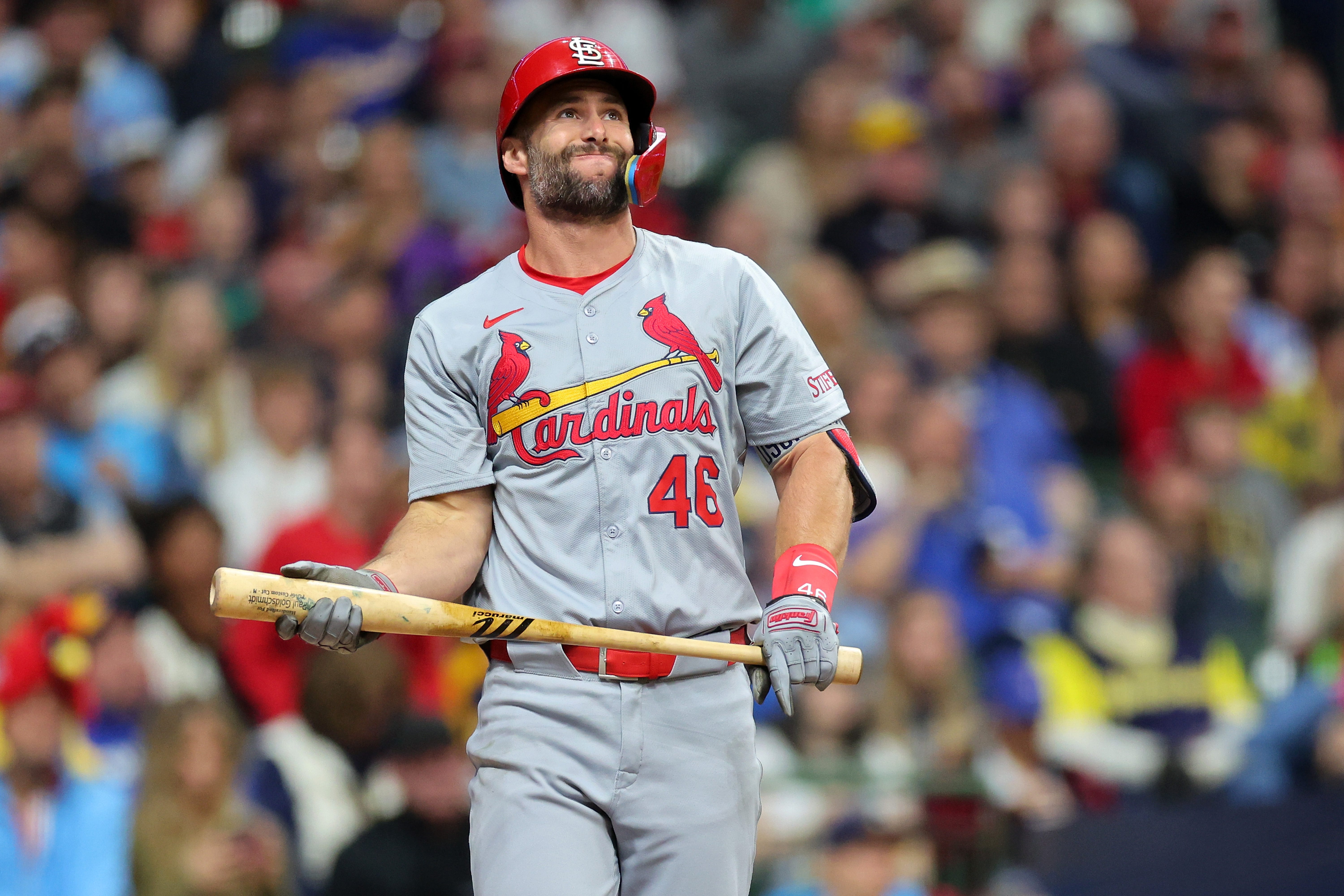
This is not to say that Goldschmidt is finished. Age is finicky. David Ortiz looked entirely finished at age 33, and at age 36, he played only 90 games. He went on to have four more fantastic years, with his best coming at age 40. So you never know. Goldschmidt might find a rhythm. But are the odds with him? No. Goldie struggled pretty badly the final two months of last season, and this season, pitchers are blowing the fastball right by him.
There’s a line in Roger Kahn’s The Boys of Summer—Kahn is getting a few batting lessons from George “Shotgun” Shuba, and he laments that he didn’t get these tips when he was young.
“Ah,” Shuba said, “you shouldn’t think like that. The fastball is by both of us.”

From BR Peggy: You have the chance to own a baseball team consisting of players whom you have known personally and like to hang out with. Name them and then select a walk-up tune for each…
Hi Peggy! If it’s OK with you, I’ll skip the walk-up tune part, but I will put together a team of some of my favorite people/players. This is not a complete list, and I’m sure I’ll forget somebody who will text me and go, “HEY WHAT’S THE DEAL, MAN?” So apologies in advance, but I’m trying to do this quickly.
C: John Buck. Just the nicest guy around. I really liked Eddie Taubensee, too.
1B: Joey Votto. This is an impossible choice—so many of the nicest guys I’ve talked to over the years have been first basemen/designated hitter types. So you might see a few players out of position on this list.
2B: Duane Kuiper. Obviously.
SS: Ozzie Smith. I caught him at the tail end of his career, and he was great to me then. And when I was doing the Hall of Fame movie, “Generations of the Game,” he was so awesome that I have to put him on here.
3B: Jim Thome. OK, here’s my first out-of-position guy—but, I mean, I can’t have a favorite-person team without Joey Votto, and I can’t have a favorite-person team without Jim Thome, and Jim did start his career as a third baseman.
LF: Raul Ibañez. They don’t come any better than Raul.
CF: Dale Murphy. My hero. And my friend.
RF: Reggie Sanders. What you want as a sportswriter is a go-to, someone you can absolutely count on, win or lose, to give you a feel for the moment. Reggie never once let me down.
DH: Mike Sweeney. When I left the Kansas City Star to go to Sports Illustrated, I heard from so many people… and one active athlete. Mike wasn’t even with the Royals at the time. Still, he left a long message on our answering machine, one that Margo never erased.
Pitchers: Hmm, I would guess Zack Greinke’s on here, Brian Bannister of course, Brandon McCarthy, since he will definitely text me if I don’t put him on here. And of course I will always put Tom Glavine on any and all of these lists, even though I only talked with him a couple times in my entire career. One of those times was when I was 24 years old and in my first big-league clubhouse, and he saw me drowning and saved me.
Manager: Buck O’Neil. Of course.
Bonus: Johnny Damon. I just got the biggest kick out of him. He’s actually coming to Charlotte to appear at a Knights game at the end of May. If I’m in town, I will absolutely go see him. I have a bunch of Johnny Damon stories, but my favorite comes from the 2009 World Series when he stole second and third in the ninth inning and then scored the go-ahead run against the Phillies. Afterward, at the press conference, Damon talked about how he used to be pretty fast when he was young. Then he looked over at me and smiled and nodded his head and said, “Joe remembers.” Which I do: I totally remember when Damon was blazing fast in Kansas City and led the league in stolen bases.
In the next day’s New York papers, they quoted Damon—only they quoted him like so: “I used to be pretty fast. Joe [Girardi] remembers.”

Hey, if you feel like it, I’d love if you’d share this post with your friends!

From BR Matthew: Who do you think will end up with a higher career WAR, Mike Trout or Mookie Betts?
So, let’s see: Here’s where they stand right now:
Mike Trout: 86.1 combo WAR (age 32)
Mookie Betts: 63.5 combo WAR (age 31)
Before we get into our calculations, this is a good reminder: Mike Trout has EIGHTY-SIX WAR through his age-31 season. This is madness. He hasn’t been healthy in five years, he played through the COVID year, and he still has more WAR than Barry Bonds, Lou Gehrig, Stan Musial, Rickey Henderson or Ken Griffey Jr. had through their age-31 seasons. What an absurdity. And what a shame.
Now, let’s consider Betts, who already has one foot inside the Cooperstown doors.
He’s 23 or so wins behind Trout, and he’s exactly 14 months younger. Let’s assume Trout either doesn’t return this season or doesn’t add much to his total, a pretty fair assumption. Betts is having a spectacular season—he’s on pace for 11 or 12 WAR—but let’s be more conservative and say that he finishes with 8 or so WAR this year. That would put him at 72 for his career, about 14 wins behind Trout.
Let’s also assume that Trout comes back… but as a designated hitter. Mike Schur and I recorded a PosCast on Thursday (we’re back, baby!) and we both agree that Trout’s future has to be at DH or, at best, first base. It would be malpractice, I think, to put him back in centerfield. His best hope to ever stay healthy again would have to be as a designated hitter, right?
I think a healthy-ish Trout can still smash baseballs. He was leading the league in home runs for a spell this year before he got hurt, and there has never been a time—despite all the injuries—when Trout failed to hit at an elite level. If he could just get a little bit healthy for the next few years (he’s signed through 2030), he could probably still put up, I don’t know, 10 or 15 or 20 or even more WAR as a hitter. David Ortiz put up 22.5 WAR in his last six seasons. Now, Ortiz was a special older hitter, but couldn’t Trout be that? It seems to me that he could, with some health, get up to 100 WAR for his career.
Can Mookie get to 100 WAR? There are too many variables to say for sure. Will he stay at shortstop? If he does that, it would help a lot. But CAN he stay at shortstop? No idea. Can he stay healthy? Will he be a good-to-great player in his mid-to-late 30s? You look at the great players around Betts’ WAR level at age 31:
Carl Yastrzemski. He played until age 43. He finished with 95.7 combo WAR.
Rickey Henderson. He played until age 44. He finished with 108.7.
Cal Ripken Jr. He moved from short to third and finished with 94.2.
Frank Robinson. He had a WAR lead at this point and ended up with 105.6.
Al Kaline. He missed a bunch of games late in career and ended up with 90.9.
So, you can see a bunch of different possibilities. It will be interesting to see if either or both of them can get to 100 WAR. That’s such an elite space; you look at position players since 1969—only four have achieved 100 combo WAR for their careers.* They are Barry Bonds, Alex Rodriguez, Rickey Henderson and Mike Schmidt. Both Betts and Trout are already at high altitude.
*Incredibly, Albert Pujols does not have 100 combo WAR over his career. He does have 101.5 bWAR, but FanGraphs has him at 88.9. The big difference seems to be defense—Baseball-Reference has Pujols as a plus-plus first baseman and, as such, he’s only minus-40 runs on defense when you take into account that he was a first baseman and DH pretty much his entire career. FanGraphs does not have Pujols as an elite first baseman at all, and has him at minus-164 runs. That’s basically the whole difference between the two.

JoeBlogs Week in Review
Monday: Brilliant Reader Questions!
Tuesday: Who’s Winning (and Losing) in MLB, and Why.
Wednesday: The Magic of Maddux.

I came to say Heshiser’s Cy Young in ‘88 wasn’t fluky (as many others already have), but then I thought about it, and I’d say this: Winning the Award wasn’t fluky, but how he finished the season was.
He pitched like 5 shutouts in a row and set the record for most consecutive scoreless innings. Then he shutdown the best team in NL and won NLCS MVP, the shutdown best team in AL and won World Series MVP. Oh and he also went 3-3 at the plate in WS. Quite possibly the greatest end to a season in MLB history.
"The fastball is by both of us." I'm going to use that.
One of my favorite baseball/life quotes—might've been in a Roger Angell article—was from Richie Ashburn, who, as he aged, had to make adjustments to his swing, and these adjustments, he knew, would've improved his younger self as well. He said: "I wish I learned early what I had to learn late."