

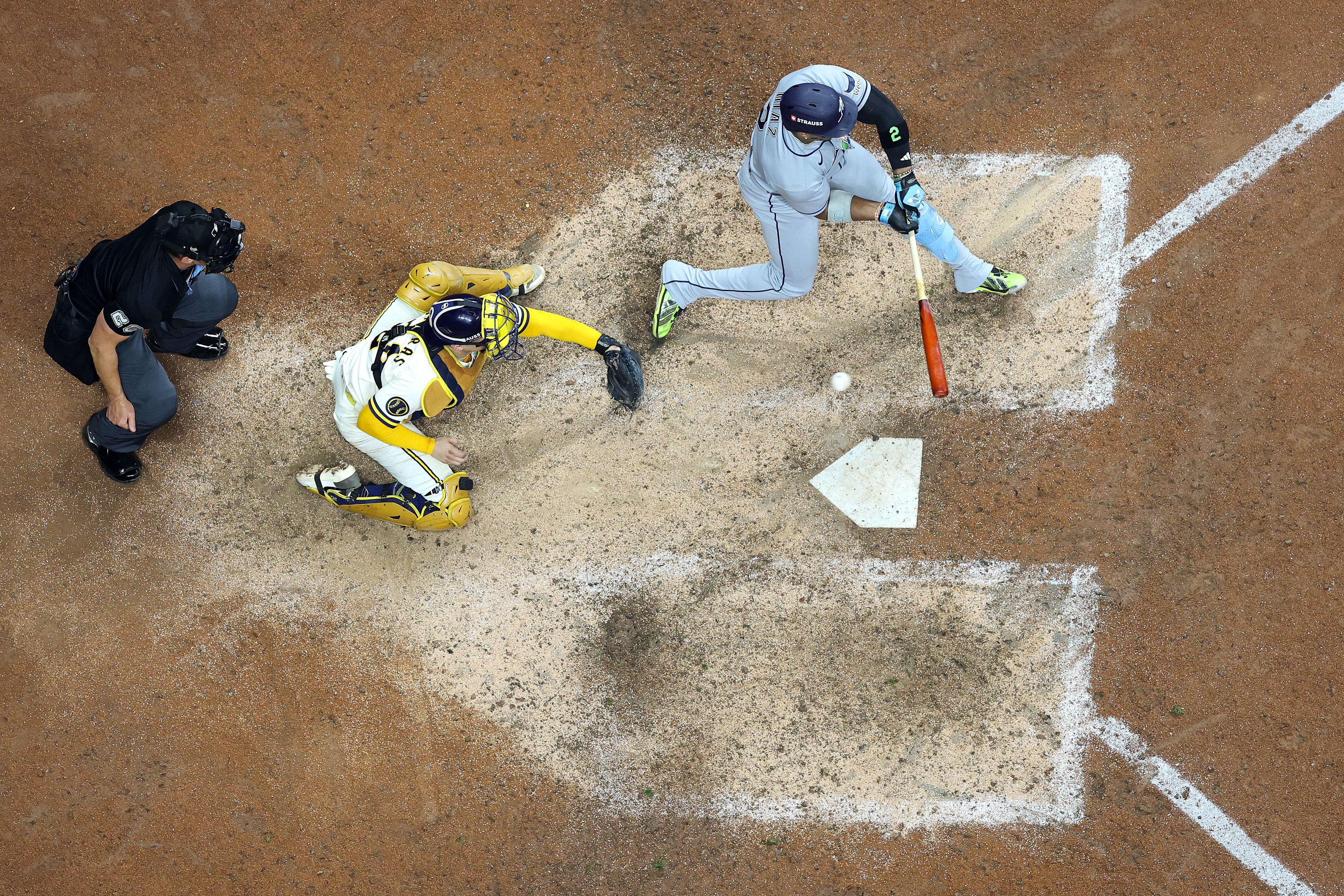
Feeling under the weather today — I guess it’s that time of year — but I did want to take a few minutes in my fog to talk about that final out of World Series Game 2, the checked-swing strike call on Yandy Diaz.
I don’t think it was a swing. I don’t think it was CLOSE to a swing.
But I don’t really want to get into the technicalities. Yes, I’ve seen the images from behind and above that suggest it was a swing. I reject those entirely because that angle is the absolute worst for determining if he swung.*
*The above photo is from above and not from behind; I think it’s still deceiving but you can interpret it however you like.
And yes, I’ve heard from some very smart baseball people who believe it was a swing. I don’t reject those out of hand, but I think they miss the point, or at least they miss the point I want to make.
And that point again is this: I don’t think that was a swing.
I don’t think that was close to a swing.
All offseason, I’ve been wincing whenever catchers appeal to first base. I’ve been wincing because I think we’ve entirely lost the plot on checked swings. We’ve turned it into a “how far did the bat go?” conversation. That is not in the rule book. There is, in fact, nothing at all about checked swings in the rulebook.
As I wrote in A History of the Checked Swing, the entire rule about swinging strikes is in these two lines:
A STRIKE is a legal pitch when so called by the umpire, which:
(a) Is struck at by the batter and is missed.
That’s it. If a batter strikes at the ball and misses, it’s a strike.
That’s why it’s CALLED a strike.
