


Password: Kuiper
The Clubhouse is now in session.

We have lots of fun behind-the-scenes stuff for you in The Clubhouse today. But let me start off by talking just a little bit about something that doesn’t sound like much fun at all: Franchise Valuations.
We’ll try to have a little fun with it.
There’s SO much talk these days about the Dodgers wrecking baseball by buying up all the great players. From what I’ve been told, we have baseball owners and executives across the country thinking that the Dodgers’ spending spree — most specifically their “did they really need him” $60 million a year purchase of Kyle Tucker — is the thing that will, in the end, break the player union’s insistence on blocking a salary cap. You’ll find countless people out there who will have much more salient and useful thoughts on that whole subject.
What interests me is why baseball FEELS more unfair to so many than other sports.
Is it that the other sports have a salary cap?
I’m not so sure it’s exactly that.
A friend pointed me to franchise valuations, so I took a closer look. Here is some raw data I chased down on the Internet (with fun sports emojis!).
🏈 NFL
Most valuable franchise: Dallas Cowboys, $13 billion
Median franchises: Denver Broncos and Houston Texans, $7.2 billion
Least valuable franchise: Arizona Cardinals, $6 billion
OK, keep this in mind: The top franchise has 181% of the median's value. The bottom franchise is worth 83% of the median.
We’ll explain why this matters when we get to the finish (though I imagine many of you already know).
🏀 NBA
Most valuable franchise: Golden State Warriors, $11 billion
Median franchises: Cleveland Cavaliers and Washington Wizards, $4.8 billion
Least valuable franchise: Memphis Grizzlies, $3.5 billion
So, in the NBA the top franchise has 229% of the median’s value, and the bottom franchise is worth 73% of the median. So there’s a wider spread in the NBA than in the NFL.
🥅 NHL
Most valuable franchise: Toronto Maple Leafs, $4.3 billion
Median Franchises: Carolina Hurricanes and Tampa Bay Lightning, $2 billion
Least valuable franchise: Columbus Blue Jackets, $1.4 billion
The top is 215% of the median, the bottom is 70% of the median, so the NHL — at least as a scale — matches up pretty neatly with the NBA.
So, you see the pattern. Rich teams are moderately richer, poor teams are moderately poorer, everybody lives with the imbalance.
Now, to the moment you’ve been waiting for: Baseball!
Most valuable franchise: New York Yankees, $8 billion
Median franchises: Toronto Blue Jays and San Diego Padres, $2.1 billion
Least valuable franchise: Miami Marlins: $1.2 billion
You will notice right away that the structure is so much more extreme than any other sport. The top franchise in baseball is worth 381% — essentially four times more — than the median. And the least valuable franchise is worth 57% (a little more than half) of the median.
This is why baseball feels unfair.
Because baseball IS unfair.
Now, we can argue whether sports leagues are SUPPOSED to be fair. The Premier League, for example, proudly trumpets the unfairness. They don’t even pretend that Burnley or Wolverhampton will have remotely the same chance to win as Arsenal or Man City. The league prides itself on its eat-or-be-eaten ethos. The great equalizer there is soccer itself and the undying belief that a well-organized bunch of dedicated players can slay giants.
But that’s not how American sports fans want it. We want our teams to have a real chance. And when they do lose — as 99% of them do — we want to blame their own incompetence or bad luck for the loss.
That’s harder in baseball. The Yankees and Marlins do not have the same chance. The Dodgers and Pirates do not have the same chance. Owners, of course, want to blame this on the lack of a salary cap rather than the more obvious issue, which is that the other league’s owners share a lot more of the money. Yes, they share national television money, and there is the luxury tax and all that.
But when there’s a $400 million revenue gap between the Yankees and Reds and Marlins every year, yeah, they’re not exactly playing the same game.
In baseball, franchise value is more than dollars on a balance sheet. It’s also mistakes forgiven. Second chances. Dramatic late-season acquisitions. It’s that third heat-throwing reliever. It’s waiting for the less-valued teams to dump their best players.
Now, there are some things in place in baseball that allow small-market teams to dream. For one thing, incredible young players get paid bubkis. You couldn’t get a Paul Skenes-level player in any other sport for less than a million dollars. For another, I believe that baseball — like soccer — offers teams with less talent a better opportunity to win on any given day than the other American team sports.
But the reality is that people who scream about every big-money contract offered by the big clubs are just unleashing their well-founded instincts about the game being rigged toward the richest teams.

I have a couple of updates about the Royals moving in the fences in 2026.
First, I got this email from a Brilliant Reader:
“Pretty good article, Joe. I played on turf for 20 years, and when I retired after the ‘93 season, they put in grass and move the fences in. Good timing?”
Yeah, that’s from George Brett.
Second, I talked at length with my pal, Royals general manager J.J. Picollo, about the move and got some great insights into the decision. Turns out, he’s only hinted at just how much work the Royals put into researching this decision. They spend countless hours studying wind, weather patterns, humidity, elevation (Kansas City has the fourth-highest altitude in all of baseball), run value per fly ball and so many other things.
“It was actually really fun,” J.J. says. “Nervewracking, but fun. We learned a lot of things, not just about fly balls. One thing we learned that’s really interesting is that our hard-hit rates to centerfield are as high as any ballpark in the game. And our strikeout rates are suppressed. Our best theory is that this is because of the quality of our batting eye; we hear it again and again that Kaufman Stadium is just a very comfortable place to hit.”
I LOVE stuff like this. I don’t know if it’s directly related, but did you know that no Royals pitcher has ever led the league in strikeouts? Or that the Royals have only had five pitchers in their history with 200 strikeouts in a season? Or that the Royals lineup has by far — by more than 1,000 — the fewest strikeouts of any team this century?
After going through every single detail, the Royals tried to project what bringing in the fences would do both to their offense and to their pitching. And based on the players they have, they determined that bringing them in eight or nine feet (while leaving centerfield at 410 feet) would help the offense just a bit more than it would hurt their pitchers. We’re talking about runs at the margins — the stats people predict it will be worth about 15 more net runs over the next five years. That doesn’t sound like a lot because it isn’t a lot, but that could mean one or two more home wins (maybe more if the timing works out), and the Royals are going for it.
“It’s really important to say that we still want Kauffman Stadium to play as a neutral park,” he said. “The last thing we wanted to do was turn it into a bandbox with home runs flying out everywhere. We looked at a whole bunch of possibilities, and for most of them we thought: ‘That’s just a little too much offense.’ This felt like the right balance.”
And, I said, what happens when the Royals lose a game on a home run that wouldn’t have been a home run last year?
“Oh, I’ve already told our R&D guys, ‘You can expect to get a call from me every single time this move hurts us,’” J.J. says. “But we hope, in the long run, that it will help.”

Here in Charlotte — and I’m sure in many of the places where you Brilliant Readers live — we are bracing ourselves for what folks are calling: Snowmageddon.
Well, that’s really not what they should be calling it because, according to the latest forecast, it looks like it will be more like a 48-hour Snow-Sleet-Ice-Freezing-Rain-Wintery-mixagedon, which isn’t as catchy or fun but definitely pumps up the chances of all of us losing power and not being able to build snowmen.
I bring this up because the weather is all anybody’s talking about here. And, this is weird: I really like it. I like that everywhere I go, people are saying: “You ready for the weather?” Or: “Do you guys have a power generator?” Or: “Our kids are so excited!” Or: “I’m just loading up on hot chocolate and don’t plan to leave the house!”
I don’t want to turn this into a Jack Handy deep thought or anything like that, but I miss us having stuff to talk about with strangers. I miss when we watched the same shows, listened to the same music, shared the same complaints and bits of joy. I used to mock the whole “Hot enough for ya,” line, but now I kind of cherish it — because it’s something we share. Snowmageddon might be even rougher than expected. Or it might pass over and leave us laughing about our panic.
Either way, we go through it together.

Let’s take a question from Brilliant Reader Michael:
Just listened/watched your HOF Video with Molly Knight, and you (in so many words) posed the question: If we swap Mark Buehrle and Andy Pettitte, is Buehrle a serious candidate for the Hall of Fame?
As a lifelong White Sox fan, I often wondered if we swapped Billy Pierce and Whitey Ford, would Billy be the HOFer and Whitey the “very solid, dependable, left-hander?”
I love hypothetical questions like this because they get at one of my favorite ideas in sports: So much of it is context. We’ll start with Mark Buehrle: He was a 38th-round pick out of Jefferson College in Hillsboro, Missouri. You might not believe this, but 33 different players have been drafted out of Jefferson College, including Mike Henneman and Cliff Politte.
Anyway, as a 38th-round pick, the Yankees absolutely could have taken him.
Andy Pettitte, meanwhile, was a 22nd-round pick out of Deer Park High in the greater Houston area. The White Sox absolutely could have taken him.
You look at their careers — they are STUNNINGLY similar. They are two left-handed pitchers who threw about 3,300 big-league innings, gave up about 1,400 runs and each finished with a 117 ERA+.
Buehrle has 60.0 Baseball Reference WAR.
Pettitte has 60.7 Baseball Reference WAR.
Pettite had one of the great pickoff moves in baseball history (it was a balk, though). Buehrle won four Gold Gloves for defensive excellence. Pettitte won 20 games twice and finished second in the Cy Young voting one year. Buehrle never won 20 games and never finished higher than fifth in the Cy Young, but he threw both a no-hitter and a perfect game. Pettitte won a record 19 postseason games while pitching 50 more postseason innings than any pitcher. Buehrle rarely pitched in the postseason, but he was the White Sox’s ace when they won the World Series in 2005.
Pettitte admitted to using PEDs.
Buehrle made his mark by pitching fast and loose.
Pettite got almost 50% support on the Hall of Fame ballot this year.
Buehrle got 12% support.
Now, we can break this down in a million ways, but the question I posed is: Would Buehrle be in the Hall of Fame if the Yankees had taken him instead of Pettitte? And, of course, there’s no way to know. Maybe the Yankees would have given up on him in the minors. Maybe he would have struggled in the playoffs, forcing the Yankees to deal him away. Maybe he would have gotten hurt in this alternate universe.
But I’d say, given what we can guess, absolutely: Mark Buehrle is a Hall of Famer if he were the one who got to pitch 276 postseason innings.
Then, Michael comes back with the whammy — Billy Pierce and Whitey Ford. Just a couple of 5-foot-10 lefties who dominated the American League in the 1950s and into the 1960s. This one is a bit different in that Ford had a much better career ERA (2.75 to 3.27) plus his historic .690 winning percentage. But how much of that came with pitching for the dominant Yankees? They have the exact same career WAR.
I could definitely see an argument that Pierce with the Yankees would be in the Hall of Fame, and Ford with the White Sox might not be.
Here’s the thing about Whitey Ford, though: He lost two prime years to military service in the early 1950s. I try to be hypersensitive to that sort of thing. Ford went 9-1 with a 2.81 ERA in 112 innings as a 21-year-old in 1950 and threw 8⅔ shutout innings against Philadelphia in his World Series start.
Then he missed 1951 and 1952, two Yankees' World Championship seasons.
If he plays those seasons, I don’t think the Pierce-Ford comparison feels quite so even. The hypothetical is absolutely still there — who knows just how great Billy Pierce would have been with a dominant team behind him? But I think in this case, Whitey Ford was the better pitcher overall.

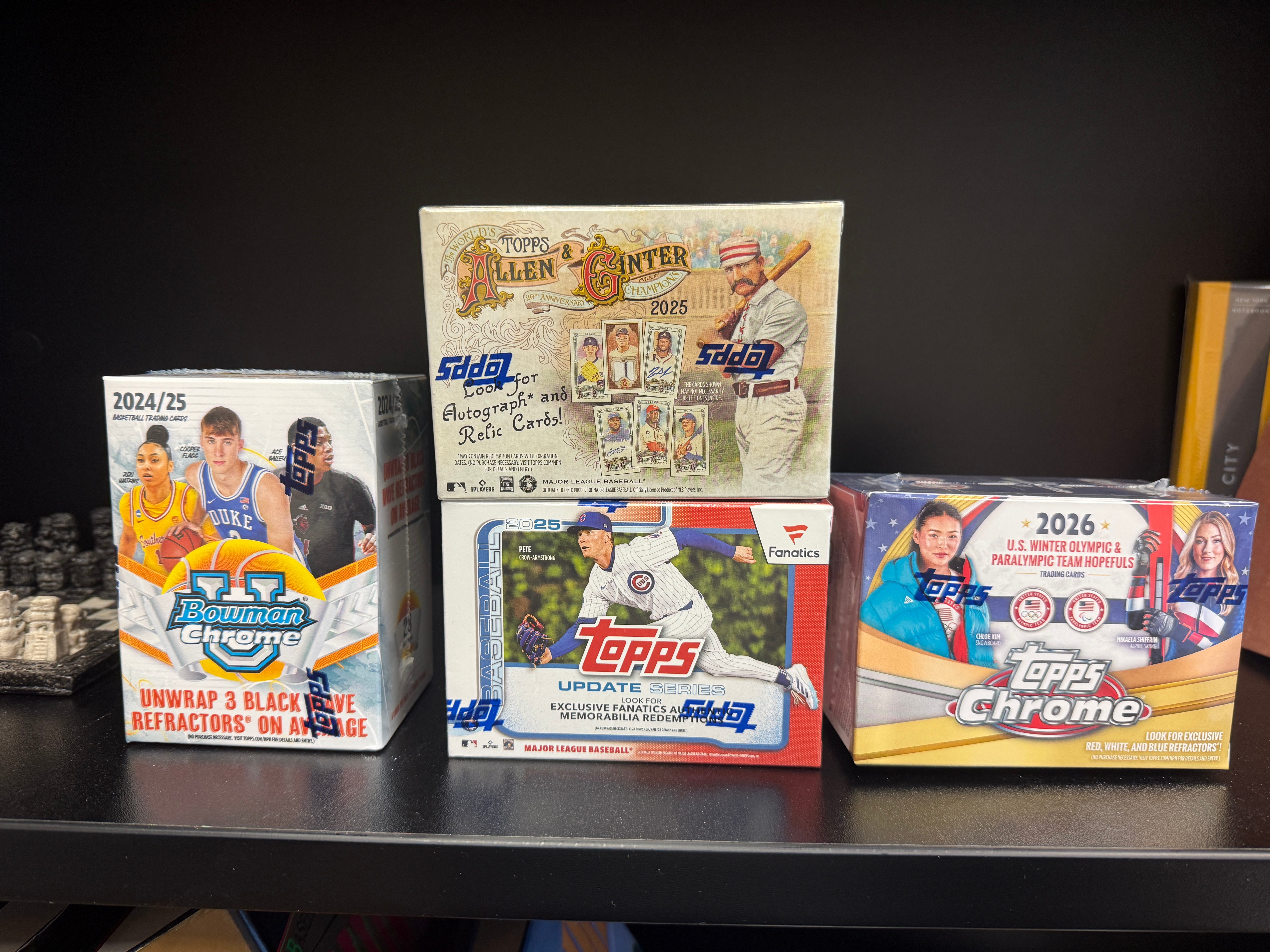
Brilliant Reader Daniel from Fanatics just sent Mike and me four boxes of cards for us to open for our Baseball Card Extravaganza to raise money for the amazing people at Team Gleason. We’re probably going to record a couple of PosCasts this weekend; not sure if we’ll do them live, but you can, as the kids say, smash that subscribe button over at our YouTube channel, and you’ll be alerted if we do.
By the way, Allen & Ginter STILL has not made a baseball card of Mike and me. I’m really looking forward to opening that box (and Mike has an A&G box to open, too) just so we can rant about some of the people who got cards before us.
Once again, please, if you can, donate to Team Gleason. We will, as always, be giving away these fabulous sports card prizes to a bunch of people who donate.
I write The Clubhouse every Friday for paid readers to enjoy over the weekend — it’s a space where I write more loosely, we have longer conversations, and I share things that don’t quite fit anywhere else. I wanted to share this one with everyone because it turned out to be especially fun, and I thought you’d get a kick out of it.

Franchise valuations do not validate the feeling that baseball is unfair. The Marlins and every team without a valuation as high as the Yankees' could be spending more money on players while still making their obscenely wealthy owners even wealthier.
If lower-revenue owners can convince higher-revenue owners to share more of their revenue, good for them. They don't currently spend all they already get from shared revenue though, so I don't know that increased sharing would actually lead to much greater payroll parity.
The Pirates run a low payroll not because they have no choice, but because they're allowed to. MLB could force them to run a higher payroll, but won't. MLB could create greater revenue and spending parity without a salary cap, but it won't.
We can talk about salary caps and revenue sharing until we're blue in the face, but at the end of the day, I just don't see how any serious person could argue against there being ten or so owners that just aren't making a serious effort to build a winning franchise. Whether that's because they themselves don't have the financial resources or they don't care or both, I don't know.
But until that's resolved, CBA discussions aren't worth much more than rearranging furniture.
The Marlins have a still-new, publicly-funded downtown ballpark in the sixth-largest metro area in the country. It's no one's fault but current and past ownership's that they have the lowest valuation of any franchise in the league. Their ownership needs to either get serious about trying to win baseball games or sell the team to someone who will. Similar things could be said about several other franchises.