


OK, look, the season just started. And we’re coming off a weird and infuriating offseason with a shortened spring training. It’s obviously too early to make any hard judgments about what’s going on in baseball right now.
But … what the heck is going on?
On Sunday, 28 of the 30 teams played — the Tigers-Royals game was rained out. And in the 14 games played, there were exactly 15 home runs hit.
Steven Vogt, Oakland vs. Toronto
Pete Alonso, Mets vs. Arizona
Adolis Garcia, Texas vs. Angels
Michael Brantley, Houston vs. Seattle
Ty France, Seattle vs. Houston
Thairo Estrada, San Francisco vs. Cleveland
Brandon Belt, San Francisco vs. Cleveland
Gavin Sheets, White Sox vs. Tampa Bay
Wilson Contreras, Cubs vs. Colorado
Seiya Suzuki, Cubs vs. Colorado
Ryan McMahon, Colorado vs. Cubs
Marcell Ozuna, Atlanta vs. San Diego
Bryce Harper, Philadelphia vs. Miami
Kyle Schwarber, Philadelphia vs. Miami
Albert Pujols, St. Louis vs. Milwaukee
That’s all. Fifteen home runs in 14 games, according to young baseball statistician and author Jeremy Frank, is the fewest since 2014, when baseball was very different from the past few seasons. And it’s the fewest for an April day since 1993, which is like 500 years ago in baseball terms.
So what’s the problem? I mean, we all know that the home run thing got out of control, particularly in 2019, when apparently even I hit 27 homers*, and you can say that maybe it’s a good thing to see some balance restored to the game. I’ve long believed that home runs are better as uncommon events; when everyone’s doing it all the time, the homer loses so much of its specialness.
*I just found this out by going to my Baseball-Reference page. Who knew?
So what’s the problem?
Well, the problem is that if this is a real trend — teams are averaging fewer than one home run per game, and that hasn’t happened since the aforementioned 2014 season — hitters are basically helpless. Home runs (since 2014) have masked the absolute cratering of offense in baseball. Batting averages, hits, triples, these are all at historic lows. Strikeouts, as everybody knows, are at historic highs.
And while the deluge of home runs may have become repetitive, they’re just about the only thing that has kept baseball from going back to 1968, when so few runs scored that the powers-that-be in baseball freaked out and just started changing stuff — OK, uh, let’s lower the mound, and uh, make the strike zone smaller, and, uh, maybe the pitcher shouldn’t hit anymore? And, uh, let’s crack down on those spitballs. Right? And, um, maybe we should call more balks? And, any other ideas out there?
In 1968, batters hit .237 — the lowest batting average on record.
This year — and again, it’s SUPER early, so let’s not jump to any conclusions — batters are hitting .233. That is not out of line from the last few seasons. Last year, batters hit .244, which was the lowest average since, you guessed it, 1968.
And the 11-point difference between this year and last year mostly comes down to the fact that batters are hitting many fewer home runs than they did last year.

JoeBlogs is a reader-supported venture. Free and paid versions are available. The best way to support us here is by taking out a paid subscription. And hey, we do have a lot of fun, so I hope you’ll come along.
Joe

Here’s why I think the trend — if it is a trend — is particularly scary: We can very clearly and vividly point to why it’s happening: Relief pitching. Let me show you this super-worrisome statistic:
Innings 1-3: Batters are hitting .243/.321/.391.
That’s not great. But …
Innings 4-6: Batters are hitting .230/.310/.367.
That’s worse, isn’t it? And …
Innings 7-9: Batters are hitting .223/.305/.371.
That’s a reflection of how much the game has changed — your best bet to score runs in 2022, by far, is to get to the starter in the first three innings. This is baseball turned entirely upside down from where it was for 100 years. Starters are the weak link now. Relievers used to be failed starters. Now starters are just bridges to get to the parade of 98-mph throwing relievers.
The Blue Jays-A’s game is a good example. You would expect Toronto to be one of the best hitting teams in baseball. You would expect Oakland to be one of the worst pitching teams in baseball. Well, the Blue Jays scored one run in each of the first three innings off Oakland starter Adam Oller, a 27-year-old righty who pitched Independent Ball for the Windy City ThunderBolts (correct spelling) in 2019, then pitched for the Sydney Blue Sox in the Australian Baseball League the last couple of years. And they scored an unearned run off reliever Ryan Castellini after shortstop Kevin Smith threw the ball away.
And that was IT. The A’s hardly have the league’s deepest bullpen, but the Blue Jays could not even manage a hit off Sam Moll, Jacob Lemoine and Zach Jackson, three totally real people I did not make up. Of course, I could have made the names up, it wouldn’t have mattered, I could have told you the three relievers were Steve McDichael, Anatoli Snorin and Dwigt Rortugal* and you probably would not have known the difference.
*These last three names, as I’m sure you know, come from the 1994 Super Nintendo “Fighting Baseball” game.
The A’s scored two of their three runs off starter Alek Manoah, who pitched six innings — a startlingly long start by 2022 standards. Only 40 of the 284 starts so far this season have gone six innings, an absurd 14%. An applying student is more likely to be accepted to Cornell than you are to go to a game and see your team’s starting pitcher go six innings.
Then after Manoah left, the A’s managed to scratch out only one run off relievers Mike Truk, Kevin Nogilny and Scott Dorque. No, I’m sorry, those are Super Nintendo made-up names again; it was actually Bobson Dugnutt, Jeromy Gride and Todd Bonzalez. No, those are also made-up Super Nintendo names. Stop that!
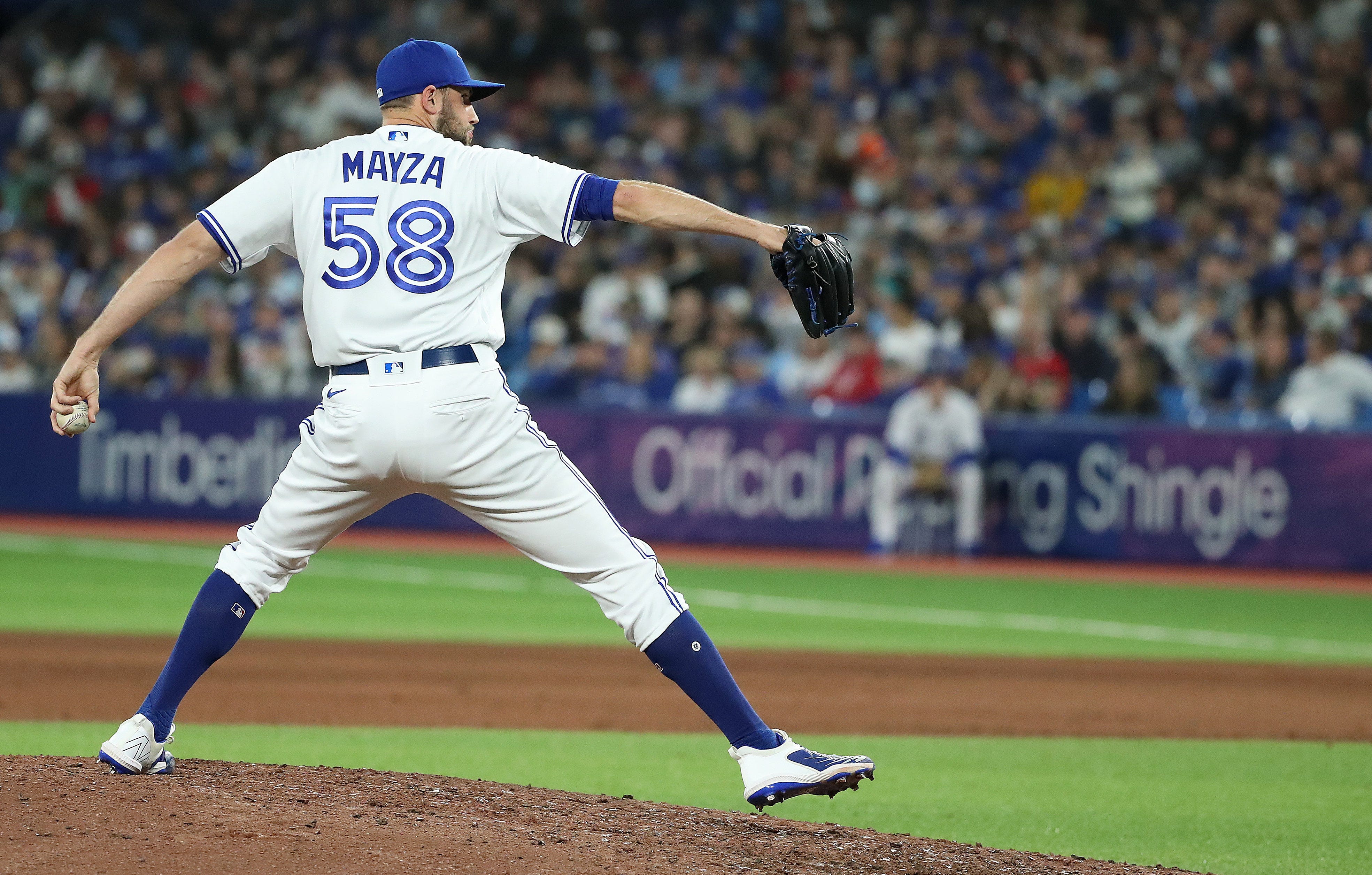
The actual pitchers were Tim Mayza, Adam Cimber and Jordan Romano.
Félix Bautista, Dillon Tate and Jorge Lopez shut down the Yankees.
Trevor Williams, Chasen Shreve, Drew Smith and Edwin Diaz shut down Arizona.
Paul Sewald, Drew Steckenrider, Andres Munoz and Diego Castillo shut down Houston.
Ryan Brasier, Jake Diekman and Austin Davis shut down Minnesota.
Steven Wilson, Luis Garcia and Taylor Rogers shut down Atlanta.
Wil Crowe, Heath Hembree and David Bednar shut down Washington.
And so it goes.
Yes, it’s true, the season is barely 10 days old, and the weather will get better, and things surely will stabilize, and all of that. But — and Joe Sheehan has been ringing this bell for quite a while now — batters truly have few weapons to deploy against this new wave of pitching.
After the fourth inning, day after day, every at-bat, they’re facing fresh pitchers with fiery fastballs and ungodly sliders and various other wicked swing-and-miss out-pitches. After the sixth inning, relievers are striking out more than 28% of the batters they’re facing. In the ninth inning, batters are hitting .211 and slugging .343.
And I don’t really see how this is going to change. With the expanded rosters, teams are now regularly carrying 15 pitchers, and basically, any of them on any given day can be Bob Gibson if only asked to pitch one inning.
The home run has become the batter’s great equalizer. That’s why for the last few years, you’ve gotten an earful of talk about launch angles and exit velocities. Everybody knows that you’re probably not going to put together a two-walk, five-hit rally against a pitcher nowadays (and even if you did, a new Robocop pitcher with a blazing fastball would be put in, probably after the second hit).
So you take your chances and swing for the fences and, in the words of the Judge in “The Natural,” “wreck things with an unexpected blow.”
But if home runs are down — and I’m not saying they are, it’s too early to tell — I’m just not sure what Plan B is.

"I am once again asking" for MLB - or at least anyone reading this comment - to consider the following proposal:
Game Eligible Pitchers.
1.) Before every game, each manager is allowed to designate up to five pitchers who are eligible for use in that game, including the starter. During regular nine innings of the game, only pitchers who are named on the Game Eligible Pitchers list can be inserted into the game as a pitcher;
a.) If a game eligible pitcher is injured and has to leave the game, the manager of that player's team may replace him on the list with another available player, but it's a one-out, one-in situation;
b.) If the game goes to extra innings, all players on both teams who have not yet exited the game become eligible to pitch;
c.) If at any point a team takes a 5-run lead (or more), all players on both teams who have not yet left the game become eligible to pitch.
Sound good? Anyone see any potential unintended consequences of implementing my idea? The only thing I can think of is that it might be the death knell of the LOOGY (if that hasn't happened already). I can't find one reason why this wouldn't result in the following:
1. Fewer pitching changes
2. An end to the endless parade of faceless relievers
3. Pitchers - especially starters - no longer can always put maximum effort into every pitch, as they now may be required to stay on the mound for more than just one inning (or less).
4. Faster pace of game
The biggest problem is that having starting pitchers never has been a good strategy. The strikeouts and lack of extra-base hits are tractable problems: some combination of lowering the mound, deadening the ball, and a pitch clock should help with these problems since it pushes the incentives in the right direction.
But I don’t see any competitive incentives pushing managers in the direction of longer starts or fewer relievers. In fact, the better hitting stats in the first three innings means that baseball hasn’t yet gone far ENOUGH in the direction of shorter starts. If those first three innings currently have the weakest pitching, then starters need to be on an even shorter lead or more teams need to try the opener or something.
I think the main thing keeping starters around at this point is tradition. If baseball were just starting now as a new sport, and you knew what you know now about the way that pitchers operate, would you even have a “starter” in the way they exist now? I imagine that the ideal schema would be to have roughly 6-8 pitchers per game, mostly pitching 1-2 innings each until the score gets lopsided and a long reliever is brought in to mop up or hold the 7-run lead. The best pitchers maybe would get 2 or even 3 innings per appearance, or they would pitch more frequently, or they would be “closers”. But I don’t see how a 6-inning start survives in this new world.
And I think the same would have been true back in the day. You always hear that pitchers could go easier for the bottom half of the lineup, but it’s not like those guys never got any hits. I’m very confident that if you brought the current pitcher usage to 1920s or 1950s (or even 1910s or 1960s) MLB, it would drive down runs then too.
We either need to accept that a parade of relievers is ok as long as the game is fast-paced with lots of action, or we need stringent rules forcing a style of pitcher usage that has proven to be radically suboptimal. But the “reliever parade” is a qualitatively different problem that the rest of the in-game issues facing MLB; we know how to address those to a certain extent, if the will is there. But the reliever parade issue in my opinion is embedded in the structure of baseball in a way the others aren’t. It just took us 100 years to fully figure out it was there.