

Look, I’m not saying that I’m the only person on Planet Earth who watched Saturday’s England-France World Cup fireworks show and thought, “Baseball pitching has become much too dangerous.”
But, yeah, I’m probably the only one.
England’s 6-4 victory in the World Cup third-place game was probably the most exciting soccer game I’ve ever seen. Our older daughter, Liz Posnanski was over to watch; it has been something to see her become a bonkers soccer fan over the World Cup month. She began the World Cup by actively disliking the sport. But then, after watching enough videos of Lamine Yamal playing with his impossibly cute younger brother, and Kylian Mbappé doing a bunch of wonderfully goofy things and, especially, all things Jude Bellingham, she now thinks and talks and dreams soccer more or less every minute of every day. She has a Real Madrid Bellingham jersey coming. She might never take it off.
Anyway, we spent all afternoon Saturday shouting happiness at the television as England and France exchanged bright bursts of brilliance, and I imagine that for at least some of the more sophisticated soccer fans, it all felt a bit insubstantial, the way an NBA All-Star Game feels. This wasn’t intense soccer played at the highest level. No, for that we got Spain’s 1-0 World Cup victory over Argentina in extra time and all the chippiness and frustration and diving and rolling around on the ground in fake agony and yellow cards and red cards and suffocating defense that goes with it.
But I’ve long believed that a game played at the highest level isn’t always the most fun version to watch.
Saturday was just fun. The teams only sort of cared. England didn’t start their captain, Harry Kane, or Bellingham. France defended as if it didn’t care at all about it. Even so, each and every goal was a little miracle that came to be because of some glorious pass or breathtaking shot or both. The things that world-class soccer players can do are mind-boggling. In the end, what makes an NBA All-Star Game a bit numbing is that there are only so many ways you can dunk, and only so many no-look passes that thrill, and by the end, you feel like you’ve been fed cotton candy for two hours. In soccer, the possibilities are endless, and every bit of splendor feels fresh and new.
What does any of this have to do with baseball?
Nothing at all.
But here’s what I was thinking: Saturday’s game was so much fun, I couldn’t help but wonder — why can’t leagues in every sport give us more games like this? The answer isn’t hard to put together: This game had something that very, very, very few games had: A rare balance of significance and meaninglessness. Here were two fantastic teams, featuring maybe a dozen of the 100 best players on earth, and they were all disappointed to be playing in a consolation game, but they were also playing in front of a full stadium for third place in the world, which is not nothing. It mattered. It didn’t matter. It didn’t make any sense to tackle hard, defend like Spartans, and push the edge. But it did make sense to put on a show and attack the goal and create everlasting memories.
Bukayo Saka’s hat trick brought tears to the eyes.
Mbappé’s two goals to secure the Golden Boot made the heart soar.
Bellingham’s final thrilling goal was like music.*
*Speaking of music — the halftime show for the World Cup final was mostly delightful. I mean, Madonna, and BTS singing “Dynamite,” and the ageless Shakira doing what only she can do, wow, incredible. My question: What was Justin Bieber doing there? I don’t mean why was Bieber there — he’s an international superstar — I mean WHAT WAS HE DOING THERE? Here was this high-energy halftime show that made the heart pump, and then Justin Bieber went out there by himself with a guitar and performed the sluggishly lethargic “Everything Hallelujah,” that, quite honestly, nobody has heard of (it did get to No. 2 on the Sweden Heatseeker list). I mean, no “Baby?” No “Beauty and a Beat?” No “Sorry?” What gives?
I suppose finding that perfect balance between important and not important is difficult. But you know what sport can find it more easily than any other? Baseball. Of course. Each team plays ONE HUNDRED SIXTY TWO GAMES in baseball. Every regular-season game, for the most part, is both important and unimportant.
And so I started thinking: What would be baseball’s version of England 6, France 4?
In other words: How would you put together a baseball game now and again that would spotlight the incredible talents of the players in surprising ways?
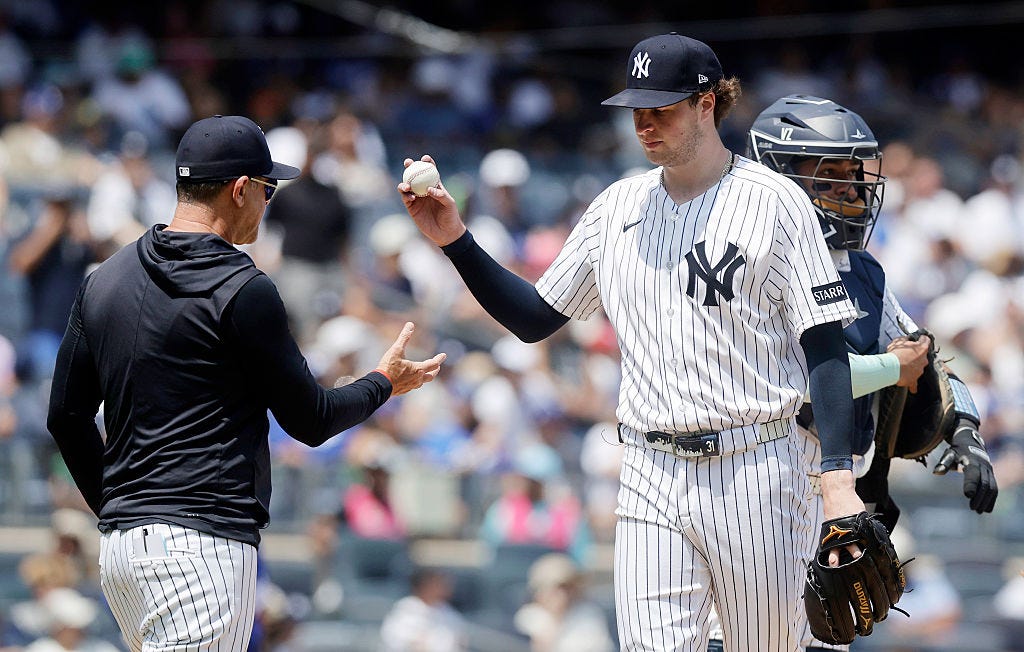
And I actually came up with a way: You would not use relief pitchers.
That’s the whole thing. You would let your starter go all nine innings, no matter how he was pitching, no matter how many pitches he had to throw. This way, you would see pitchers trying to get batters out without their best stuff. This way, batters wouldn’t face 100 mph fastballs in every at-bat. This way, the game would have a dramatic arc that flowed from the first inning to the last.
Teams would never ever do this because, yes, pitching has become much too dangerous. No team would ever dare let their best pitcher throw 140 or 150 pitches or anything like that, especially in a game that didn’t determine the team’s fate. Side effects for throwing that many pitches could include nausea, vomiting, diarrhea, exploding elbows, dislocated shoulders, and long rehab assignments to the Lehigh Valley.
I can’t think of another position in any other sport where simply doing your job is so scary and treacherous. Mbappé is one of the greatest soccer players ever, but he played all ninety minutes of the Third-Place game even though it was in Miami and it was a bajillion degrees with 294% humidity. Is there a risk of injury? Always. But the risk is not the main thing.
Look, it’s risky for a quarterback to play an NFL game because there are monster trucks in full pads trying to run him over on every play; but nobody thinks a quarterback will get hurt simply by THROWING too much. Nobody thinks an NBA player will get hurt by SHOOTING too much. Nobody thinks a hockey player will get hurt by taking too many slap shots. Nobody thinks a tennis player will get hurt by serving too hard and too often.
No, it’s only baseball that features horror movie risk on every pitch … and because of that, baseball is not free to make the game as fun as it could be. You saw the All-Star Game. You saw how fun it was (or not fun it was) to watch an army of relatively obscure relief pitchers throw lightning bolts an inning at a time. Heck, most of the game’s best starting pitchers — Jacob Misiorowski, Cam Schlittler, Paul Skenes, Tarik Skubal, Shohei Ohtani, Max Fried, Sonny Gray, on and on — didn’t pitch because of the danger (or because they’re already hurt).
I sometimes wonder — heck, I’m wondering right now — what if MLB announced tomorrow that starting pitchers had to finish games. I don’t wonder about the chaos and carnage it would cause; I know all about that. No. I wonder: What would pitchers do? Would the starters pull back and throw at 80%? Could they do that? Would that make a difference as far as injuries go? Would the 100-mph relievers teach themselves how to stretch out now that their jobs were obsolete?
And would hitters go bananas? Would someone hit 75 home runs? Would someone hit .400? You probably saw the statistic that came out — James Wood has now faced quite a few more pitchers in his less-than-three-year career (477) than Ted Williams faced over his 19 years (447). He has also faced more pitchers than Babe Ruth faced in his whole career (456).
Do you know how many pitchers Ted Williams faced the year he hit .400? Seventy-four. He faced a pitcher named Johnny Gorsica twenty-four times. So far this season — and remember, we’re only in July — Wood has faced 228 pitchers, four times as many. He has not faced the same pitcher more than six times.
So while we talk about how pitchers are so much better than they’ve ever been, well, are they? Or do they just have very different jobs? Or both? Tarik Skubal’s stuff is otherworldly, and it’s laughable to put it up against the stuff of, say, Warren Spahn. But Warren Spahn also completed more games in the first three weeks of May 1949 than Skubal will in his entire baseball career (he’s still three complete games away).
Anyway, these were some of the absurd thoughts that ran through my absurd head while watching England and France play their glorious game. Even now, I’m not sure that they make any sense, but like an odd dream, they make perfect sense to me.
One other thought about how few pitchers Ted Williams faced in 1941: think of how much easier it must have been to be a fan back then. If you just discovered baseball on Opening Day and read the morning edition of the Boston Globe and listened to a few games (all taking place in the afternoon), how long would it take you to learn the starting lineup for your own team and the best pitchers on the other seven American League teams? Combine that fact with all the folks who tell stories about sneaking into the old ballparks without paying, you can understand why baseball was once the county's most popular sport. *You* can understand this, unless *you* own a baseball team, in which case you have no idea why anyone likes baseball and act accordingly.
I think about this a lot. Not complete games, maybe, but ways to make baseball more entertaining. To me, strikeouts and walks are boring, balls in play and fielders making plays and baserunners taking the extra base are what's fun. I think the best way to make baseball more interesting and fun is to lessen the number of pitchers a team can use. I just don't know how you do it in a way that is not heavy handed and not fraught with unintended consequences. But it would be better if pitchers had to throw enough innings so that they're not ALL throwing 95+ MPH seeds on every pitch. I've been watching baseball since the 60s, and the players are the most talented they've ever been but at the same time the game is a less enjoyable spectator sport than it's ever been. That shouldn't be.