

FIFTY SEASONS comes out on February 2, and we have two special preorder offers going — if you preorder from Rainy Day Books, you can get a signed book inscribed however you like. And if you preorder from anywhere, save your receipt — we’re going to be giving away a special FIFTY SEASONS package which will include the complete table of contents and one of the many chapters that were cut as the shape of the book changed.
And for the next three days, if you are a Barnes & Noble member, you can get 25% off your FIFTY SEASONS preorder. Just use the code PREORDER25 at checkout.

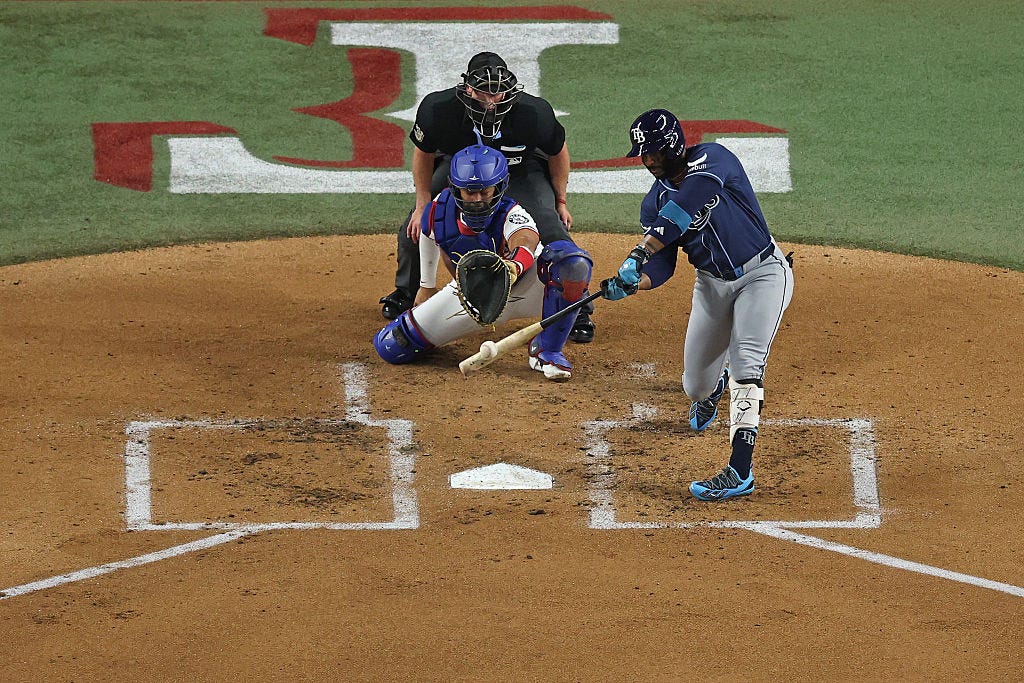
There are currently seven players in the major leagues hitting .300:
2026 batters who are hitting .300
Luis Arraez, Giants/Phillies, .316
Yordan Alvarez, Astros, .311
Chandler Simpson, Rays, .307
Yandy Diaz, Rays, .306
Nick Gonzalez, Pirates, .306
Otto Lopez, Marlins, .301
Gabriel Moreno, Diamondbacks, .300
That number seven matters to me because that’s exactly how many players hit .300 last year:
2025 batters who hit .300
Aaron Judge, Yankees, .331
Bo Bichette, Blue Jays, .311
Jacob Wilson, Athletics, .311
George Springer, Blue Jays, .309
Jeremy Peña, Astros, .304
Trea Turner, Phillies, .304
Yandy Diaz, Rays, .300
Yep, Trea Turner was the only player in the National League to hit .300 last year.
Seven is also the number of .300 batters in 2024.
2024 batters who hit .300
Bobby Witt Jr., .332
Vladimir Guerrero Jr., .323
Aaron Judge, .322
Luis Arraez, .314
Shohei Ohtani, .310
Yordan Alvarez, .308
Marcell Ozuna, .302
Seven batters hitting .300 is not quite the all-time low — that would be 1968, the year of the pitcher, when only six players hit .300 — but it’s all the way down there, and it’s now becoming an annual thing. And it bums me out.
We have talked a lot here about the limited value — Tom Tango would say non-value — of batting average as an analytical tool. We all know by now that batting average is a mishmash of old-timey and outdated baseball judgments. Walks are to be ignored. Errors should be counted as outs. Sacrifices should not be counted as outs. All hits are the same. All that stuff. We have a hundred better ways of determining a player’s offensive value that are exponentially better than batting average.
But …
In my original version of FIFTY SEASONS, I wrote a chapter I really liked about the invention of batting average. I had to cut it, alas, because it didn’t quite fit in with the new concept. Maybe that will be the chapter I include in our preorder campaign. The invention of batting average more than a century ago was a major breakthrough — with a very surprising hero.
And batting average swept the American sports landscape like no statistic before or since. Bill James, in a famous essay, wrote about how “baseball statistics, unlike the statistics in any other area, have acquired the power of language.” I’d argue that batting average was the first statistic to acquire that power. A .300 batting average came to have its own meaning in the same way that “kayfabe” or “bathos” or “sarcasm” has its own meaning. A .400 batting average meant something else. A .200 batting average meant yet another thing.
But the power of batting average went beyond the round numbers — I imagine that there are dozens of three-digit batting averages I can shout out that will, for many of you, bring to mind a player and a time and a feeling. If I shouted out .388 or .366 or .301, you would probably think of someone.
I can’t see the number .279 — the plainest of batting averages — without thinking about Rusty Staub. He feels to me like the human form of .279. Maybe you think of Chris Chambliss or Buddy Bell or Bobby Bonilla.
In the newspapers, teams were listed in the order of batting average, not the order of how many runs they scored. On the radio, on television, we were introduced to players by their batting averages. Hi everybody. Meet Jay Buhner. He’s hitting .271! The player with the highest average was crowned the batting champion, a most regal title. And of course, batting average was used constantly outside of baseball. Politicians would talk about their batting averages. Lawyers and surgeons and salespeople would talk about their batting averages. I remember once, many years ago, taking my busted-up car to an auto mechanic who said he couldn’t guarantee that he could fix it … “but,” he added humbly, “I have a pretty high batting average.”
The point is that batting average was everywhere. It was in the air. And, yes, of course, much of it was silly and misguided.
So was the song “Come on Eileen.” I still dance when I hear it.
And I mourn the .300 hitter. Does the fact that PCA is hitting .281 in any way diminish the preposterously wonderful season he’s having? Of course not. But I wish he was hitting .300. I wish Shohei was hitting .300. I wish Bobby Witt Jr. was hitting .300. That round number just looks better by their names. I hear the argument from batting average enthusiasts that while batting averages may not be great analytical tools for teams looking to increase run production, they do speak directly to the fun of baseball — a single being more fun than a walk and all that. Maybe there’s something to that. Maybe there isn’t.
What I do know is that for me it’s a bummer to look at the leaderboard and not see a single player batting .320.
It’s a bummer for me to look at the Cubs, the highest-scoring team in baseball, and not see one regular hitting anywhere close to .300 (PCA leads the regulars at .281).
The Dodgers are the most expensive collection of players ever assembled, and they don’t have a single .300 hitter (though Freddie Freeman is hitting .297 — there’s a chance there).
Aaron Judge has been hurt, yes, but the regular (more than 30 games played) with the highest batting average on the New York Yankees at the moment — bleepin’ Murderer’s Row and all that — is Cody Bellinger. He’s hitting .264.
And here’s where we are. We might get more than seven .300 hitters this year — there are a couple of guys hovering in the high .290s. We also might get fewer than seven — Gabriel Moreno and Otto Lopez are barely hanging on.
It should be easy enough to let go of batting average for all the reasons we talk about and just accept that we have better stats, and baseball is played differently now, and batting average is so flawed, and pitchers all throw 100 with exploding sliders and demon sweepers. Strikeouts are inevitable. Defenses are better positioned — you can’t hit em where they ain’t when they’re everywhere.
And the one guy who defies the time by putting the ball in play and never striking out, Luis Arraez, is playing on his fifth team since 2022 because nobody has any idea what his batting average is even worth.
I know all this.
But there’s a part of me that can’t let go, won’t let go.
Too-rah-loo-ra
Too-rah-loo-rye-ayyy
And we can sing just like our fathers.
Come on Eileen.
While I think Tom Tango, et al., might argue that batting average is a poor analytical tool for baseball performance (and probably be right), it does strike me as an exceptional analytical tool for baseball entertainment. Sure, all hits aren't created equal, but as a fan (especially if I'm watching a game I don't have a clear rooting interest in), hits are the functional equivalent of dialog that drives the plot forward. They create dramatic tension to have a runner on first, or second, or third. The home run is a fun spectacle, but low-BA, high-SLG baseball sometimes feels more like watching roulette or craps. On a related note, it would be fun to see a JoeBlogs post on the stats that best reflect the entertainment value of baseball...
Hits are fun; walks are almost always boring.
It would be as if analysts decided that the best way to win an NBA game was to get fouled as much as possible and shoot 50 free throws each night. And then, suddenly, we'd wake up one morning to find that half of all the scoring in basketball was taking place at the charity stripe (do they still call it that or am I channeling Chick Hearn from about 1971?). And field goal percentages were dropping into the low 30s. Bo-ring.
But you know something? If that happened, the NBA would do something about it.