


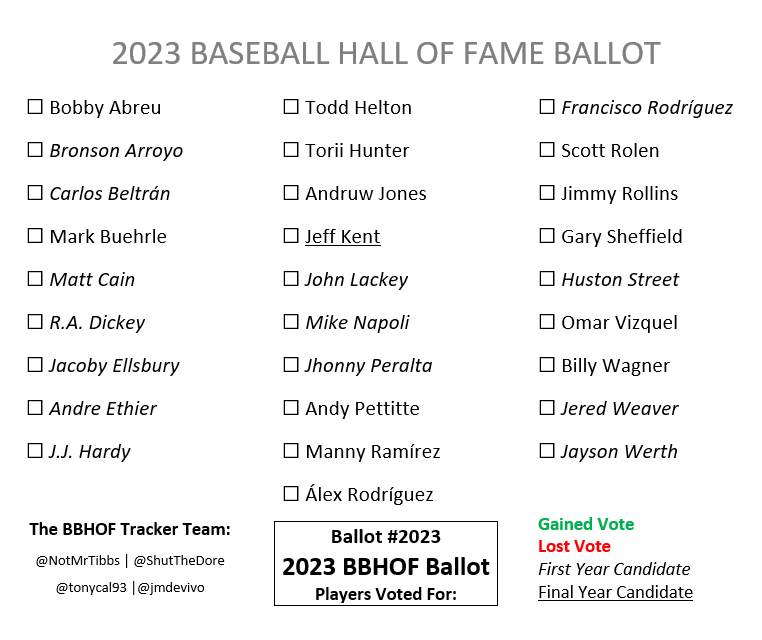
OK, before we get into the new year and start breaking down the Baseball Hall of Fame ballot player by player, I want to talk about this ballot for a minute, because it’s been a very strange voting experience this year.
I’ve been thinking a lot about this: What does the Hall of Fame want (and not want)?
By “Hall of Fame,” I could obviously mean a lot of things. I could mean the Hall of Fame staff. I could mean the Hall of Fame board. I could mean the Hall of Fame players. I could mean people who pay to be Hall of Fame members; I’m one of those.
I guess by “Hall of Fame,” I mean all of them — the people who run the Hall, as well as the people who have been elected to the Hall, plus the Hall’s staunchest supporters.
What, generally, do they want and not want? Obviously, I’m trying to read the clues, but it seems to me that:
— They generally want good and popular players like Fred McGriff to be elected. Crime Dog was elected UNANIMOUSLY this year by a Hall of Fame committee. That was a bold statement and, frankly, a rebuke of the baseball writers, who voted on his worth for 10 years and never gave him even 40% of the vote.
— They generally don’t want obvious PED users elected, no matter how good they might have been as players. End of story. The argument that there are already steroid users and amphetamine users and other drug abusers and various sorts of cheaters and miscreants in the Hall of Fame is viewed as entirely beside the point. The PED users did not act admirably. And they are, in the eyes of the Hall, unworthy of induction.
— They generally don’t want the Hall of Fame to come down to advanced numbers like WAR or FIP or anything else that wasn’t on the back of a 1977 Topps baseball card. In the last few years, the players the committees have put into the Hall of Fame have mostly fallen short in the WAR column, but they had a lot of wins (Jim Kaat and Jack Morris), a high batting average (Tony Oliva), a lot of hits (Harold Baines and Ted Simmons) and a lot of saves (Lee Smith). The most nuanced modern player the committees elected was probably Alan Trammell, who does have 70 WAR and was a big miss by the BBWAA. They’ve, so far, ignored other top WAR candidates such as Lou Whitaker and Dwight Evans.
— They generally want the BBWAA to err on the side of voting players in rather than keeping players out (unless they are PED-stained). There’s a very good chance — in fact, I think it’s by far the most likely scenario — that the writers vote in zero people off this year’s ballot. I feel 100 percent confident in saying that the Hall of Fame HATES that. The Hall needs new players to give it life and vibrancy and urgency. An induction day without a single BBWAA inductee puts a giant hole in the Hall of Fame’s heart.

You know we’re always going to be talking a lot about the Hall of Fame here at JoeBlogs — among many other things — and I’d love for you to be a part of all that. So I’m having a year-end blowout sale! Subscribe by Jan. 1, and you’ll get 20% off the annual subscription price.
Joe

Many years ago, I asked Bill James what his philosophy would be if he were a Hall of Fame voter*, and he told me that he would vote for the maximum number of players every year. Why? Because, he said, the Hall of Fame voting is WAY too restrictive, and that has led to stagnation and absurdity. We saw that with the Fred McGriff voting. We’re seeing it now with, say, the Scott Rolen voting. We damn well know the BBWAA will vote in Scott Rolen before it’s all said and done, so why wait?
For that matter, I feel 97.7% confident in saying that when Jeff Kent comes up on the Today’s Era veterans ballot in three years, he will get elected. The guy’s got the most home runs for any second baseman ever. So why wait?
*And how ridiculous is it that Bill James has never voted for the Hall of Fame?
Andy Pettitte has 256 wins, and everybody seems to have totally forgiven him for whatever PED offenses he committed. I’ll bet he gets elected to the Hall of Fame by a committee eventually. So why wait?
And let me make it clear: I’m asking MYSELF the question, “Why wait?” Because I didn’t vote for most of these guys. Up until this year, I didn’t vote for McGriff or Kent or Pettitte or Morris or Lee Smith. What I did was draw a line where my personal Hall of Fame would be, and if a player was below that line, I didn’t vote for them.
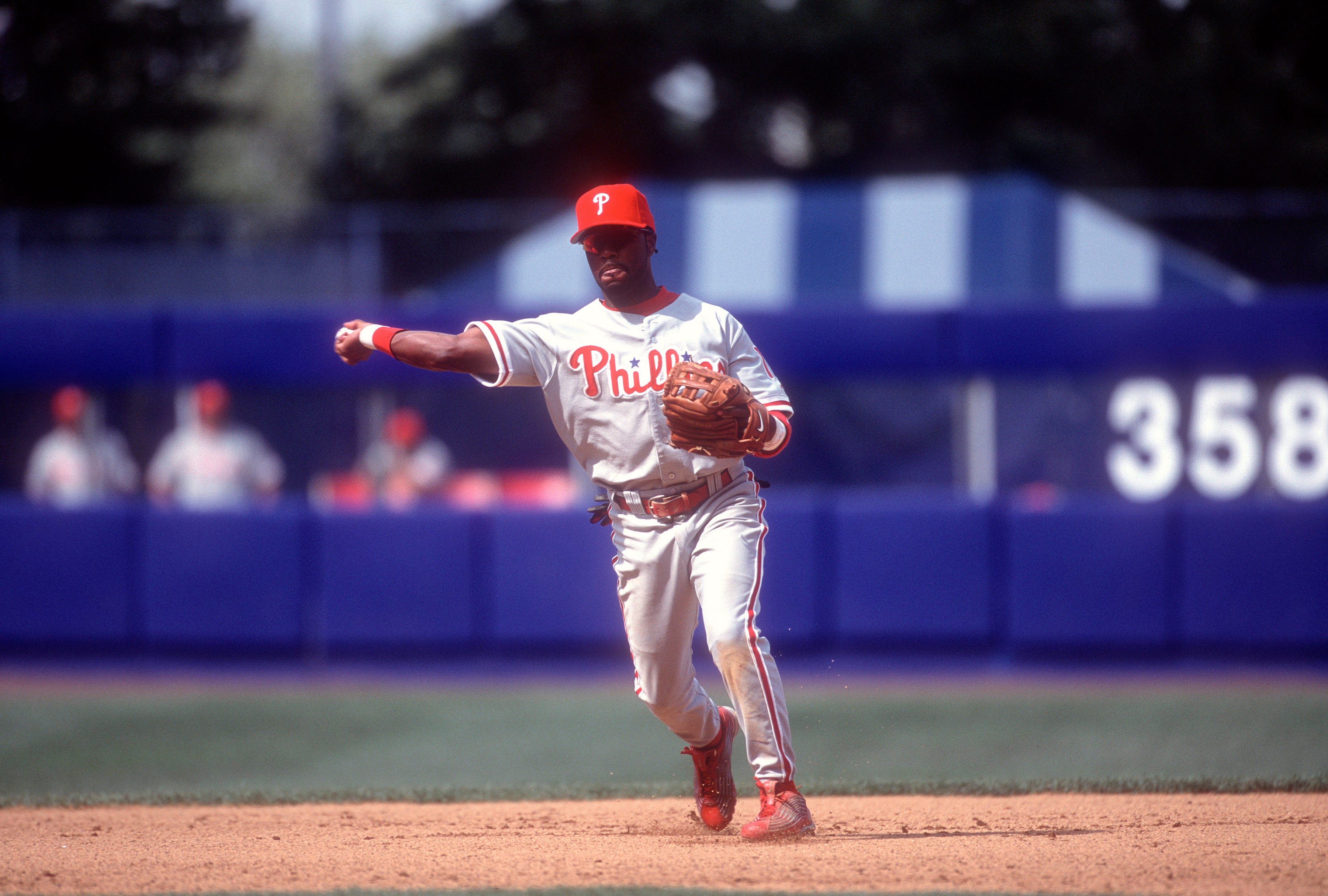
But — and this is what I’ve been thinking about — maybe I’ve been doing it wrong. Take a guy on this year’s ballot: Jimmy Rollins. Rollins is below my imaginary line. He’s not far below, but with 47.6 WAR and 40.1 JAWS and a 95 OPS+, along with various other stats, he’s just not quite there. By my measurements, I have him below numerous infielders who are not in the Hall of Fame, such as Whitaker and Bobby Grich and Graig Nettles and Ken Boyer and even his old teammate Chase Utley.
Is that the right way to look at it? I’m just not sure. Because Jimmy Rollins did everything well, he hit and had some power, he stole bases and he won Gold Gloves. He was an MVP. He was a leader. He has almost 2,500 hits. He was a credit to the game. From the cues the Hall of Fame has given, Jimmy Rollins is EXACTLY the kind of guy they want to be elected.
Knowing that, should I vote yes on him even if he’s below my line?
Should I change my line and be more inclusive in order to be in coordination with the Hall of Fame’s wishes?
Or is it my responsibility to simply vote based on my own personal Hall of Fame criteria, and let the chips fall?
These are the questions I’ve been asking myself over the last few weeks. I imagine you have some thoughts of your own.

There's a problem with using WAR to evaluate the career of player from another era for Hall worthiness. WAR takes the modern understanding of value and applies it to the way the game was played previously, which doesn't always comport to the way that managers utilized their players and players were taught to play. The legends still shine, but it breaks down at the Hall of Very Good and Hall of Great levels.
In addition, the defensive component of WAR is so speculative when retrofitted to prior eras. And Bill James himself has been an outspoken critic of the fact that WAR does not do anywhere near a good enough job adjusting for differences between eras, including styles of play.
WAR is great for comparing two players of the same era. It is really, really, problematic for comparing players across eras. I'm not aware of a regression analysis on WAR that goes back before 1996. But at a common sense level, it makes zero sense from a statistical level that the positional adjustments are the same in the "shift era" as in the "pre-shift era."
If the baseball-analytics community continued to pursue advancement with the same rigor they did before their methods were the dominant paradigm, we'd see experts continue to test and refine and improve, and challenge and revalidate. Sadly, that is not happening.
Do not lower your standards. Follow your own criteria.
Based on reading your writing, you know more than most of the voters out there.