


As many of you probably know, The Baseball 100 was published on Tuesday. I was going to give you a little play-by-play of the day here since the journey to publication began here, a decade ago, when I woke up one morning, put together some long-forgotten baseball stats formula, and thought: “Huh, I like this list. I should count down the 100 greatest baseball players ever.”
That list died at No. 30. The next list died sooner. The project then was too vast. It was too muddled. I didn’t really know WHY I was doing it — I am hardly the first person to come up with the idea of counting down the 100 greatest players ever in any sport. What was my purpose?
It wasn’t until 18 or so months ago that I figured out my purpose: I wanted to tell a baseball story. My baseball story. Why I love this game. Why so many of us love this game. It would be about the 100 greatest players, yes, but even more it would be about fathers and sons, about the pain and triumph of integration, about hats flying off and called home runs and headfirst slides and cutters that smash bats into smithereens.
It would be about the word smithereens, so perfect, so underused.
Anyway, back to the point, I was going to give you some thoughts on launch day.
But then … launch day went wild and I found myself unable to even keep up.
The book — I can’t even believe I’m saying this — became an actual phenomenon.
I don’t know exactly how a nearly 900-page, 300,000-word, $40 book about baseball becomes a phenomenon. No idea. The New York Times hasn’t reviewed it. The book wasn’t featured on NPR. They didn’t talk about it for 15 minutes on “Meet the Press.” I haven’t been on any of the late-night talk shows. None of the massive book promotions that tend to go along with bestsellers have been done with this book.
So how does this happen?
It’s a question I was asked dozens of times on Tuesday by many different kinds of people. I have a few theories, but, in the end, I don’t know … and I don’t need to know. I’m just blown away by it all.
The book broke all sorts of presale records at Rainy Day Books in Kansas City. I guess that could be explained somewhat by the fact that we did a special signing promotion with Rainy Day. But the numbers are still mind-blowing. They have an entire basement filled with these gigantic Baseball 100 books that they have to ship all over the country (and if you are one of those who ordered, please be patient with them; this is a small operation working countless hours to make this happen).
Then, on Tuesday, the book went to No. 4 on Amazon. That’s an absurdity. There are like 57 million books on Amazon. Any author who closely watches the Amazon numbers — and that would include ALL authors — knows that the dream is to break into triple digits and then, if you’re super lucky, get into double digits. No. 4 is the slot for Harry Potter books, political tell-alls and John Grisham thrillers. It isn’t the place for a baseball book lauding the talents of Arky Vaughan.
The book went to No. 13 at Barnes & Noble, and there are some absolutely wonderful booksellers — like the amazing Eric in Midlothian, Texas — who have made it their PERSONAL MISSION to sell this book, like they wrote it themselves.
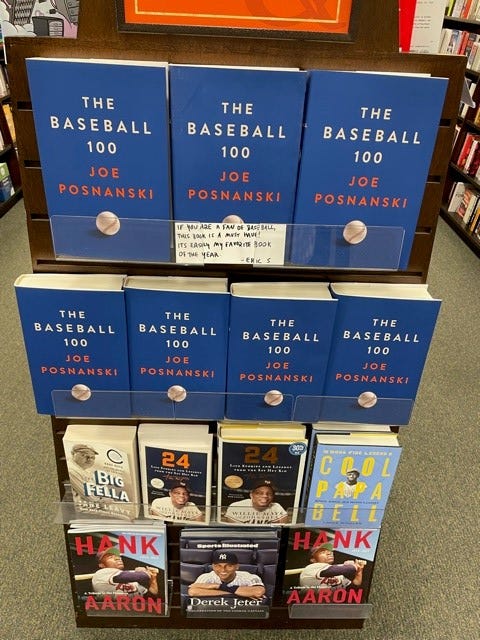
And the story goes on. Social media buzzes with people talking about the book. On “CBS Mornings,” Tony Dokoupil, who I don’t know, gave this book the most amazing endorsement I could ever imagine (he even emailed me to apologize about mispronouncing my name which I’m like — um, Tony, call me whatever you want):
“It’s a book, when you read it, you fall in love with the game all over again.”
Um …
This book has had some kind of magic hovering over it every step of the way. You might know that George Will wrote the introduction, which was exceedingly kind of him. What you might not know is that three or four times while the series ran, he wrote emails to me — and I did not know George Will, had never met him, still have never met him in person — even DEMANDING that I make the Baseball 100 into a book, telling me he would do whatever he had to do to make it a book (including, obviously, writing the introduction).
What you might not know is that along the way I’ve heard from so many people, in and out of baseball, who have told me the most beautiful stories about The Baseball 100, reading it to their parents in hospitals, reading it to their children at bedtime. I heard from one person who said that he reconnected with his brother after many years because of The Baseball 100. I heard from another who said she and her father, who could never find anything to talk about, would talk about The Baseball 100 for hours.
Just last night, I went to see my friend and hero Jason Kander play in his over-30 baseball league for a few minutes, and someone on the other team came over just to say that he’d gotten the book … and his 13-year-old son had taken it away and is now 17 players in.
And we are only on Day 2 of the book’s life.
I think you probably know me well enough to know: This is all I’ve ever wanted, to write words that are meaningful to people. Who knows, right? The Baseball 100 phenomenon could totally die today, and life could return to normal, and you know what? That would be absolutely fine. I never expected to have even one day like that.

Well, I will tell you — life won’t go back to normal today. Because today, 7 p.m. Central, I’ll be doing a live event (!) with Bill James (!) at Unity Temple on the Plaza in Kansas City. If you’re in the Kansas City area, I hope to see you there. This will be really special; I’m not going to be able to do many live events because of, well, you know.
And if you’re not in the KC area, I do hope to have the conversation recorded, and I’ll put it up here as a podcast. We’ll find out if we can take care of the technical stuff.
Oh, and I will be doing some radio too. I’ll be on “The Dan Le Batard Show” at 10 a.m. Eastern. And I’m joining my good friends Baskin & Phelps in Cleveland at 1:20 p.m. Eastern, though I imagine we’ll end up talking at least as much Browns as Baseball 100.

Hey Joe. Congratulations on what seems to be a resounding success. And congratulations to all the readers who will experience the joy of reading these stories again or for the first time. I just got my preorder from Powell’s books here in Portland.
I was one of those who read the entries on both your first attempt - you made 69 entries- and your second attempt - you got thru 35 that time around. Plus your corresponding “Shadow Ball” entries.
As the third, final, and official series counted down on The Athletic I made an excel spreadsheet that compared Joe’s three lists. Posted the results under the comments for TY Cobb I believe.
Readers, these first two attempts by Joe had a total of 104 stories not included in his final Baseball 100 at The Athletic. Most of these were for the same players as in the final version, but often the stories were different by a little - or a lot. Also there were 21 players who were on one- or both (e.g. Ron Santo was 78 on one, 98 on another, not on final list) of Joe’s first two lists but not on The Athletic list.
I’m pretty sure his second draft postings are here on his substack blog from his first time here. It may be a little difficult to search for them though. His first draft consisting of 69 stories I’m not sure where on the web they are. They preceded his substack days. Wondering if Joe- can someone at substack ask him- might create category folders for both of these first two drafts so that people can get more ‘Joe”. Maybe Joe can use this fact to market his blog here a little bit more?
Finally, all three versions not only had Joe’s stories, but of course many comments from the readers. Especially at the Athletic, where there was a big audience, there were hundreds, often over a 1,000 comments for each story. I spent so much time reading those comments. I can’t begin to estimate how many words those comments consisted of, but it would dwarf Joe’s masterpiece. Sure there were lots of - how shall I say it? - inane comments, but there were tons of fun, thoughtful observations and analyses. For those who still have a subscription to The Athletic- I went there for Joe, but decided to stay on - reading the comments was mostly a joy, just a little less than reading Joe’s stories. During the dark days of the pandemic when most things were shut down, the back and forth between regular commenters was like a social lifesaver.
There were many wonderful participants, two I remember most as having especially insightful comments were Nik K - a combination of Shakespeare and Bob Hope- and John A who volunteered such wonderful analysis and stats and subsequent reader discussions- all inspired by Joe’s original stories.
I had hoped that Joe could publish an addendum to his baseball 100 of all the comments. But rather than being an appendix it would be more like an encyclopedia set. And probably legally not possible. But I suggest that you all share the existence of these online comments - and extra stories- with those who are only reading the hardback version.
Have a good day all.
I don't know. Maybe part of it is that you started it and didn't finish it a few times. Lots of loyal readers were willing to read about some of the same players multiple times while you tinkered. You knew people were still interested based on the comments. You had data analysts and mini-feuds and inside jokes. They followed you from SI to Sports on Earth to NBC to Hogwarts and New Jersey and then the Athletic. I can't be the only one who went to the Athletic just for the Baseball 100. Those people, including me, forwarded meaningful players to friends and family. They begged for a book so they could have this list in their hands and could give it as a meaningful gift. They spent more on the book and shipping to support a bookstore they may never visit just to get you to write more. We kind of know you, Joe. Of course you are surprised. But none of this is surprising.