

Bill James talks all the time about something universal and eternal about baseball: We always think we know more about the game than we do. This is because we always think we know more about the world than we do, about the universe than we do, about OURSELVES than we do. That’s the human experience. We are adrift in a black sea of ignorance, and we are carrying handheld flashlights.
The funny part of this in baseball is that our confidence never falters.
Baseball fans in the 1970s and 1980s and into the 1990s were SURE that the game was 90% pitching, that batting average was the key statistic, that RBI men were of greater value than those who walked, that batters who struck out too much hurt the ballclub, that speed could kill, and that it was worth an out to move a runner from first to second base.
Oh, we scoff at those fans now — even if we were those fans at some point.
Well, we were young. We were foolish. We didn’t know.
On-base percentage, not batting average, is what matters, we learned. You really don’t want to make outs by being too aggressive on the bases, we learned, and you certainly don’t want to give up outs. Pitchers do not control nearly as much as we had thought. The RBI is a wildly overrated individual statistic because it’s context-driven. And so on.
And then we started getting more information, so much information, about bat speed and launch angles and barrels (the perfect blend of bat speed and launch angles) and spin rates and sprint speed and outs above average and so much else, and maybe we started to realize that, yes, we figured out baseball! Our little flashlights had become giant beam lights.
And we make the same mistake that we always make.
The black sea of ignorance is still overwhelming us.
Consider a baseball team. They are dead last in hard-hit percentage. Dead last. They are also, as you might expect, last in baseball in average exit velocity. They have hit many fewer barrels than any other team in the game. This is also team that doesn’t walk much. They are in the bottom three in home runs.
And they have more sacrifice hits than any other team in the game.
They’re actually trying to win in 2026 with stolen bases, bunts and bloops.
This team stinks, right?
Well, wait, I should also tell you they are not a particularly good defensive team, minus-10 outs against average, not quite at the very bottom, but in the bottom third.
And their pitching? Meh. Bottom third in the league in expected batting average and expected slugging percentage against. Their ace starter is a 35-year-old journeyman who spent his prime years pitching in Japan. Their closer is a 31-year-old reliever on his third team who was never a closer before.
This team REALLY stinks, right?
This must be the Colorado Rockies? The Los Angeles Angels? The 1962 Mets?
Yeah, these are the Tampa Bay Rays.
And they have the best record in the American League.
For almost 20 years now, the Rays have confounded expectations by more or less doing the George Costanza, which is to say doing the opposite of what everybody else is doing. It’s not quite that straightforward, but close enough. And they remind us that we still don’t know diddly about this wonderful, expansive and unknowable game.
Sure, it’s still early in the season, and yes, they might fade — they are 9-1 in one-run games, and we all know how hard it is to keep up that sort of pace — but in a moment when teams pray at the altar of exit velocity, it’s utterly striking to see a team go in entirely the other direction. The Rays play more like the 1982 Cardinals than they do any modern team. They put the ball in play (the Rays have struck out way fewer times than any other team in the game) and their whole offensive strategy seems to be to get runners into scoring position and then knock hits to score those runs.
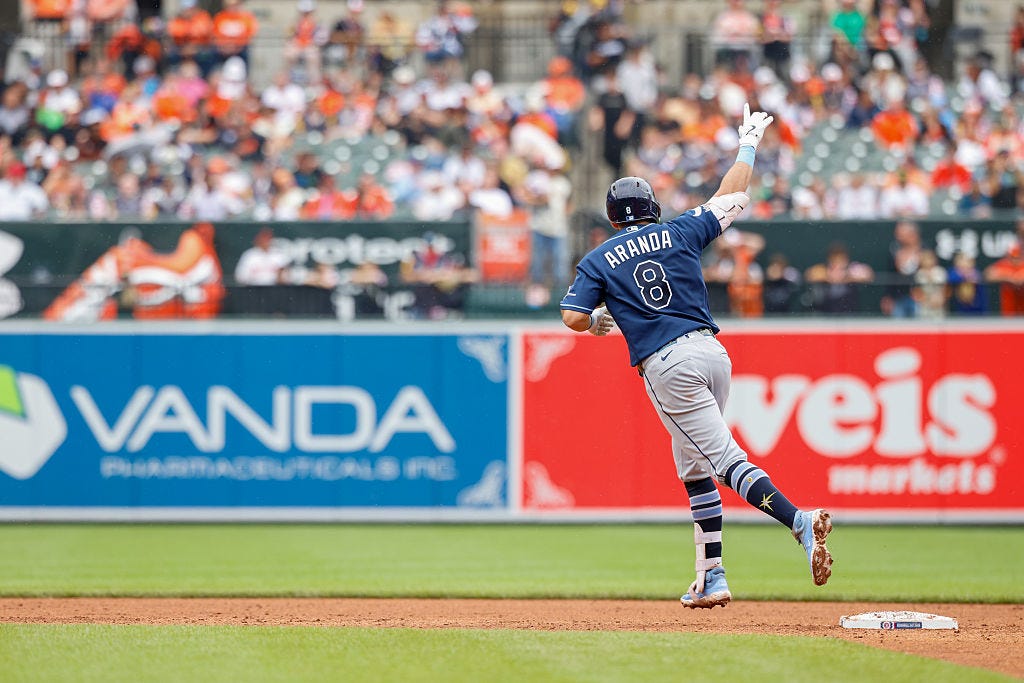
In this way, Jonathan Aranda is the perfect Tampa Bay Rays player. He leads the league in RBI in large part because he’s hitting .356 with runners in scoring position — but here’s the fascinating part. He has exactly ZERO home runs with runners in scoring position. All seven of his home runs have come with nobody on base.
It looks like Jonathan Aranda is, um, purposely trying NOT to hit home runs in clutch situations.
It looks that way because, best I can tell, he IS purposely not trying to hit home runs in clutch situations. The whole team is like that. As a team, they’ve only hit eight home runs with runners in scoring position. But they are hitting .285 in those situations, the best average in the league.
It sure seems like the Rays are doing EVERYTHING wrong.
And yet, they’re somehow scoring enough runs to win games.
Again, this all may fade. But it’s worth remembering that we probably don’t have baseball figured out, that 25 years from now we might look back and laugh at the idea that anyone ever thought launch angles and swinging for the fences and playing station to station baseball was the way to win. That’s the beautiful thing about baseball. We’ll never figure it out.
I’ve written often about my dear friend Dan McGinn, the smartest guy I know and my partner on some incredible projects like Tip Your Cap and Honor Your Hometown. Well, Dan has quietly been one of America’s leading crisis counselors over the last 40 years — quietly is the key word; he’s very carefully stayed out of the limelight. Well, he just gave a wonderful interview to Malcolm Gladwell on trust, and he talked more about how he went about his work than he ever has before. I give this my highest recommendation. You’ll feel a lot smarter after the next 40 or so minutes (or less if you listen at faster speeds):
I agree that the Rays can be confounding, but I don't feel like their success is QUITE as mysterious as Joe makes it sound. The clue is near the top of his article, when he says we learned OBP is more important than batting average. And the Rays are the best team in the league in on-base percentage. This is where the Whiteyball Cardinals comparison is instructive. Yes, the Cards played 'small ball' and didn't hit homers and all that, but when they were good it's because they got on base; when they weren't good, it's because they didn't. (Just look at their league rank in OBP in their 3 playoff years: 1st, 1st, 1st.) Yes, those Cards also had much better gloves than these Rays, but otherwise the formula is not terribly complicated: OBP is life.
The Rays are a great example of the value in just trying to be a decent team every year. If you're a smart organization, I believe it's not *that* hard to win 77-80 games. And if you shoot for that mark, you're going to have years where enough guys overachieve that you end up winning a lot more than that, while also putting yourself in position to add more talent along the way.
Too many other teams with limited financial resources get stuck in perpetual rebuilds.