


Tim McCarver at age 25 had an absolutely fantastic season. This was 1967. He hit .295/.369/.452, with 26 doubles, 14 homers, he struck out just 32 times and he played fantastic defense behind the plate, throwing out 55% of the baserunners who tried to steal off his pitchers and brilliantly handling a pitching staff with titans Bob Gibson and Steve Carlton and a 29-year-old rookie named Dick Hughes.
“Oh,” Gibson would remember “he could call a game.”
The Cardinals won the World Series. McCarver finished second in the MVP voting. He looked at that moment to be one of the bright stars in baseball and perhaps even a baseball legend.
“The kid,” four-time World Series champion Wally Schang said, “reminds me of Mickey Cochrane.”
As a player, alas, it wasn’t meant to be. That was his last great season. McCarver kicked around the big leagues for another 13 seasons — well, parts of 13 seasons —and he had his good moments, particularly as Gibson’s and Carlton’s personal catcher, but he settled in as a backup and a good teammate.
And then he became a baseball legend.
When I heard on Thursday that McCarver had died, I reached out to some friends to ask what he meant to them. For people my age, Vin Scully was the poet, Jack Buck and Harry Caray were the heart, Bob Costas was the history, Joe Garagiola and Bob Uecker were the laughter, Tony Kubek was the friend.
And McCarver was the teacher.
“I learned 33.3% of my baseball from him,” my friend Mike Vaccaro texted me. “I learned 33.3% from Buck Showalter his first year as the Yankees manager. And I learned 33.3% from my father.”
Funny thing, McCarver came up at a time when Howard Cosell was furiously railing against what he called the jockocracy — the hiring of former players instead of journalists as announcers.
“I have kids all over the country writing me hundreds — maybe thousands — of letters a year,” he said. “‘How can I get into your field?’ they ask. What do I tell them? Become a guttural illiterate and throw a football or throw a baseball? That’s what it’s come down to.”
Cosell was rude and self-serving, but that doesn’t mean he was entirely wrong. The exclusive hiring of former players to be in booths across all sports for approaching a half-century has peppered our games with a lot of cliches, a lot of one-note analysis, a lot of low-energy reliance on “when I was playing” stories, and a lot of sameness.
I think it comes down to this: Everybody hires former players — the more famous the better — in the hope that they can take us fans inside the game. And while there will be some exceptions, the results usually will be disappointing because it takes so much more than big-game experience to bring people inside.
What does it take? Right: It takes insight and perspective and curiosity and storytelling talents and a generosity of spirit. There have been many, many Tim McCarver wannabes. But there was only one Tim McCarver for those reasons.
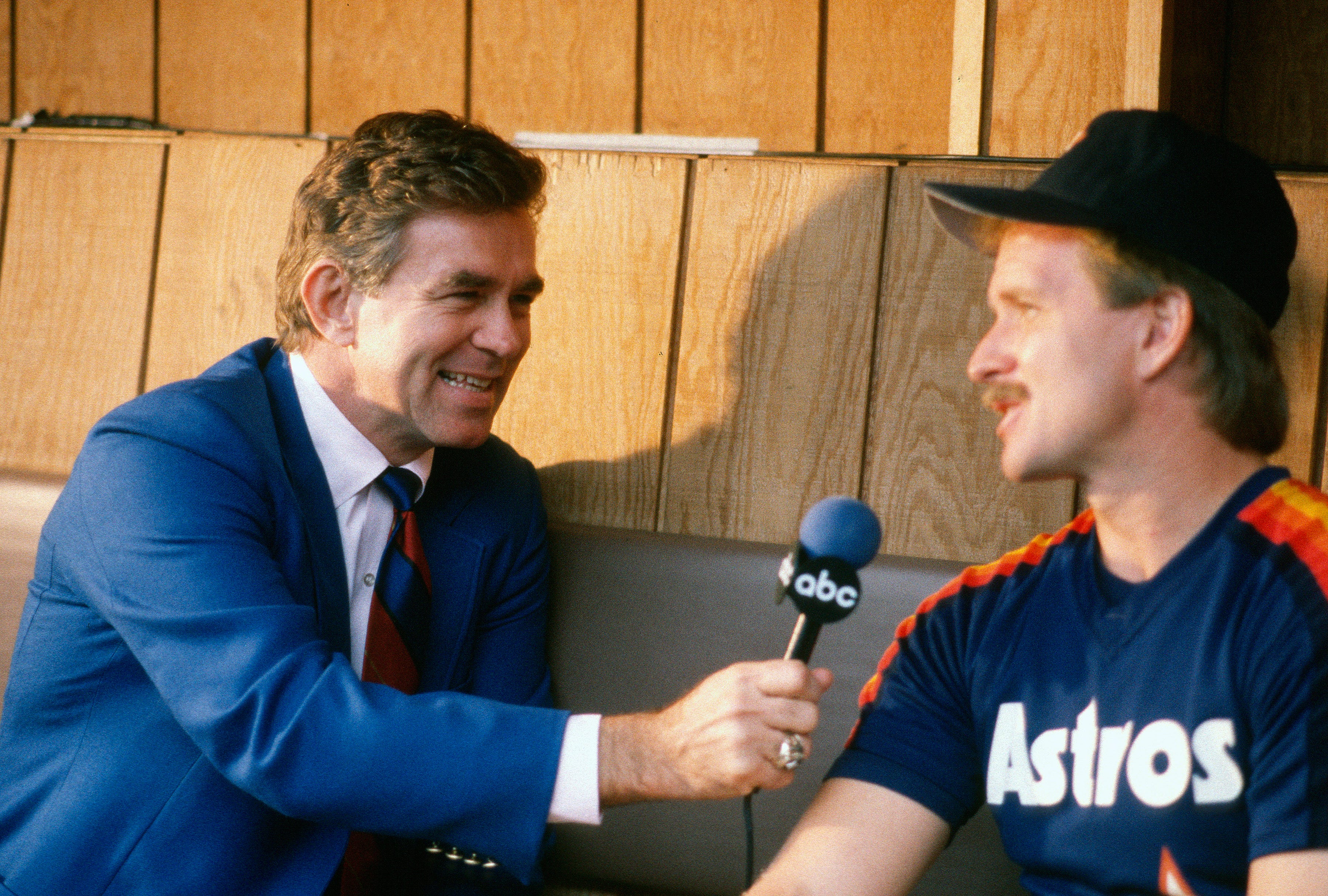
He was funny, too — I loved his story about going to the mound to talk to Bob Gibson (“He said to me, ‘get back behind the plate, the only thing you know about pitching is you can’t hit it”) and his insightful line “speed, ironically, slows down the game,” and how he would call Dwight Gooden’s fastball “Lord Charles,” because it was too regal to be called “Uncle Charlie,” like other curveballs.
“Have you ever watched his call of the Luis Gonzalez at-bat?” a friend asked me. I had not. I was at that game — Game 7 of the 2001 World Series — and while I certainly have seen the highlight of Luis Gonzalez against Mariano Rivera before, I had never before listened to Tim McCarver’s call.
Here’s what he said while Gonzalez dug into the box and Rivera took the ball and readied for the next pitch. Just as a reminder: The bases were loaded. There was one out. The score was tied 2-2.
Take it, Timmy:
“The one problem is Rivera throws inside to lefthanders, so lefthanders get a lot of broken bat hits into shallow outfield … the shallow part of the outfield. That’s the danger of bringing the infield in with a guy like Rivera on the mound.”
On the next pitch, Luis Gonzalez hit a broken bat single over the drawn-in infield. The ball landed in the shallow outfield.
Incredible. That might have been the greatest broadcasting prophecy in any sport.
And, funny, you never really hear people talk about it. Tony Romo predicts a screen play correctly and people are ready to give him the Nobel Prize. McCarver perfectly called one of the most iconic hits in baseball history before it happened and … nothing.
I suppose that’s because McCarver was just around for so long. The color commentator game is not built to last; eventually, even the best of the best like McCarver start to repeat themselves, lose touch with the younger players, stubbornly cling to the way things used to be. By the end, sure, McCarver could be a hard listen.
Then again, by the end, so could the Rolling Stones.
I like what Gary Cohen says about McCarver: “He simply revolutionized what it meant to be a color analyst on a major league sports broadcast, really baseball or any other sport. … He was able to see things, he was a great observer, and he was able to relate those things to non-baseball people in a way that allowed us to better enjoy the games.”
Yes. I want to go back to three words I used earlier: “Generosity of spirit.” Of course, Tim McCarver loved baseball. That’s a given and it’s true for many, many athletes.
But what isn’t nearly as common is this: He deeply wanted to share that love of baseball with us. He wanted to unwrap the game for us, explain to us the relationship between the pitcher and catcher, describe to us the back-and-forth mind games and reveal to us the complexities that we were not seeing. He didn’t want there to be any secrets. He wanted everyone to be able to see the full-color beauty of baseball.

Roger Angell (another great recent loss) wrote a really wonderful appreciation of McCarver entitled “The Bard in the Booth.” Well worth searching out.
I feel like I’ve attended a wake where 90% of the people cried and were telling great stories about the departed while the other 10% loudly complained that he couldn’t speak French or that his lawn looked terrible.
I enjoyed Mr. McCarver’s work and, like many others, feel like I learned a lot from him, even though I was an expert based on my considerable experience as the worst player on my Little League team. He was a terrific analyst and will be missed.