

One of the things about sports that blows my mind in the most wonderful way is that, every now and again, a person will come along who is just better than everyone else. I think, for example, about Jannik Sinner. I recently saw an interview with comedian Michael Costa, a former professional tennis player who topped out at No. 864 in the world. What he said to the host, essentially, was: “I’m a better tennis player than anyone you know.” He didn’t say it in a bragging way at all, just matter-of-fact.
And he’s 100 percent right. Unless you happen to be friends with, say, Pete Sampras or Rafa Nadal, Michael Costa is better than anyone you know. The tennis pro I hit with every week, Bobby, is a fantastic player (and a high-level ironman competitor) capable of hitting the line on any and every lob he hits, capable of blasting a forehand or backhand so deep on each shot that all I can do is (sometimes) chip the ball back.
Michael Costa is WAY better than Bobby. Like he’s in another world.
And he topped out at EIGHT HUNDRED SIXTY FOUR in the world.
That’s how good these top tennis players are — then, when you get into the top 500, the top 250, the top 100, the top 50, I mean, these players are so good that the mind can barely even comprehend it, and then when you get into the Top 25 or the Top 10, it doesn’t even make sense.
Then you see that Jannik Sinnner has won 31 consecutive Masters 1000 matches? He’s won five straight Masters 1000 tournaments (a record) and seems well on his way to winning in Rome. He has lost TWO SETS during the streak, both in tiebreakers, both early in the tournament when he was still getting his bearings.
It’s lunacy. Yes, it’s true that Carlos Alcaraz, the only player in Sinner’s universe, has been hurt, but Sinner did beat Alcaraz in April in Monte Carlo, and anyway, you have to play the players in front of you. Zverev is the No. 3 player in the world — Sinner beat him 6-0, 6-1 in Paris on hard courts, beat him 6-2, 6-4 on hard courts at Indian Wells, beat him 6-3, 7-6 on hard courts in Miami, beat him 6-1, 6-4 on clay in Monte Carlo, and beat him 6-1, 6-2 on clay in Madrid.
And it defies explanation how one player can be so much better than everyone else.
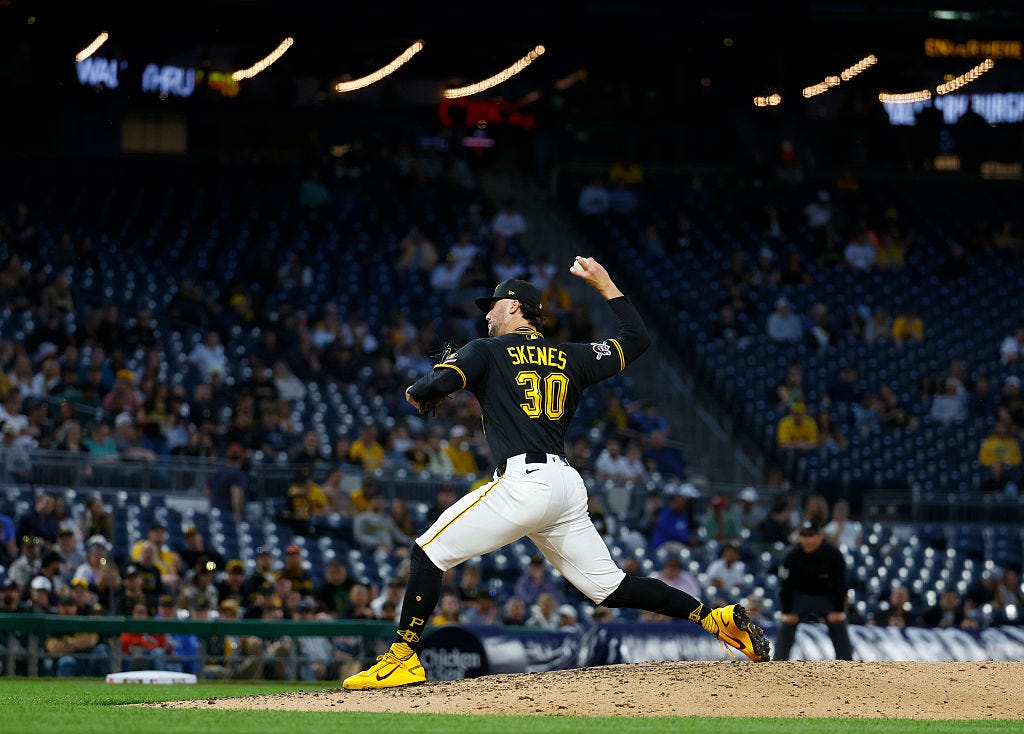
That’s what I’ve been thinking about with Paul Skenes.
On Tuesday, Paul Skenes faced the Colorado Rockies. He struck out the first six batters he faced, had a no-hitter going into the seventh, and ended up throwing eight shutout innings. In other words, it was just another Tuesday for Paul Skenes. His season ERA is now 1.98, which is both remarkable (you might remember he gave up five runs in two-thirds of an inning on Opening Day, thanks in some part to some creative defense from Oneil Cruz) and utterly mundane (his career ERA is 1.97).
This was the grand hope for Skenes when he was the first pick in the 2023 draft after, perhaps, the greatest college pitching season ever. But such grand hopes are rarely realized. Skenes was the eighth college pitcher to be taken No. 1 overall this century. Here’s that list:
2002: Pittsburgh took Bryan Bullington No. 1 overall out of Ball State
Expectations were actually not that high for Bullington — the Pirates drafted him because they could afford to sign him. Pittsburgh GM Dave Littlefield basically said that nobody really stood out in the draft, and so they took a college pitcher they could sign, and they hoped he was close to the big leagues. They passed on, among others, Zack Greinke, Cole Hamels, and Matt Cain. Bullington dealt with injuries and inconsistency and made 10 big-league starts.
2006: Kansas City took Luke Hochevar No. 1 overall … sort of out of Tennessee
In 2005, Hochevar was the 40th pick overall by the Dodgers — technically a first-round pick because of all the compensatory picks — and he didn’t sign. His agent Scott Boras instead had him play some independent ball, and it’s still a complete mystery why the Royals fell in love with him. The Royals were in limbo at the time; they didn’t technically have a general manager (Dayton Moore had been hired but had not started) and somehow, at the midnight hour, they decided to take Hochevar over, get this, Clayton Kershaw, Max Scherzer, Tim Lincecum and Andrew Miller. It didn’t work out, though Hochevar did throw 10⅔ scoreless innings in the Royals run to the 2015 World Series title.
2007: Tampa Bay took David Price No. 1 overall out of Vanderbilt
Price was the first mega-hyped college pitcher of the 21st century, I think, and he was called up the very next year and pitched very well in the playoffs. Price was terrific from 2010-12, making the All-Star team all three years, winning a Cy Young Award and also finishing second in the Cy Young voting. In 2015, while pitching for both Detroit and Toronto, he won his second ERA title and again finished second in the Cy Young voting. He was a huge part of Boston’s run to the World Series title in 2018. It was a fantastic career.
2009: Washington took Stephen Strasburg No. 1 overall out of San Diego State
Strasburg might have been the most hyped pitcher of all time — his debut was something of a national celebration. Injuries plagued him and his career, but he carried the 2019 Nationals to the World Series title, and while his career feels more like a “what could have been” than anything else, when he was healthy, he was truly something else.
2011: Pittsburgh took Gerrit Cole No. 1 overall out of UCLA
The Cole hype was not quite on the level of Strasburg or even Price, I don’t think, but everybody knew he had a chance to be a special pitcher. And he has been that. If he can come back after Tommy John surgery and be even a passable version of his former self, Cole has a real shot at the Baseball Hall of Fame. He has finished top five in the Cy Young voting six times.
2013: Houston took Mark Appel No. 1 overall out of Stanford
Weird one. Pittsburgh took Appel with the eighth overall pick and turned down a nearly $4 million offer. What’s weird about it is that, apparently, his agent Scott Boras was not the driving force behind the decision. Appel wanted to play for his hometown Houston Astros and was confident enough in his own abilities (and the power of a Stanford degree) to go back to school. Then, the next year, Houston took Appel No. 1 overall. There were some scouts who were skeptical of Appel’s stuff, and sure enough, he struggled to miss bats in the minors. Then he hurt his shoulder and stepped away from the game. He tried to return four years later and briefly reached the big leagues in 2022.
2018: Detroit took Casey Mize No. 1 overall out of Auburn
What really impressed scouts about Mize coming out of college was his command; he had good stuff, certainly, but it was the way he commanded his pitches — “He’s like a 10-year veteran,” one scout said — that seemed to separate him. Because of that, there wasn’t a lot of hype about him; he didn’t look like a future ace so much as he looked like a solid middle-of-the-rotation pitcher who might make a couple of All-Star teams. Then came the injuries. He’s back now, and he’s pitching pretty well despite a meh fastball. His splitter and slider are top-notch.
2023: Pittsburgh took Paul Skenes No. 1 overall out of LSU
The reason I went through all eight pitchers taken No. 1 overall this century is to make the point — there’s SO much talent out there. The worst big league pitcher, if he’s from your hometown, will be elected to various hometown Halls of Fame and might even have a statue built in his honor. The best baseball player to come out of my high school is almost certainly Luke Little, who has made 40 big league appearances for the Chicago Cubs, and you probably haven’t even heard of him.
And so when you’re talking about the No. 1 overall pick in the draft, my gosh, the heights.
And then you see how some of them didn’t pan out, yes, but others like Cole and Price and Strasburg have been amazing, superstars, Cy Young winners, World Series heroes.
And then along comes Paul Skenes, and he’s simply better than any of them, better than anybody, the best pitcher in baseball (certainly now that Tarik Skubal is hurt), one of the most dominant pitchers we’ve ever seen. He doesn’t give up hits — he’s had no-hitters going late into each of his last two starts and is allowing an unthinkable 4.5 hits per nine — but he also doesn’t walk anybody. His 0.906 career WHIP is simply laughable. Sure, he’s only thrown 370 career innings, but nobody is even close. Addie Joss is second among starters with a 0.968 WHIP, but Addie Joss played in the aughts, when baseballs weighed as much as Buicks.*
*Joss pitched 2,327 innings … and allowed 19 home runs in his entire career.
How is Skenes so good? Yes, he throws a high-90s fastball, but other guys do that too. Yes, he has a disappearing change-up, but others have great change-ups. Yes, his sweeper moves like a wiffle ball, but it seems like everyone can throw that pitch in baseball today.
No, there’s something else about Skenes — just like there’s something else about Sinner — that comes down to focus and will and utter command of his talents. Skenes has walked seven batters all year and none in a month. That doesn’t just tell you about his control, it tells you about his confidence. He doesn’t give in. He doesn’t back down. He knows EXACTLY what he’s doing at all times.
Look at the first six strikeouts of Tuesday’s game:
First: On a 2-2 count, he threw an 89-mph changeup just off the plate to Edouard Julien, who dutifully chased it for strike three.
Second: He threw a 96-mph fastball up in the zone to Mickey Moniak, just low enough to be tempting to a slugger like Moniak, just high enough to be out of reach.
Third: On a 1-2 count, he threw a 97-mph fastball to Hunter Goodman that was not hittable, but because he was ahead in the count, he knew Goodman would try. Goodman did try.
Fourth: On an 0-2 count to T.J. Rumfeld, Skenes decided to paint the outside corner with a 96-mph fastball. Rumfeld watched it go by and walked dejectedly back to the dugout.
Fifth: With the count 2-2 to Tyler Freeman, Skenes threw a new look — a sweeper that seemed, for an instant, to be in the zone but very quickly spun away. Freeman realized he’d been fooled way too late, and he couldn’t hold up his swing.
Sixth: On a 1-2 count, Skenes went back to his old standby against Troy Johnston — a fastball just a touch too high to hit. Johnston swung under it, of course.
I love Salieri’s monologue about Mozart in the movie “Amadeus,” when he recalls the first time he understood Mozart’s genius:
On the page it looked … nothing. The beginning simple, almost comic. Just a pulse, bassoons and basset horns … like a rusty squeezebox. Then suddenly — high above it, an oboe. A single note, hanging there unwavering, till a clarinet took over and sweetened it into a phrase of such delight. This was no composition by a performing monkey! This was a music I’d never heard.
More and more, I feel that way about Paul Skenes’ pitching. Of course, we’ve seen great pitchers before, greater pitchers, I mean, as amazing as Skenes is, come on, we’ve watched Skubal the last couple of years, we saw Kershaw in 2014, we saw Pedro in 1999 and 2000, and we saw Maddux in the mid-1990s, and we saw Gooden in 1985, and on and on. But there’s something about how he commands a game, how he conducts it, how he makes hitters bow to his will that feels, well, yeah, a bit like genius.

I’ll be at the Arboretum Barnes & Noble in Charlotte this Sunday at 2 p.m.!
I play in a 40+ baseball league in Vermont. Former major leaguer Bill Lee plays for a rival team in the league. My first year in the league, 2015, Bill Lee threw 58 innings with a 0.78 ERA and 0.62 WHIP. He also batted .345 with a .472 OBP. At 68 years old. It’s not top level, but almost everybody played HS or D3, with a few D1 and minor leaguers in the mix. He would have been unhittable by almost any of us in his prime.
Skenes currently has a 1.98 ERA, a 211 ERA+, a 2.52 FIP, and 10.1 K/9 in 2026. All of those would be career worsts.