

You think about the strangest things when you get older. Today, for probably the seventh or eighth time this year, I find myself thinking about the tug-of-war.
I suppose this requires a setup for you, kids out there who don’t wake up wondering why, for no apparent reason, a new body part is hurting.*
*The other day, Danica McKellar — who seems to be awesome in every possible way — posted this list on her social media with the comment, “Anyone else get 20/20 like me? 😁”
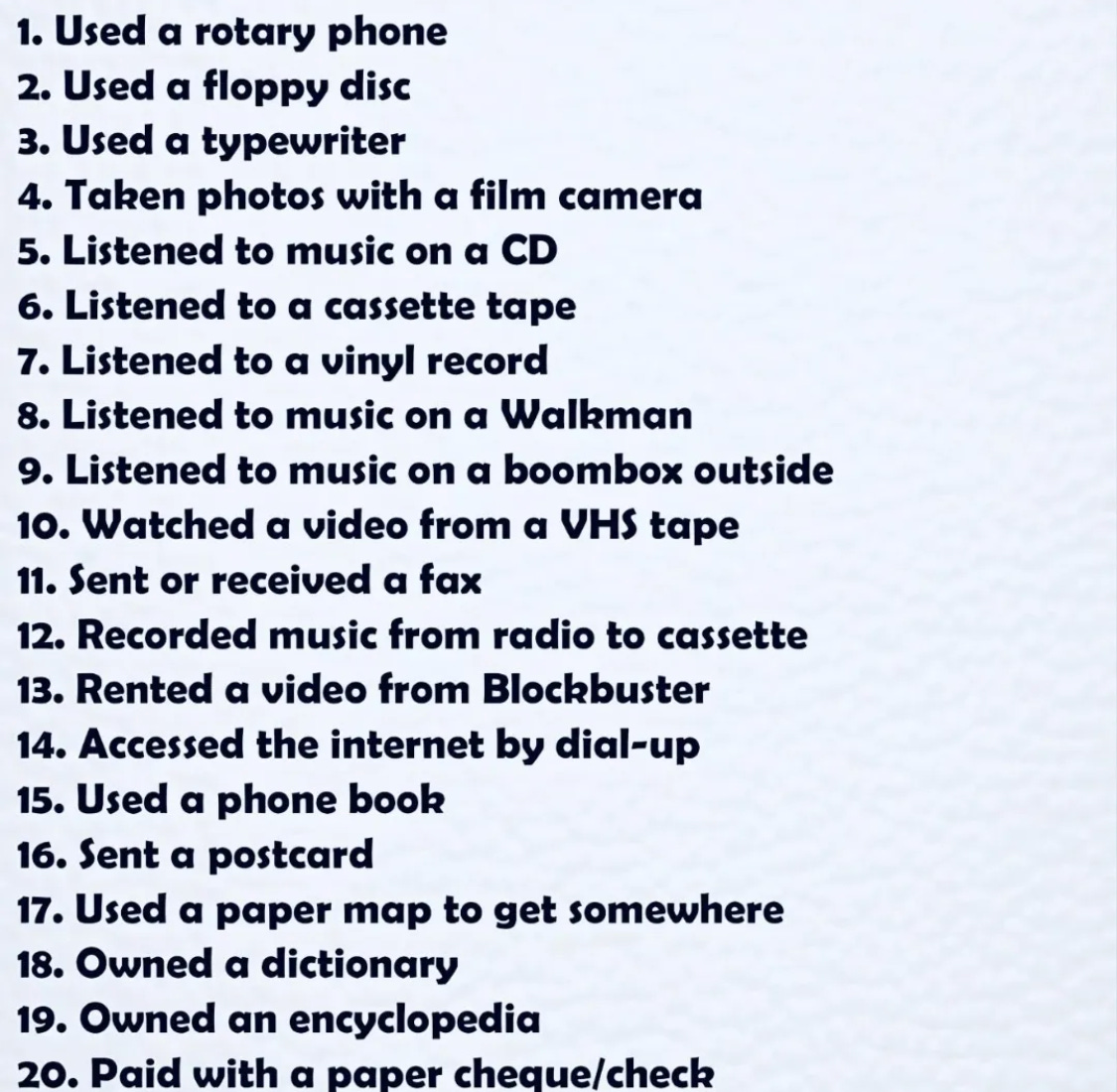
What strikes me about this list is not that I, of course, am 20 for 20 — that goes without saying — but that I never did a single one of these things thinking that it would be the last time. A lot of this stuff was cutting-edge technology at the time. I mean, when I learned I could record music from the radio onto a cassette, I remember thinking, actually thinking, “Wow, the Jetsons are real! We are in the future! There’s no place to go from here.”
OK — so the tug-of-war. Back in the 1970s and 1980s, ABC broadcast these wonderful contests that you might loosely call the Superstars franchise.
Superstars was the centerpiece, of course; it matched up an odd collection of athletes to compete in a series of athletic competitions, such as bowling, canoe racing, weightlifting, swimming, tennis, cycling and, most famously, the obstacle course race, which involved prime athletes climbing a wall, jumping across a water hazard, leaping over a high bar, and running through tires.
Oh, it was the purest splendor. We don’t have time to go through all of it, but let’s just say that in 1973, there was a swimming race between:
Lane 1: Mr. Ranger, Rod Gilbert.
Lane 2: Maybe the greatest catcher of them all, Johnny Bench.
Lane 3: Maybe the greatest tennis player of them all, Rod Laver.
Lane 4: Maybe the greatest quarterback of them all, John Unitas.
Bench had the lead when, exhausted, he suddenly started swimming backstroke. John Unitas couldn’t even finish. Rod Gilbert at no point put his head in the water. And Rod Laver took the race. But none of them could outshine Joe Frazier, just weeks after losing the heavyweight title to George Foreman, doggy-paddling his way in an earlier race and, at one point, seemingly on the brink of drowning.
But he kept going because, as he said, “Joe Frazier is no quitter.”
Anyway, that was the Superstars.
Its more famous cousin was Battle of the Network Stars, where some of the biggest stars on television competed in the Superstars events. This is where you went to find out, once and for all, who is faster on the obstacle course: model Cheryl Tiegs, who insisted she wasn’t nervous, or Victoria Principal, who insisted that she was nervous but was there for her team. Principal was pressed into competition because Bo Svenson hurt his arm during the Frisbee competition.
I promise you, kids, I’m not making up any of this.
Answer: Cheryl Tiegs edged Victoria Principal by handling the water hazard just a little bit better.*
*One of my favorite lines ever, in any sport, comes from Battle of the Network Stars when Howard Cosell said something like this about “Wild Wild West” star Robert Conrad: “You can doubt Robert Conrad’s athleticism, but you should never, ever underestimate his insatiable will to win.” I believe this happened after Conrad pulled a muscle or something, but refused to pull out of the competition.
Finally, the least famous of all the Superstars competitions, but in many ways the most fun, was Superteams. This involved the teams in the Super Bowl and the World Series competing against each other until we found out, once and for all, something, I’m not sure what we found out. But it was intense. In 1976, the Pittsburgh Steelers angrily put the whole competition under protest because they believed the wall in their obstacle course was, and I quote, “slipperier” than the wall the Cincinnati Reds had.
My gosh, can we please go back to the 1970s?*
*Wait, I just looked at gas prices and was reminded that, actually, the 1970s were generally awful. Never mind.
All of which takes us to the 1978 Superteams final between the Dallas Cowboys and the Kansas City Royals. What a battle it was. You had 5-foot-4, 140-pound Royals shortstop Freddie Patek leading off the relay against 6-foot-5, 260-pound Cowboys defensive lineman Harvey Martin (as it turned out, Martin was MUCH faster than Patek, at least in a sprint). You had George Brett and Darrell Porter on a tandem bike battling Charlie Waters and Cliff Harris. You had a couple of legends, Roger Staubach and Big John Mayberry, swimming against each other.
I’m thinking, more and more, that Superstars needs to be my next, next book.
And here’s the thing: The teams were so evenly matched that they went into the final event tied. And that final event was the tug-of-war, the most grueling event of them all. The two teams would pull on a rope until one could pull the flag in the middle far enough to their side.
The Cowboys would have been heavy favorites — though this was in the glorious days when there were no Vegas lines on dumb competitions — but to even the scales, the Cowboys had to go seven against eight. And it was the Royals who got the initial pull to take the early lead. The Cowboys stabilized. And then the two sides went into a war of attrition. Each side pulled. The rope would not budge.
“At the beginning,” Keith Jackson said at about the 20-minute mark, “the adrenaline flowing easily and freely. At the beginning, there was enthusiasm. At the beginning, there was an excitement. It was to wear, wear, and wear.”
Twenty minutes was already a Superstars record. But they pulled on. Roger Staubach exhorted his Cowboys teammates. George Brett dug his feet in the sand and pulled with all his might; his face was pure pain. And that’s when Keith Jackson said that the teams, for reasons that still boggle the mind, had agreed beforehand to no time limit.
“I’m sure they’re regretting that,” Jackson said.
And so it went on and on and on. Twenty-five minutes. Thirty minutes. Forty. Even in 1978, when you watched athletes do all sorts of pointless things on television because they could really use money, this seemed absolutely bananas. Forty-five minutes. Fifty minutes.
At some point, I can only imagine, these incredible athletes found themselves between two undeniable drives.
Their competitive natures would not allow them to lose.
The working parts of their brains were shouting, “What in the heck are you even doing? Let go of the rope. Let’s get out of here.”
But you know how it is with athletes — their competitive fury will always eclipse the working part of their brains. And so they pulled on, past the hour mark, past an hour and 10 minutes.
At some point, it became so ridiculous that someone else finally had to step in. That someone else — and this is one of my favorite parts of this delightful story — was Hall of Fame point guard Bob Cousy, who was, for some reason, the commissioner of this competition. He decided that the contest would end at one hour and 15 minutes.
Which it did: The two teams were declared co-champions of the Superteams, and everybody got a check for $12,500.
I feel sure that if not for the Cooz, the Royals and Cowboys would still be on that beach in Hawaii pulling at the rope.
If you ask George Brett about that day, he will tell you that he’s STILL sore.
As I say, I think about that tug of war all the time. It was just so wonderfully pointless from a time when sports were allowed to be utterly pointless.
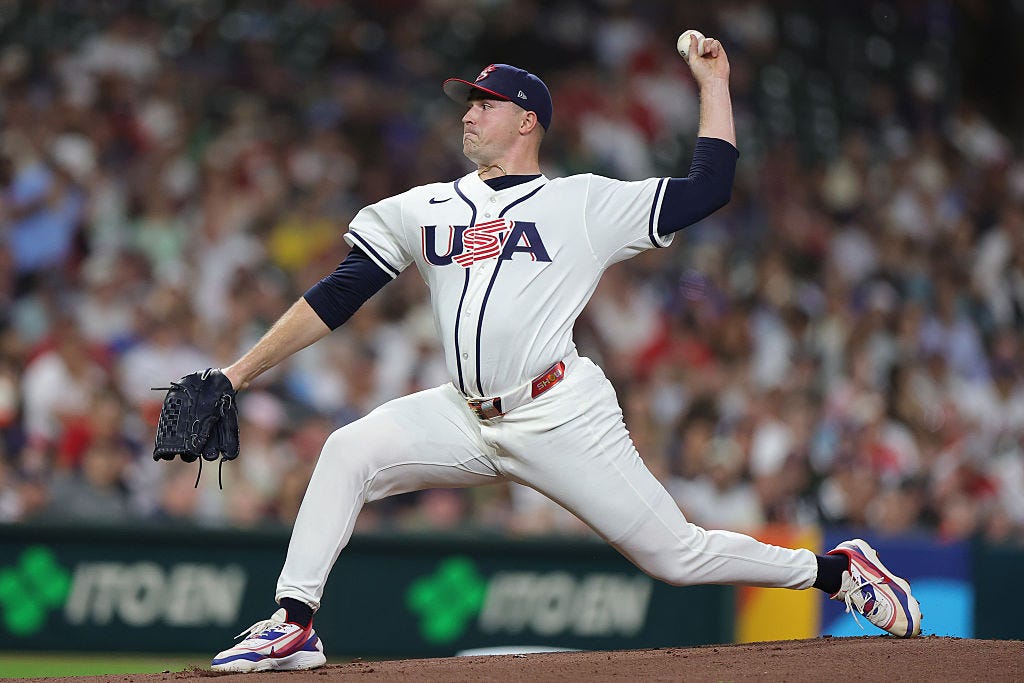
I think about it today specifically because of Tarik Skubal. Maybe you watched the best pitcher on earth pitch Saturday against Great Britain in the World Baseball Classic. He gave up a leadoff home run and then turned on the Skubal jets and pitched three dominant innings. Typical stuff.
But what was striking was just how happy he looked doing it. The Tigers had allowed Skubal to make this one start, and only this one start, in order to keep his fresh and healthy for the regular season. Skubal was fine with that.
But after pitching those thrilling three innings, Skubal was no longer fine with that.
“I didn’t expect these types of emotions to run through my brain,” he said. “I was pretty committed to making one start and getting back to camp. Things have changed, obviously.”
Yes, now Skubal wants to pitch again. More than that, he NEEDS to pitch again. This was too much fun. Playing for his country filled him with too much pride. Being on a star-filled team — playing with Aaron Judge and Bobby Witt Jr. and Gunnar Henderson and Bryce Harper and Kyle Schwarber and all the rest — was the most amazing feeling imaginable.
The Tigers, at last check, said they were thinking about it.
This points to a couple of things at once. One, it points to the fact that the WBC is awesome; I think it’s the best thing going in baseball right now. These games feature the purest emotion that the sport has to offer.
Two, nobody quite knows what to do about that. It’s not a big enough money-driver for MLB to go all in on it. And so they don’t. They limit their players. They fret constantly about injury. This isn’t the case for the World Cup, obviously, because the World Cup is the biggest sporting event on Earth, bigger even than the Premier League or LaLiga. There, teams can worry about injuries all they want, but it’s laughable to think they could keep the best players in the world from playing for their countries. They don’t even try.
But the WBC is not the World Cup. And so Mike Trout isn’t playing because he couldn’t get insured. Same with Carlos Correa. Same with Jose Altuve. Max Fried and Cody Bellinger declined. Tarik Skubal and the Tigers wanted him to be limited to one start. Etc. Sports are built around risk aversion.
I get it. We all get it. Sports are not what they were fifty years ago, and they never will be again. I’m not so old or nostalgic that I miss that multi-billion dollar truth. And, look, sports are better now in so many ways.
But in other ways …
The same instincts that drove the Cowboys and Royals to pull on that rope for an hour and 15 minutes are driving Tarik Skubal now. That competitive will is humming.
He doesn’t want seventy-five minutes of pain.
He only wants three more innings.
Maybe the Tigers will let him have them.
I hope they do. For his sake. For our sakes too.
This is why I love Joe.
You take this situation, Tarik Skubal wanting to pitch again in the WBC, and 75% of sportswriters will write about patriotism, and maybe a few will write about how fun it is having a team of All-Stars backing you up, and maybe the rest will write about the competitive nature of the professional athlete. And maybe some of this last small group will come up with previous examples of competitive nature.
But only one will write about the 75-minute tug-of-war between the Dallas Cowboys and Kansas City Royals on ABC-TV in 1978. And that's why we're all here.
How many innings would Skubal throw in spring training? Good grief, let him pitch again.