

You have probably heard the story of Pedro Martinez and the London cricket fan. I’ve heard it many ways, but my favorite is that a Red Sox fan in 2003 looked all over London to find a bar open late that would show ALCS Game 7 between the Yankees and Red Sox. Pedro started for Boston that day, of course, Roger Clemens for the Yankees, and for seven innings it looked like Pedro would win the day.
He wasn’t vintage, unhittable Pedro — he gave up two solo home runs to Jason Giambi and had to work his way out of a couple of small jams — but he was more than good enough. Boston led 5-2 when Pedro struck out Alfonso Soriano with runners on first and second to end the seventh.
But it had been hard work — he had thrown 100 pitches going into the eighth, and those were 100 pitches under great duress. He had a long and grueling seven-pitch at-bat with Nick Johnson before getting him to pop out to start the eighth. Then Pedro got ahead 0-2 against Derek Jeter.
If you are a Red Sox fan, you know to stop reading now.
Pedro tried to throw a high outside fastball past Jeter, and he did not get it high or outside enough. Jeter smacked it to right field — outfielder Trot Nixon took a bad route to the ball, and it went over his glove for a double. I’m not sure that if he had taken a good route, he would have caught it. But it’s possible.
In any case, Red Sox manager Grady Little chose to keep Pedro in.
Bernie Williams was next, and he worked a 2-2 count and then lined a clean single to center field to score Jeter and make the score 5-3. Pedro had now thrown 115 pitches.
The Red Sox relief pitchers were warm and ready.
Red Sox manager Grady Little chose to keep Pedro in.
He got ahead of Hideki Matsui 0-2 and then Matsui absolutely crashed a line drive down the right field line, and the ball hopped in the seats for a ground rule double.
Now … for sure …
No. Red Sox manager Grady Little chose to keep Pedro in.
And after a five-pitch battle, Jorge Posada blooped a ball that dropped between the shortstop, second baseman, and center fielder for a double that tied the game.
This all, of course, is now baseball legend — the game where Grady Little wouldn’t take out Pedro Martinez.
And in London, our Red Sox fan was watching in the one pub showing the game, and he was surrounded by several drunken London men who knew and cared nothing about baseball but found themselves intrigued by the drama on television. And, as the legend goes, before the Posada at-bat, one of them said this to the Red Sox fan:
“Would the rules allow these fellows in red to substitute for this bowler? He appears to be laboring.”
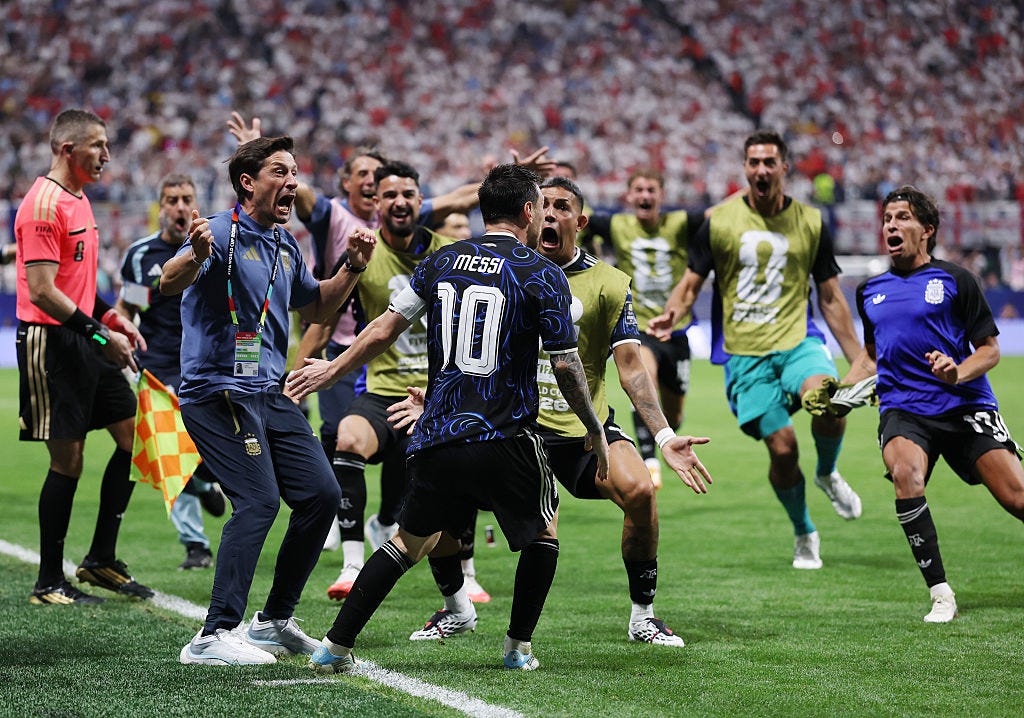
I tell this story for the most obvious reason in the world — Wednesday, Margo and I watched England-Argentina, and we were essentially that drunken man in the pub. We were not drunk, but we know little more about England’s sport than most Englanders know about our pastime, and several times during the second half, with England leading 1-0, we asked each other repeatedly: “Why is England just staying back and letting Argentina control the ball and take shot after shot after shot? … Is this a viable strategy? … How many balls do they think are just going to hit the post? … Do they really think they can survive a Messi and Argentina onslaught for like 40 minutes?”
“I don’t like it,” Margo kept saying. “Why isn’t England trying to score a second goal?”
Funny thing: That’s exactly what ALL OF ENGLAND is asking today.
England’s manager, Thomas Tuchel, knows 10 billion times more about soccer than you, Margo, and I do. And yet … I’m sure you were yelling the same things. Argentina controlled the ball EIGHTY-EIGHT PERCENT of the time after England’s goal. Messi did something incredible and dangerous literally every time he touched the ball after England’s goal, including assisting on the two goals. There was absolutely no way England was going to go into a rope-a-dope defense and beat Argentina. No chance. England was lucky Argentina only scored twice.
Sigh. Sometimes the obvious answer is the right answer.
Remember to joke about how long the grass is in Grady Little's front yard? His lawnmower sat idle because he couldn't pull the starter!
As my father would say, The prevent defense only prevents you from winning.