

It took a very long time for FIFTY SEASONS to tell me what it wanted to be. I know that might sound a little weird, but that’s the only way I can explain it. I have had a pretty clear idea at the start for all ten books I’ve written. Not one of those books came even close to looking like what I envisioned. These books eventually tell me what they are.
FIFTY SEASONS held out longer than any of the others. I sent in a full 100,000-word book to my editor in March and felt semi-good about it.
Then, I spent the next 10 weeks completely rewriting it.
Because FIFTY SEASONS was so stubborn, I have more cutting-room chapters than I’ve ever had for any book. I literally cut a Tuesdays with Morrie-sized book from this book. I didn’t cut these chapters because I didn’t like them. They’re some of my favorites. I cut them because they just didn’t fit into what FIFTY SEASONS evolved into.
Stage 1: A countdown of the 100 greatest individual seasons in baseball history.
Stage 11: A countdown of 50 great seasons with bonus chapters about players who were GEY (Great Every Year).
Stage 23: A countdown of 50 amazing seasons, with various extra chapters that put them in context.
Stage 39: Stories of the baseball seasons that echo.
Yes, that has left me with LOTS of DVD extras. And so, every Tuesday from now until December 15 — that’s six Tuesdays if you’re scoring at home — I’m going to pull out and rework one of those cut chapters just for you.
Why December 15? Full disclosure: that’s the last day of our special Rainy Day preorder campaign. If you order the book through Rainy Day Books by December 15, you will get a signed book that I will personally inscribe however you like. I’m coming to Kansas City in January specifically to personalize the many, many (many) books that you are preordering. It will be great fun. Or not.
But it makes a great gift!
You can also preorder from Amazon, Barnes & Noble, Bookshop.org, Target, and all the rest.
This chapter about the meaning of 60 feet 6 inches was meant to accompany Amos Rusie’s incredible 1894 season. Rusie’s remarkable season remains in the book, but this chapter felt like it belonged to a different book. I have updated it for you here.
“At some point Major League Baseball has to accept the fact that the pitching distance established in 1893 (60 feet, 6 inches) no longer works, and has to be adjusted. There are a hundred other things you COULD do to keep the game from being swallowed up by strikeouts, but those are all just buying time. At some point you are going to have to bite the bullet and adjust the pitching distance. “
— Bill James
On March 7, 1893, an eclectic group of millionaires, baseball lifers, newspaper men, and such gathered at a Fifth Avenue hotel in New York City. They came to talk about the future of baseball.
They all were worried about the future of baseball for any number of reasons — people have ALWAYS worried about baseball’s future — but the biggest issue on their minds was the way that pitchers were taking the life out of the game.
In the beginning, pitchers — like Victorian children — were supposed to be seen and not heard. Their entire job was to pitch the ball underhand to where batters could hit it. That was it. Batters would shout that they wanted a high one or a low one, and pitchers were required by the rules to comply.
But pitchers had no interest in being put in a corner like that, and so they simply stopped complying. They pitched the ball wherever they liked, turning at-bats into tedious and endless tugs of war. They put sneaky spins on the ball. They started throwing more sidearm than underhand and dared umpires to challenge them. The powers that be kept adding various rules to put pitchers in their place. In 1878, for example, they created a rule where nine called balls were an automatic walk. Around that time, they experimented with a four-strike strikeout.
But nothing worked. Pitchers were determined to be the most important players on the field, and they kept flaunting the rules until baseball executives threw their hands up in the air and simply let pitchers throw pretty much however they liked.
The effect on offense was devastating. In 1892, the whole league hit .245 with a .328 slugging percentage. But the sheer dominance of pitchers went beyond the numbers. In those days, pitchers were supposed to stay in a five-and-a-half-foot box that was a mere 50 feet from home plate. Many flaunted that rule too and stepped even closer to home plate as they released. But even those who stayed in the box were still only FIFTY FEET FROM HOME PLATE. Pitchers like Amos Rusie, George Meekin and Cy Young, who fired breathtakingly fast fastballs, were utterly terrifying to face.
As historian John Thorn has written, Rusie was likely the fastest pitcher in baseball history because of the shorter distance to home plate.
So the baseball people came to New York in large part to take the game back from the pitchers. The leader in this effort was the founder of the Brooklyn Baseball Club, a short but mighty former sportswriter everyone called Napoleon Byrne. He was responsible for many baseball innovations, including the rain check and promoting the game to women.
And he believed the only way to fight back against the pitchers was to move them farther from home plate.
In all, his big idea was this: Get rid of the pitcher’s box entirely and replace it with a slab or rubber. The pitcher would have to keep his back foot on that slab so that there was no creeping closer to home plate.
And that slab would be the magical distance of 63 feet and 6 inches from home plate.
Wait, SIXTY-THREE FEET AND SIX INCHES? What? Why? Byrne knew exactly why: That would place the pitcher at the geographic center of the baseball diamond. Everything would be in balance. He felt sure that was the right answer.
But a Cleveland Cable Car titan named Frank Robison loudly disagreed. Robison had founded the Cleveland Spiders, and his club was coming off its best season thanks largely to the ferocious fastballs of its best pitchers, Cy Young and George Cuppy. He thought it was absolutely outrageous to move his pitchers back.
“The members of the Playing Rules Committee do not know the difference between a flat bat and a round one or a round ball and an oval one,” he reportedly shouted out during the meeting. And he saved his most pointed fury for Byrne, who he said “would place the pitcher at second base.”
From what was reported in the New York Times, it seems that Byrne and Robison were at each other’s throats throughout — and Robison found enough votes to kill the 63-foot, 6-inches idea (other owners worried pitchers simply wouldn’t be able to throw strikes from way back there). But everybody except Robison still wanted to move the pitcher back at least a little bit, so they compromised and decided to use the slab idea but only move the pitcher back five feet.
The box was 50 feet from home plate.
The box was 5½ by 5½.
Move the pitcher back another five feet … and the rubber was placed 60 feet 6 inches from home plate.
There is your magical number.
Here’s what one of baseball’s most respected voices, O.P. Caylor, wrote after the rule change:
The impression is widespread that the new rule will remove the crown from the pitcher king; that hereafter he will be no more important than other members of the team. For several years, the public has clamored and hungered for “more batting.” Now they’ll get it. There may be a surfeit after the famine in base hits. Too much of a change would be unpopular. And yet the summer’s batting promises to be of the biff, bang, set-‘em-up-again kind. My modest opinion is that one season, or maybe part of one season, will be enough under the new rule to make the baseball public pine for a few feet nearer relationship between the lordly pitcher and the vengeful batter.”
Caylor was right about offense — batting averages skyrocketed in 1893. Strikeouts plunged. The next year, the whole league hit .309 and five different players hit .400, including Hugh Duffy, whose .440 average remains the highest in National or American League history.
But he was wrong about the public wanting to go back. Within a few years, that distance of 60 feet, 6 inches became sacrosanct. Poems would come to be written about it.*
*Rabbit hole alert! While 60 feet, 6 inches is a part of baseball lore, I’m pretty sure very few people actually know what it means. To test this theory, I put up a poll this week:
You know that the pitcher’s rubber is 60 feet 6 inches from home plate. Without looking it up, is it 60 feet, 6 inches from …
The front of home plate
The back of home plate
The middle of home plate
Honestly don’t know
More than 13,000 people took the poll. Do you know what percentage got it right?
Just twenty-nine percent.
More than half the people think that it’s 60 feet, 6 inches to the FRONT of home plate. It is not. It’s the back. It has always been the back of the plate. In other words, you COULD move the pitcher back 17 inches — that’s the size of home plate from front to back — and the pitcher would technically STILL be 60 feet, 6 inches away.
Over the years, numerous people have fought to move the mound back. My favorite is Paul Richards, the famed Wizard of Waxahachie. He was some character. He managed the Go-Go White Sox in the 1950s. He then managed the Orioles for a few years and more or less crafted the famed “Oriole Way.” He was general manager for the expansion Houston Colt 45s in 1962, which led to one of my all-time favorite quotes. After he was fired by Houston’s mercurial owner, Judge Roy Hofheinz, he was told by a sportswriter that the Judge was his own worst enemy.
“Not while I’m still alive,” Richards growled.
He clashed with people all his baseball life … see, Paul Richards had opinions. And he was absolutely certain that his opinions were right. “Nobody ever agrees with me right away,” he said.
But in time, he added, they would realize that he was right.
In the early 1960s, he started putting pitchers on pitch counts to protect their health. People thought he was nuts. He said people would come around. And they did. Sure, it took 25 years or so. But they came around.
“Paul Richards,” sportswriter Milton Richman wrote, “is way ahead of his time.”
At the 1967 Winter Meetings in Mexico City, Richards — who was Atlanta’s general manager at the time — frantically ran around telling anyone who would listen that the game was on a precipice and needed to move the mound back five feet, to 65 feet, 6 inches.
“The way things are now,” he said, “I don’t think the hitters can handle 60 feet. Their averages are way down and going down more all the time. Look at it this way: They’re making gloves bigger, parks bigger and everything else bigger to help the pitcher. What about helping the hitter for a change? We gotta do something to put the double and triple back in baseball.”
“What’s so sacred about 60 feet?” he added.
Richman wrote that when Richards suggested moving the mound to 65 feet, 6 inches, “Everybody in the room fell over laughing.”
Richards shrugged.
“Let ‘em think about it a while, the same way they do with all my ideas,” he said.
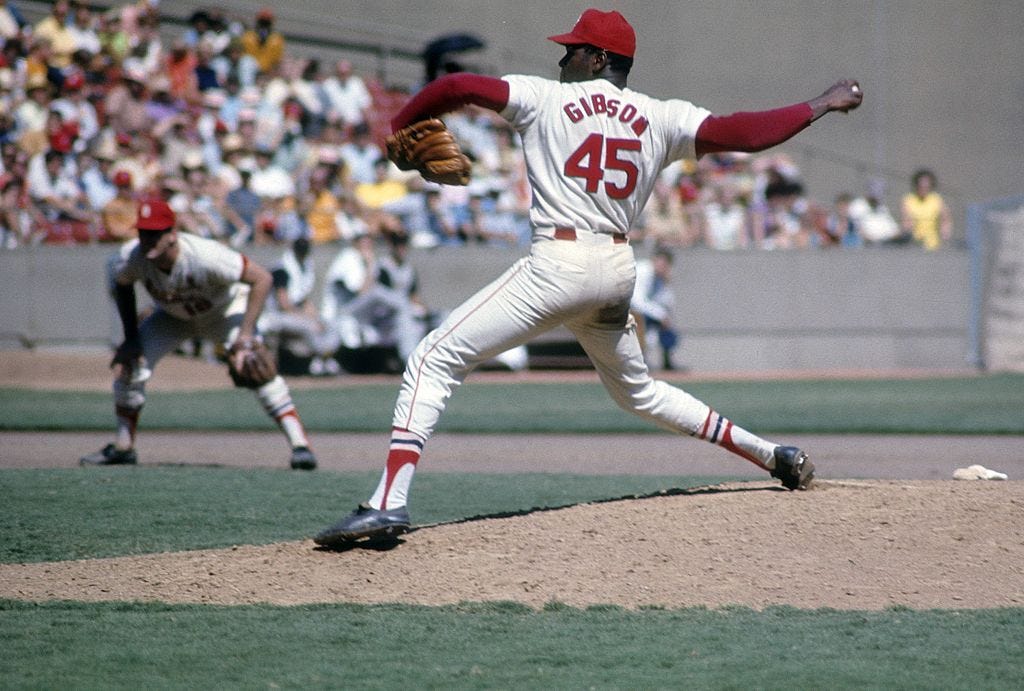
And sure enough, one year later all the baseball people were in a full-fledged panic. Richards had seen what was coming: In 1968, pitchers overwhelmed the game. Batters flailed helplessly against Bob Gibson and Luis Tiant and Denny McLain and the rest. One American League batter, Carl Yastrzemski, batted .300. Teams averaged just 3.4 runs per game. One in six games was a shutout. The owners were willing to try anything and everything to pump more offense into the game.
And Richards was louder than ever. He kept insisting on moving the mound back five feet … except for Bob Gibson. For Gibby? “Move the mound back to second base,” he said.
In the end, the owners decided not to move the mound back but instead to lower it. They believed that would have the same effect without touching the magic of 60 feet, 6 inches.
So where do we go from here? Batters hit a mere .245 in 1892, the year before baseball moved the mound back. Batters hit .244 this year … and .245 last year … and .243 the year before that.
Strikeouts spiked in the late 1880s and early 1890s — teams were whiffing almost four times per game for crying out loud!
In the last five years, teams are striking out eight-plus times per game.
Bill James has come around reluctantly to the idea that they will have to move the mound back. “I’ve only recently come to accept the inevitability of this myself,’ he says. He believes, and he’s not alone, that every other solution to the lack of hits and explosion of strikeouts is little more than a Band-Aid.
You gotta move the pitchers back.
But he also believes that the only way to do it is gradually. Recently, MLB experimented in the Atlantic League with pitchers at 61 feet, 6 inches … and it had little to no effect. Bill was utterly unsurprised because that’s not a big enough move to make any real difference. “If you move the mound back to where it has to go (right away),” he says, “breaking pitches will not cross the plate at the correct spot, basically creating atomic-bomb level consequences.”
What are those consequences? Who knows for sure? Pitchers would have to relearn how to pitch. The number of walks would probably explode. The number of home runs would probably explode. Pitcher injuries might go up, as difficult as that is to imagine.
“Other than radical gradualism, I don't see any way to do this without hugely significant short-term consequences,” Bill says. “If you move the mound an inch a year for 36 years, you can cut strikeouts in half.”
And then he admits: “It is hard to imagine baseball doing that.”
But he does think it will have to move back.
How much? Well, an inch a year for 36 years would eventually move the mound back three feet. That would put it 63 feet, 6 inches.
And that is exactly where Napoleon Byrne wanted to move it 130-plus years ago.
This game does echo.
Gradual change would be insane. You’d be forcing pitchers to learn a new distance every time you change. Better to do it all at once and get it over with.
I'd rather not wait 36 years. How about 6 inches a year for 6 years?