

For about a year now, I’ve been jotting down a list of things that bring me joy. I started doing it as an excuse to use the Sailor Pro Gear Slim fountain pen I bought — it’s so much fun to write with. Around the same time, I also started keeping a list of all the ridiculous pharmaceutical names that blared at me whenever I tried to watch sports:
Veozah, Skyrizi, Caplyta, Nemluvio, Ebglyss, Jardiance, Nucala, Tezpire, Qulipta, Keytruda, Cosentyx*, Duprixent, Rezdiffra, Nemuuvio, Vabysmo …
*There’s an up-and-coming tennis player out there from Belgium named Alexander Blockx, a name I love because it’s the most typical name imaginable, and then there’s an X at the end of it for no apparent reason.
Anyway, the joy list is all over the place — sports stuff that makes me happy, songs and food and movies and TV shows that make me happy, people who make me happy, little daily moments that make me happy, and so on. Some of the stuff is obvious. Some of it is a little bit baffling, if I’m being honest. For example, one of the items I jotted down was “wave.” I surely was not talking about the wave at sporting events; those don’t make me happy. So I can’t decide if I was referring to the wave you get when you let cars go in front of you or the automatic wave in the neighborhood when you pass somebody, even if you don’t know them.
Both do make me happy.
In any case, I was looking at the list over the weekend, and this thought occurred to me: “We all need a little more joy in our lives, right now. I should write a little essay on each of these things. Maybe people would like that.”
We’ll give it a try. I’ll try to give you a little essay on stuff that brings joy until we all get bored with it. Maybe you’re already bored with it. We’ll see.
If you have any joy requests, send them along.
Buck O’Neil gave the greatest explanation I’ve ever heard of why we love the triple: It’s the one play where the entire field is in motion. The batter hits the ball, and everybody moves — the batter runs at full tilt, the baserunners move, the outfielders chase, the infielders position themselves, the pitcher and catcher look for the base to back up, the coaches jump around with their arms waving, it’s a blur of motion in a game that is notably stationary.
It’s that glorious feeling of getting out of the car after a long ride and just wanting to stretch your legs and fly.
Wahoo Sam Crawford hit more triples than anyone in baseball history. They called him Wahoo Sam because he was from a small town called Wahoo in eastern Nebraska. If you’re a David Letterman fan, you might remember Wahoo as the home office for the Late Show Top Ten List. The city bribed Letterman to take the office away from Grand Rapids by naming him an admiral in the Great Navy of the State of Nebraska. Nebraska is not near any oceans. Others in the Great Navy include Franklin Delano Roosevelt, John Glenn, and Bill Murray.
Wahoo Sam’s remarkable talent for triples — he hit 309 of them in his career — was the result of three factors coming together in a perfect storm.
Wahoo Sam crushed baseballs. He was a well-built 6-foot, 190 pounds — “While we are no sculptor, we believe that if we were looking for a model for a statue of a slugger, we would choose Sam Crawford,” F.C. Lane wrote — and he was left-handed, and hit the ball harder than anybody of his time, at least until Joe Jackson came along.
Wahoo Sam could fly. He was not a huge stolen base threat, but once he got going, it was said there was nobody faster. In 1901, while playing in Cincinnati, he led the league with 16 home runs — 12 of them were inside-the-parkers.
Wahoo Sam spent his career playing in massive ballparks.
After Deadball, the parks started getting less massive, batters started swinging for the fences, and triples started to decline. In 1921, teams averaged .55 triples per game. By 1961, the first year of expansion, that average was cut by more than half.
The greatest tripler over the last, say, fifty or sixty years is probably Lance Johnson. Remember One Dog? He was a heck of a player who never really got his due as a heck of a player. Johnson was a blazing fast centerfielder who led the league in triples five times in six years from 1991 to 1996. He was also a great defensive centerfielder who hit as high as .333 and stole as many as 50 bases in a season. He became the first player to lead each league in hits, and he did it in back-to-back seasons — 1995 for the White Sox, 1996 for the Mets.
But, again, it was the triple that made him unique: 117 of his 1,565 hits were triples. That’s about 7.5 percent. He’s the only everyday player in the Expansion Era with such a high triple percentage. In 1991, he got 624 plate appearances, and he didn’t hit even one home run. He only managed 14 doubles.
But he still led the league with 13 triples.
The triple is dying, of course, and has been for some time. This, alas, has been a choice. As recently as 2009, teams averaged 32 triples in a season. Last year, teams averaged 21 triples per season. This year, it will likely be even less than that. There are lots of reasons for it, starting with changes in ballparks and the emphasis on bashing home runs over fences.
But there’s something else: The triple is, and has always been, a risky play. It’s a risky baseball play because the run expectation difference between a double and a triple is very small.* Analysts will tell you that’s almost never worth taking a chance, and, when it comes to pure risk aversion, they’re right. There’s also the injury risk.
*Some quick numbers for those of you who like the math: The difference between hitting a leadoff double (1.12 expected runs) and a leadoff triple (1.38 expected runs) is nothing compared to the difference between hitting a leadoff double (again, 1.12 expected runs) and getting thrown out at third (0.25 expected runs).
Baseball has become all about eliminating as much risk as possible.
In a way, it’s a wonder that we ever see any triples at all.*
*Thank goodness for Arizona and Chase Field. It has become the best triples park in baseball, even better than cavernous Coors Field, in part because of its dimensions but mostly because of Corbin Carroll, who has led the league in triples the last three years and is leading the league again. Corbin Caroll just keeps going for triples because that’s who he is, and the Diamondbacks let him be himself.
I can’t blame teams and players for pulling back on triples, but I do see a baseball argument for the triple: Nothing gets a team or crowd more excited, not even a home run. Triples put pressure on pitchers. Triples put pressure on the defense. Triples add color, electricity, and life to a long, exhausting, monotonous season. No two triples are exactly alike. I believe that if a team were to break away from the safe, prudent, timid way that most teams play ball, it could be surprisingly successful.
Especially a team that has nothing to lose.
I’ve said that I would like to help the Colorado Rockies break this horrible malaise that they’re in — in part because Denver is such a fun baseball town, in part because my friend Maddy went to the prom with manager Warren Sheaffer, and in part because I think finding a way to win in Coors Field might be the greatest challenge in sports right now.
Well, I think they should triple down on the triple. It’s an absolute travesty that the Colorado Rockies have four triples this year. Four! The whole team! Corbin Carroll has four triples all by himself. Coors Field should be the ultimate triples park, and the Rockies should be loaded up with the fastest players in the game, not only so that they could triple their way to fun, but also so they would have the best defensive outfield in the game. They do have Jake McCarthy, and he can fly (and he leads the team with two triples), but he’s not really an everyday outfielder for some reason.
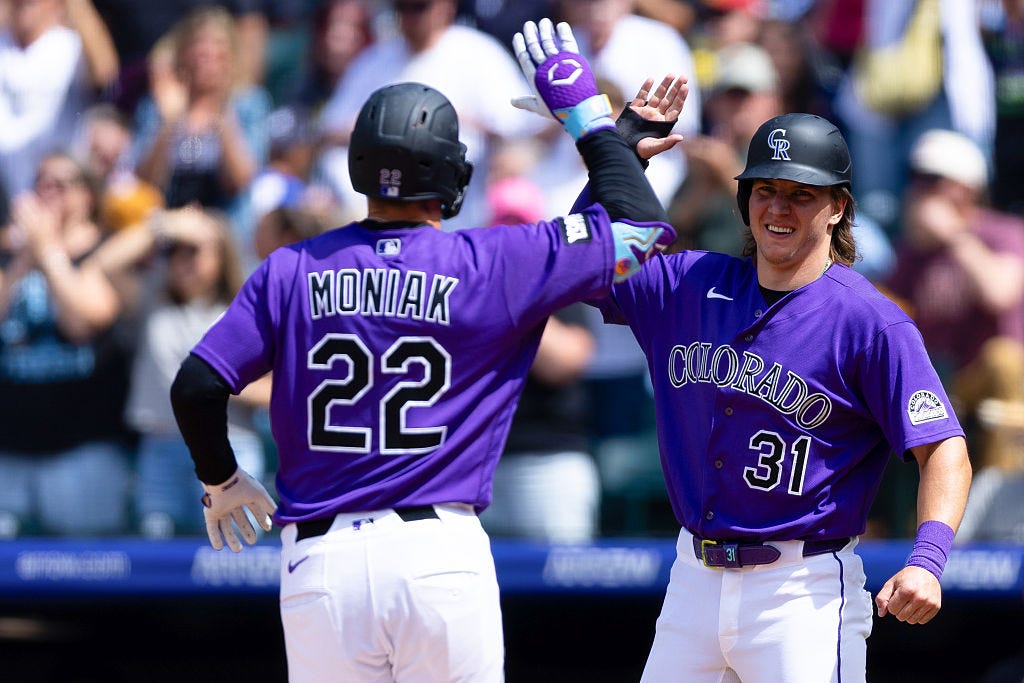
The rest of their players are just not very fast. McCarthy is the only Rockies player in the top 84 in sprint speed. It’s inexcusable. The Rockies aren’t going anywhere, everybody knows that, so the goal should not be to minimize the damage and try to avoid losing 110 games, it should be to develop an identity, a reason for being. Mickey Moniak is fun; he’s already had four multi-homer games this year. He should be the everyday DH.
But, I think the rest of the team should be filled with athletes, speedsters, Wahoos — the Rockies should have a distinct playing style that separates them from everyone else because they play in a ballpark that is different from everyone else.
The Rockies should be the Terrifying Triplets.
I know I’d watch them more.
The best description of a triple appears in The Great American Novel. Explaining why he loves triples even more than he loves his girlfriend, here’s the great Luke Gofannon:
“Well,” he said in his slow way, “smackin’ it, first off. Off the
wall, up the alley, down the line, however it goes, it goes with that
there crack. Then runnin’ like blazes. ‘Round first and into second,
and the coach down there cryin’ out to ya’, `Keep comin’.’ So ya’ make
the turn at second, and ya’ head for third—and now ya’ know
that the throw is comin’, ya’ know it is right on your tail. So ya’
slide. Two hundred and seventy feet of runnin’ behind ya’, and with
all that there momentum, ya’ hit it — whack, into the bag. Over
he goes. Legs. Arms. Dust. Hell, ya’ might be in a tornado,
Angela. Then ya’ hear the ump—’Safe!’ And y’re in there.”
— Philip Roth, The Great American Novel
Little frisson of joy: the sun reflecting off of an almost but not quite still lake. It's like a zillion diamonds have been spread out just for my entertainment.
Very early in my professional life, I had a brief period where I was involved representing One Dog in an appeal of a divorce decree. My involvement was limited to dropping a footnote into the brief about the absurdity of his ex claiming that he said he was unemployable when he had just lead the AL in hits the prior year and the settlement decree was entered during the no-contact period before FA started. One of the few times my baseball obsession had a professional impact.
A second frisson of joy related to that case. One time when the Mets were in Atlanta, another junior associate and I visited from Alabama to update Johnson on the status of the appeal. He got us tickets in the family section for that day's game and I sat next to the wonderful Mrs. Bernard Gilkey. She and her child (children?) were watching and were a pleasure to talk to. Mid game, the husband hit a loooong fly and watching her watch it was just fun. That it was caught up against the fence was a reminder of how we should remember our joys even if short-lived.