

For years now, I have tried this little experiment when I speak: I ask audience members to raise their hand if they would put Pete Rose in the Baseball Hall of Fame.
Half the hands go up. Every time.
This is as true in Houston as it is in Cincinnati. Half the hands. Every time.
I feel sure that if I tried the same experiment with Barry Bonds or Roger Clemens or Curt Schilling or Shoeless Joe Jackson, it would come out more or less the same. Half the hands. Maybe a few more. Maybe a few less.
But never the necessary 75%.
And here’s the thing: The people who would not raise their hands feel VERY strongly about it. The people who believe that Barry Bonds does not belong in the Baseball Hall of Fame believe that with all their hearts. They believe voting him in would ruin something about the Hall of Fame. Joe Morgan was like that, for example. These are not persuadable voters. Their minds are made up.
So … even though I do believe that Barry Bonds does indeed belong in the Hall of Fame — that the plaque room is diminished because it does not have one of the five best players who ever lived — I wouldn’t just put Bonds in the Hall of Fame today. I don’t think that’s fair to all those baseball fans who feel so strongly against him. My hope is that someday cooler heads will prevail, we’ll look back on the steroid era with clearer eyes, and the best baseball players will be elected.
But we’re not there yet. We’re not close to there yet.
This list, then, is different: These are 10 people I would put in the Hall of Fame today, right now, no more questions asked. You won’t find A-Rod or Palmeiro or Rocket or Bonds on here. No Pete Rose. No MannyBManny. That’s obvious.
But you also won’t find any people on this list who don’t stand out from the pack — who aren’t unique. Take Don Mattingly. I could absolutely argue that Donnie Baseball belongs in the Hall of Fame. But is he unique? I’d say no. I’d say that his contemporary Keith Hernandez has, for me, an even more persuasive Hall of Fame case. I think Dale Murphy belongs in the Hall of Fame. But isn’t Dwight Evans at least as good a candidate? Reggie Smith? Graig Nettles has a good case. But was Nettles decisively better than Buddy Bell? Sal Bando? Kenny Boyer?
The ten on this list are, in my view, separated from the rest. There is one player on this list who I went back and forth on, which maybe should have disqualified him. But I decided to keep him on. We’ll get to him before the end.
And away we go …
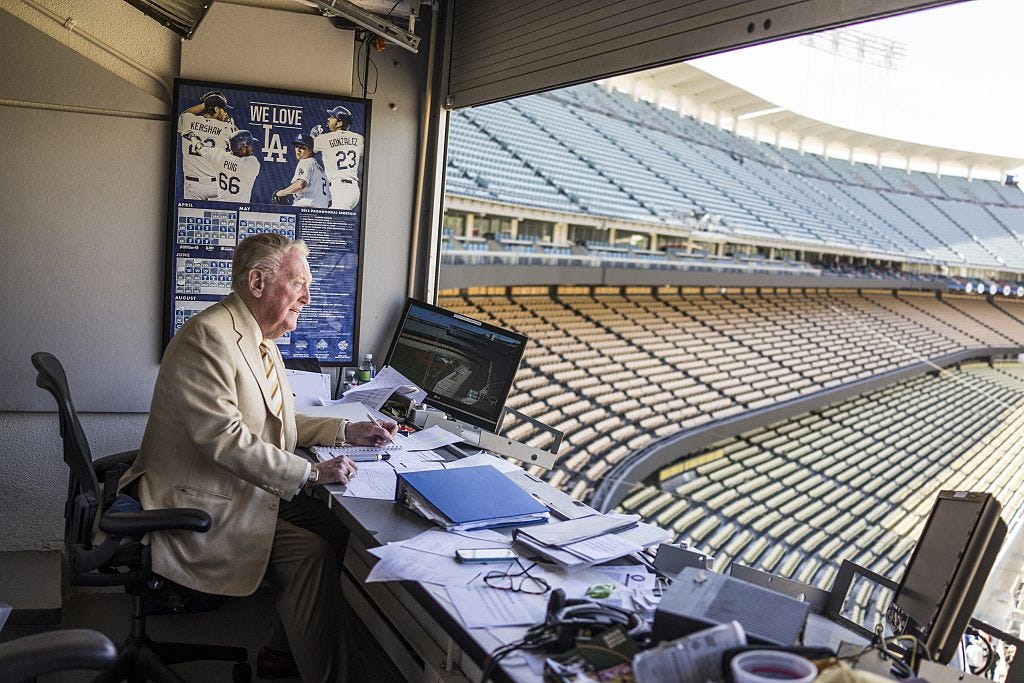
Vin Scully, broadcaster
I’ve had a longstanding disagreement with the folks at the Hall of Fame — I like to think that Ford C. Frick winners (for excellence in baseball broadcasting) and BBWAA Career Excellence Award winners (for meritorious contributions to baseball writing) ARE Hall of Famers. They are usually introduced that way at dinners.
But the Hall insists they are not Hall of Famers. They are not in the plaque room.
If that’s the case, it’s a travesty that Vin Scully is not in the Baseball Hall of Fame.
We sometimes talk here about the Mount Rushmore of Baseball — not the four best players but the four baseball people who have had the biggest impact on the game. Jackie Robinson is, obviously, on that mountain. Babe Ruth. Those are the easy ones. Then, of course, you could go with other legendary players — Henry Aaron, Willie Mays, Ted Williams. Joe DiMaggio. Maybe Cy Young or Walter Johnson or Tom Seaver.
You could go with someone like Marvin Miller; he impacted the game like no other.
I believe there must be a spot on the mountain for Vin Scully. He was baseball’s greatest storyteller. He is the soundtrack of baseball history.
If I did my experiment and asked a room full of baseball fans if Vin Scully should be in the Hall of Fame, every single hand would go up.
Janet Marie Smith, contributor
Janet Marie Smith will tell you that she has never been a hardcore baseball fan. The statistics don’t move her. She doesn’t obsessively memorize baseball facts or muse about long-ago players or moments.
And yet, she understands the heart of baseball like no one else.
In the early 1990s, Baltimore President Larry Lucchino had this vague notion of a new kind of ballpark — or maybe it’s better to say an old kind of ballpark. He mostly knew what he didn’t like: the soulless, cookie-cutter, concrete baseball stadiums that dotted the baseball landscape. Philadelphia. Cincinnati. St. Louis. Atlanta. Why did it have to be that way? Why couldn’t cities build ballparks as wonderful and distinctive and alive as Fenway Park? Wrigley Field?
Janet Marie Smith was an urban planner with no baseball experience, but Lucchino hired her to direct the design of what would become Camden Yards. And she brought a vision to life of a ballpark that was old and new at the same time, a place that was somehow distinctive and yet felt like it had been in Baltimore for a hundred years. Camden Yards is a miracle. And every ballpark constructed since then — all twenty-two of them — has merely been an effort to replicate that miracle.
She has been involved in many, many other baseball projects — she conceived the idea of installing the seats at the top of the Green Monster at Fenway Park, she has modernized Dodger Stadium, etc. But Camden Yards alone is enough. She changed the way we watch and enjoy baseball.
Doc Adams, contributor
Here’s a mea culpa — when Doc Adams came on the Hall of Fame ballot in 2016, I was pretty dismissive of him. Well, to be fair to me, I was dismissive of the whole ballot: Doc Adams’s case was being considered by what the Hall of Fame then called the “Pre-Integration Committee,” and my feeling was that having a “Pre-Integration Committee” was a sham and an embarrassment, especially because there was not a single Negro Leagues player on that ballot. I still feel that.
And so I dismissed Doc Adams out of hand.
That was wrong. As I’ve written since then:
“Doc Adams is the closest thing baseball has to a true father. Doc was the first shortstop in the history of the game. He played a critical role in setting the bases 90 feet apart, headed the convention that solidified baseball as a nine-player, nine-inning game, and was an evangelist for removing the rule that allowed balls caught on one bounce to be considered outs.”
You already know that the Baseball Hall of Fame is in Cooperstown because of the Abner Doubleday myth. You might know that Alexander Cartwright is in the Hall of Fame and his plaque calls him the “FATHER OF MODERN BASE BALL,” and credits him, not Doc Adams, with setting the bases 90 feet apart and establishing baseball as a nine-inning game.
But our great baseball historian John Thorn, among others, has discovered that Cartwright had little to nothing to do with either setting bases or determining the number of innings. He certainly played a role in the development of baseball, but that role has been wildly overstated.
Doc Adams is the real hero at the heart of the story.
John Donaldson, Pitcher
In 2002, a Minnesota man named Peter Gorton was asked to write a chapter for a book called “Swinging for the Fences: Black Baseball in Minnesota.” His subject: John Wesley Donaldson, a long-forgotten barnstorming lefty pitcher.
Gorton couldn’t believe what he found: Donaldson was incredible. He was an overwhelming pitcher who routinely threw no-hitters and struck out everyone. And he was an entertainer, a showman, who inspired Satchel Paige, among others.
“Paige is a great pitcher all right,” Kansas City Monarchs owner J.L. Wilkinson said. “But Donaldson had more stuff. There never was a pitcher, Black or White, who could put more on the ball than Donaldson.”
Gorton was so enthralled by Donaldson that he put together a network of baseball fans and researchers to try and find every single victory and strikeout in the archives. You can still see the results here. More than 400 wins. More than 5,000 strikeouts. They have found dozens and dozens of contemporary quotes that highlight his greatness. And they’re still finding more.
There can be no doubt: John Donaldson was one of the greatest pitchers in baseball history. Put him in the Hall of Fame right now.
