

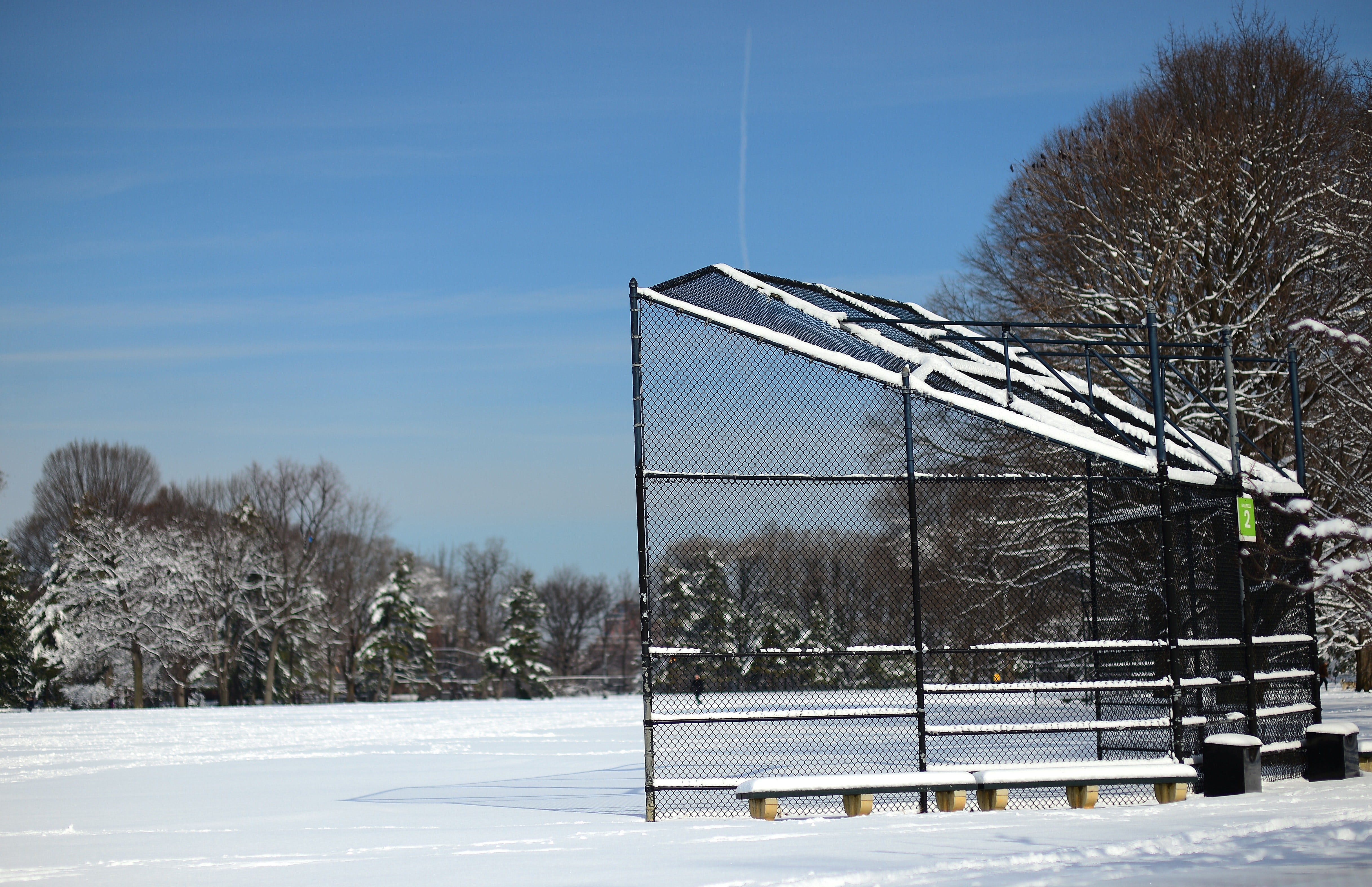
“People ask me what I do in winter when there’s no baseball. I’ll tell you what I do. I stare out the window and wait for spring.”
— Rogers Hornsby
Every year when the baseball season ends, this old Rogers Hornsby quote gets sent around America, baseball fan to baseball fan, now by email and text but before by post, as a way of brightly expressing the barrenness of winter. Punxsutawney Phil saw his shadow today. Six more weeks of winter. Break out the Hornsby quote.
What people might miss about the quote — or maybe they don’t miss it — is that in the spirit of Hornsby, it’s a deathly depressing collection of words. He meant them all. Baseball was his everything. The Rajah didn’t read, didn’t watch movies, didn’t drink, didn’t smoke, didn’t have friends, divorced twice and had no other interests to speak of except the track, where he lost a lot of money betting on longshots. He didn’t even love baseball that much; it was hitting that he loved. He used to grumble, representing his role as a second baseman, that fly balls were the responsibility of the right fielder.
“I’ll do the hitting,” he’d say.
Saturday, Charlotte was hammered with its biggest snowfall in more than two decades, and while it sadly wiped out my planned trip to speak at the Naples Library (we’ll reschedule!), it was, from inside the house, utterly beautiful.
And I found myself, indeed, staring out the window, watching the biggest snowflakes parachute into our backyard, and I thought about baseball. I thought about Don Hood. Why in the world would I think about 1970s pitcher Don Hood? My first vivid baseball memory is of seeing Don Hood picking off a runner. I have no idea why it sticks with me so, but I feel certain now that it happened on July 20, 1975, in a game between Cleveland and California. I was 8.
Cleveland won that game 10-4 in front of 10,000 or so fans at old Cleveland Municipal Stadium, and I remember walking away from the stadium vaguely believing that I was the team’s good luck charm. Everything went right for the club that day. Rick Manning homered. Buddy Bell homered. Rico Carty homered. Oscar Gamble finished a home run shy of the cycle. Cleveland scored early and often.
But in my memory, the loudest cheer was for Don Hood picking off Dave Collins in the fourth inning. I remember being startled by how loud the cheers were, and I shouted out, “What happened?” And the man standing next to us rubbed my head and said, “Don Hood picked the #$&#% off!”
I didn’t know what any of those words meant.
But the world suddenly seemed a bigger and wider and happier place.

Baseball does this to us more than other sports, right? Surely, yes, there are football fans in April daydreaming about the time Buck Belue heaved a long pass to Lindsay Scott, and basketball fans asking friends in the heat of summer if they remember the way Jamal Wilkes brought the ball around his head when shooting a jumper, and hockey fans who fall asleep to the echoes of Mike Bossy slapshots. Nick Hornby writes about how long-ago Arsenal games run through his mind like old movies.
But, baseball — because of its pace, its rhythms, its ubiquity, its timing — seems to come back easier, happier, more vividly. I stare at the snow and somehow see a young and limitless Carlos Beltrán in 2003 trying to carry an undermanned Royals team to another unlikely victory. Beltrán claws and fights and draws a walk. He steals second. He steals third. Ken Harvey, who held the bat in this odd way so that his right hand covered his left hand, hits a short fly ball, much too short to score Beltrán, and yet Beltran races home anyway and beats the throw because in those days he could do anything.
The Royals didn’t even win that game.
And yet more than 20 years later, I think about that moment all the time.

Jerry Dybzinski. The Dybber, everyone called him. Or maybe they didn’t. They should have. He hit .234 for his entire career, and yet there’s always a little place in my memory for him. He hit three total home runs, and yet I remember one of them in full color even though I only heard it on the radio. Cleveland trailed Texas. The Rangers had Jim Kern on the mound, the unhittable Jim Kern, my first autograph Jim Kern, and the Dybber took him deep, a titanic blast in my memory, a 340-foot poke in reality,
“When you talk about mismatches,” the Toledo Blade’s John Gugger wrote the next day, “Jerry Dybzinski taking a bat to the plate to swing against Jim Kern’s bamboozling fastballs fits.”
Dybzinski told reporters that most of his nine brothers and sisters were in the crowd that day to see his greatest day in baseball — he was a Clevelander, through and through — but his mom and dad couldn’t make it because “it was kinda cold.”
“You try to run around the bases as fast as you can,” he said, “before somebody says it doesn’t count.”
All these years later, I imagine that Jerry Dybzinski will look out at the snow — at last check, he lived in Colorado — and remember that home run.
But why do I?
“I think the Dybber’s home run helped the fans,” his teammate Toby Harrah said.
They DID call him the Dybber! I knew it!

Numbers pop into the mind as the snow piles higher. I don’t just mean famous baseball numbers like 755 or 56 or .406 or 1.12.*
*I love that when you type the words “Bob Gibson” into the Baseball Reference search box, it will give you two choices. There’s the Bob Gibson who dominated the 1960s, struck out 3,000 batters and inspired more stories of intimidation than any other pitcher. And then there’s Bob Gibson from Philadelphia who played for college ball for Bloomsburg University of Pennsylvania and won 12 big league games. He also saved 13. One of the glories of baseball is that there is plenty of room in the Baseball Encyclopedia for both Bob Gibsons.
I also ponder the number 21. That’s how many times Luis Arráez struck out in 2025. That’s mind-boggling. The San Francisco Giants have just acquired Arráez — to play second base, apparently, which is a bold choice — and he might or might not be the droid they are looking for, but he’s a wonder. His own thing. In the age of strikeouts, he whiffed once per every 30 at-bats. Next on that list was the Cubs’ Nico Hoerner. He struck out once every 12 at-bats.
Three times in Ted Kluszewski’s career, he hit 40 home runs and struck out less than 40 times.
Fred Lynn hit exactly 23 home runs four years in a row. The two years before that, he hit 21 and 22 homers.
Baseball historians keep trying to uncover games that Josh Gibson played in the Negro Leagues in 1943. As of now, they have him hitting .466 with 22 doubles, 9 triples and 20 home runs in 69 games.
In 1971, Mickey Lolich pitched 376 innings. The next year, Wilbur Wood pitched 376⅔. Neither of them was one-tenth the athlete that Blake Snell is. Blake Snell has never thrown half as many innings in a season.
Then I think of a random number like 336. I don’t have any particular connection to that number other than I know it’s the area code for Winston-Salem, North Carolina, where my daughter goes to college. When we moved as a family from Cleveland to Charlotte, we drove past a “Winston-Salem” sign. My 14-year-old brain couldn’t quite wrap itself around a city named after two cigarette brands.
Thirty-four baseball players in MLB history have hit .336 in a full season — from Jack Glasscock in 1890 for the New York Giants (led the league!) to Buster Posey for the San Francisco Giants in 2012 (also led the league!).
Todd Helton hit .336 in his 2001 Coors Field masterpiece season when he mashed 49 homers and drove in 146 RBI.
Al Rosen hit .336 in 1953, when he fell one hit shy of the triple crown. He lost the batting title to Washington’s Mickey Vernon by a single point. On his last at-bat of the season, Rosen seemingly beat out an infield single to win the batting title, but umpire Hank Soar said he missed the bag. Rosen conceded that he probably did.*
*In Washington, some shady stuff was going on — after the Senators’ Mickey Grasso doubled in the eighth, Mickey Vernon was due to bat in the ninth. If he didn’t get a hit, he’d lose the batting title. But then Grasso got himself picked off second base. Washington’s Kite Thomas led off the ninth with a single, and bizarrely tried to stretch it into a double (this with Washington trailing 9-2) and was thrown out. Mickey Vernon finished the season on deck and as batting champion.
Stan Musial, Duke Snider, Vlad Guerrero and Tony Gwynn all hit .336 in a season. So did Taylor Douthit, Carney Lansford, Del Bissonette and Johnny Hopp. Lyman Bostock hit .336 the year before he was killed. Joe Sewell hit .336 in 1925.
Sewell struck out four times all season.

Kids are throwing snowballs now, and I think about how a manager takes a pitcher out of the game. I don’t need snow to think about this. I think about managers taking out pitchers at least once a week, every week.
In no other sport do we turn substitutions into royal ceremonies.
The manager walks to the mound — slowly most of the time. The crowd boos because the pitcher has struggled. Or the crowd cheers because it’s not their pitcher. Or the crowd cheers because the pitcher has given everything. Or the crowd boos because they don’t want the pitcher removed from the game.
Sometimes, the manager looks to the bullpen and points to one of his arms. I want the lefty warming up out there! No, not the righty! The lefty! Look at the arm I’m pointing at! The manager steps over the foul line because stepping on the foul line is bad luck and, whether you believe in superstitions or not, there’s no reason to tempt bad luck.
When the manager reaches the mound, there’s a short off-Broadway play. Maybe the manager and pitcher talk. The talk could be anything. The manager could be asking the pitcher if he has anything left. The pitcher could be pleading his case for staying in the game. The manager could be congratulating the pitcher for a job well done. The manager could be griping at the pitcher for not throwing strikes.
Sometimes, the manager and pitcher don’t talk at all.
In every case, though, the pitcher gives the manager the baseball.
And then the manager waits on the mound for the relief pitcher to arrive. He might talk with the catcher and maybe a couple of infielders wander over. Candlesticks always make a nice gift. Sometimes, the relief pitcher runs in fast, as if he can’t wait to get into the ballgame. Sometimes, he jogs more slowly and takes in the scene. However long it takes, though, the manager holds on to the baseball and waits.
Then he gives the new pitcher the baseball. This is your game now.

The other day, I spoke to Michael MacCambridge’s Communication and Sports class at the University of Texas, and someone asked me to make a case for baseball. Why should we still care about this ancient game with so many other thrilling sports out there, with unlimited entertainment options, with time being squeezed out of our lives?
I probably should have told the Gaylord Perry story again because that has become my go-to whenever anyone asks why we love baseball, but I didn’t, and in truth, I don’t really remember what I said. It was probably gibberish. I can, you can, all baseball fans can come up with a thousand reasons why this game means so much to us. I just don’t know that those reasons have words attached.
Pitchers and catchers report in about a week, and spring will follow soon after, then summer, and Aaron Judge will hit a home run that does not land and Paul Skenes will fire a pitch that disintegrates on the way to the plate and Shohei Ohtani will throw a perfect game and hit five home runs or something. Also Vinnie Pasquantino — whose name and game is a blend of Dan Pasqua and Tino Martinez — will dribble a grounder through the hole to pull the Royals within 1. Ceddanne Rafaela will make a hard catch look easy. Adrián Morejón will get a routine grounder to short to end the seventh inning. Trea Turner will come flying around second base and slide into third just ahead of the throw.
And when winter comes again, we’ll remember.

I just checked out Mickey Vernon's BBR page, and it seems like he is a forgotten star. Two batting titles, 7 x AS, and 2495 hits. He also missed two full seasons to military service. Based on his seasons before and after those two years, he probably puts up at least 300 more hits (assuming no injuries). That gets him to around 2800 hits, and there are no eligible players with more than 2800 hits who aren't in the HOF unless they have some sort of scandal associated with them.
It's interesting to look back at players who missed years due to military service, segregation, lockouts and strikes, epidemics, etc. and wonder what could have been. I'm sure there will be a few borderline guys who fall short of milestones due to the Covid shortened season and the looming lockout.
Wow!
So much in that column!
.336. What a special number. Who knew & yet we knew.
Pitchers leaving the game. Nancy Faust united a fan base & resurrected a song one season just because she could (just a couple weeks back, I was watching a Serie A game and the crowd in Torino was singing the same song 48 years later).
The Dybber. Ah the Dybber. One of the great things in baseball is that players can be remembered by two fan bases in different ways. Glad that Dybber is a hero to some. Here in Chicago, mention the Dybber and Sout' Siders will groan or curse ('83). Me? I don't carry that grudge. It's baseball ... baseball happens.
Another terrific post Joe.
Thanks
JT
Chicago