

Many years ago, when choices were limited, and music was what you heard on the radio, and Happy Days was the No. 1 show on television, there was a weekly sports experience we all watched called Wide World of Sports. You’ll remember, most of you. The thrill of victory. The agony of defeat. The human drama of athletic competition.
Sometimes, there would be popular sports on there. Ali knocked out Foreman on Wide World of Sports. Pele played his last Brazilian club game on the show and Kareem Abdul-Jabbar played his first NBA game on there. They might show the Monaco Grand Prix. They might show an early three-year-old horse race to introduce the most promising thoroughbreds before the Kentucky Derby. One year, I remember, they showed the final game of the Little League World Series. Apparently, in 1966, they showed Willie Mays hitting his 512th home run, the one that broke Mel Ott’s National League record.
Sometimes, there would be weird and fun exhibitions. The Harlem Globetrotters were regulars on the Wide World of Sports, and sometimes, they’d throw a bucket of water on Howard Cosell. Evel Knievel would jump his motorcycle over buses and cars and fail to make it over Snake River Canyon. Philippe Petit would walk across a high wire tied between New York skyscrapers.
But my favorite Wide World of Sports always involved these semi-inane sporting events that I had never heard of before. Barrel jumping. Cliff diving. Mr. Universe. Cycling. Various table tennis championships. Etc. The reason I loved these so much is that when they began, I didn’t care at all. But slowly I would find myself learning the rules, getting into the rhythms, and then, involuntarily, rooting for someone. And then it suddenly MATTERED to me if this person jumped over 18 barrels or that one made it to the Ironman finish line.
It mattered to me more than anything.
On Monday night, I watched the Home Run Derby and found it mostly utterly uninteresting. I don’t want to tell the Netflix people how to do their jobs — they seem to be doing OK for themselves — but that was one of the least enjoyable sports broadcasts I’ve ever seen. I get that it’s challenging to bring glorified batting practice to life, but my gosh — why did they have those cameras moving around like nervous wedding photographers afraid they might miss the shot?
I imagined a director in a booth somewhere barking orders like so:
DIRECTOR: OK, Camera 1, close up on Ben Rice, now back away, now get really close, I want to see every pore on his face, now camera 2 go behind him and NO cut to the crowd, I don’t care if a pitch is coming, cut to a kid, now, OK, I heard a crack of the bat, Camera 6, go back to Rice, looking, Camera 4, give me a shot of those guys in the outfield trying to catch the ball, now, OK, before the ball lands, Camera 8, give me a random shot of Munetaka Murakami, good, now, Camera 13, show me a fan wearing a Royals jersey, oh, wait, that was Murakami, OK, show me another fan in a White Sox jersey, oh, damn, I heard another crack of the bat, Camera 74, who is batting, oh, right, Ben Rice, Camera 111 go on on Rice, NO, wait, Camera 134, go find the ball, is it going into the crowd, I think it is, now Camera 1 get in closer, I want to see Rice swing but I don’t want to see him actually hit the ball, give me the most awkward and least revealing angle you can find, good, now Camera 7 go behind Rice and give me a panerama of the field, yes, that’s the best angle, very nice, now Camera 7, walk away from there, let’s get another close up on Rice camera 194, and, OK, Camera 223, give me a shot of Barry Bonds for some reason, now, damn, another crack of the bat, cut back, Camera 74 you got the ball?
I mean, the old black-and-white Home Run Derby show only had like two old cameras, but you actually knew what was going on.
It was dizzying and mostly awful, and there were probably two dozen times I thought about turning it off and watching an episode of Diners, Drive-Ins and Dives, my favorite comfort show these days. The Home Run Derby is, fundamentally, a dopey event, and it’s particularly dopey when it doesn’t even feature the biggest stars in baseball — no Shohei, no Yordan, no James Wood, Aaron Judge is hurt, Byron Buxton is hurt, Mike Trout and Bobby Witt Jr. don’t hit enough home runs to qualify, I guess.
It’s also a monotonous grind; the whole point about the magic of home runs is that they’re HARD to hit. They’re little miracles. And the home run derby cheapens them. It’s like watching soccer players try to score goals into an empty net from the halfway line.
Seeing 131 home runs hit in rapid succession between T-Mobile commercials — each one looking identical to the one before — is just not my idea of a good time.
But, hey, it’s tradition, and so we watch and hope that the Wide World of Sports fascination somehow kicks in.
And damn it … it did.
In the semifinal round, Philadelphia fans did what they do better than anyone — they booed the Haddonfield out of Boston’s Willson Contreras, who had the misfortune of being matched up against local superhero Kyle Schwarber. The booing was one thing; they also cheered loudly every time he failed to hit a home run. Maybe that’s happened at a home run derby before, but I don’t remember it happening, and certainly not as loudly and proudly as Phillies fans were doing it.
It felt like something new, and my first reaction was to be turned off by it — my wife Margo was so turned off that she actually stopped watching — but after a little while, I kind of found it delightful. I mean, Philadelphia fans are their own thing. I know many of them have tired of that whole “Philadelphia fans booed Santa Claus” thing, but they did, and I think many Philly fans (most?) take particular pride in being the toughest and least sentimental fans in the game. They wanted Schwarbs to win. Of course they did. So why hide that? Maybe the quote-unquote “right” thing to do is to root for the home run, but is there a right and wrong way to cheer in a home run derby?
Does this absurd thing demand etiquette?
Anyway, the fans cheering Contreras’ pop-ups gave the event a certain drama that wasn’t there before. As a viewer, I now had to make an instant choice. Did I want to root for Schwarber and make all those booing Philly fans happy? Buck O’Neil always rooted for the home team.
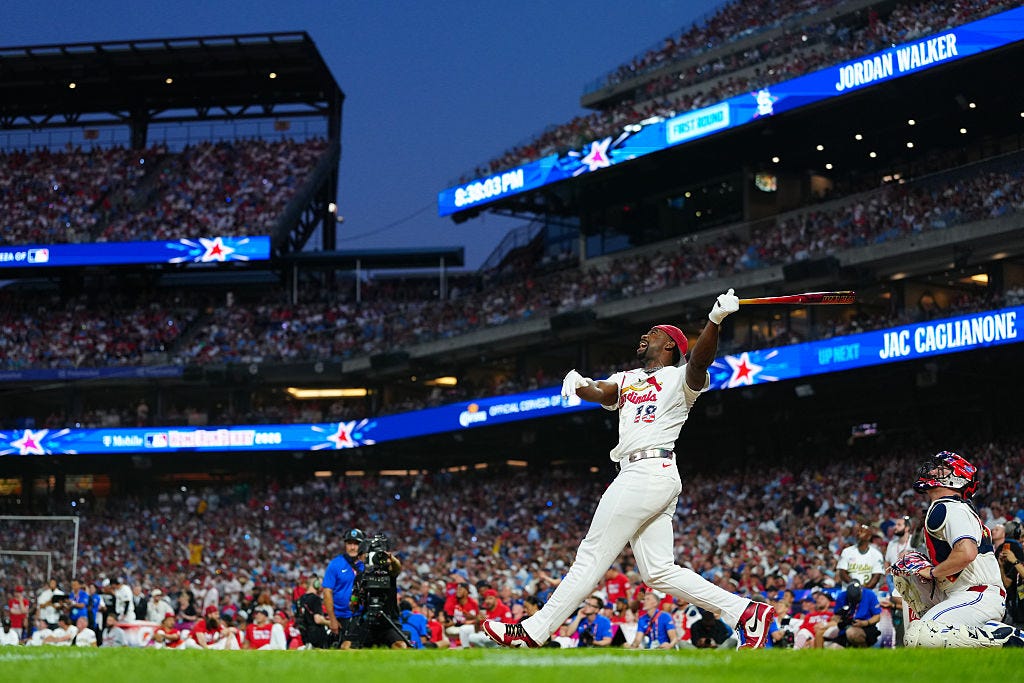
Or did I want Jordan Walker in the final to beat Schwarber and stick it to all those fans?
Yeah, I chose the latter.
And this led to the craziest finish in Home Run Derby history. Walker trailed Schwarber by three home runs, and he was down to his final swing — according to the new rules, you get to keep swinging along as you hit home runs. In other words, Walker had to hit three home runs in a row to tie Schwarber and four to beat him. The Philadelphia crowd was frantic. Walker’s parents were behind the plate, cheering.
And Walker hit home run number one.
Suddenly, this wasn’t a pointless event at all. The crowd gasped. Schwarber looked worried.
Then Walker hit home run number two.
How do sports do this to us? How did this annoying thing I almost turned off a half hour ago become the most important thing in my life?
And Walker hit home run number three to tie it up.
This is the thing about sports: They can’t ruin it. The owners. The leagues. The gambling companies. The corporate shills. The ticket merchants. The hot takers. The cynical marketing people who try to soak us. They can’t ruin it because these games, even at their silliest, reach inside us and pull out our curiosity and interest and passion. And I sat there in front of the television and said a silent prayer, and the director tried to magnify the moment by cutting to shots from each and every camera there, and then there was a pitch, and Jordan Walker swung, and the ball sailed into the night and the fog of Phillies fans’ despair.
It was entirely and utterly wonderful.
Some years ago, I got the chance to meet my idol Jim McKay, the host of Wide of World of Sports. I got to tell him how much the show meant to me, and he nodded, and I got the sense I was just telling him what so many people had already said.
“I have this belief,” he said, “that, no matter the sport, as long as there was competition, people will care.”
I think Jim McKay would have enjoyed Monday’s Home Run Derby. At least until the end. Jim McKay was born and raised in Philadelphia.
I just finished a book -- Big Fan -- and one of the chapters is about the delight of attending pro wrestling's biggest event, even though the writer wasn't a wrestling fan at all. Apparently, *his* coauthor forced him to attend in revenge for something involving pickleball. (None of this made sense. Why would anyone force their friend to do something he hated? And wouldn't it make more sense to make him go somewhere very cold?) Anyway, the author turned out to enjoy the wrestling thing because of the spectacle. Twist!
I can't believe Joe hasn't mentioned this book. It seems like something he'd enjoy.
It's a core childhood memory watching that guy get absolutely destroyed on the ski jump as the agony of defeat