

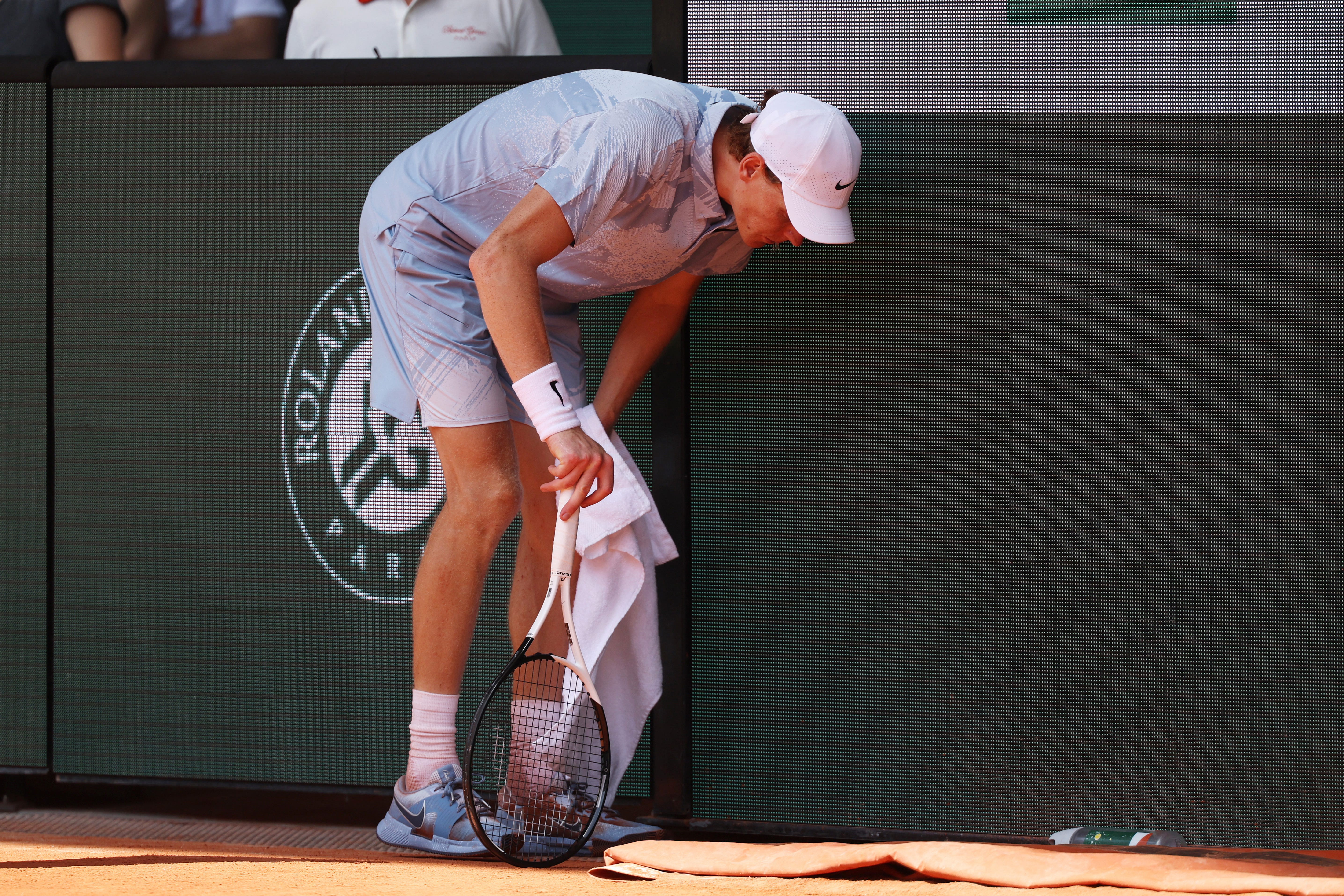
One of the craziest things in tennis history happened a few minutes ago: Jannik Sinner — the odds-on and overwhelming favorite at the French Open — up two sets and 5-1 in his French Open match against Juan Manuel Cerundolo, started to cramp up.
The heat in Paris has been unrelenting in the first week, and Sinner’s one weakness as a player is his inability to endure the heat and grueling long matches. He has never won a match that lasted at least 3 hours and 50 minutes.
Fortunately, he rarely plays such matches. Sinner is a steamroller. He blasts through opponents like no one since the young Federer. He came into this match having won 30 matches in a row, almost all of them in straight sets, with most of those sets finishing 6-0 and 6-2.
And that was the match he was playing against Cerunolo — 6-3, 6-2, 5-1, and then the heat caught up with him, and he started to cramp up, and what followed was terrible and fascinating and earth-shaking for the sport: Sinner was utterly helpless. He framed overheads. He hit forehands out by 10 feet. He tried drop shots that buried in the bottom of the net. As the match went on, it seemed like every single part of his body seized up, including his tennis brain.
It’s a jarring thing to watch the best tennis player on earth turn into a weekend hacker right before your very eyes, especially at a tournament like the French Open.
But that’s what happened. Cerundolo won 18 of the next 20 games. He took the last three sets 7-5, 6-1, 6-1. For Cerundolo, this wasn’t just the biggest moment of his tennis life — he came into the match ranked 56th in the world — it was a momentous display of tennis intelligence. He simply kept the ball in play. He understood that the man he was playing was not Jannik Sinner, and that this diminished version couldn’t stay out there much longer.
The tournament is now wide open, utterly wide open, no Sinner, no Carlos Alcaraz, and there are countless juicy possibilities. Novak Djokovic could win his 25th Grand Slam title. An American — Ben Shelton, Learner Tien, Tommy Paul, or Francis Tiafoe, or somebody — could win a Grand Slam for the first time in more than two decades. The Spanish phenom, Rafael Jodar, could, at 19, follow in the footsteps of Rafael Nadal.
But in this moment, I am not thinking so much about the possibilities as I am about human frailty. The greatest pitcher in the world is just an elbow twinge away from disappearing from the scene. The greatest running back on earth can be sidelined because his big toe turns the wrong way. One wrong step can end the season — or even the career — of the most heavenly basketball player or purest goal scorer. We, as human beings, can teach our bodies to do seemingly impossible things.
But we cannot teach our bodies to not break down.
I kept watching Jannik Sinner’s face as he tried to go on. At first, it seemed like he felt some hope that his body would recover — if not entirely, at least enough for him to put up a fight. But soon, even that hope was gone, and he played on because that’s what you’re supposed to do. It’s quite a thing to watch someone battle on long after they know the battle is lost. I suppose it’s just what we are born to do.
So tough to watch. Reminded me of the famous 1982 Ironman Triathlon in Hawaii when race leader Julie Moss had a huge lead. Dehydration then set in, and she was reduced to walking, stumbling, falling down, even crawling. Only to be passed in the final yards of the race by Kathleen McCartney.
So painful to watch. I believe it was broadcast on Wide World of Sports or something like that. It put the sport of triathlon on the map.
This match is a perfect example of what makes tennis great, or horrible, depending which side you're on.
You're never out of a match, but you can also never relax, no matter your lead.