


Hi everybody.
Today you’re getting a free read of my post on the Cy Young winners and the evolution of the award. I would love if you would consider subscribing (button below). But please enjoy this post. And thanks as always for being a reader.
Joe

In so many ways, the Cy Young Award is a reflection of the baseball times. Do you remember in the late 1970s and throughout the 1980s when Cy Young voters, all at once, decided that the best pitchers in baseball just had to be relievers?
This really came on all of a sudden — for the first 20 years of the Cy Young Award, the winner was ALWAYS a starter and, usually, a starter who won a lot of games. The award began in 1956 and it wasn’t until 1973 that a pitcher, Tom Seaver, won the Cy without winning 20 games. Seaver won 19 games but led the league in strikeouts, ERA, WHIP, complete games, etc., which was enough to beat out Ron Bryant, who won 24 games for the Giants that year.
Looking back, it seems obvious that Seaver was the better pitcher, but it was actually a controversial choice in ’73. The Sporting News did its annual poll of players, and they chose Bryant as pitcher of the year, even though his ERA was almost a run-and-a-half higher than Seaver’s, he gave up 75 or so more base runners and he struck out 100-plus fewer hitters.
Anyway, in 1977, for the first time, the voters selected a reliever, the Yankees’ Sparky Lyle*, as Cy Young winner. It was at the time a curious choice — I mean, Lyle had a very good year and the 1977 Yankees were certainly the story of baseball. But there were three 20-game winners, including Jim Palmer (who pitched 319 innings), Nolan Ryan (who struck out 341 batters), etc.**
*As pointed out by brilliant reader Joe Pancake, Mike Marshall actually won the Cy as a reliever in 1974 … I overlooked him because even though he was a reliever, he threw 208 innings that year while appearing in 106 games. There’s never been another year quite like that one — Lyle was the first, I guess, typical reliever to win it.
**Funny thing is that if the vote were held today, there’s a good chance Frank Tanana would have won the award, as he led the league in bWAR (8.3) and ERA. But in 1977, he wasn’t even CONSIDERED for the award because he won only 15 games.
“Maybe now relief pitchers will start to be recognized after sweating blood out there in the bullpen day after day,” Lyle said after the vote.
And that turned out to be prophetic because the voters decided that, yes, relievers might throw fewer innings and win fewer games, but they are the new lifeblood of baseball. Here are the relievers who won the Cy Young over the next few years:
1979: Bruce Sutter
1981: Rollie Fingers
1984: Willie Hernandez
1987: Steve Bedrosian
1989: Mark Davis
1992: Dennis Eckersley
The Bedrosian choice was particularly wacky — but that was just a wacky year overall in the National League. Bedrock had a 2.83 ERA, a 3.79 FIP, he gave up 11 homers in 89 innings, he probably wasn’t one of the top five RELIEVERS in the National League that year. But he led the league with 40 saves, and no starter won 20 games (or even 19 games), and Ryan led the league in ERA and strikeouts but went 8-16 so he obviously couldn’t win the thing.
After Eckersley won the award, though, the writers seemed all at once to come out of their weird daze. Only one relief pitcher has won the Cy Young Award in the last 29 years (Eric Gagne in 2003, when he had a 1.20 ERA and saved 55 games … though looking back he was clearly the wrong choice too). The voters never gave a Cy Young to Mariano Rivera or Trevor Hoffman or Billy Wagner or Aroldis Chapman or even Francisco Rodriguez in 2008 when he saved 62 games, a record that might never be broken.
So what do we make of that brief run of relief pitchers winning Cy Youngs? I think it was this: Starting in the late 1970s, the game was changing in obvious ways — relievers were becoming a much bigger part of baseball strategy. Relief pitchers like Fingers and Sutter and Goose Gossage were becoming some of the biggest stars in the game. The save was becoming a major statistic. Closers became a thing.
And the voters were just trying to keep up.
And now the game is changing too fast again, and we’re all desperately trying to keep up.

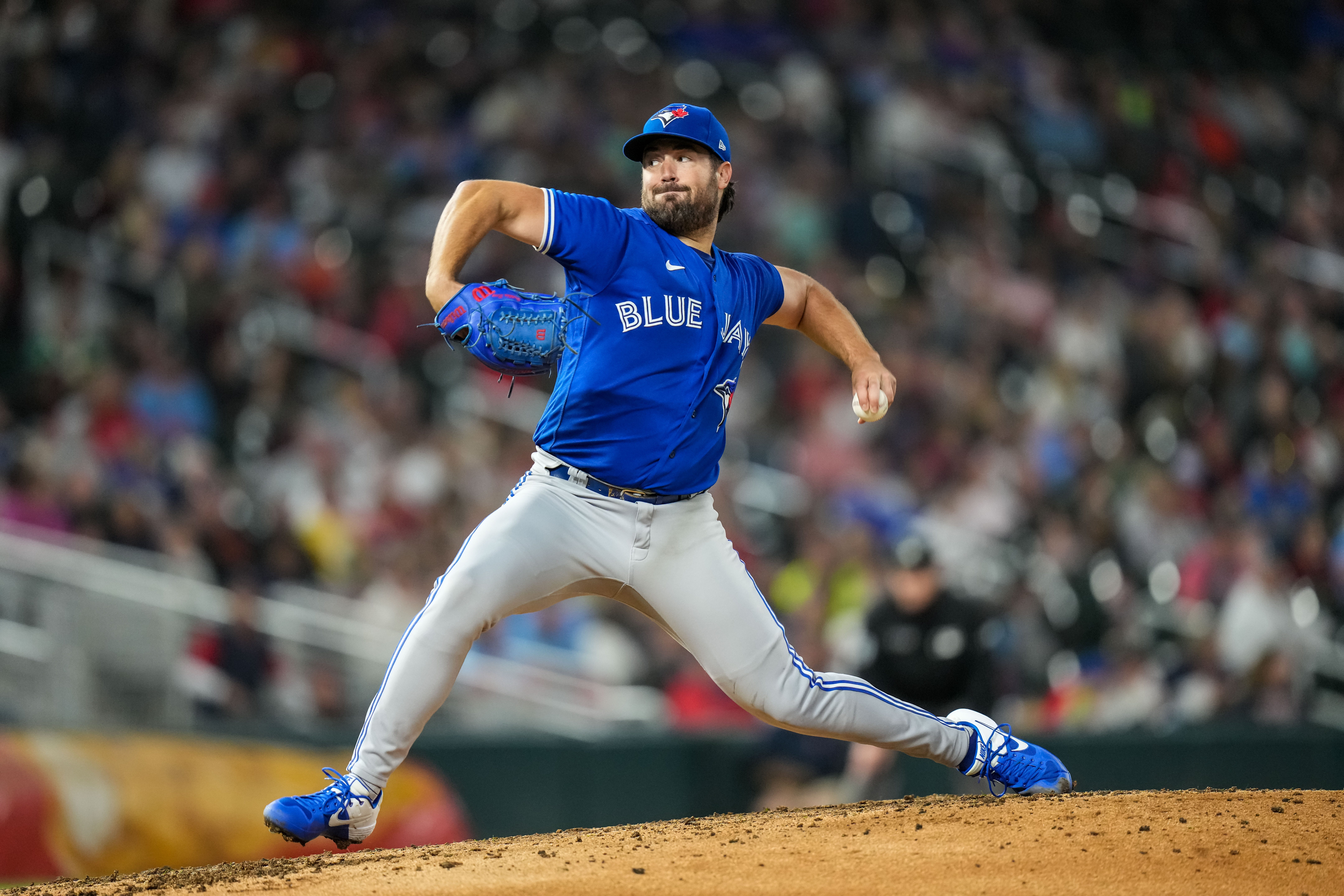
Let’s start with the less controversial Cy Young choice, Robbie Ray of the Toronto Blue Jays. In many ways, Ray is pretty much the ONLY choice, right? he got 29 of the 30 first-place votes because of course he did. Ray led the American League in ERA, in games started, in strikeouts, in WHIP, in bWAR and, interestingly enough, in innings pitched with 193 1/3.
Why is that interesting? Because that is the fewest innings EVER to lead either league (except in shortened seasons). We had never had a full season where there wasn’t at least one pitcher in the league who threw 200 innings. This is a new game they’re playing out there, and I think we’re only just beginning to get our arms around that.
OK, so, Ray is the obvious choice, right? Well, um, maybe not. It depends on how you look at his season because FanGraphs isn’t nearly as impressed. FanGraphs, as we’ve written about numerous times, judges a pitcher based on the theory that a pitcher only has real control of walks, strikeouts and home runs. And, yes, Ray led the league in strikeouts and he cut down his walks significantly, but the guy gave up bingos. Lots of them. He allowed 33 home runs, fourth-most in the league.
And because of that, his Fielding Independent Pitching (FIP) number was 3.69, which was significantly higher than second-place Cy Young finisher Gerrit Cole (2.92). FanGraphs has Cole at 5.3 WAR and Ray at 3.9 WAR, a pretty healthy difference.
Then, FanGraphs doesn’t even have Cole as the best pitcher in the league. No, by FIP, the best pitcher, incredibly, was Boston’s Nathan Eovaldi (5.6 fWAR), who struck out 195, walked just 35 and allowed only 15 home runs. Eovaldi’s ERA was 3.75 but it is FanGraphs’ contention that this was due to Boston’s subpar infield defense and some bad luck.
If you look at pitchers who threw 100 innings, Robbie Ray’s fWAR ranked him 22nd in baseball.

Then you go to the National League, and it’s the OPPOSITE situation. In this case, FanGraphs LOVES the winner, Corbin Burnes. He led all of baseball in fWAR at 7.5 because by their measurements he had an absolutely ridiculous season with 234 strikeouts, 34 walks and only seven home runs allowed. His 1.63 FIP was the lowest in the National League since, get this, Christy Mathewson in 1909.
But Baseball-Reference has Burnes SIXTH in the league in bWAR — two full wins behind second-place finisher Zack Wheeler — in large part because he pitched only 167 innings. Now, I’ve made it clear that I don’t love the way that Baseball-Reference does pitcher WAR, and I do think they do seriously underrate Burnes by giving too much of his credit to the Brewers’ admittedly good defense. Regardless, you can’t overlook the fact that Wheeler threw 46 more innings than Burnes. It’s like Wheeler was Corbin Burnes PLUS an effective reliever.
Can you overlook that?
Apparently, you can. Burnes and Wheeler each got nine first-place votes, but the rest of the spread gave Burnes the Cy Young and Wheeler was left only with Ellen Adair’s boundless love, which is truly the greater award.
The point is that we are in the midst of another pitching revolution, and the Cy Young voting just reflects the confusion that surrounds it. As starters throw fewer and fewer innings, it becomes trickier to properly assess a pitchers’ value. We threw out pitcher wins as a measure a few years ago*. We’re now throwing out innings pitched as a measure. We no longer consider relief pitchers for the award. Something’s gotta give.
*It really is quite amazing to us old-timers that Julio Urias, who went 20-3, wasn’t even a FINALIST for the award.
All of this is not to say that I would have voted any differently. I’m pretty sure I would have voted for Ray, and while I would have hesitated on Burnes because he threw so few innings*, I probably would have voted for him too when it came down to it.
*Brandon McCarthy insists that 167 innings is simply too few for a Cy Young winner, and I can see his point.
Look: I’m not at all crazy about the way pitching usage changes — I don’t think the deemphasis of starters, the proliferation of bullpen games, the parade of relievers that is the postseason is good for baseball fans. But we didn’t get a vote on that.
And now we’re stuck with this award from another time. The first Cy Young winner was Don Newcombe, who went 27-7 for the 1956 Brooklyn Dodgers. He not only won the Cy Young, he also won the MVP. Was he the best pitcher in baseball that year (there was only one Cy Young for both leagues in ’56)? These days we would probably say no. Cleveland’s Herb Score went 20-9 with a 2.53 ERA, and he led everybody in strikeouts, shutouts, ERA+, fewest hits per nine and he easily led in fWAR thanks to a baseball-best 2.78 FIP. I suspect he would win the award running away.
In 1956, he didn’t get a single vote.
We like to think we’re a lot smarter now. But are we? I wonder how this Ray and Burnes vote will look 50 years from now.

The problem isn't the number-crunching, it's the desire to simplify a complex decision by boiling it down to one crunch. All the data matters. Including results-oriented numbers like W-L record.
So I am a little late to this and no one will read it but here it is anyway. I would have voted for Wheeler.
While BR is far better at rating position players (partially because Fangraphs sucks at rating defense, using the archaic UZR) they both have problems rating pitching. Fangraphs problem is bigger, because they basically go entirely by FIP. It is a fine tool for predicting whether a guy can repeat, but for all the luck it tries to take out, home run luck is one of the biggest fluctuations for pitchers, and K's are overrated as a positive for pitchers. (And underrated as a negative for hitters. They are the exact same amount positive for one side as they are negative for the other -somewhere in the middle.) BR should emphasize defense a bit less, but defense absolutely does make a difference. The funny thing is that they are trying to take luck out of it, and no one does this for hitters.
It is my belief that a hitter could go say .300/.370/.600 one year, and .264/.330/.522 the next with the same average launch angle and speed. Both are great seasons, but a big difference in WAR. Half a dozen home runs (1 a month) go away because he had good luck hitting borderline home runs in smaller parks the first year and hits the same flies in bigger parks the second year - luck of the draw. He has 1 more play made per month against him in the field. He doesn't get as many borderline pitches and strikes out 6 more times and walks 6 more. (If you don't think that is possible, you haven't watched enough borderline pitches) This is not even counting fielding. Anyone who pays attention knows that for any fielder, it can fluctuate a lot year to year.
Speaking of fielding, team defense absolutely should factor in to pitcher WAR, but maybe not as much. DRS looks at every play. A team averaged +16 last year, because good fielders play more. But the Brewers were 45 above that. On average based on innings pitched, 5 of those runs saved happen with Burnes on the mound which changes his ERA from 2.43 to 2.69, still great. The Phillies were an incredible 70 runs below average, which could have cost Wheeler 10.5 on average taking his ERA form 2.78 to 2.34
I don't think you could go all the way with that though, because of a few things: The first is that Better pitchers put less balls in play. (Burnes had 11.6% of innings, and only 10.5% of balls in play, Wheeler had 15% of innings and 14% of balls in play) They have less base runners. Runs saved or cost happen much more often with more runners on base. Bad pitchers are affected much more. Wheeler with that 15% of innings only allowed 11.9% of base runners. Burnes with 11.6% of innings allowed only 9.7% of base runners. The third is that they don't assign runs saved to a pitcher. They don't keep track. They should probably cut the defensive influence in half just because of these things. That would put Burnes at 2.56, and Wheeler at 2.56
I wanted to make those points, even if no one reads this book, but the defining thing for Wheeler to me is that WAR is a counting stat, and should be. Wheeler pitched about 28% more innings than Burnes. For Fangraphs to have Burnes ahead of Wheeler, they are not saying he is a little bit better than Wheeler, they are saying he is a 31% better pitcher, and that is certifiably crazy.