


Apologies for the delay on this one … had some unforeseen things to deal with over the weekend.
I hope you joined in for our live thread during the Giants and Mets game on Thursday. Molly Knight stopped by. One of our Brilliant Readers, Snarffles!, almost caught Francisco Lindor’s home run ball (kind of). We all got to share in the live experience of Aaron Boone intentionally walking Miguel Cabrera with 3,000 hits on the line. So much fun. We’ll do it again soon; if you have any suggestions for ways to make it better, please leave those thoughts in the comments.
Now for random thoughts about our random game!

One thought crossed my mind when the Giants’ Mike Yastrzemski led off the game with a bunt single against the shift. Well, honestly, two thoughts, because I can never see Mike Yastrzemski hit without thinking about his grandfather, the original Yaz.
But beyond that, my thought after the bunt single was: “Wow, that looks SO easy. Why doesn’t everybody do it?”
It’s possible you thought the same thing.
I do realize that this is the devious brilliance of the shift — it really does look incredibly simple to beat. In a piece I just finished about Dusty Baker approaching 2,000 wins, I wrote a bit about the disastrous managerial tenure of Maury Wills with the Seattle Mariners. Well, one of the things that Wills believed in deeply was bunting.
I guess that should be obvious, since bunting was such a huge part of Maury Wills’ game. In his career, he had 1,866 singles out of 2,134 hits. That means more than 87% of his hits were singles, far and away the highest percentage for any player since Deadball (min. 4,000 plate appearances). How many of those were bunt singles? I suspect a lot of them.
Anyway, Wills was so committed to the bunt that he had his players do a half-hour of bunting practice before batting practice, and he said that he would call on every single player on the team to bunt … except for Willie Horton.*
*I certainly can understand why he excluded Willie Horton; you didn’t mess with Willie the Wonder. George Brett tells a hilarious story about the time during a brawl with the Rangers when, by mistake, he tore Horton’s jersey. The terror in Brett’s eyes never left him.
Now there are two ways you can look at Wills’ commitment to the bunt, depending on your own particular baseball philosophy. One, you might say: “That’s just a bananas strategy.” Or two, you might say: "Hey, you know what? That seems pretty smart to me. Bunting is an important part of the game, especially now. And hitters can’t do it anymore.”
I’ll admit that when I see Baby Yaz just make a mockery of the shift like that, I find myself thinking about Maury Wills’ strategy and thinking a little bit about the second part. Could a team bunt their way to glory in 2022?
It’s not as weird a question as it used to be. You’re probably aware that offense is not just down right now, but SCARY down. Let’s talk about that for a minute, because even though it’s early, and the weather will turn and all that, at this particular moment in time, teams are averaging BARELY over four runs per game. I mean barely — if the Cubs had not scored 21 on the Pirates the other day, teams would be averaging fewer than 4 runs per game; it’s that close right now.
The last time teams averaged fewer than four runs per game? That would be 1976.
Teams are hitting .232 right now. The last time the league batting average was that low? Never.
In the same spirit, teams are averaging 7.63 hits per game. The last time teams were averaging that few hits? Never.
Fewest hits per game:
2022: 7.63
1908: 7.75
1968: 7.91
1909: 7.92
1907: 7.99
That’s not the best company, no. And yet, this is the way the game has been going. Next on the list is the COVID season (8.04 hits per game) and then comes 2021 (8.13 hits per game). The lack of hits in baseball is kind of an epidemic.
So when you see Baby Yaz lay down an easy single like that, you have to think: Come on! Everybody should do that! Hitters could bat like .889 against these shifts! And then teams would stop shifting! And there would be peace across the land! And the game would be more fun to watch!
Lots of exclamation points.
Like Admiral Ackbar, I say, that’s the trap. Yes, it’s true, you can bunt for singles against the shift. No question. Trouble is that it isn’t as easy as Yastrzemski made it look. These pitchers are throwing dynamite at the plate, it’s not easy, facing that, to bunt the ball into fair ground, much less hit it where the ball will elude both the pitcher and catcher. Bunting against the shift is like stand-up comedy or making a pie or painting like Bob Ross. Looks easy when it’s done right.
But it’s actually very hard.
And the thing about the shift is that it preys on your mind. Sure, you can try to bunt for a single, and you might get it. But if you don’t, you feel like a jerk. You feel like you’ve thrown away an at-bat. You feel like — “Well, if I wasn’t even going to get a hit, what was the point of that?”
Sure, it’s genuinely satisfying seeing Baby Yaz make the Mets pay for their insolent shift, but no matter how it seems, you know deep down that it’s actually much more difficult than it looks.

Speaking of the shift, I felt the strangest feeling with Thairo Estrada at the plate. The television cameras panned back to show the defense and … lo and behold, the Mets were playing Estrada straight up. The third baseman was playing third, the second baseman was playing second, the shortstop was playing short, and the first baseman was playing first.
This is not the rarest occurrence; there are times when teams do not shift. Still, when I saw the Mets in a standard baseball defense, I felt my whole body relax. It was the oddest thing, not easy to explain. It’s like I had been clenching my fists for five years and suddenly noticed it and was able to unclench and unwind.
People here probably know that I’ve generally been on the side against banning the shift. I can give you any number of reasons why — two of them being (1) In the larger sense, you shouldn’t punish a team for knowing where you’re going to hit the ball and (2) I don’t think it would make that much of a difference in the actual stats of the game.
But, I must admit, in that moment, seeing the Mets playing a traditional defense against Estrada, something in my brain clicked in as if to say, “Oh, hey, you know this song.” I watched the at-bat with a different sort of confidence, knowing that when the ball came off the bat, I would instantly grasp its chances of becoming a hit. I felt calibrated with the game again.
Being honest, I had not realized how much I missed that feeling.

It’s so much fun to see the real Francisco Lindor again. In 2015, two extraordinary rookie shortstops hit the American League — Houston’s Carlos Correa and Cleveland’s Francisco Lindor. Funny thing, they both played 99 games that year and had almost the exact same number of at-bats (Lindor had 390, Correa 387).
At the time, I boldly said that I would rather have Lindor. It was a mockable opinion, and I was appropriately mocked for it. I don’t bring this up now to show I was proven right. Both have turned out to be superstars, and though Correa is off to a horrific start in Minnesota, it’s unclear which player has had the better career so far.*
*By bWAR, Correa has the slight edge, 34.0 to 32.3. But by fWAR, Lindor has a significantly larger lead, 36.5 to 27.3.
No, I bring it up now because what I loved about Lindor was the WAY he played the game. Joy just radiated off him. He always played with that big smile, and he played a great defensive shortstop, and he ran the bases beautifully, and you could tell how much his teammates loved him, and then he started bashing home runs, and I just enjoyed him as much as any player in memory. That’s not to say that Correa plays the game with any less enthusiasm, but it just felt so much more evident with Lindor.
Then, Lindor was gone from Cleveland — a heartbreaking development — and he was playing for the Mets, and it seemed like all of the joy just left him. He got off to a terrible start, the fans booed him, he got hurt, he and his pal Javy Baez gave a thumbs down to the New York fans, the New York fans didn’t appreciate that one bit, it was all so un-Lindor like.
And now he’s back — smiling again, playing great defense again, bashing homers again, scoring runs again. I had hoped this would happen. In the Pozeroski Mets preview, I wrote: “I believe in Francisco Lindor.” And I do. But, sure, I had doubts. It’s so wonderful to see the guy in all his glory.
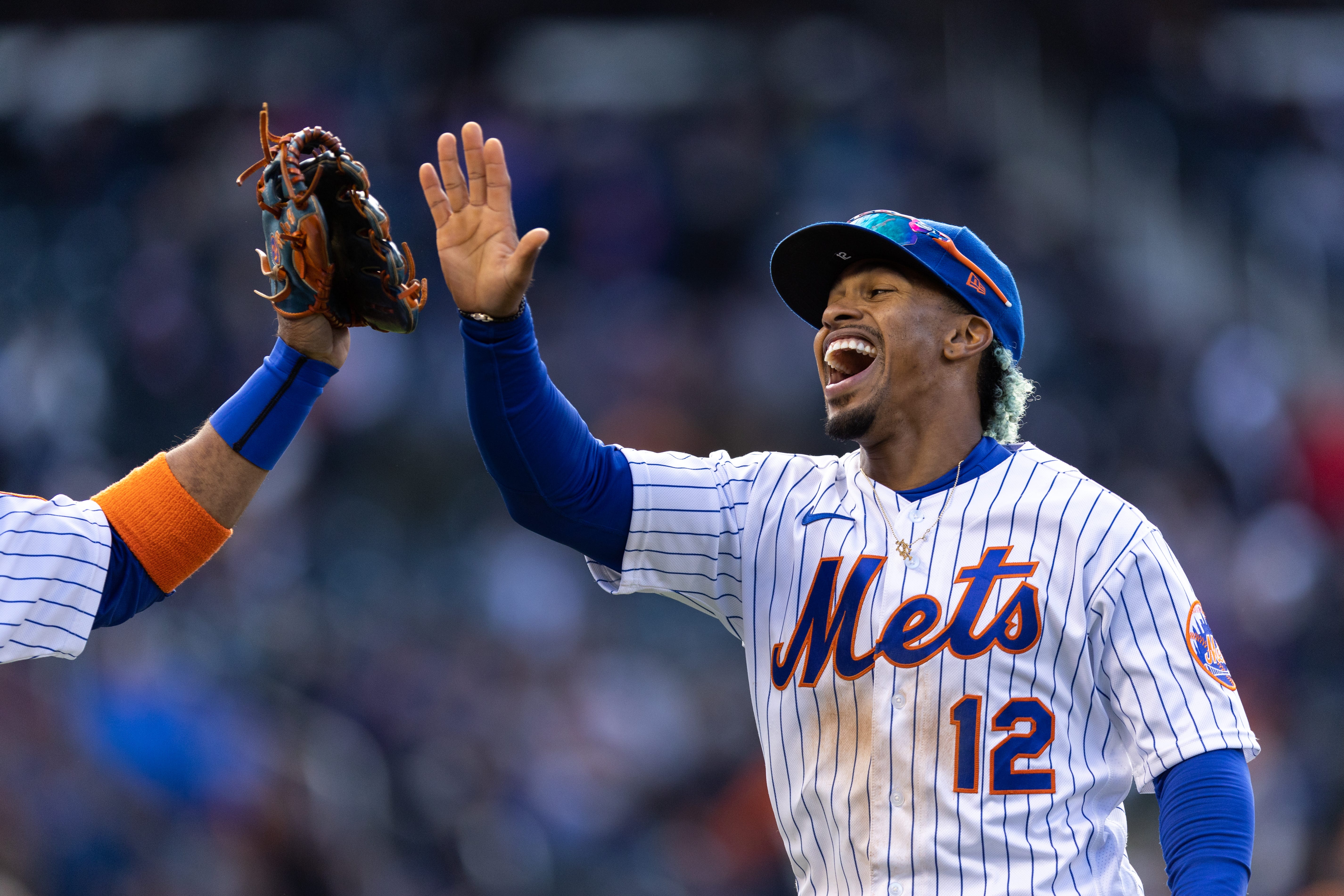
Since we’re talking about Lindor, we should mention the designated hitter thing. Lindor has been a designated hitter 12 times in his career. In those 12 games, he’s hitting .462 with seven home runs.
Yes, obviously, this is the smallest of small sample sizes and unquestionably simply a statistical oddity. But as a thought experiment, I wondered: How good would Francisco Lindor have to be as a designated hitter to make it worthwhile to put him there? Like how much better would his bat have to be at DH to make it an even tradeoff to not put his above-average glove out there?
I asked our good friend Tom Tango … and he kindly suggested it was a pretty ludicrous question since the evidence suggests that players actually hit better when they’re in the field and in the flow of the game than they do when they have to come off the bench just to hit. But he played along because he has infinite patience for my dumb questions, and he said that Lindor is probably worth about 20 runs defensively so he’d have to be worth at least 20 more runs offensively as a DH to make it worthwhile.
In 2021, roughly 20 runs separated Aaron Judge from Joey Gallo — just to give you an idea how much better a hitter Lindor would have to be as a DH than a shortstop.
This is the sort of pointless information you come here to get!

With Miguel Cabrera getting his 3,000th hit, our intrepid JoeBlogs editor Larry would like to point you to this awesome trivia question he saw on YES the other night: There are now four players in baseball history who had 3,000 career hits AND won a Triple Crown. Can you name them?
I’ll work through the question exactly as I did when Larry first posed it to me. Who is the first person you think of who won the Triple Crown?
For me, it’s Yaz in 1967. And I know that Yaz had 3,000 career hits. So that’s one.
Then, I think of Frank Robinson, who did in 1966 for Baltimore. Did Robinson have 3,000 hits? Actually, I know this one, no, he did not — he famously fell just a few hits short (57, to be exact). “I would like to get 600 homers and 3,000 hits,” Robinson said at the beginning of the 1976 season, but as a manager he only gave himself 79 plate appearances in ’76 and then stopped playing.
“I fell short of both goals,” he would say (he ended up with 586 homers), “but I’d never go back now just for the purpose of trying to reach them.” He was sort of the anti-Pete Rose.
Next, on the Triple Crown list, I think of Mickey Mantle and Ted Williams. Mantle walked so much and dealt with so many injuries I know he didn’t even come close to 3,000 (he finished with 2,415).
And the wars took Ted Williams’ shot a 3,000 away (he finished with 2,654).
Who else won a Triple Crown? I know Jimmie Foxx did, but his career was cut short (2,646 hits). I know Lou Gehrig did, but I also know that Derek Jeter was the first Yankee to 3,000 hits (Gehrig finished with 2,721).
So who else? Oh, wait, I know Ty Cobb did it. He obviously had 3,000 hits.
So who is the fourth? Rogers Hornsby? No, he didn’t have 3,000 hits (he finished with 2,930). Ducky Medwick won the Triple Crown one year, didn’t he? I know he didn’t have 3,000 hits (2,471). Anyone else? Oh, wait, Chuck Klein won the Triple Crown that crazy year in Philadelphia’s Baker Bowl right? I don’t think he even came close to 3,000 hits (he didn’t — 2,076 total).
So that’s everybody, isn’t it?
OHHHHH, wait a minute. Nap Lajoie. Sure. He won the Triple Crown in the first year of the American League — totally forgot about him. And Lajoie did have 3,000 hits.
I’m very proud of myself for coming up with the answer to that one.

At some point, someone hit a routine fly ball to New York Mets leftfielder Mark Canha.
I hereby rule that all such fly balls will now be referred to as a “Canha Corn.”
So it shall be written. So it shall be done.

JoeBlogs is a reader-supported venture. Free and paid versions are available. The best way to support us here is by taking out a paid subscription. And hey, we do have a lot of fun, so I hope you’ll come along.
Joe

I know I should say a bit more about the Giants and Mets, but I want to talk just a bit more about this home run thing — it continues to be staggering how few home runs are being hit so far. The Cincinnati Reds just played the St. Louis Cardinals in a three-game series at the Great American Ballpark, which is one of the true sandboxes in baseball.
Last season, Cincinnati had the second-easiest home run park in the National League (weirdly, behind Dodger Stadium, which was always viewed as a great pitchers park) … and the easiest home run park in the league for lefties.
Do you know how many home runs were hit in the Cardinals-Reds series?
That would be a big fat zero, cero, zeru, nul, nula, Núll, noll. I don’t know the last time that happened and am too exhausted at the moment to look it up, but that certainly feels like a bit of baseball madness.
A lot of people are talking about the lack of home runs — Dodgers manager Dave Roberts has complained about it, players are grumbling about it, batters are hitting just .89 home runs per game, down from a record 1.39 homers per game in 2019. Some are blaming the humidors that are now being used in every ballpark. Some are blaming the baseballs themselves — MLB admitted that it used two different baseballs in 2021 and maybe they’re going with the deader ones now.
Whatever the reasons, I’m more interested in where this will lead. Certainly, more home runs will be hit as the weather warms up, but it’s looking more and more like home runs will be way down in 2022. And what will that mean?
Or more to the point: Can hitters make the necessary adjustments against the wave of 100-mph pitchers with exploding sliders and change-ups that stop in midair? Right now, everybody is sort of adapting, but in time: Can batters find a new way? Can they start putting a lot more balls in play? Will they start, as mentioned at the top, bunting and slashing more against the shift? Will they find a new route to success?
This is the great battle of baseball — the balance of the game tilts toward hitters and then pitchers adjust, then it tilts toward pitchers and hitters adjust, back and forth it has gone for 150 years. If we have really reached a point where pitchers in the aggregate have become too good, then I imagine significant rule changes (such as limiting the number of pitchers you can use in a game) will have to follow.
For now, though, we look to see what batters can do when baseballs die at the warning track.

There's got to be something they've done to the ball itself. The year-to-year comparison of batted balls shows that the likelihood of a ball hit 95+ mph off the bat is only slightly down this year, but then chances of such a ball leaving the yard are WAY down from last year. It should go up slightly as the weather warms up, but jeez, not that much.
Last year there were about 10.2 baseballs hit 95+ mph off the bat per game. Those events became hits 48.8% of the time (i.e. hitters have a .488 BA when they hit the ball 95+ mph), and were homers 11.96% of the time.
This year, so far, there are slightly fewer such events, only 9.93 per game, a decrease of about 2.6%. The batting average on those is only .451, a 7.6% decrease from last year. Maybe the humidors, maybe the increased shifting, etc. could account for that, but probably not.
But the real kicker is that the chances of those batted balls becoming a homer have dropped to just 8.91%, a decrease of 25.5% from 2021!
Given that hits are coming off the bat at high speeds at a rate almost the same as last year, this can clearly not be blamed on humidors. That would change the exit velocity, I would think.
Which means it has to be the drag coefficient on the ball. Maybe the leather is slightly rougher. Maybe the seams are slightly higher. I don't know. But I bet MLB knows EXACTLY what it did, and it just isn't telling. Joe made a comment once a couple of years ago about how the PGA knows exactly what the golf ball does in every way imaginable, and was incredulous that MLB said they really didn't know. I would posit that MLB does in fact know, but they pretend ignorance so they can screw around with things when they perceive a need to do so and then plead innocence when things backfire on them.
https://baseballsavant.mlb.com/statcast_hit_probability
Something that is masking the decline of offense a bit this season. We have a universal DH.