


I asked my dear friend, the great Ellen Adair, to write up a short Phillies postmortem. She happily did this, except… she couldn’t keep it short. Too much to say!
Earlier this year, I had author Noah Gittell—a Mets fan, congrats, Noah!—on our podcast, Take Me In to the Ballgame, where we graded baseball movies on the 20-80 scouting scale).
The wise and delightful Noah quipped that nothing teaches life lessons like baseball.
At the time, I fully agreed, but with the outcome of this Phillies season sending me in a philosophical direction, the thought has recurred. It also could be that this whole year, a bit tough both for me and for the world, has me grasping at life lessons wherever I can get ’em. In any case, bear with me.
Of course, Phillies fans can—and probably will, in the long, dark offseason that started yesterday—get both philosophical and granular about what went wrong for the team, which spent 159 days in first place, and then caved in the NLDS. But perhaps I lean philosophical since I haven’t yet had the heartbroken inclination to read dissections of the highly-priced superstar bats who mostly fell short, or the “daycare” members, like Bohm, Stott and Marsh, who also, mostly, fell short, or how the bullpen, a vast improvement over the Phillies bullpen of 2022, imploded in the few innings for which it had been cultivated.
But a few bare facts before the philosophy: The Phillies had a 62-34 record in the first half (.646 win-loss percentage), and a 33-33 record in the second (.500, for anyone more mathematically challenged than even me). The Mets, by contrast, had a 49-46 record in the first (.516) and 40-27 in the second half (.597). This is not a revelation. This is not deep analysis. But the real reason they lost in four games was because the Phillies team that brought eight players to the All-Star Game wasn’t the same by the time they hit October.
Because I wouldn’t be me if I didn’t look under the hood, consider the Phillies’ chase rate. Robert Orr (@NotTheBobbyOrr on Twixter) posted a graph showing the Phillies’ chase rate on a very tragic ascent—from 26% in July, through 31% and 36% in August and September to a horror-movie 44% in the postseason. (For context, the league-average chase rate is 28.5%.)
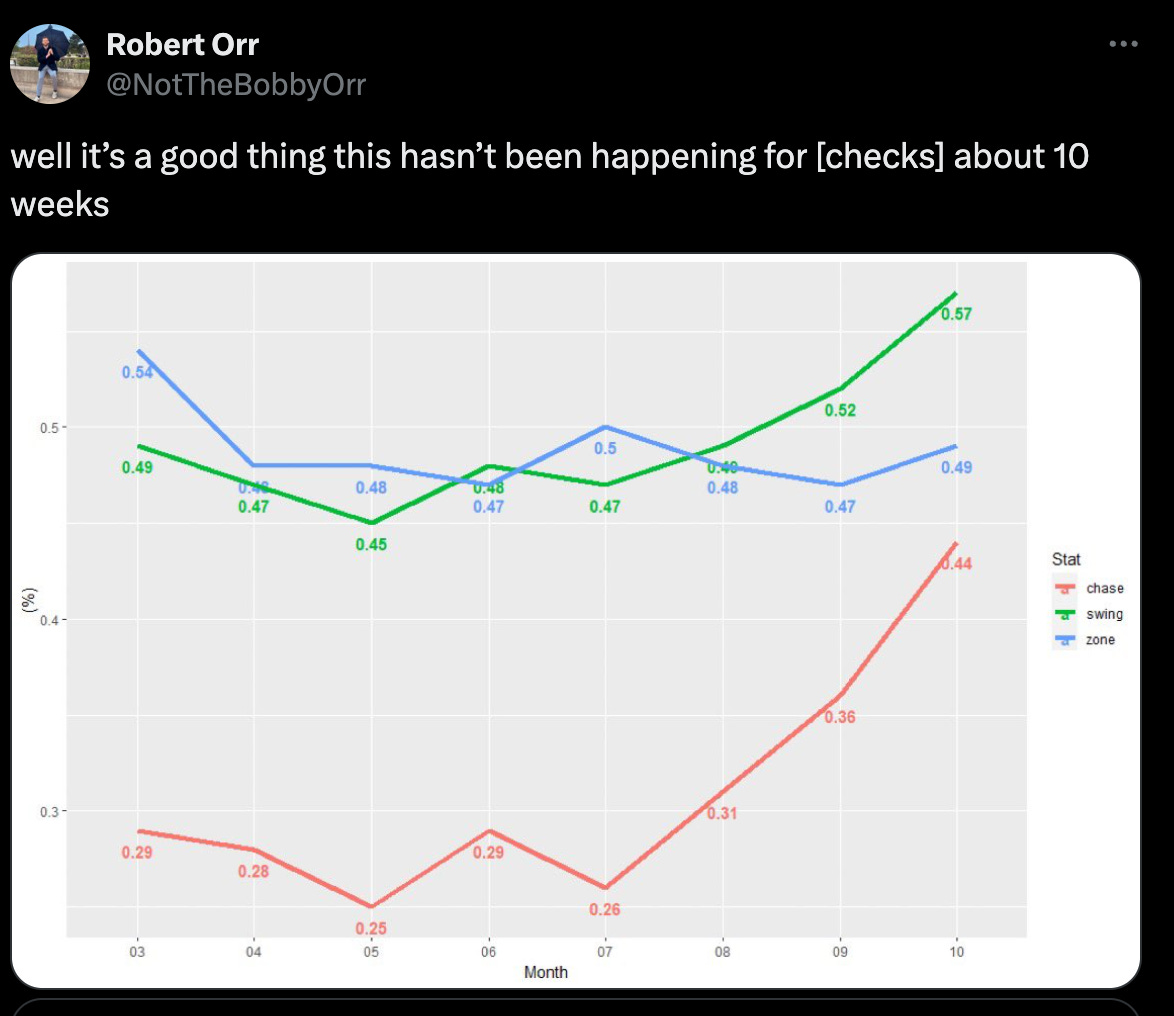
The chase rate graph isn’t a perfect mirror of the Phillies’ overall season, but it’s not far off.
This trend is particularly disheartening, because too much swing-and-miss is exactly how the Phillies lost their 2-0 lead (and 3-2 lead) in last year’s NLCS. The Diamondbacks adjusted to the Phillies, and the Phillies didn’t adjust back. The offense can be incredibly formidable, but as fans who watched the team every day know, it could also ghost the day’s starting pitcher without so much as a text.
When the Phillies were at their hottest early in the season, it was starting pitching that kept them consistent, with Wheeler, Nola, Suarez and Sanchez out-doing each other with heroics. In the NLDS, the starting pitching ranged from dazzling (55% whiff for Wheeler!) to competent, but every starter kept the team in the game.
To be clear: it’s not the bye. I think I’m not the only Phillies fan who wants to shove an entire cheesesteak into the mouth of anyone who mentions the bye. The Phillies looked lackluster enough down the stretch that I thought that a change in routine, having several days off, might be something that could shake them up and wake them up. It didn’t turn out that way, but that’s not the schedule’s fault. The postseason is always going to be a measure of the team that’s hottest rolling into October, which is not the same thing as the best regular-season team. This is a fact that this Phillies team has seen from both sides now.
Even before this year’s NLDS began, I found myself thinking of the 2011 Phillies. I’m getting to the Life Lesson, I promise. If you need a refresher, that 2011 team was not only the best regular-season Phillies team of my lifetime, but the best in all of Phillies history, going back to 1883. They had four aces, Roy Halladay, Cliff Lee, Cole Hamels and Roy Oswalt, a surprisingly good Vance Worley, and solid seasons from the back-to-back pennant core, Ryan Howard, Jimmy Rollins, Chase Utley, Carlos Ruiz, Shane Victorino., Raul Ibanez, a fantastic Hunter Pence.
I get a little teary thinking about how beautiful that 2011 team was: they had a .630 winning percentage. But toward the end of the year, they lost eight in a row, and they ran right into the eventual-World-Series-champion St. Louis Cardinals with their .556 winning percentage And that was the end of their glory. This kind of regular-season injustice has been happening since the League Championship Series was introduced in 1969, and it was no longer simply the best two teams in the World Series. I believe the team with the best record has won 15 times since 1969, i.e., not most of the time.
What makes me particularly sad are the people for whom the hollow end to the 2024 Phillies season—or the 2011 Phillies—negates the joy of the season, when the Phillies spent 159 days in first place. The 2011 Phillies were beautiful, and the 2024 Phillies were beautiful, despite their flaws. This team of lovable human beings was a delight to root for, and a joy on a hard day.
The real misfortune, and possibly the real crux of the matter, is that a number of those people considering this a lost season may be… Phillies. Many members of the team, players and staff were vocal about just trying to get back to October to complete the unfinished business of winning a championship. That makes this feel very bleak; since the Phillies are my life partner, I’m mostly happy when I know they’re happy, and sad when I imagine they’re sad.
If the script of the years had been reversed, and they’d fallen in the NLDS their first time back to the playoffs, we’d probably all still see it as a success: Yay, playoff drought is over! Instead, it’s a failure.
So, baseball life lesson number one: expectation is everything. Overhyped movies often underwhelm. The exact same soup tastes different priced at $4.95 or $28. Or, to bring us back, the same NLDS loss sits differently if you lost in the NLCS and the World Series the previous two years (also the case for the 2011 Phillies, by the way), versus if you were the division winner or snuck in on a wild card.
But I said, “the crux of the matter,” two paragraphs back, because we’re not talking about the exact same differently-priced soup, we’re talking about human beings, susceptible to the weight of expectation itself. Expectation can affect the outcome, not just color it. Perhaps there’s a reason that the 2024 Mets look like the 2022 Phillies. Perhaps there’s a reason that the 2022 Phillies made it so far, and the 2024 Phillies didn’t, despite a stronger roster. Rather than running into the playoffs like a kid given $20 to spend at M&M’s World, they came in shouldering three years of expectations.
Does this explain every last swinging strikeout, every missed pitch location? No. But although it’s not as impossible as hitting a 100-mph fastball, surviving in the entertainment industry in 2025 is Not Great, and I can tell you, the more I think about absolutely nothing when I’m auditioning and the fewer expectations I have, the better the outcome. I know this is unscientific, but the mental part of the game is real. Players aren’t random number generators, they’re human beings (although if you’re looking to quantify the weight of expectation, let me point you to a 44% chase rate).
And to some extent—baseball life lesson number two—if you spend the season thinking that you’re only trying to get to what’s at the end, it can mean that you’re just looking ahead rather than being present. It’s a truism I can vouch for: how you practice is how you’ll perform. Paradoxically, if you’re focused only on actual-or-metaphorical October, when it rolls around, being present will be harder.
Essentially, being focused only on the postseason is a shame because 1) it devalues the journey that brought you there, and 2) once you arrive at the end-goal, it can confound you. Expectation can be the thief of joy, and the thief of success.
So, having taken all of this in, this is my 2024 Phillies postmortem: Thanks, Phillies.
Thanks for the back-to-back Bryce Harper and Nick Castellanos homers on Sunday, when I shredded my voice in exultation.
Thanks for Bryson Stott’s two-RBI triple.
Thanks for clinching the NL East title with Aaron Nola on the mound.
Thanks for complete game shutouts by Nola and Ranger Suarez and Cristopher Sanchez (I was there!) and Tyler Phillips. Thanks for Zack Wheeler being Cy Young-worthy, start after start.
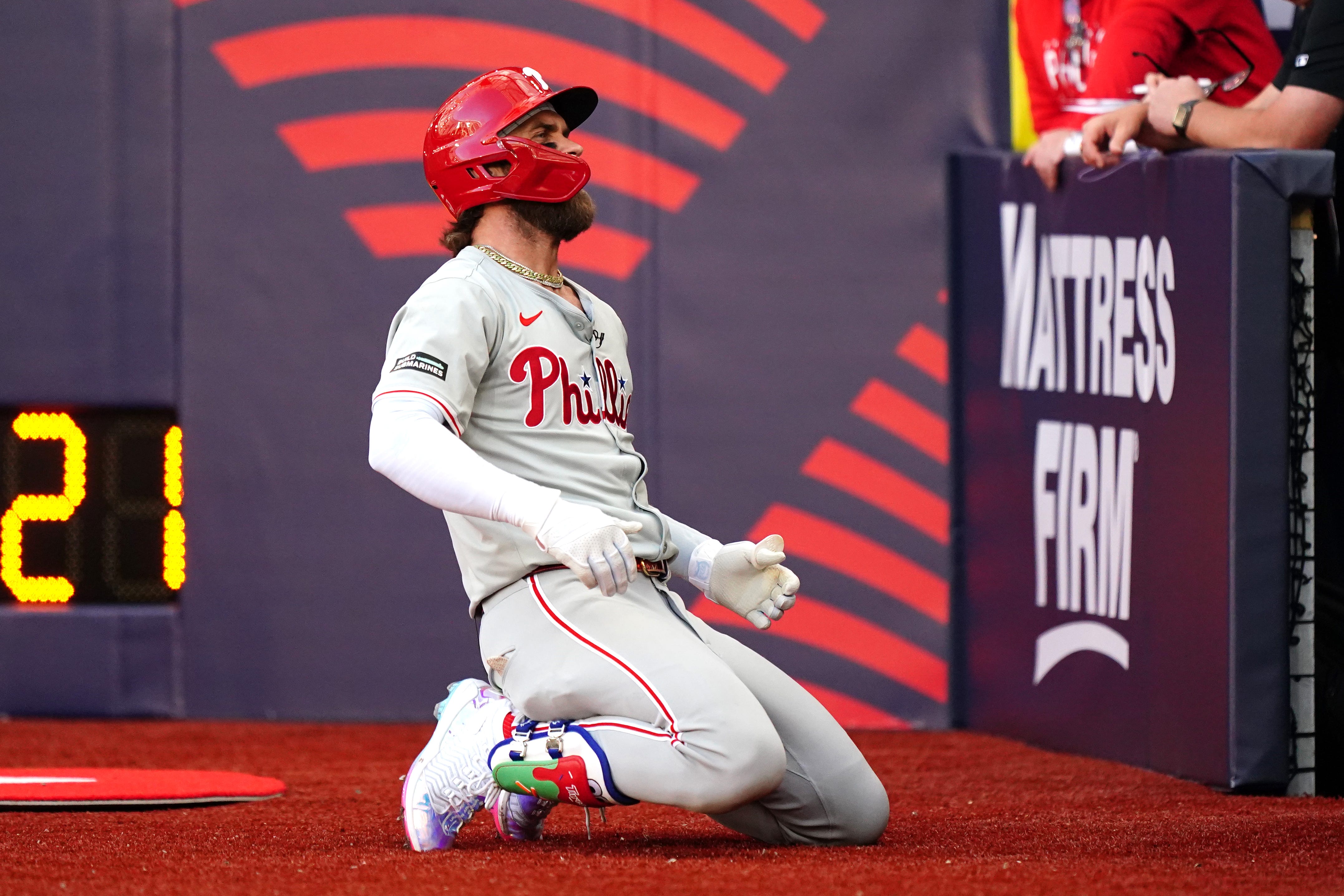
Thanks for Bryce Harper sliding on his knees in London.
Thanks for the Cal Stevenson game versus the Mets, with that fantastic home run larceny. Thanks for Johan Rojas wagging his finger after a diving stop in extras versus the Astros. Thanks for every sweet Johan Rojas hit that I celebrated like it was my own.
Thanks for Matt Strahm in his workout gear when the benches cleared. Thanks for Alec Bohm hitting better than Pete Alonso and Marcell Ozuna in the home-run derby, and laughing about the National Anthem, and for eight Phillies All-Stars, and three infield starters.
Thanks for the Weston Wilson cycle (I was there!). Thanks for Kyle Schwarber breaking the leadoff home run record while adding 50 points to his batting average. Thanks for Trea Turner’s walk-off versus the Nats, Castellanos as walk-off machine. Thanks for Marsh’s three-run, come-from-behind homer versus Atlanta, stay loose and sexy, baby. Thanks for J.T. Realmuto’s seven-RBI night. The Garrett Stubbs 4/4 game. Thanks for Edmundo Sosa in May. Thanks for Klutch Kody Clemens (and his klutch matches). The Buddy Kennedy Game. Thanks for Carlos Estevez throwing two heroic innings. Thanks for Strahm and Jeff Hoffman and Orion Kerkering looking unhittable. Spencer Turnbull, I haven’t forgotten you.
Thanks for playing baseball for me, for us. I’m grateful for every moment.

And thanks Ellen for putting so well why we love the long season, with its ups and downs, its slow building of tension, its deepening ties to "our" players. As the playoffs expand and teams - and fans - are more and more focused on a couple of short series in the cold weather, I don't ever want to take for granted the long summer of hot nights and near yet not really meaningless games.
What as awesome piece and the line about negating the joy of the season is perfection. At the end of the day baseball/sports are entertainment and nothing more. If the team you cheer for can make it entertaining for about 96% of a season, that’s a success to me. Sad and disappointed not to win, of course, but angry and disrespectful to those who play, ridiculous.
I’m a Yankee fan and no fan base is guiltier of the above than ours. As much as I loved the play of Derek Jeter I’d find it infuriating when at years they didn’t win it all he would always characterize it as a failure. I understand the desire to win, but there are better ways to describe losing in a WS or an ALCS.