

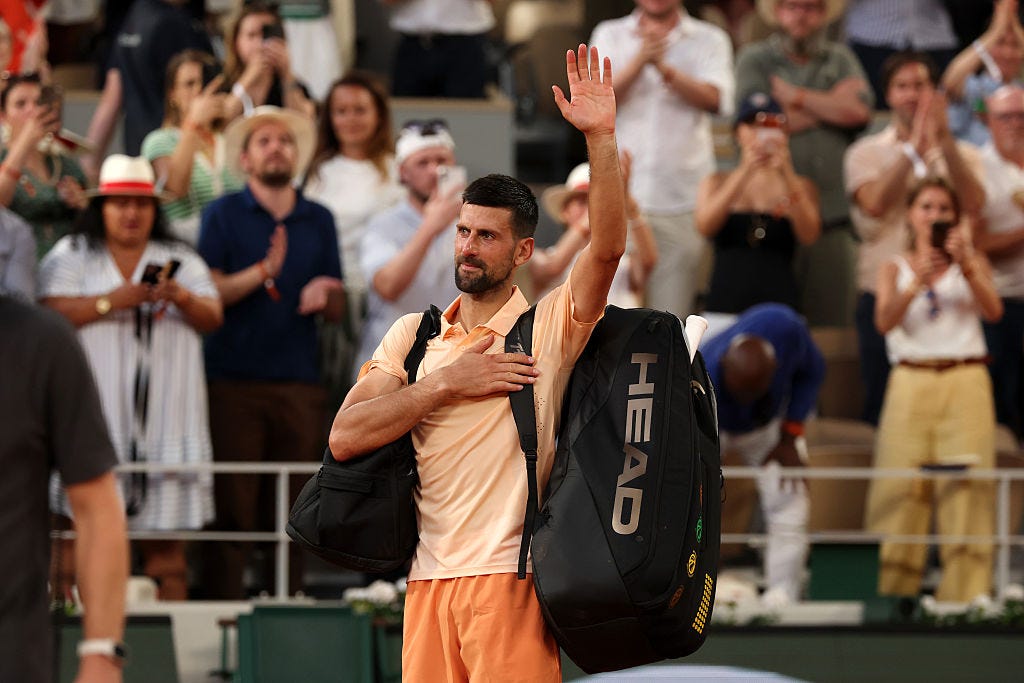
Just as Friday’s unimaginably brilliant match between Novak Djokovic and Joao Fonseca entered the fifth set, I got a text from a good friend that went like so:
Is Novak going to escape this one? Please advise! … I know you know already … out of sheer prescience.
It is true, I think — and I don’t believe it is bragging — that as a fan over the last 20 years, I have developed a highly attuned connection to Novak Djokovic’s psyche. As someone who thinks about fandom all the time, I deeply believe in this power, deeply believe that when you care about something deeply for many, many years, you do begin to build something of a cosmic sense. I think longstanding Brewers fans understand the Brewers in ways the rest of us can’t. Knicks fans, too. Canadiens fans. There’s an unspoken knowledge that builds up inside you.
This is especially true in individual sports for all the obvious reasons — while I do think that there’s something that bridges all Knicks teams, the 2026 Knicks team is entirely different from, say, the 1999 Knicks team.
But 2026 Novak is bound to 2011 Novak, even if he can no longer do so many of the things he did then.
I never intended to become a Novak Djokovic fan — I was as caught up in the splendor of Roger Federer and the gallantry of Rafael Nadal as everybody else. One day, it just happened. Djokovic was playing Federer. The crowd was against him. I was against him. And then for reasons I can’t fully explain, it turned, suddenly, without warning. I found myself rooting for Novak. Looking back, I think of it a lot like the wonderful early scene in Babe when the farmer first saw the pig:
Narrator: The pig and the farmer regarded each other. And for a fleeting moment, something passed between them. A faint sense of some common destiny.
Not long after that match, I switched from a one-handed to a two-handed backhand.
I don’t know that I connected this to Novak at the time. I understand it now.
No, Novak Djokovic has not always made it easy to root for him. There was the vaccine thing. There were the meltdowns on the court. Coaches and others around him have talked about how difficult he can be away from the court. He never had the cool grace of Roger, or the friendly warrior persona of Rafa, or the ironic mischievousness of Andy Murray.
To so much of the world, he was a villain right out of central casting.
But he has brought me so much joy as a fan. There are many surprisingly wonderful things about him. For instance, Novak is, I believe, the most gracious loser in the history of tennis, a remarkable thing considering how rarely he has lost. I think sometimes about Federer breaking down after he lost to Nadal at the 2009 Australian Open, and I think about how I understand that. It’s the most human thing in the world. Fed put so much into it, he cared so much, and losing felt a little bit like death.
How many times have we seen that in sports? I remember when the Kansas State football team lost in the Big 12 Championship Game — losing their shot at the national title — their head coach, Bill Snyder, compared the feeling to that of losing his mother. He took some “get some perspective” criticism from many, but I never thought that was fair. That was how it felt TO HIM. I don’t believe we have any right to tell others how they should process their feelings.
The point, though, is that Djokovic NEVER reacts that way, not even after the most devastating losses. I’m sure he reacts privately — he is a perfectionist, after all — but publicly, he makes no excuses, and he throws out praise, and he often sounds like he’s oddly PROUD of his opponent for rising up in the moment.
And as a player, Djokovic’s ability to get a little bit better every year — even after he became the greatest player on earth — is simply astounding. I have spent hundreds and hundreds of hours (we’re probably well into the thousands by now) watching Djokovic play, and to see how he turned from a slightly robotic baseline machine into a tennis artist is, well, it’s unprecedented. In 2011, he won three Grand Slam championships and was the No. 1 player in the world. A decade later, his forehand was better, his backhand was better, his serve was better, his netplay was at a whole other level, and his imagination on the court — his ability to dazzle a player with dropshots and lobs and angles that aren’t in any geometry books — simply boggled the mind.
It was as if Tom Brady, after becoming the best quarterback in the world, improved every part of his game (which he did) but also somehow added Lamar Jackson’s open-field running and Patrick Mahomes improvisation.
Over all those years, I’ve lived with Djokovic and died with him … but mostly lived. His ability to meet the moment, to adjust to whatever his opponent is throwing at him, to shapeshift into whatever player he needed to become is what makes him, in my view, the greatest tennis player — and maybe the greatest individual athlete — in history.
All of which finally brings us back to Friday at the French Open — perhaps Djokovic’s last French Open.
I will admit that I was more than a bit bummed to see Djokovic matched up with Brazilian wonderkid Joao Fonseca in the third round. I believe Fonseca is one of maybe three or four players on earth with the firepower and will to break the Jannik Sinner-Carlos Alcaraz stranglehold on tennis. His forehand is like something out of comic books. I went into the match feeling pretty confident that Fonseca, at 19, would simply be too much for Novak, at 39.
But Fonseca, at 19, is still learning how to harness his powers, and so Novak simply played to the kid’s inexperience and inconsistencies and outmaneuvered him for two sets. At that point, a lesser force than Fonseca would have wilted. Instead, he dug in, and he began outhitting Djokovic, and he took the third set with some ease, and he took the grueling fourth set by simply being a better player than Novak is right now. And that led to the fifth set, and the text from my friend:
Is Novak going to escape this one?
My first thought was: Yes. He will escape because he always escapes, because that’s his greatest gift. A stat came across the screen that Djokovic is 38-10 in Grand Slam five-setters, and as incredible as that statistic is — he also has winning five-set records against both Federer and Nadal — it doesn’t fully capture his specific talent for breaking the spirit (and the serve) of his opponent at exactly the right moment.
And, sure enough, he broke Fonseca’s serve early in the set. Over two decades, that has been enough to sink the hopes and dreams of so many players on the other side of the net.
But Fonseca is made of sterner stuff. And he’s young. He broke right back, powered by that dream of a forehand, and suddenly I had to reevaluate. Djokovic looked so tired. Fonseca looked like he had just woken up from a refreshing nap. And I knew, even if I didn’t want to say it out loud, that this time, Djokovic would not escape. He is 39. He has been too injured to play. His legs and lungs carry the weight of the years.
Djokovic played brilliantly. That last set was the highest level of tennis imaginable, with Fonseca hitting rocket launchers and Djokovic countering with impossible winners he learned somewhere along the long road. But the ending was becoming more and more clear, even to Djokovic himself. He would stop and smile now and again, and I think there were two meanings behind that smile.
The first, I feel sure, was his almost disbelieving admiration of Fonseca’s play, as if he was saying: “What more can I do? Every shot I hit, he answers. How can anyone defeat youth?”
And then, second, I hope, was almost disbelieving admiration of his own play. I’d like to think he was thinking, at least a little bit, “Wow, look at me, after all these years, still playing heavenly tennis against someone less than half my age.”
Fonseca got the go-ahead break with a drop shot that was too good to even chase. And then, when Djokovic got a break point to even the match, Fonseca dashed hopes with an ace … and then another … and then, yes, another. He rocketed three aces to knock out the greatest returner in tennis history. Djokovic rushed to the net to praise the kid because that’s what he does. And Fonseca, when he realized what he had done, broke down in happy tears.
No one knows — probably not even Djokovic — if this was the last time in Paris. I imagine Novak will go to Wimbledon with a bit of hope that the grass can bring out his youth one more time, and then maybe he will go to the U.S. Open with a vague belief that he has a chance, but by then Carlos Alcaraz should be back, and Jannik Sinner will be locked and loaded, and the kids will be a little bit older and better, and Novak is not much for self-delusion. When he no longer believes he can win, I suspect he will stop. That moment is coming. It always comes. But it has been one helluva ride.
With the caveat that the last time I watched an entire tennis match, it likely featured Arthur Ashe ... I've always like watching players keep going long, long after they have nothing left to prove and no hope of regaining their younger selves. Julio Franco, Jamie Moyer, Jesse Orosco ... loved 'em all. Greg Maddux on the far side of 40 pitching for the Dodgers and Padres when his fastball could be timed with a sun dial. Rickey Henderson suiting up for the San Diego Sea Dogs and Newark Bears when he was closer to 60 than to 30.
Maybe its different in tennis but Novak has maybe 30-50 years of being retired in front of him. Nothing wrong, from my POV, of playing as "only" the 10th or 20th or 50th best in the world.
Brilliant and heart warming at the same time.