

Hi Everyone!
So this week, I’ll be narrating the audiobook for BIG FAN — Mike has already read his parts, and now it’s my turn. That means the newsletter will be a little bit light this week. Narrating a book is fun — this will be the third consecutive audiobook I’ve read — but utterly exhausting. It always amazes me how much a few hours of reading aloud my own words will drain me.
BIG FAN — the book and the audiobook — comes out on May 19.

There’s a very famous strike zone story that has been connected with Stan Musial, Ted Williams, Ty Cobb, and others. I’m not sure the story ever happened, but if it did happen, it probably involved Hall of Fame umpire Bill Klem and Hall of Fame second baseman Rogers Hornsby.
It goes a little something like this: A young pitcher, maybe even pitching in his first game, throws what he thinks is a good pitch to Hornsby. The Rajah doesn’t swing, and it’s called a ball. He throws another pitch he likes, Hornsby takes it, and the pitch is called a ball again.
He starts screaming at Klem, who looks at him with a fatherly gaze.
“Son,” Klem says, “when you pitch a strike, Mr. Hornsby will let you know it.”
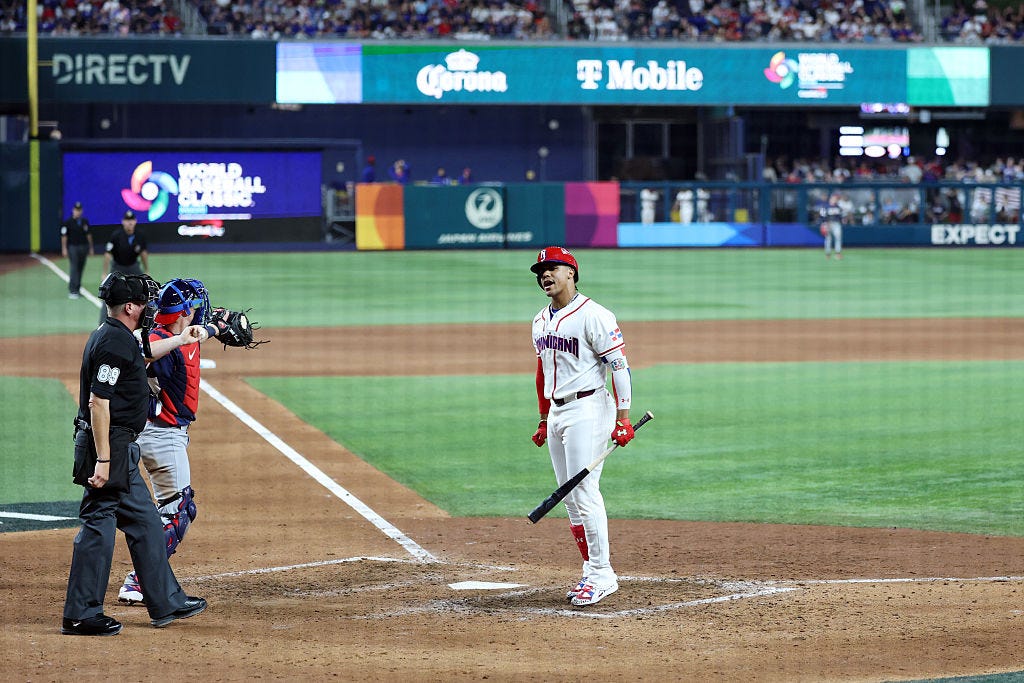
I couldn’t help but think about that story again on Sunday during the United States’ unsatisfying 2-1 victory over the Dominican Republic during the World Baseball Classic. In the bottom of the eighth inning, Juan Soto led off against Garrett Whitlock. Here’s what the at-bat looked like:
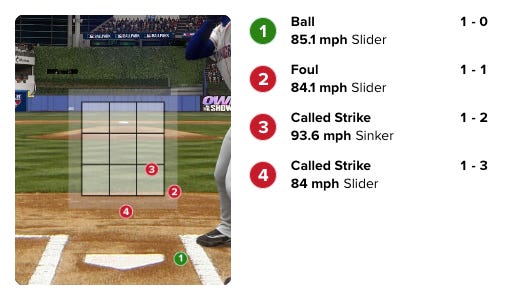
Yes, home plate umpire Corey Blaser rang up Soto on a pitch that wasn’t even close to a strike, and while this wasn’t what made the game unsatisfying — as most of you know, a worse call was yet to come — it really struck me wrong. I couldn’t even believe how much that call ticked me off.
And I think I’ve figured out why: There are some people out there who are opposed to automatic strike zone calls because they don’t want to lose the humanity of umpiring. Well, what does “humanity of umpiring” even mean? What do we believe that human beings do better, perhaps, than the robo-umps that are exponentially more accurate?
I suppose if that question has an answer, it would be that human beings can embrace what my favorite chess content creator, Levy Rozman, calls “superseding concepts.” That is to say that an umpire can take into account the situation, the conditions, the flow of the game, the importance of the moment, the spirit of the rule, and make a call based on all of it, rather than just embracing the microscopic difference between safe and out, strike and ball.
An example of this is the player who steals a base cleanly, but whose foot bounces a millimeter off the bag while the fielder keeps on the tag. The runner is technically out, but I don’t believe that the out call fits the spirit of the rule. A human umpire could call the runner safe. That would be an example of the “humanity of umpiring.”
But, of course, human umpires WILL NOT call the runner safe because they are bound by instant replay. So the humanity of umpiring has already been taken out of the game … except for ball-strike calls. And with the Automated Ball Strike challenge system coming in 2026, that last bit of humanity will begin to disappear.
Is that something worth mourning?
Well, it’s not if, in the eighth inning of a tight and exciting one-run game between the United States and the Dominican Republic, Corey Blaser thinks he knows the strike zone better than Juan Freaking Soto.
We don’t need that kind of humanity.
That wasn’t Blaser’s worst call of the night, nor the most devastating.
In the bottom of the ninth, with the tying run on third base, Mason Miller and Geraldo Perdomo locked in a breathtaking eight-pitch at-bat. This is as good as it gets; the hardest-throwing pitcher in baseball vs. one of the most disciplined players in the game. Perdomo became a star last year, in large part because he almost never swung at bad pitches and almost never swung and missed — he was 95th percentile and above in chase percentage, whiff percentage, and strikeout percentage.
This was a battle of wills. Miller started off with a pitch high and way above the strike zone. Then Miller threw a 101 mph fastball at the very top of the zone — maybe a strike, maybe a ball. I don’t know what ABS would have registered; I think it was probably a ball. Blaser called it a strike. He might have been right.
And then Miller threw another 101 mph fastball over the heart of the plate, and Perdomo took that for strike two.
Miller missed badly with a fastball, then tried to get Perdomo to chase a slider down and away. Perdomo did not bite. The count was full. This is one of the reasons why we watch baseball: to watch that ancient battle between, as my friend Jon Hock calls it, “a man with a rock and a man with a stick.”
Miller threw a 101 mph fastball at the top of the zone in almost exactly the same spot as the second pitch — if anything this one was even closer to being a strike. Perdomo fouled it off.
Miller threw a 101 mph fastball over the heart of the plate. Perdomo fouled it off.
And the eighth pitch was a slider. And …
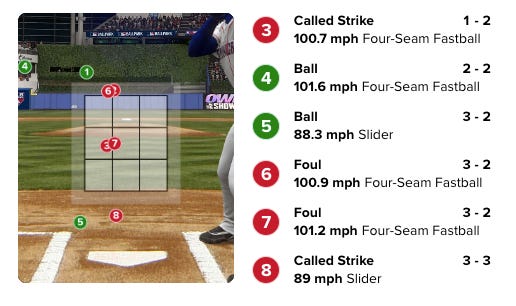
That is one of the most egregious strike three calls you will ever see.
And it was called for the FINAL OUT OF THE GAME AFTER AN EPIC AT-BAT BETWEEN TWO TITANS AND ARE YOU KIDDING ME??? That’s why we need human umpires? So they can override correct calls and wreck legendary baseball games?
I saw a few people write that Sunday’s game was basically one long advertisement for the ABS Challenge System. That sounds about right to me.
In a prior life, I was a high school baseball umpire in Florida after a few years of being a little league umpire. The bottom line is that it was a culture shock just moving from watching 12 year-olds to 16 year-olds throw the ball. I was down in central Florida calling a game, and this kid threw a curveball that I was sure was a strike, until it landed smack on home plate. My right arm was halfway up before I put it down sheepishly.
As it turns out, that was a very young Greinke.
That pitch gave me a lot of humility. I am constantly amazed the umpires do as well as they do. But we have the technology to do better now, and so we have too. Most officials I know want more than anything to get the calls right and to be invisible to the players, coaches, and fans, just facilitating fair play.
Even rooting for the US I couldn't enjoy the victory in the moment because the call was so obviously wrong and it robbed us of a tense and exciting finish that the game deserved. Very excited about ABS this coming season and hope we move to only ABS in the near future.