


This is going to be about Tuesday night’s battle of aces between Chicago’s Dylan Cease and Houston’s Justin Verlander, but first, let’s talk for a couple of moments about the Field of Dreams II game played a few days ago in the Iowa corn.
I’d say the results were mixed. We’ll start with the flaws, because there were plenty. As it happened — nobody’s fault — Field of Dreams II was a mostly boring game between Cincinnati Reds and Chicago Cubs teams that, alas, aren’t going anywhere anytime soon.
The Hologram Harry Caray singing the seventh inning stretch was just plain weird and discomfiting and an idea that should never have made it out of a boardroom.*
*You wonder if Fox will have a Hologram John Madden giving out the Turkey Leg Award at Thanksgiving this year. I suspect they will not because football tends not to do embarrassing stuff like this.
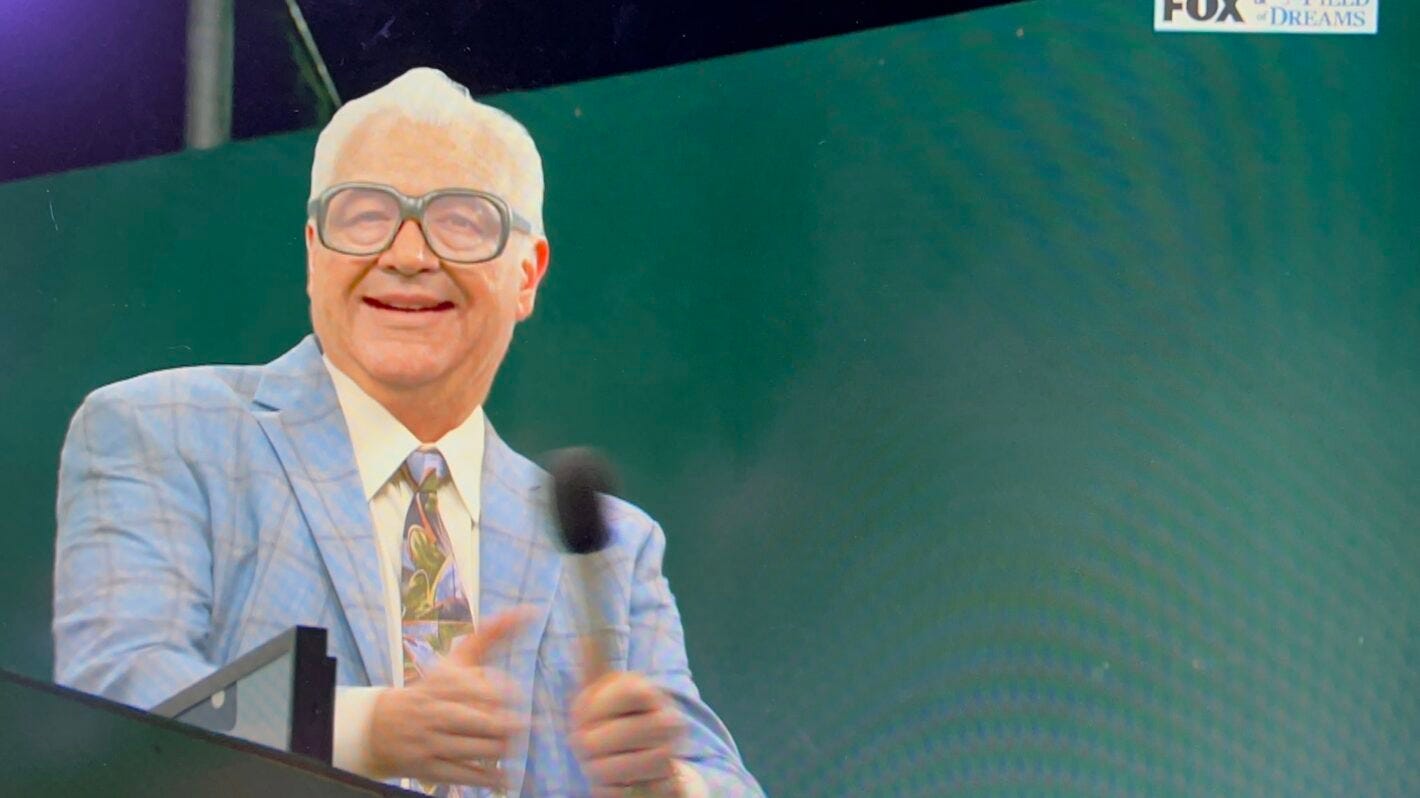
And there’s something else: Look, I’ve written at some length why, despite its many flaws, I still love “Field of Dreams” the movie. It’s a favorite of my father’s, and any son or daughter unwilling to stand up for their father’s favorite movie is no friend of mine. That said, in addition to its many other defects, “Field of Dreams” is an unapologetic celebration of one of baseball’s worst moments: It’s a celebration of the ballplayers who threw the 1919 World Series.
Yes, Shoeless Joe is at the center, and there’s some question about his commitment to the fix. But if you’ll recall, he brings back ALL of the Black Sox players who were suspended.
“There were others, you know,” Joe says to Ray Kinsella. “There were eight of us.”
“They’re all welcome here,” Ray says.
They’re all welcome here. Really? Is MLB really going to celebrate the 1919 Black Sox every year? So there’s going to be a day for Jackie Robinson, a day for Lou Gehrig and a day for Chick Gandil and Eddie Cicotte approaching bookies with the idea of throwing the World Series?
It’s really strange, if you think about it — especially because there’s a TRUE Iowa story they could use. Right: The story of Bob Feller. He grew up in Iowa, just three or so hours away. His beloved father really did build a baseball field in the corn. Bobby learned the game there. He threw fastballs against the barn. Now, it’s true that Feller could be a crank who ticked off his share of people through the years, but he was a full-fledged baseball legend and an authentic American hero who volunteered for service the day after Pearl Harbor.
I’m just saying that it seems rather silly to keep celebrating the movie “Field of Dreams” when Bob Feller is right there.
Anyway, Field of Dreams II, as you might expect, drew in about half the audience of the first Field of Dreams game. Well, it was a rerun. There wasn’t anything new about it.
Except … there was something wonderful about it: The game was different. And, as Bill Murray says at the end of “Groundhog Day,” different is good. In a 2,430-game slog that is the baseball season, here was one game, pulled from the rest, and it was on network television, and it was in prime time, and it was both recognizable (the rules are the same) and unrecognizable (they’re playing in a cornfield!).
There should be a game like this twice a month all summer long.
I obviously don’t mean a game at the Field of Dreams field … I mean a special game that stands out from the rest.
I thought about this a lot during Field of Dreams II; even if the game was kind of a dud, it still FELT distinctive and quirky and entertaining, words that baseball has trouble with. There was a real reason to gather with the family around the set and watch a baseball game in August. Sure, the ratings were way down, but still, 3.4 million or so people tuned in, making it the most-watched regular-season game of the year and a relative ratings’ success.
JoeBlogs is a reader-supported venture. Free and paid versions are available. The best way to support us here is by taking out a paid subscription. And hey, we do have a lot of fun, so I hope you’ll come along.
Joe
I thought about that a lot again during Cease vs. Verlander on Tuesday night. I kept thinking: This game should be on national television. This game should be given the big sports treatment. Here you have a superstar young pitcher vs. the superstar legend who was his hero — I mean, that stuff writes itself.*
*This was supposedly the first game since 1985 where both starting pitchers had ERAs under 2.00. I heard this stat on the broadcast and have not had the time nor inclination to look it up. It sounds good.
As I may have mentioned — and will mention 1.4 billion times over the next year — I’m writing a book called WHY WE LOVE BASEBALL, a countdown of the most magical moments in baseball history, and I’ve been thinking a lot about Reggie Jackson’s three-homer game in the World Series. That is obviously one of the most magical moments in baseball history.
And yet, the moment I remember better and cherish more was not the three-homer game of 1977, but the Bob Welch-Reggie Jackson matchup in the 1978 World Series. The Yankees trailed by a run, bottom of the ninth, two on and two out, Bob Welch was a rookie and 21 years old, Reggie Jackson was Mr. October, and everything about that matchup was epic and colossal and nail-biting and wonderful, even if you didn’t care who won or lost.
Sure it was all different then — there were 43 million people across America watching, about four times the number of people who watch the World Series now — but the point was that if you watched that moment, no matter what else, you could not help but fall in love with this crazy game.
Baseball doesn’t give us nearly enough of those moments.

What if they reduced the schedule some to create special baseball nights twice a month during the summer? Would Fox go for that? Maybe so — feels like it could be pretty great. We’d call these “Highlight Games” or “Super Games” or something, and maybe you would play them on Thursday nights, and the schedule would be built around them.
Some of the highlight games would be special games like Field of Dreams or having teams play in Negro leagues uniforms at Rickwood Field in Birmingham (where the Birmingham Black Barons used to play) or Hamtramck (where the Detroit Stars used to play). Maybe you’d have a Bull Durham game in Durham, N.C., a “Major League” game with Bob Uecker in the booth, a “Who’s on First” game with the players wearing the names of the players in the skit on their backs (I just want to see Joey Votto with WHO on the back of his jersey).*
*I’ve long had this idea of an “announcer” game, where you would have different announcers every inning — some just great announcers like Jon Miller or Gary Cohen or Duane Kuiper and Mike Krukow, some celebrities like Will Ferrell and Paul Rudd, some announcers from other sports like Charles Barkley and Tony Romo. I don’t know, maybe that’s a flop of an idea, but it’s always been there in the back of my mind.
But other games would be exciting matchups planned somewhat in advance. I realize that this takes some imagination, but to me it’s simple: Baseball has become a thoroughly local game. There aren’t BASEBALL fans across America so much as there are Yankees fans and Royals fans and Cardinals fans and Dodgers fans and Mariners fans. You’re not going to change that entirely, nor should you … but MLB, in my mind, has done such a poor job of selling the sport as a sport.
So, I would do it so that the Angels would save Shohei Ohtani to pitch in a Highlight Game. That would just be baked into the schedule. Players who know they’re playing in a Highlight Game might be asked to wear a microphone for a half inning. When a player is having an extraordinary season, like Aaron Judge is, you would set up a Highlight Game around him (and maybe not against the Red Sox since that’s pretty much the only game they ever show on Sunday Night Baseball).
And when you look ahead — maybe 10 days ahead — and see something like the Dylan Cease-Justin Verlander matchup, you do whatever you can to make that a Highlight Game.
True, doing any of this would mess with the timing. Teams might have to move their pitching matchups. They might have to play their stars rather than giving them a rest. Maybe they’d even have to change dates, moving a Wednesday game to Thursday. I’m sure there would be enormous backlash from the Players Association and from teams and, basically, everybody. As one insider says, “it sounds like a heavy lift.”
But as mentioned, there are TWO THOUSAND, FOUR HUNDRED AND THIRTY baseball games during a regular season. It’s one big bog. MLB has found a way to cater to gambling. MLB should find a way to cater to its own interests.
Hey, if you feel like it, I’d love if you’d share this post with your friends!
Now, I will admit: This might all be wishful thinking. As Sports Media Watch tweeted, the largest MLB audiences this year have been the Field of Dreams game and nine Yankees games. Maybe there simply isn’t a national audience appetite for baseball games.
But I’d like to find out. I want to believe that the reason there isn’t a national audience for baseball games is that there hasn’t been the right kind of effort to sell baseball to America. In my mind, there have been only two games this year where there has been any effort whatsoever to promote the game.
One is the All-Star Game, which drew record-low ratings this year, but still had about 7.5 million viewers.
The other is the Field of Dreams game, which, as mentioned, was a rerun and still drew the biggest regular-season crowd of the year
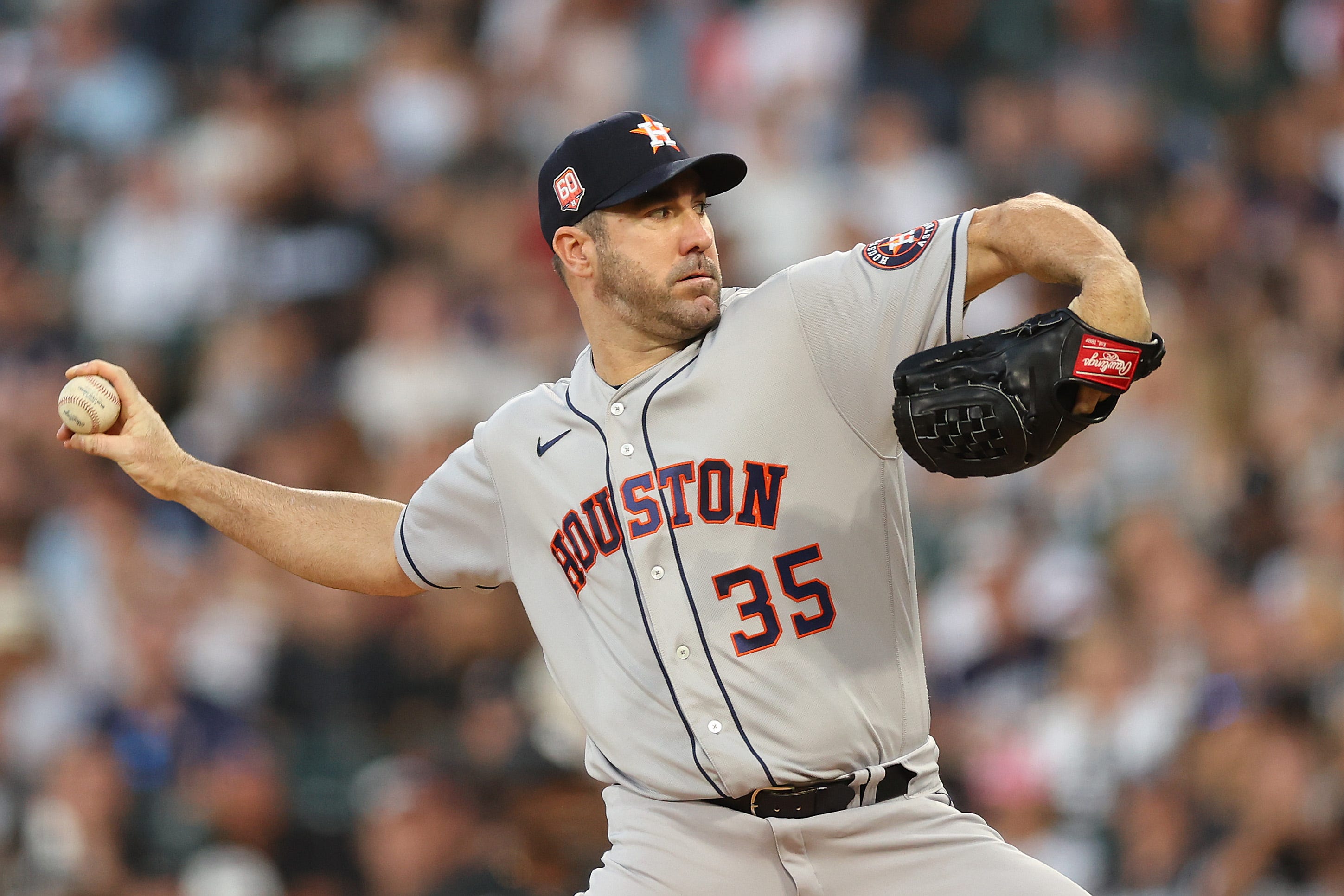
I’d like to see baseball try to get up on the national stage. Tuesday night’s matchup between Cease and Verlander would have been a good opportunity. It could have been used as an homage to the great pitching rivalries of the past. It could have been a celebration of Verlander, having an absolutely extraordinary season at age 39.
Instead, it was another regular-season game that I watched because I love baseball but few others did unless they were Astros and White Sox fans.
As for the game — as it turned out, the pitching itself was a bit disappointing. Cease was not sharp and he gave up three runs — the first time in almost two months that he has given up more than one earned run in a game.* Verlander hung tough for six innings but gave up two in the seventh on a Gavin Sheets double (though he did dial up a vintage Verlander 99-mph fastball to strike out the next batter, A.J. Pollock).
The White Sox scored the winning run in the eighth off Hector Nerris.
*Defense is such a big part of pitching. As you know, Cease had a 14-game stretch where he did not allow more than one earned run. Incredible stuff. Historic stuff. His ERA over that stretch was 0.66. Of the six runs he gave up, five were on solo homers.
But … it wasn’t quite that good because the White Sox defense is pretty terrible. He gave up 10 unearned runs over the same stretch. And on Tuesday, he gave up two runs because rightfielder Andrew Vaughn couldn’t pull in a very catchable fly ball hit by Kyle Tucker. It wasn’t a routine play, so Vaughn was not given an error. But it was unquestionably a makeable play. If Vaughn catches that ball, Cease’s streak is likely still alive.
People sometimes ask me what I’d do if I were named commissioner. Well, first thing I’d do is renovate our bathroom because our shower is the worst. But second, I’d go all in on trying to make the game more national by highlighting the incredible players, thrilling matchups and unmatched history of baseball as often as I could. Maybe it can’t be done. But I’d sure give it a try.

There really needs to be more discussion about how difficult it has become to watch baseball if you want to. Most teams games are only available on cable services so not available in most streaming packages. MLB offers a streaming service that is pretty expensive but would at least be an option for fans EXCEPT you cannot watch the games of the team you actually care about. I live in New England and want to watch the Red Sox. NESN is only available on one service (fubo). They finally came out with their own streaming service but the pricing for it is insane. I would gladly be a MLB.tv subscriber if the Red Sox games were just available to watch. Not counting last years playoffs, I have seen maybe 6 Red Sox games over the last few years because their game was on national TV (and I realized it in time). No other sport operates like this. It is insanity.
It was easier, I think, to be a BASEBALL fan back in the day. Yes, I am a Red Sox fan and have followed the team for almost fifty years, but, almost fifty years ago, not all the Sawx games were on the tube. There was radio, and there was the coverage in the paper the next day ... that also included full MLB recaps. And then there was weekly coverage in Sports Illustrated (for the life of me I don’t understand how I missed the Sporting News back then, but I did ... that’s 50 points from Hufflepuff), and, in the pre-investment days, baseball cards. We had the game of the week on NBC ... and Monday Night Baseball ... and for those not old enough to remember, it was not wall-to-wall Red Sox-Yankee coverage. We got to see ... the stars. The Dodgers, the Pirates, the Reds ... from that strange and wondrous place of which we’d heard was rumored to exist ... the National League. So, sure ... we could experience our home team to a degree, but, we also experienced ... BASEBALL. I had three big posters on my bedroom door ... Jim Rice (naturally), Tom Seaver, and George Brett. BASEBALL had cast its spell on me. It’s hard, though. As you mentioned ... unlike the NFL or NBA where the biggest stars must rise to the occasion every single time ... Steve Garvey could go 0-4 ... Dave Parker could ground into a rally-killing double play ... Jim Palmer could give up the game winning RBI via a double to the gap. Mike Schmidt strikes out. Orel Herscheiser is wild. Greatness in baseball is mostly cumulative. Rarely do we catch lightning in the proverbial bottle. Baseball needs to promote its stars ... and its game ... and not just as a function of and for gambling. It seems some days MLB fears promoting the players for fear of raising their value, which, in turn, would raise their cost. Owners are all in on growing their assets in and surrounding their ballparks, but, seem at a loss for how to grow the game between the lines.