


At least once a match these days, but often two or three or four times, Novak Djokovic does something that I can only describe as a magic trick. What happens is this: Djokovic will hit a poor shot — a short lob, a sitting duck, something that seems to set up an easy putaway for his opponent.
Only then, just before the opponent hits it, Djokovic suddenly sprints to exactly the right spot, as if he has read his rival’s mind, and he hits some sort of crackerjack shot, sometimes a clean winner, other times a lob that turns the point around, sometimes a dipping shot that forces an error and leaves the opponent cursing himself.
“Novak guessed right there,” the announcer will say, but I’ve watched Djokovic enough now to know that this isn’t exactly right. He’s right too often for it to be guesswork. It’s mentalism. It’s fortune telling. Others guess. Novak knows.
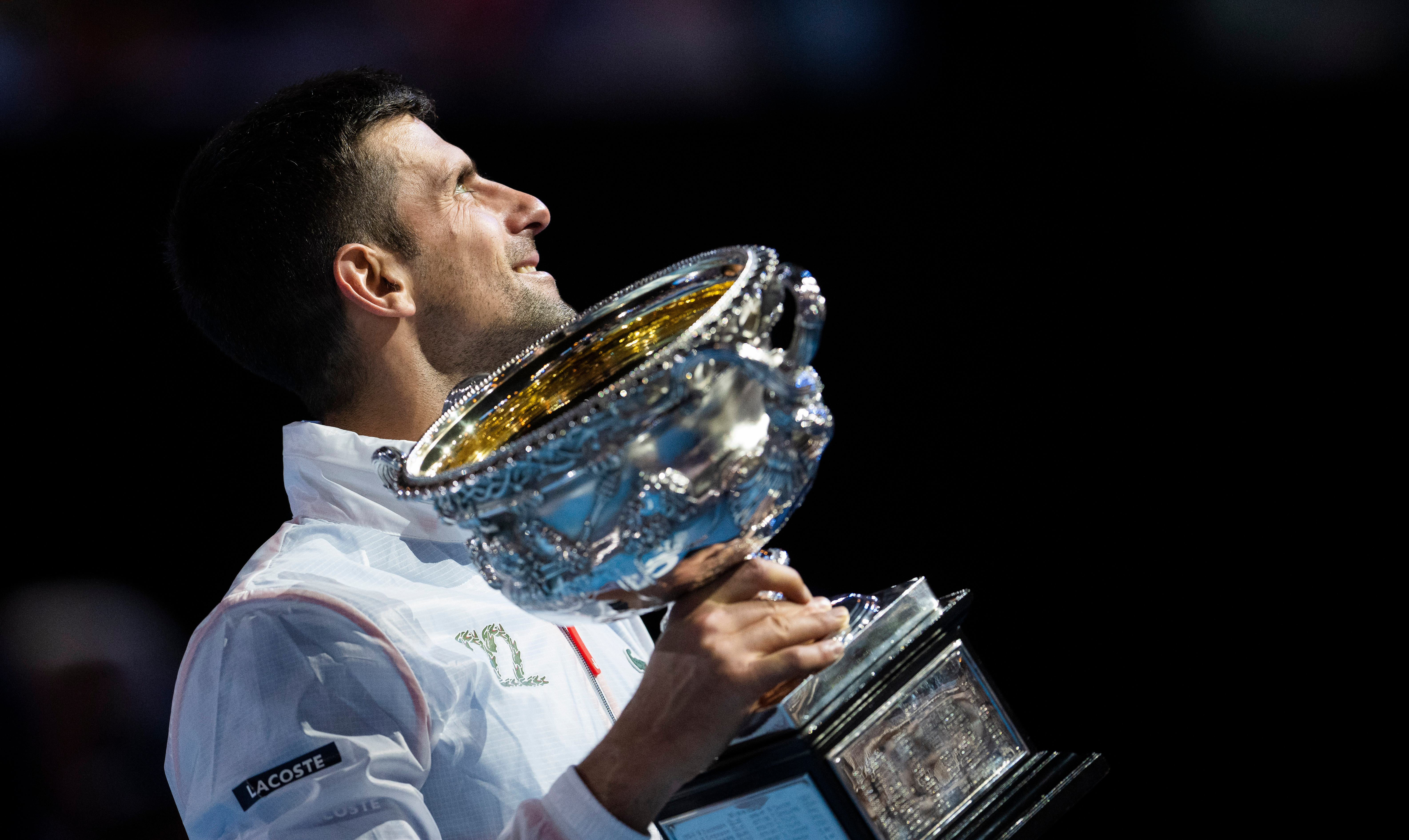
It does not seem possible that Novak Djokovic, as he closes in on age 36, could actually be better than he was in his younger days, and yet here we are. He has just won his 22nd grand slam title, his 10th Australian Open, he’s No. 1 in the world again. He lost only one set in the whole tournament, and that was back at the beginning when he was dealing with a hamstring injury and the public doubts about that injury.
The rest seemed so impossibly easy.

JoeBlogs is a reader-supported venture. Free and paid versions are available. The best way to support us here is by taking out a paid subscription. And hey, we do have a lot of fun, so I hope you’ll come along.
Joe

For the record, that one lost set was to a 27-year-old Frenchman named Enzo Couacaud, who has spent a few years hustling in Futures and Challenger Tournaments, and who is hoping to once again break into the world’s top 200. Taking a set off Djokovic might just be the highlight of his tennis career; he won the last three points of a second set tiebreak when Djokovic’s relentless concentration briefly broke down. Enzo looked to his box and pumped his fist in triumph when Djoker’s final backhand went a few inches long.
Djokovic won the next two sets 6-2, 6-0.
Grigor Dimitrov is a likable Bulgarian who built his game to look like that of his idol, Roger Federer — big forehand, good serve, one-handed backhand, good net game, etc. They used to call him “Baby Fed.” Dimitrov can play all-world tennis when so inspired, and he did force a tiebreak in the first set when Djokovic briefly lost focus after the umpire called a time violation. In the end, Djokovic won the tiebreak and the next two sets despite at times limping and calling for a medical timeout.
“I’m still here and still holding on,” Djokovic said afterward.
The next match was against Alex de Minaur, an Australian speedster whose style favors Djokovic’s — at his best, de Minaur runs down everything and forces opponents to hit two, three, four more shots in a rally than they would like. Djokovic often plays that way; he can become a wall and make opponents wilt in frustration and exhaustion.
But the thing that makes him Novak Djokovic is he doesn’t HAVE to play that way. He’s a man of many games, many styles, many masks. On this day, he decided not to play around; he overpowered de Minaur. Djokovic won 6-2, 6-1, 6-2 in a little over two hours, and de Minaur never had a single break point.
“If that’s [his] level,” a shattered de Minaur said of Djokovic after the match, “yeah, that’s the guy that’s going to take the title.”
Next up, Andrey Rublev, a Russian slugger with one of the best forehands on earth. Rublev’s hammer forehand comes with perhaps the loudest grunt on the men’s tour, so it feels doubly ferocious. Rublev is ranked No. 5 in the world and had beaten Djokovic in the past — in Djoker’s home tournament, no less — and he came in with some hope. “The only chance I have is if I play my best tennis, just fight for every ball,” he said.
Djokovic dispatched him in a little over two hours, and Rublev did not break Djoker even once.
“I don’t know what to say,” Rublev said afterward.
Then came Tommy Paul, an American having the tournament of his life. When Paul is at his best, he’s a complete player, super fast, great touch, good at the net, can stand in for the long rallies, returns very well. He too seems to be in the mold of Djokovic. The first set was interesting, Paul came back from 4-1 to even the match, but he simply could not hold off Djokovic’s sheer intensity. Novak won the next two sets, 6-2, 6-1.
“He didn’t let me execute any of the game plan I laid out for myself,” Paul said. When someone asked him about the experience of playing in his first grand slam semifinal, Paul offered a sad smile and said this:
“I mean, walking on the court was cool. Playing the match and getting beaten like that kind of sucked.”
Finally, Djokovic played Stefanos Tsitsipas in Sunday’s final, and Tsitsipas has everything in his game: huge serve; enormous forehand; great movement; big one-handed backhand. He came into the match knowing that if he won, he would not only have broken through at a grand slam — something people have been predicting for him for a long time now — but he would be No. 1 in the world.
And Tsitsipas, unlike everyone else, often matched Djokovic’s brilliance. He won some of the more intense rallies. In the match, he actually hit more winners than Novak did. He often overpowered Djokovic with his serve. He unleashed a couple of devastating drop shots — nobody on earth chases down drop shots like Djokovic does, but Tsitsipas managed to win a couple of big points that way.
But — such a big word — when it mattered, when the match hung in the balance, it was Djokovic who was triumphant. How does he do that? What is it that beats inside him that allows him to play the big points better than anyone no matter what’s going on around him? Off the court, this tournament was typically turbulent for Djokovic. Some of it was his doing. Some wasn’t. He was deported from Australia just last year for not getting vaccinated and everybody wanted to talk about that. It looks like he will miss the big U.S. tournaments this spring because he’s not vaccinated and everybody wanted to talk about that, too. People questioned his injury. A heckler was so insistent that Djokovic asked the umpire to have him removed. His father, Srđan, was caught on camera posing with Russian fans holding up flags and wearing the Z symbol in support of the country’s war with Ukraine.
“Yes,” Djokovic said with exasperation in his voice, “there always seems to be something.”
And yet, when the moment comes, when it’s break point or set point or deuce, and the match hangs in the balance, he goes inside himself like no one else. He beat Tsitsipas in straight sets, the last two in tiebreakers. As mentioned, he now has 22 majors, tied with Rafa Nadal for most ever. He’s No. 1 in the world again and will only add to his record of 374 weeks atop the globe. This was among his most dominant performances.
For a long time now, I’ve had this theory about the Big Three: Federer, Nadal and Djokovic. I think most people would call them the three male greatest players of all time*.
*Though my friend Jeff Sackmann ranked Rod Laver No. 1. His Top 10 list is fascinating; he ranked men and women together and put them in this order.
Rod Laver
Steffi Graf
Martina Navratilova
Novak Djokovic
Roger Federer
Serena Williams
Bill Tilden
Rafael Nadal
Chris Evert
Helen Wills
My list would, I must admit, look VERY different, but Jeff does know a lot more about tennis than I do.
But my theory is that we wouldn’t fully appreciate how great the Big Three is — how impossibly great — until they are gone. And I see my theory coming to life now. See, here’s my thought: The three of them were so historically great (and Andy Murray briefly joined them in the stratosphere) that they counteracted each other. If you have Carl Lewis, Mike Powell and Bob Beamon all at their best long jumping against each other, you will have an extraordinary contest … but you will not full appreciate just how much better they are than everybody else ever.
And I think that’s what we had with Fed, Rafa and Djoker. Together they pushed tennis to an entirely new place.
And with Fed retired and Nadal diminished and near the end, only Djokovic can reach that place now.
That’s why he looks better than ever.
Because there’s no one in the world right now who can reflect and deflect his greatness. It’s certainly possible that young talents like Carlos Alcaraz and Ben Shelton and Holger Rune and Felix Auger-Aliassime and Jannik Sinner will reach these heights. And it’s also possible that they won’t, possible that when Djokovic finally does leave the stage, he will leave behind chaos, disarray, upsets, like it is in the women’s game. He just might leave behind a rotating No. 1 ranking and years where four different men win the four grand slams.
And then we’ll be able to fully appreciate the way those three played off each other.
Ah, but Novak is not leaving the stage just yet. He has 22 grand slams, and if he stays healthy (and depending on Rafa’s health) he will be the favorite in every grand slam he plays for a while. I suppose controversy will continue to surround him; that seems to be his lot in life. But on the court, there’s never been anyone like him. He keeps guessing right.

Novak is the mentally toughest player to ever play the game. He dominates and intimidates everyone not named Rafa and Roger. For years I’d picked Fed and Nadal as the top two GOATS, but that was, I see now, simply me choosing whose tennis styles I preferred, not who legitimately is/was the best. I really want to see a final between DJokovic and Alcaraz, the only person under 30 I think can beat Novak at full strength. I don’t put his feelings on vaccines or diet or politics above what he does on the court. If I had to choose who I would want to spend a weekend hangout out with, I’d pick Rafa and Roger in a heartbeat but I had the pleasure of meeting Novak in person at Indian Wells and he was the warmest, most down-to-earth pro-player I’ve ever met. I can see him getting to 30 Grand Slams if he doesn’t get hurt.
I still think Federer at his absolute best is better than Djokovic at his absolute best — there were even a couple of years there at the end of Federer’s career where it felt like he was the only player on tour who had a chance against Novak in big matches on grass and hard courts — but that’s kind of irrelevant. From a historical standpoint Novak is going to go down as the best with the most weeks at #1 and almost certainly the most major championships as well.
Also, I loved that tennis countdown. I think you’re misrepresenting it slightly since it wasn’t just his personal opinion; he mainly used peak ELO rankings. Not across the board since that wasn’t feasible for the early 20th century players, but it was a bit different than someone just ranking whoever they personally thought was the best. That obviously doesn’t make it objectively correct, though.