


Sometimes, you get lucky. I have spent a lot of time in my life traveling around America to find the future of baseball. On Saturday night, the future of baseball came to visit us.
“I knew I’d see you at a ballpark sooner or later,” Theo Epstein said.
He certainly didn’t think it would be in Charlotte, North Carolina.
Before I go deep on Saturday’s Game of the Future between the Charlotte Knights and Syracuse Mets, let me talk for a moment about the future of JoeBlogs. This week will mark our one-year anniversary, and we’ll have a few special pieces to commemorate and, I hope, kickstart the new year. It has been wonderful.
A year ago, I took a pretty big chance on JoeBlogs, and I cannot thank you enough for being a part of it. And there are some even bigger and better things ahead and, oh, hey, who put that subscribe button there?
The national anthem on Saturday night in Charlotte was sung by “Your Favorite Singing Realtor,” I think his name was Joe, and he did a bang-up job. But I couldn’t help but wonder — why didn’t he just call himself “The Singing Realtor.” Is this such a crowded field that Joe needed to differentiate himself as our favorite?
Answer: Yes. A quick search shows that there are numerous singing realtors out there, including Roberto J. Reyna in Houston, Shae Williams somewhere in Middle Tennessee, StephanieTheSingingRealtor in Nashville, Jenna Richard in New Orleans. Lindsey Fowkes in Tampa — there are actually many, many more singing realtors, but I mention those five because each of them doesn’t just sing but ALSO lay claim to the much-coveted title of “your favorite singing realtor.”
In other words, yes, I have stumbled onto the next big reality TV show.
Having a singing realtor always open up baseball games was not really a part of this Game of the Future showcase … it was just an added bonus. The real spotlight was that this game would feature three new rules — two of which will almost certainly be part of Major League Baseball next year and a third that is drawing such rave reviews that it might be in MLB as soon as 2024.
Let’s talk quickly about the two rules that will get promoted to the big leagues next year — the pitch clock and the larger bases.
I’ve written at some length about how much I love the pitch clock, but what I’ve never quite been able to get across to cynics is how unobtrusive it is. You might remember, I was cynical about it, too, for all the romantic reasons — baseball is supposed to be the game without a clock, and you don’t want to mess with the leisurely pace of the game, and there are studies that project a clock could create more pitcher injuries …
I can’t speak to the last part, though MLB does tell me that pitcher injuries in the minors are not up (alas, I have no way of confirming or disproving this). As for the rest, I have to tell you that if you are a baseball traditionalist, there’s a pretty good chance you will love the clock if you give it a chance.
The reason is: The clock takes baseball forward and backward at the same time.
It takes the game forward for all the obvious reasons, but it takes the game backward because if you watched baseball in the 1960s, ’70s, or ’80s, THIS was how they played the game. The pitcher would get the ball. The batter would get in the box. And the game just MOVED, there was no standing around, no stepping out of the box, no 20-second staredowns, none of that.
If you’re old enough, you will remember Mike Hargrove, the ballplayer, before he became a manager. Grover had this whole ritual between pitches, well, let’s use the words of our pal Bob Costas when he profiled Hargrove in a little series called “Characters of the Game.”
“When pitchers faced Mike Hargrove, patience wasn’t only a virtue, it was a requirement. This was Hargrove’s exacting pre-pitch ritual: three warm-up swings; stretching the muscles; knocking the dirt off his shoes; cleaning that dirt off his bat; getting his left foot set and, oh yeah, adjusting the batting helmet and batting glove. And he did it after EVERY PITCH. A Hargrove at-bat was a signal to fans to go buy a hot dog or even run an errand because he’d still be there when they got back. It’s certainly safe to say he was the all-time leader in extending the game.”
So fun. But here’s the thing about Hargrove that stands out now: When he batted, based on a quick timing of his YouTube videos, it was usually about 18 or 19 seconds between pitches. In the 1970s and 1980s, when he played, that wait time was such an outlier, such an absurdity, such a scandal, that people called him “The Human Rain Delay” (a great nickname).
In 2022, that’s basically the league average. Seriously. Everybody is a human rain delay. With nobody on base, the league average is 18 seconds between pitches. With runners on base, it jumps up to 23.4 seconds.
And this is the league average.
Put Kenley Jansen on the mound with runners on base, he’s averaging more than THIRTY-ONE SECONDS between pitches.
There’s really no other way to say it: They have let baseball get away from them. It wasn’t any one person’s fault, but gradually, things started slowing down and they kept slowing down and apparently nobody felt empowered to speed things up. During the game, I took an elevator down from the press box and four women walked on.
“Where to?” the elevator operator said.
“We’re going to dinner,” one of the women said.
“But the game just started,” the operator said; she was right, it was probably only an hour into the game.'
“Yeah,” the woman replied. “But baseball is a LONG game.”
Saturday’s game wasn’t long — either in time or rhythm. Charlotte won 4-3 in two hours and 17 minutes. And it felt crisp — and this is true even though the Mets starter, Jose Rodriguez, decided to challenge the clock virtually every pitch. He actually got THREE clock violations (if you don’t get a pitch off, it’s an automatic ball), which is wild because according to Theo, teams have been averaging fewer than .5 violations per game. In my mind, it’s just a superior game with the clock, no doubt about it. They’ll probably adjust some of the clock rules for the major leagues, give the players a bailout in key situations, but I’m ready for them to put the clock in yesterday.
The second rule change will rarely be noticed, I suspect, but it’s a personal one to Theo Epstein — probably seven or eight years ago, back when he was running the Cubs (and before the Cubs had won it all) I was chatting with him when he brought up this crazy idea about making the bases bigger. His idea was this: Everybody knows that there is 90 feet between the bases — it’s baseball canon. And yet, he asked a bunch of people around baseball, “Do you know how big the bases are?” Nobody did.
So his thought was if he could add a few inches around the bases, he could actually shorten the baselines without touching the holy distance of 90 feet. And a few inches on both sides of the baseline might increase base stealing, might encourage players to put the ball in play more … AND, not for nothing, it might be safer to give the fielder and runner more area to avoid each other.
Now, all these years later, Epstein and company are going to make it happen.
I would say that I only noticed the bases twice on Saturday night. The first time I noticed them was pregame, when they were putting them in — they look much flatter than the current bases. I am assured that they are exactly the same height, but because of the extra area they just LOOK flatter.
The second time I noticed it was when there was a ground ball to first and the pitcher ran over to cover. He and the runner got there at pretty much the same time. And because the base was bigger, the pitcher was able to run toward the base at a slightly better angle than usual and get the out.
Other than that, no, I didn’t really see any difference.
Now we come to the third rule change, the big one, the one that brought Epstein and MLB Network and a bunch of MLB officials to watch:
On Saturday, Charlotte and Syracuse played with a ball-strike challenge system.
You will often hear people talk about having Robo Umps in baseball — that is, having an automatic system (using computer-linked cameras and 3D technology) and rather than the home plate umpire call the balls and strikes. On a nightly basis, Mike Schur sends Brandon McCarthy and I screenshots of blown ball-strike calls, and when you see so many of them, yeah, it’s super-tempting to say that it’s time to dump the umps and bring in the machines.
Maybe … but everybody should understand going all Robo Ump will certainly create some consequences. All such moves do. But Robo Umps in particular come with some easily foreseeable problems. Baseball has tried the ABS in the minor leagues and seen strikeouts go up. That’s definitely not the direction anybody wants. Pitch-framing has become a catcher artform, it’s a big part of the game that would just be eliminated.
Plus, we are used to a certain rhythm in baseball, one that has been trusty for more than 100 years. Forever, umpires have always expanded the strike zone on 3-0 and shrunk the strike zone a touch on 0-2, the idea is to keep the game moving forward. People might SAY they want all pitches called exactly the same, but the reality is that in practice, many players have not liked it, many managers have not liked it, and many fans have not liked it.
Here’s what I think: You should use technology in sports solely to solve the PROBLEM. And that’s where it should stop. Everything else creates more problems. You want to use technology to make sure that NFL referees don’t blow obvious calls, but instead of stopping there, you keep slowing the game down and slowing it down until everything becomes theoretical and nobody knows what a catch is and nobody knows what a fumble is and nobody even knows where the ball should be marked.
You bring instant replay into baseball to prevent Jorge Orta from being called safe or Armando Galarraga from losing a perfect game. But you keep slowing the game down and slowing it down, until everybody’s looking to see if a baserunner’s cleats bounced a millimeter off the base.
As Ed Harris says in “Apollo 13,” “Work the problem, people.”
And the problem, I believe, is not that the umpires fail to get every single pitch right — it’s that they will, at times, miss critical pitches that have a significant impact on the game.
And, so, yes, I’m super-intrigued by the challenge system.
It works pretty much the way that tennis’ Hawk-Eye System works. A pitch is called by the umpire. Each team has three challenges they can use — the batter or pitcher (or manager, I suppose) can challenge the call instantly.
Then, up on the scoreboard, a three-dimensional rendering of the pitch pops up on the scoreboard, and we all watch to see if the pitch was ACTUALLY a ball or strike.
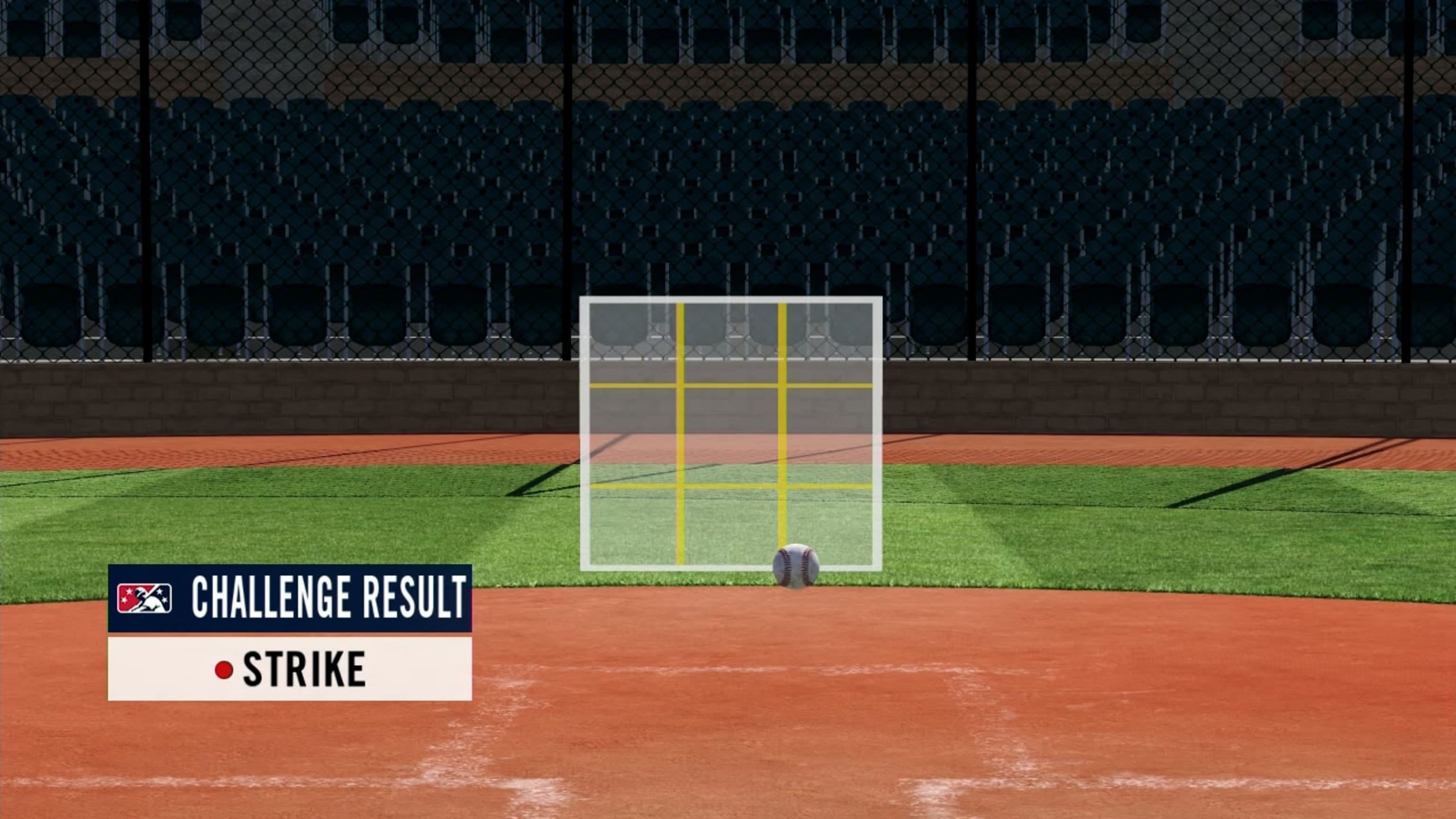
In Saturday’s game, five pitches were challenged.
One pitch was overturned, a 1-1 pitch by Charlotte’s Tanner Banks that was called a ball but turned out to be a strike.
Now, look, I don’t know that this is the perfect solution. But, having seen it in person, I believe there’s an elegance to it. See, players — and managers — gripe all the time about ball-strike calls. This gives them a chance to stop griping and start doing something about it. But there’s a risk: If you miss your challenge, you lose it and that could play a role later in the game.
And because of that, people have to be pretty sure to challenge. They’re not going to challenge relatively unimportant pitches. They’re probably not going to challenge when trailing or leading by a bunch of runs.
Plus, the challenge system in Charlotte worked so quickly and efficiently that it didn’t have an adverse effect on the pace of play.
So, yes, I could see this ball-strike challenge system moving into the big leagues quickly. Maybe it’s just a weigh station on the way to full Robo Umps. Maybe this is the best solution. A lot more testing has to be done. But I have to say I like what I saw.
One thing that was not on display on Saturday was a banning of the shift — they still shift in Class AAA so that players who get called up to the big leagues will be accustomed to it. But a ban of the shift, surely, will be coming next year too.
Theo and I talked for quite a while about some other intriguing (and strange) possibilities for baseball’s future — like with the big bases all those years ago, I probably should not go into detail about them just yet. But soon.
One thing we know is that it’s HARD to change baseball, with its traditions, with owners unwilling to part with a nickel, with players often stuck in their ways, with many fans instinctively rebelling against any adjustments. But there are practical ways to not only make baseball more interesting for young people but also to make it look and feel more like the game so many of us grew up watching and playing. I’m all in for trying.

As a Millenial who loves baseball, most of my friends are loath to go because a game is always 3+ hours. Pitch clock will have a huge impact on the game. I can’t wait
Joe, since you have Theo’s ear, I have one other minor replay suggestion.
I’m all for correcting bad calls but the interminable timing of review is just awful.
My suggestion is that teams shouldn’t have enough time to challenge they they can employ a replay coordinator to consult film and recommend whether to challenge. If - with the naked eye - you think the ump got it wrong, you should say so within about 10 seconds. And if not, tough luck.
I heard the Mets announcers talking about how great their replay coordinator is the other night and it just really seemed like we’ve lost the thread.