


For various reasons that I can go into another time, I’ve been thinking a lot about MLB’s All-Star Game lately. Well, to be more specific, I’ve been thinking about all-star games in general and what purpose they serve in today’s world. The NBA All-Star Game on Sunday offered a little insight, maybe.
The first official All-Star Game in American sports was, of course, baseball’s — it was played on July 6, 1933, long before there was an NBA, when the NFL had a team a Portsmouth, Ohio, and when the NHL had five American teams, two of them in New York. It is difficult to overstate how baseball dominated the American sports landscape in the 1930s and ’40s. We talk about how the NFL reigns today, and it does, but baseball was pretty much everything then — baseball and boxing and maybe a little college football.
The All-Star Game was the brainchild of a newspaper editor, the Chicago Tribune’s Arch Ward. There’s a rabbit hole for you — Arch Ward. His impact on American sports is enormous. He did not only conceive the idea of baseball’s All-Star Game, he worked out all the details of timing and the fan vote, and then made it happen through sheer will, promotional talents and barrels of newspaper ink. Ward created the college football All-Star Game, which would soon draw more than 100,000 fans. He also essentially created the Golden Gloves, which existed only as a disparate group of local fights before he turned into a national and international tournament.
Anyway, there had been any number of exhibition baseball games featuring some of the league’s best players — most famously, in 1911, the Cleveland Naps played against a group of American League All-Stars (Ty Cobb! Tris Speaker! Home Run Baker! Walter Johnson!) to raise money for the family of the great pitcher Addie Joss, who had died a year earlier after contracting meningitis. Vague all-star teams — usually with a couple of big stars and a lot of filler — had barnstormed America, playing each other or Negro leagues players, to make some money during the offseason.
But there had never been an official all-star game with all the best players. And the two leagues hated each other enough in those days that neither side seemed especially interested in having one. It took a figure like Ward — and, obviously, the potential for substantial money — to make that first All-Star Game happen.*
*Rabbit hole alert! Two months later, the first Negro Leagues East-West All-Star Game was played, also at Comiskey Park in Chicago. I have always wondered if Arch Ward played some role in that as well; it doesn’t seem like anything happened in Chicago without his stamp of approval, and sure enough the Tribune was one of the few white papers to cover the game, which was won by the West 11-7. My guess is Ward was involved. Every player on the West squad got at least one hit, including future Hall of Famers Turkey Stearnes, Willie Wells, Mule Suttles, and pitcher Bill Foster.
What makes it a rabbit hole is that even though 15,000 people attended the first East-West All-Star Game … it was not intended as a one-off. Three days later, a second East-West All-Star Game was scheduled to be played in Cincinnati. Unfortunately, that game was rained out and was replaced with a game between the Chicago American-Giants and Homestead Grays in front of 2,000-plus three days later.
Right away, the MLB All-Star Game was a massive deal. “Baseball’s dream comes true tomorrow,” was the Associated Press headline leading into the game. The two greatest managers in baseball history by all accounts — Connie Mack and John McGraw — were chosen to manage the clubs (McGraw came out of retirement to do so). And the newspapers made it clear that this game was not just for fun or mindless entertainment, no, at stake was the question at the heart of baseball in those days: Which league was superior?
The American League won that first game in Chicago 4-2. The two Lefties — Lefty Gomez and Lefty Grove — combined for six scoreless innings, but more significantly Babe Ruth hit a line drive home run … or as the Associated Press put it:
“Out of the shooting of baseball’s big dream game blazed the mighty war club of the one and only Babe Ruth today to hoist the American League to a spectacular 4-2 triumph of the National League in the first all-star game in the majors’ history.”
I have no idea what that actually means. But right away the All-Star Game was immediately huge— not quite on par, perhaps with the World Series or a heavyweight championship fight or the Kentucky Derby, but pretty close. And then, thanks to some big moments, it grew.
The next year, 1934, Carl Hubbell famously struck out Babe Ruth, Lou Gehrig, Jimmie Foxx, Al Simmons and Joe Cronin in order.
The next year, Jimmie Foxx homered and the American League won its third consecutive All-Star Game, seeming to end all arguments about which league was better.
The next year, Dizzy Dean pitched three dazzling no-hit innings and the National League held on to a 4-3 victory despite a late rally by the American League.
And then in 1941, in front of 54,674 at Briggs Stadium in Detroit, the American League came back from a 5-3 deficit in the ninth inning, with Ted Williams hitting the walk-off grand slam and clapping his way all the way around the bases.
Joe Blogs is a reader-supported venture. Free and paid versions are available. The best way to support us here is by taking out a paid subscription. And hey, we do have a lot of fun, so I hope you’ll come along.
Joe
Then came the war, but by that point the All-Star Game was an American treasure and soon after all the leagues would follow with all-star games of their own. The NHL had a collection of all-stars play against the Stanley Cup champions beginning in 1947. The first NBA All-Star Game was at the Boston Garden in 1951. The first Pro Bowl was played that year as well — Otto Graham was the first Pro Bowl MVP — though there had been NFL All-Star Games earlier.
Of course, those were very different times for so many reasons. There were so many fewer entertainment options. The players needed — or at the very least could use — some extra money. Very few games or highlights were available on television. The chance to see all the great players in one place, facing each other in combinations that previously had been left only to the imagination, was thrilling, to say the least.
But it seems to me that, above all, from the beginning, All-Star Games were about moments. Sure, people may have rooted for the American League or the NFL or the Western Conference, but those were shallow roots to say the least. And the games themselves, with the shuffling of players and tentative motivations and injury risk being a defining standard, were chaotic and messy and superficial.
No, I think what people really rooted for was the chance to see something utterly different, something transcendent, something unforgettable. Bo Jackson’s home run. Jack Youngblood getting two sacks while playing on a broken leg. Magic Johnson’s game-winning three-pointer. Gordie Howe’s final All-Star Game in Detroit. From the start, really, we have cheered for the moment more than for the game.
Which brings us back to the NBA All-Star Game and what MLB can learn from it.
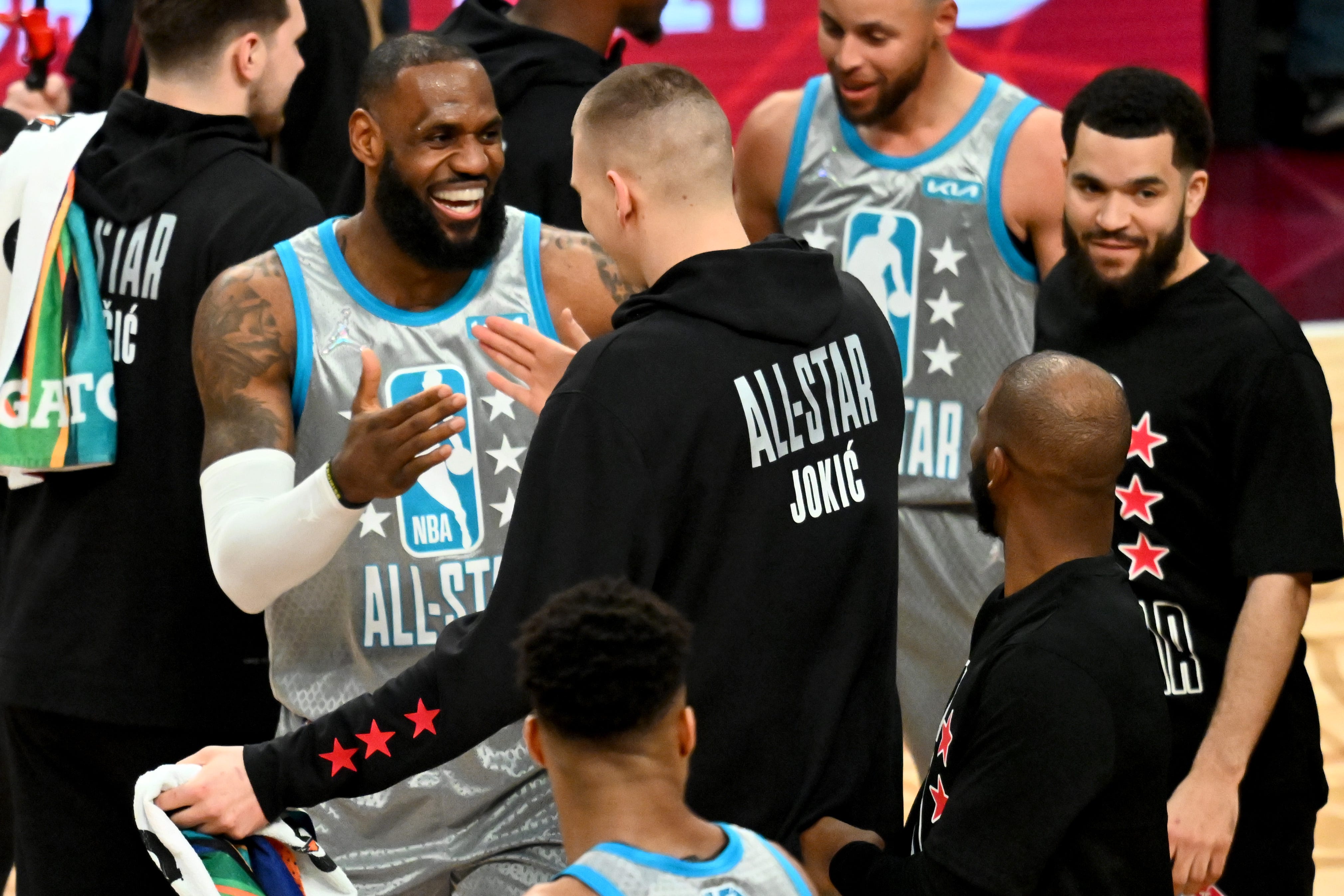
First off, the NBA All-Star game itself was generally silly — red-carpet defense, a jillion turnovers, lots of alley-oops, fancy dunks against nobody, two jillion three-pointers, a sort of baffling quarter-by-quarter scoring system and a lingering bitter aftertaste from the snooze-fest that was the Saturday night dunk contest. I mean, we don’t need to get into this here, but come on: We’ve seen all the dunks, the props get more and more tiresome, that thing jumped the shark like 15 years ago*.
*But the three-point contest is still kind of a blast. The one thing I’d say about the three-point shootout is that I would prefer if they didn’t have the whole contest just for sharpshooters. I wish they would have a fan vote and just have the biggest NBA stars in it, even some who might not be great three-point shooters. I mean, no offense to Luke Kennard, but I don’t care. Give me a three-point contest with LeBron, Jokic, Dončić, Giannis, Embid, Steph, Harden, Durant, maybe throw Rudy Gobert in there, now THAT would be fun.
But as silly as it was — there were moments galore. All those amazing Steph shots. Some LaMelo Ball magic. Devin Booker doing Devin Booker things. Embid and Giannis doing things athletically that boggle the mind. And, of course, the final shot game-winner for LeBron James in Cleveland (thank you Elam Ending).
Was it perfect? Certainly not. It was tedious for the most part. But the last few minutes were fun and seeing Steph Curry hit bombs over and over was fun and LeBron taking down the big shot at the end of the game was really fun. I walked away with an OK feeling because I saw some cool things at the finish, which is really all you can hope for with an All-Star Game these days.
Now, consider how baseball’s All-Star Game ended — these were the lineups at the end of that game:
American League
Nelson Cruz, DH
Matt Olson, 1B
Tim Anderson, SS (defensive replacement)
Joey Gallo, RF
Joey Wendle, 3B
Whit Merrifield, 2B
Mike Zunino, C
Jared Walsh, LF
Adolis Garcia, CF
P: Liam Hendricks
National League
Trea Turner, SS
Justin Turner, DH
Eduardo Escobar, 3B
Jake Cronenworth, 1B
Juan Soto, RF
Kris Bryant, LF
Omar Narvaez, C
Chris Taylor, CF
Ozzie Albies, 2B
P: Zack Wheeler
Now, I mean no offense — these are all very good players, and there a couple of mega stars in there too — but that’s just not a lineup that will get you excited. Why would you stay up to watch that? What chance is there that something unforgettable will happen? What chance is there that we will get a moment?
Of course, we can list of any number of things wrong with the MLB All-Star Game, and at the same time we can concede that even if the game was the best version of itself, we no longer live in a time when all-star games matter as they once did. But … there might be something bigger at play here.
MLB’s All-Star Game is, fundamentally, what it was 10 years ago, 25 years ago and 50 years ago. It’s a mid-summer game, played on a Tuesday night, featuring a roster of “all-stars” (at least one from each team) made up of some of the game’s best players and some of the players who had the best first half. It is a matchup between the American League and National League even though interleague play essentially eliminated most of the tension between the two leagues 25 years ago. There are no special rules for the game (other than the exemption put in last year so that Shohei Ohtani could stay in as a hitter after being pulled as pitcher).
And because the rules haven’t changed, the game has changed immensely — that’s the irony of staying in place. Last year, 20 American Leaguers and 20 National Leaguers got at-bats, nine pitched for the AL and 10 for the NL, there were more passed balls than stolen bases, as many errors as hits with runners in scoring position, and at the end it felt like a pickup game with nobody knowing who was in or out.
Fifty years ago, starters Joe Morgan, Lee May, Reggie Jackson and Bobby Grich played the entire game, eight pitchers went two innings or more, and even though it also started at 8:30 and went 10 innings, it was crisply played, no errors, and was over by 11.
I’m not saying that MLB’s All-Star Game should be a free-for-all like the NBA — as far as I know, NBA All-Star Game has never, even in the Michael Jordan heyday, beaten out the MLB All-Star Game’s ratings — but I am saying that Baseball (assuming they ever again play baseball) should be willing to following the NBA’s path and throw caution to the wind and try some stuff with the All-Star Game. Go crazy with it. Create a baseball version of the Elam ending where teams can send in anybody they want in the ninth inning in any order. Ban shifts. Make it a 3-2 game, with three balls being a walk and two balls being a strikeout. I don’t know. Maybe you have some ideas.
It’s so difficult for baseball people to try anything new — partly because, in general, baseball people are not geared that way, partly because many fans are resistant to change, partly because the game has a beautiful rhythm and there’s always a concern that even the smallest change will knock that rhythm out of sync. But, sheesh, this is the All-Star Game. Nobody really cares anymore. Let’s have some fun, huh?

Totally serious about this idea:
Go back to everybody wearing their own uniforms for their own teams. But let them choose WHICH uniform from their team. If Tim Anderson wants to wear the Southside alternate jersey, go for it. But if he wants to wear a ca. 1972 throwback, he can… he just has to talk about Dick Allen. Bryce Harper can wear that beautiful powder blue Phillies jersey… and talk about how great Mike Schmidt was. Connect the current game with the past by having today’s stars embrace yesterday’s legends. This changes zero about the way the game is played but it gives baseball another chance to be absorbed in its history and a lot of people will eat that up.
The biggest change should be that players who are removed from the game can return -- if you are going to remove Mookie Betts after the third inning, let him be a pinch hitter in the 7th. Who cares what the box score looks like? Let Jose Altuve come back to pinch hit against Josh Hader. It's an exhibition game designed to give the fans joy -- let them have it.