


Let’s continue Hall of Fame season by looking at two more players on the ballot. As I’m sure you surmised, I did not vote for either of these players. You might remember that this year I voted for 10 players. I’ll get to those 10 at the end of the series.
Remember, the Hall of Fame announcement this year will be made on Jan. 24 on MLB Network. We’ll have plenty to say leading up to that announcement; right now, based on what we’re seeing over at Ryan Thibodaux’s Hall of Fame Tracker, I’d say it’s likely that no player gets elected, though Scott Rolen is doing quite well in the early balloting and might sneak through.

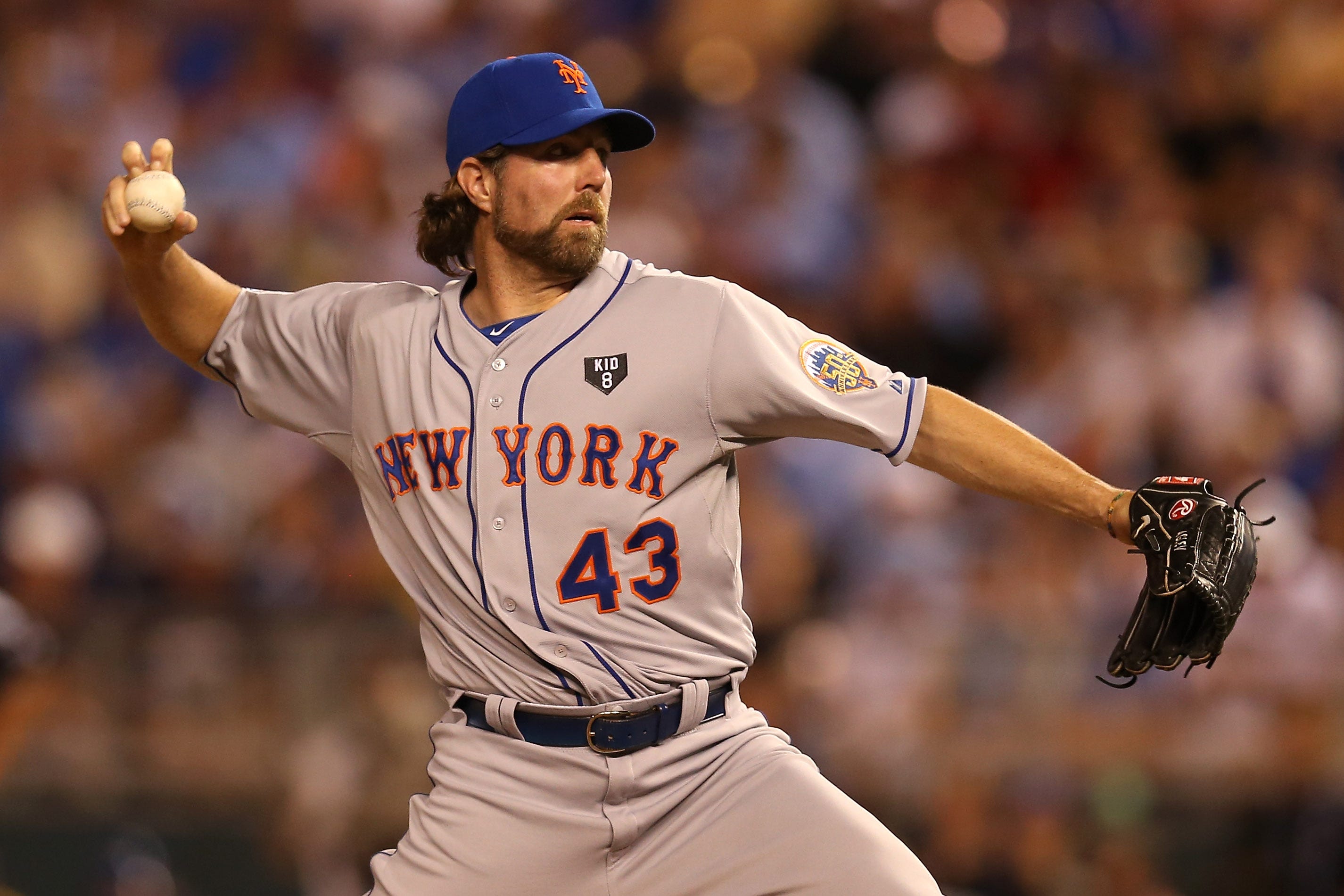
R.A. Dickey
First knuckleball pitcher to win the Cy Young Award, Gold Glove winner, won 120 big league games.
His full name is Robert Allen Dickey. I don’t know when or why he started going by the initials R.A., but I’d like to believe it is because R.A. Dickey sounds like a Southern novelist who writes about the dark inner secrets of prominent and eccentric families living among the azaleas and magnolia trees.*
*It’s also possible he chose R.A. to honor fantasy author R.A. Salvatore. I don’t have anything whatsoever to back that up other than the fact that Dickey seems to love reading fantasy novels.
Then, there are many things I like to believe about R.A. Dickey, because there has never been a career like his, and I suspect there never will be again.
For example, I like to believe that R.A. Dickey found his knuckleball at the summit of Mount Kilimanjaro. He hasn’t exactly said this, but I think he’s hiding it.
I mean: Look at his career. Dickey was a star pitcher at the University of Tennessee, good enough that the Texas Rangers took him with the 18th pick in the 1996 draft and offered him $825,000. Only then did the Rangers notice his right arm hanging kind of funny. That does seem like something that scouts might have detected while scouting him, but they sent him to a doctor to see if maybe there was something wrong with the ulnar collateral ligament (UCL) in his right elbow, you know, if maybe he needed Tommy John surgery or something.
The doctor came back with news that even now seems quite jolting.
R.A. Dickey DID NOT HAVE A UCL.
Yes, that’s right, he didn’t have one. The doctor had never seen that before. The Rangers knocked a neat $750,000 off their offer and sent Dickey to Port Charlotte, Fla., where he began his long, slow, painful baseball journey. By 2001, he was 26 years old, stuck in the minors and not even listed among the Rangers’ top 30 prospects.
But he kept grinding away. He made it to the big leagues briefly in 2001 and for a more extended stay in 2003. Over the next few years, he had a few nice moments — a shutout in Detroit, he picked up a save against the Angels, then he started messing around with a knuckleball. It didn’t take at first. In his one and only start for the Rangers as a knuckleball pitcher, he gave up six home runs to the Tigers — two to Magglio Ordóñez and two more to Chris Shelton.
“It can be really ugly when it’s ugly,” Dickey said of the knuckler.
The Rangers gave up on him and he signed with Milwaukee. The Brewers gave up on him before he pitched a single big league game, and he signed with Minnesota. Then Seattle took him in the Rule 5 draft, and then the Twins traded him to the Mariners, and he pitched for a while in Seattle, and then they gave up on him and he signed with the Twins again. It was all very confusing. After that, he signed with the Mets.
And for a couple of years in New York, he pitched quite well. His knuckleball was dancing. He was getting some outs. It was nice.
Then came Kilimanjaro. He and some friends decided to do the climb for charity, specifically for the “Red Light District Outreach Mumbai Program,” which focuses on the horrors of human trafficking. Dickey writes in his superb autobiography* about the climb, which was life-altering for him in many ways. He does not write that he found his knuckleball at the summit. But I believe he did.
*Wherever I Wind Up: My Quest for Truth, Authenticity and the Perfect Knuckleball.
The next year, 2012, he was utterly fantastic — 20-6, 2.73 ERA, led the league in starts, complete games, shutouts, innings and strikeouts. He convincingly won the Cy Young. There’s a pretty good argument to be made that Clayton Kershaw was the best pitcher in the National League that year, but I’ll bet you even Kershaw was rooting for Dickey. It was one of the really feel-good seasons so far this century in baseball.
The rest is kind of just baseball stuff — the Mets didn’t want to pay him, so they dealt him to Toronto, where he pitched reasonably well but not quite at the level of his Kilimanjaro season. That’s the knuckleball for you. It giveth. It taketh away.
Anyway, there’s a whole lot more going on with R.A. Dickey the person — he’s a voracious reader, a born-again Christian, someone who has looked to help people who were sexually abused as he was. He won’t get too many Hall of Fame votes, but he seems more interested in being a Hall of Fame person.

Mike Napoli
One-time All-Star hit 267 big league home runs and was a key member of the 2013 World Series-winning Red Sox.
I don’t actually remember anyone calling Mike Napoli “Porterhouse,” but that’s the nickname they have for him over at Baseball-Reference. It’s a nickname I can get behind. It just sounds right. Porterhouse Napoli. Sounds like the biggest steak you can get at the Napoli Steakhouse, the one that if you can finish you get your meal free.
Napoli was a 17th-round pick by the Angels in 2000 and he kicked around in the minor leagues until 2004, overcoming various injuries and defensive issues, until he banged 29 home runs in Rancho Cucamonga. That got him on the Angels’ radar, and the next year in Little Rock he hit 31 home runs. The Angels brought him to the big leagues after that as a backup catcher who could add a few home runs.
He did that for a few years — hitting 92 homers over five seasons, 26 of them in his final Angels season — and then he asked to be paid some more money, and the Angels promptly traded him to Toronto for Vernon Wells. The Blue Jays held on to Napoli for the better part of four days and then traded him to Texas for a relief pitcher and some dough.
The Rangers had this notion of getting Napoli in more games by having him play some first base as well as DH. And here’s the thing about that: It worked better than they could have dreamed. Freed from the grind of playing catcher every day, Napoli had a spectacular season in 2011. He hit .320/.414/.631 with 30 home runs in 113 games. Then he was fantastic in the playoffs, helping lead the Rangers to the World Series. And in that World Series, he hit .350 and slugged .700.
But, here’s the even more remarkable thing to me: Napoli developed into a damn good first baseman. Like really good — like Gold Glove good. I mean, maybe you could have seen the hitting coming, but when you put a struggling defensive catcher at first base, you are not expecting to get Wes Parker. But Napoli flashed some good defense with the Rangers and even better defense after he signed as a free agent with the Red Sox.
I remember Bill James telling me something to the effect of: You need to watch Napoli play first base, he’s excellent out there. So I started paying attention, and it was really remarkable. He always seemed to be in the right place. He was brilliant at saving bad throws. His range was excellent — and this was a guy who everybody knew couldn’t run at all. And the defensive stats back all of this up.
Napoli never had an offensive season nearly as good as he did in 2011, but he slugged, and he played good defense and teams seemed to rally around him. He was not only a pivotal player for the 2011 World Series Rangers and the 2013 world champion Red Sox, but also for the 2016 Clevelanders.
In Cleveland, he wasn’t quite the defensive marvel he had been the years prior, but he smashed 34 home runs and drove in more than 100 runs. He did struggle in the postseason, which might be the thing that Cleveland fans remembered — he went 0-for-5 with three strikeouts in Game 7 — but he was such a big part of getting them there. As I put together my own personal Hall of Fames (plural), I am pondering the “Got the Most Out of Their Talents” Hall of Fame. Porterhouse Napoli might very well be in that one.

The R.A. Dickey story is so crazy on so many levels. When the Neyer/James Guide to pitchers came out in 2004, Dickey's original pitching arsenal was listed as:
𝘙.𝘈. 𝘋𝘪𝘤𝘬𝘦𝘺 (2001 2005)
𝘗𝘪𝘵𝘤𝘩 𝘚𝘦𝘭𝘦𝘤𝘵𝘪𝘰𝘯, 2003: 1. “𝘛𝘩𝘦 𝘛𝘩𝘪𝘯𝘨” 2. 𝘍𝘢𝘴𝘵𝘣𝘢𝘭𝘭 (𝘭𝘰𝘸-90𝘴)
𝘚𝘰𝘶𝘳𝘤𝘦: 𝘛𝘩𝘦 𝘚𝘤𝘰𝘶𝘵𝘪𝘯𝘨 𝘕𝘰𝘵𝘦𝘣𝘰𝘰𝘬 2004
𝘕𝘰𝘵𝘦: 𝘈𝘤𝘤𝘰𝘳𝘥𝘪𝘯𝘨 𝘵𝘰 𝘴𝘰𝘶𝘳𝘤𝘦, “𝘛𝘩𝘦 𝘛𝘩𝘪𝘯𝘨” 𝘪𝘴 “𝘢 𝘩𝘺𝘣𝘳𝘪𝘥 𝘬𝘯𝘶𝘤𝘬𝘭𝘦-𝘤𝘶𝘳𝘷𝘦/𝘴𝘱𝘭𝘪𝘵𝘵𝘦𝘳 𝘵𝘩𝘢𝘵 𝘩𝘦 𝘤𝘢𝘯 𝘮𝘢𝘬𝘦 𝘮𝘰𝘷𝘦 𝘭𝘪𝘬𝘦 𝘢 𝘴𝘭𝘪𝘥𝘦𝘳. 𝘈𝘤𝘤𝘰𝘳𝘥𝘪𝘯𝘨 𝘵𝘰 𝘉𝘳𝘦𝘯𝘵 𝘚𝘵𝘳𝘰𝘮, 𝘋𝘪𝘤𝘬𝘦𝘺'𝘴 "𝘛𝘩𝘪𝘯𝘨" 𝘪𝘴 𝘵𝘩𝘦 𝘴𝘢𝘮𝘦 𝘬𝘯𝘶𝘤𝘬𝘭𝘦-𝘤𝘶𝘳𝘷𝘦 𝘵𝘩𝘢𝘵 𝘉𝘶𝘳𝘵 𝘏𝘰𝘰𝘵𝘰𝘯 𝘶𝘴𝘦𝘥 𝘵𝘰 𝘵𝘩𝘳𝘰𝘸.
So, basically, they had no idea what it was. I have read that it was really a hard knuckler, but there was no indication of that at the time, and anyway he did not throw it like a knuckler, he came straight over the top like Mike Mussina and fell off to the side, releasing it like a splitter, albeit not always with the same action on it. It does not seem that it was a knuckler.
In any case, later on, c. 2005, he was listed as having a Knuckelball, then fastball only, though at the time the distinction was academic at best. He had pitched fewer than 30 innings in MLB in 2005 (giving up 22 Earned Runs!) and would make only one appearance in MLB in the next two seasons, allowing 7 ER in 3.1 IP in 2006. He didn't get back to MLB til 2008, at age 33, and didn't have success as a starter til 2010, his age 35 season.
There really never has ever been a career anything even remotely like Dickey's. His career WAR of 23.7 is in itself nothing special, but the fact that he earned almost all of it (96%!) from his age 35 season on is absolutely unprecedented.
There have, amazingly, only been 34 pitchers who amassed at least 20 WAR from age 35 on. Twenty one of those are in the Hall of Fame, and a couple more (Clemens, Schilling, Tommy John) may be someday.
But all of them have one thing that Dickey does not: They were good, or at least useful, before turning 35. Each and every one of them amassed at least 7 WAR and had pitched at least 200 innings more than Dickey had to that point. The group averaged 42 WAR and over 2200 IP up to age 34. Dickey had 0.9 WAR and 442 innings.
On average, they earned about 47% of their career WAR up through their age 34 seasons, and none were close to Dickey's 96%. Charlie Hough was the only other one above 80%, and just barely so. Only two others, Hoyt Wilhelm and Jack Quinn, were even above 70%.
Hough had the lowest WAR through age 34 at 7.4, and even he had pitched nearly 1200 innings in the majors up to that point, mostly in relief, which is why his WAR total is not higher. Ellis Kinder did not even *reach* the majors until age 31 and he had amassed almost 10 WAR and over 700 innings before turning 35. Hoyt Wilhelm and Mariano Rivera, both almost exclusively relief pitchers had both pitched a couple of hundred innings more in the majors than Dickey had to that point.
Pitchers like Phil Niekro, Randy Johnson, Jamie Moyer and Jack Quinn, all famously late-bloomers, had all pitched at least 1300 innings in the majors and been worth a dozen or more WAR up to that age. Even Satchel Paige's page, which shows official records just a small fraction of all the Negro League and barnstorming games he played, shows him pitching almost 900 innings before age 35 and amassing 26 WAR.
There really, really, has never been a career like this before, and it's hard to imagine it ever happening again. It's all but impossible for someone to stick around for more than a decade the way Dickey did and then somehow successfully remake himself in his mid 30's without, well, cheating, frankly.
But one of the best things about baseball is that this is probably the only sport where something like that could happen. Nobody in any other sport I can think of can somehow develop in their 30s a skill they never had in their 20s and not just hang on but thrive at the highest levels of competition. Just astonishing, and maybe worth a vote for the Hall of Perseverance, if not for Cooperstown.
One nice thing, hopefully, about the ballot going back to normal is that some of these guys can get "honored" with a vote or two. Without it becoming some major argument about the soul of baseball. I remember that more commonly in years past where beat writers or local journalists would tip their cap to a long time player, without fear they were keeping someone else out of the HOF with that vote.