

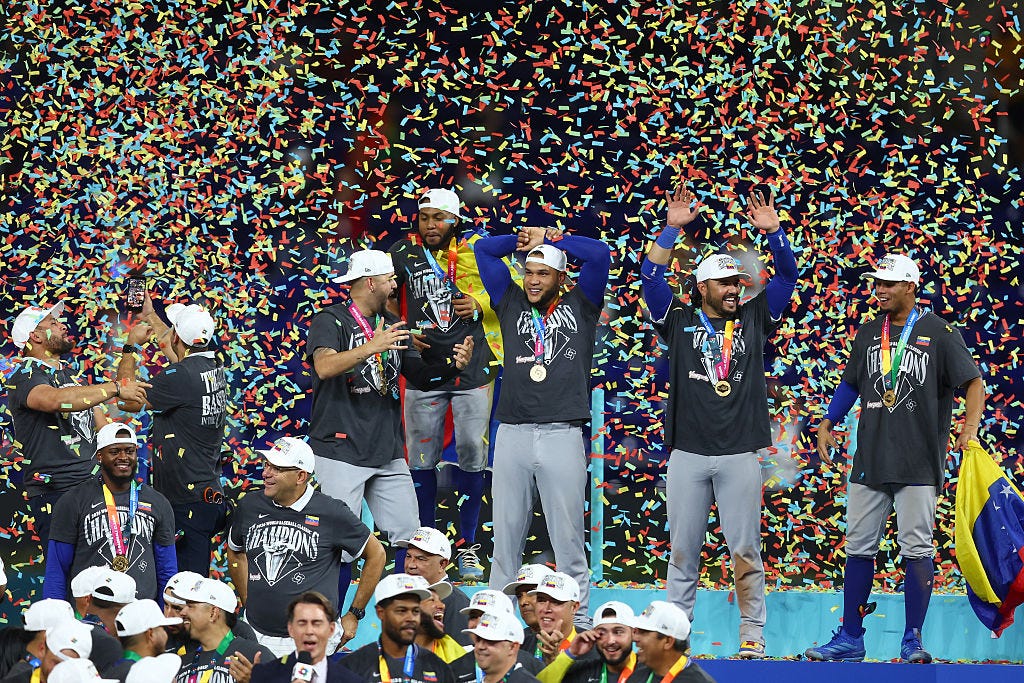
In the moments after Venezuela’s utterly wonderful 3-2 victory over the United States in the final of the World Baseball Classic, I found myself wondering: Why was this tournament so absurdly awesome? Why did it draw bigger numbers than any regular season game, and most playoff games, and even the All-Star game? Why was it the talk of social media?
Why is it that I have friends, moderate baseball fans at best, who were OBSESSED with the WBC, who were constantly texting me to chat about the Italian baseball players taking shots of espresso and kissing each other on the cheeks, or the Mexican players putting a giant sombrero on the head of the guy who hit a home run, or that fun thing the U.S. team did where they … I’m just joking, they had no fun at all this entire tournament.
Some of it is obvious, I suppose. Nationalism. The knockout format. The post-Olympic glow. The fact that these were, for the most part, the best of the best playing.
But I think there’s something bigger going on here.
I think there’s something the WBC has unlocked that Major League Baseball, mostly, has not.
It’s that three-letter word again: Joy.
In thinking about what MLB could take from the WBC to bring more joy to the game, I want to stay away from the format stuff. Sure, MLB’s 162-game season and 12-team playoffs make up an absurd combination. There are too many games for too many playoff teams. One of the reasons the WBC captured attention is that the whole tournament was short, easy to follow, and had clear stakes every single day.*
*Clear to everyone except U.S. manager Mark De Rosa.
But MLB’s season serves a different purpose; it offers us baseball every day. You could argue, I suppose, that this is an archaic design that no longer matches the American attention span (or the durability of pitchers’ elbows), but 70-plus million people attend the games annually, and baseball is the No. 1 show on television in many local markets throughout the summer, so it’s working for a lot of people and, anyway, the format ain’t changing.
But that’s OK, because I don’t want to talk about the format.
I want to talk about how the WBC made us feel.
Here’s something that might or might not be unrelated: Do you know about the Pasquatch? I imagine you do: In Kansas City, they call Vinnie Pasquantino “Pasquatch,” and for a while now, whenever Vinnie gets on base, this Big Foot will come bolting out of the Royals Hall of Fame and stomp around joyfully. OK, that’s kind of awesome.
But here’s the TRULY awesome part:
For a long time, the Royals refused to acknowledge it.
People would ask about the Pasquatch, and the Royals would say, “We don’t know what you’re talking about,” and “We didn’t see him,” and “I’m pretty sure there’s no such thing as a Pasquatch.”
The Royals now acknowledge the Pasquatch, which was probably inevitable. I guess they even had a Pasquatch necklace giveaway this past year. All that’s fine. But it was so much better when they refused to acknowledge him. That was something very funny, and very cool, and VERY Kansas City.
If you wanted to catch a glimpse of the Pasquatch, you had to go to a Kansas City baseball game and hope.
I think that touches on what made the WBC such a delight: Every team was different. They played differently. They celebrated differently. They danced differently. They reflected their nation’s pride. Winning mattered, sure, but winning wasn’t everything. Playing was everything. Enjoying the moment was everything. This was baseball bursting with color, life, energy. Each hit was a party. Each run was a carnival.
And all the while, you had the loaded and glum U.S. team as a contrast, as if they were determined to represent the dreariest possible way to play baseball. The MLB way. Nobody ever seemed to even smile. Cal Raleigh wouldn’t shake hands with Randy Arozarena. A lot has been written about the militaristic vibe this team disseminated (undoubtedly WITH the express written consent of Major League Baseball), but one thing that really struck me was how wrong they got it.
“You never want it to get lost why you’re doing this, whatever that why is,” USA manager Mark DeRosa said after being asked why he had a former Navy SEAL who claims to have killed Osama Bin Laden speak to the team rather than, say, Ken Griffey Jr., George Brett, or someone like that. “And a lot of people – like Paul Skenes said to me when he signed up for this, ‘I want to do this for every serviceman and woman who protects our freedom,’ and that’s why we wear USA across our chest.”
Yeah, that’s backward. The servicemen and women who protect our freedom, sure, that’s why THEY wear USA across THEIR chest.
You are playing baseball. A kid’s game.
You are getting paid a small fortune for playing that kid’s game.
You are surrounded by applause and fanfare and a clubhouse filled with some of the best players on earth.
You are sacrificing nothing.
You can salute each other like children playing war games, and you can speak platitudes about freedom, but doing so, to me, misses the whole point. Freedom for what? If you believe deeply in American freedom, then you must believe in those things that make freedom worthwhile, no? What are those things? How about teachers who dedicate their lives to educating our children? How about the Grand Ole Opry? The Apollo Theater? Broadway? How about the first responders who arrive in the bleakest moments?
How about Casablanca and Sinners and Singing in the Rain?
How about the neighbors who mow the lawn of the elderly couple two houses down? How about the waiter or waitress who remembers your order at the diner, the bookstore owner who is dying to tell you about a book you will absolutely love, the bar band breaking into “Sweet Caroline,” and the way everyone in the place sings along? How about the crossing guards who know every kid’s name, the auto mechanics who tell you that, actually, the fix was a lot simpler than you thought, the mother who brings orange slices for everyone at Little League games?
How about chili in Cincinnati, pizza in New York, clam chowder in New England, hot dogs in Chicago, a Polish Boy in Cleveland, barbecue in Kansas City, gumbo in New Orleans, fajitas in Texas, fish tacos in San Diego?
How about road crews out there in the blazing heat, holding up traffic and testing our patience, while they’re paving tomorrow’s paths? How about the electricians and plumbers and heating and air folks who make problems go away? How about high school marching bands on a Friday night, the reserved shelves at the Public Library, the way you can recognize every baseball diamond from a plane flying 10,000 feet over a city?
How about The Great Gatsby and The Catcher in the Rye and Where the Crawdads Sing and Charlotte’s Web?
And how about playing for THAT?
That’s what made the WBC feel special to me. You had players playing this wonderful game for the joyful things that they cherish all around them. Well, we can bring that to MLB, can’t we? Can’t the Phillies play for those things that make Philadelphia great? Can’t the Rockies play for those things that make Denver great? Can’t every team find something happy and fun and life-affirming to build around? Can’t baseball be a celebration of us? That doesn’t seem so hard to me.
A few people noticed that several of the U.S. players immediately took off their silver medals after having them draped around their necks. That made me sad. I know they wanted to win the thing. I know they felt the pressure to win the thing as tournament favorites. I know that for many of the best athletes, the only point is winning.
But is it? Do you know that SEVEN MILLION PEOPLE in Italy watched a bunch of happy Italian Americans play baseball against Venezuela even though it was at 5 a.m.? That’s bananas. We can rarely get seven million Americans to watch what is supposed to be our national pastime in prime time, and the United States is six times larger than Italy.
What drew them in? National pride? Sure. The newness of it all? No doubt.
But also: When Team Italy played baseball, it looked like a hell of a lot of fun.
“We just wanted to thank the fans,” Vinnie Pasquantino said when asked why the team hung around after the game. “The Italian fans. The Venezuelan fans. It was so loud.”
As he spoke, a Pasquatch did not come out and stomp around. Or maybe one did. I couldn’t say.
This is a more elegant and profound critique of US militarism than anything our so called leaders have managed this year. It’s a classic piece, rooted in the best of newspaper sports column writing. Thanks Joe!
Joe, this is really a great column. It really struck a nerve. I served five years in the Marine Corps, and it irks me intensely that MLB, NFL, etc., pander so blatantly to and for the military. When people say, "Thank you for your service," it makes me very uncomfortable, and I usually just kind of nod. I understand why people say that, and I would likely do the same if I had never served. But what I really want to say to them is "Thank *you* for *your* service as a teacher, or a store clerk, or a waiter." Anyone who contributes to our society. I reject the notion that active military or veterans should have one iota's worth more credit than anyone else. Or that my opinion about the flag or anything else is more valuable than anyone else's. It's clear that, starting in the first Gulf War, America began overcompensating for how poorly the Vietnam veterans were treated. And boy, the pendulum has really swung too far the other way. As the late, great Marty Di Bergi once said, enough of my yakking! Opening Day is a week away: Play Ball!