


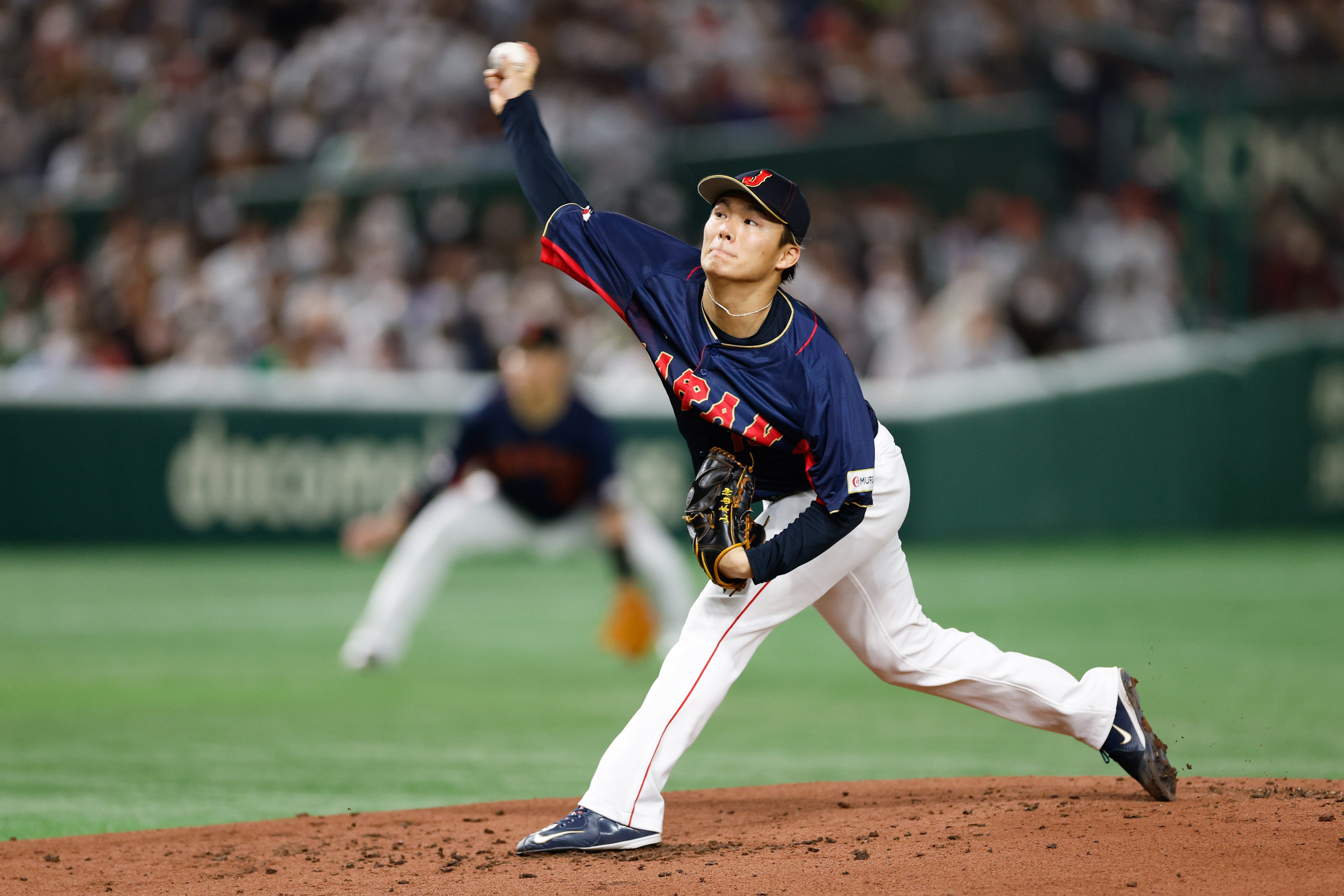
On Thursday, the Dodgers signed Japanese super-ace Yoshinobu Yamamoto to a 12-year contract worth $325 million. Let’s take a brief look at the Dodgers’ signings the last few years.
— In July of 2020, the Dodgers gave Mookie Betts a 12-year, $365 million extension.
— In March of 2022, the Dodgers signed Freddie Freeman to a six-year, $162 million contract.
— Back 10 days or so ago, the Dodgers gave Shohei Ohtani a 10-year, $700 million deal. All but $20 million of it is deferred to 2034.
— At around the same time as the Ohtani deal, the Dodgers traded for Tyler Glasnow and then extended his contract for five years and $136,542,400 (they threw some odd numbers into his player option).
— Yesterday, as mentioned, they signed Yamamoto for 12 years and $325 million.
That’s five players they have signed through at least 2027 (Freeman) but most are signed into the 2030s.
The cost: $1.69 billion, rounding up from Glasnow’s player option.
There is no easy way to describe how much money that is. I mean, you could say that John Sherman bought the Kansas City Royals for less than that, but I’m not sure that gets us there. You could say it’s roughly equal to the Gross Domestic Product of the Solomon Islands, but what do we know about the export business of the Solomon Islands?*
You could say that the 2024 Porsche 911 S/T is priced at $291,650 (including destination charges!) and that with $1.69 billion you could buy 5,794 of them, which would be a neat trick, since Porsche is not even building half that many.
*The Solomon Islands, apparently, were hit hard by a collapse in the tropical timber market and have since relied on palm oil, which is a whole controversial thing that will probably be a topic on “Last Week Tonight” before long, so, you know, maybe it’s best if we just leave this whole thing Solomon Islands GDP alone.
You could say that if there were a million-dollar coin, and it weighed, say, 35 grams (roughly the weight of the $20 eagle gold coin available at the turn of the century), then $1.69 billion of those coins would weigh more than gymnast Simone Biles holding a male Icelandic Sheepdog.
That probably doesn’t get us there, either, but it’s fun to think about.
The point is that while we know $1.69 billion is a lot of money, we probably don’t have the capacity to understand JUST how much money it is. The Dodgers have gone multi-Steinbrenner here, and I don’t think Justin Halpern will mind me quoting his text to Michael Schur, since I imagine it’s pretty representative of many baseball fans: “I’m not even a Padres fan anymore. I’m a fan of every single team that is playing the $@#$*( Dodgers.”
The funny thing about this is: I STILL don’t know that the Dodgers are the best overall team in the National League. The Braves still look better to me, assuming their players don’t wake up one morning and wonder why the heck everybody else is getting paid so much more.
BUT, there’s actually something else I’m thinking about now …
Look, we all know that Dodgers GM Andrew Friedman is a really smart guy. The guy figured out how to win in Tampa Bay, when winning should have been impossible. He came to the Dodgers in 2015, and since then, the Dodgers have not only had the best record in baseball, it’s a runaway:
Records since 2015:
Team W L W% GB
Dodgers 845 512 .623 --
Astros 801 555 .591 43.5
Yankees 771 585 .569 73.5
Guardians 744 610 .549 98.5
Rays 739 617 .545 106.0
If you had told me that the Guardians had the fourth-best record in baseball since 2015, well, no, I wouldn’t have believed that. But that’s not the point here. The point is that Andrew Friedman is really smart, and the Dodgers have won 100-plus games five times in the last seven years, and he and that Dodgers front office seem to know stuff that other people don’t know.
With that in mind, I can’t help but wonder: Are these signings specifically designed to make the Dodgers a postseason killer? See, here’s the thing: The Dodgers have already been the best team in baseball. That simply doesn’t mean as much as it once did, not with the expanded playoffs and short series. The Dodgers, everybody knows, have won just the one World Series since 2015, and that one in the bizarro pandemic season. Just as a reminder:
2015: Lost to the Mets in five games
2016: Lost to the destiny Cubs in six games
2017: Lost to the trashcan Astros in seven games
2018: Lost to the Mookie Red Sox in five games (later signed Mookie)
2019: Lost to the destiny Nationals in five games
2020: Won the World Series by winning four playoff series, including a tense seven-gamer with Atlanta.
2021: Lost to the Freddie Freeman Braves in six games (later signed Freeman)
2022: Lost in four games to a Padres team that they beat by 22 games in the standings
2023: Swept in three straight by a Diamondbacks team that they beat by 16 games in the standings
You can see the pain there. And it seems to me that, ever since Moneyball, we have sort of given really good teams that lose in the playoffs something of a pass by talking about how short-series are crapshoots. I totally believe that to be true—short series are crapshoots—but I also believe that it’s Andrew Friedman’s JOB (and the job of his front office) to change that dynamic and take some of the chance and luck out of winning those short series.
You might say: That’s impossible! Baseball doesn’t work like that!
But it isn’t impossible. There are ways to give your team the best chance to win a short series. And because I think Andrew Friedman is a smart guy, I’m guessing that he is spending not just a lot of his time but pretty much ALL of his time trying to unlock that mystery. Losing short series is the Dodgers’ core problem, the only problem that matters. If they spend $1.69 billion on five players, and win 115 games, and promptly lose to an 84-78 Rockies team that they beat by 31 games in the standings, well, almost nobody is going to think the signings worked.
What I’m thinking is that by signing two potentially dominant pitchers in Yamamoto and Glasnow (and, you would hope, eventually a third in Shohei), Friedman is betting that those guys, along with the return of Walker Buehler and the continued development of Bobby Miller and so on, will make them invincible come playoff time. What I’m thinking is that he and his folks have pored over all the data they can find about what wins in the playoffs, and they have developed countless secret theories, and then they acted and spent all the money in the world to build an October Death Star.
Of course, only time will tell. For now, right, I can’t wait to see how good Yamamoto will be and what it will look like to have Mookie-Freddie-Shohei hitting back-to-back-to-back. But I’m also looking to see if the Dodgers unlocked something to do with the postseason.

Happy Friday! Our Friday posts are free so everyone can enjoy them. Just a reminder that Joe Blogs is a reader-supported newsletter, and I’d love and appreciate your support.

As everybody knows or should know, we try not to delve into politics here, or anything even resembling politics. This is meant to be our own little funhouse where we play make-believe and backyard games and tell jokes and promote the heck out of our books and stuff.
Please take the previous paragraph as the warning it is intended to be — you can definitely skip to the next section.
I’m not kidding. You can skip this section and you’ll be fine.
But I cannot ignore what has been happening lately with Substack.
There’s at least a reasonable chance that you don’t even know what Substack is; it’s the online platform I use to circulate the nonsense and silliness I write in this newsletter. The Substack folks have been very good to me; they helped me take control of my work, they helped me build this wonderful community, they gave me the courage to go out on my own. I’m forever grateful to them for all of this.
But — and you had to know a but was coming — lately, Substack has come under a heap of criticism, beginning with the Atlantic story from about three weeks ago headlined “Substack Has a Nazi Problem.” I’m trying not to get too deep into the weeds here, but it seems that among the million-plus Substack newsletters, several are Nazi-centric newsletters, including some with actual Swastikas.
Now, here’s the thing: Unless you read that story or specifically searched Substack, you surely didn’t know any of that. There is nothing whatsoever connecting those Nazi newsletters with our little corner of the world, other than we each use Substack to distribute our work. This isn’t like Twixter or Facebook, where, by following friends, you might run into a long hate speech post.
There’s no chance, for example, that by subscribing here that you will get an email suggesting you sign up for a Nazi publication or a socialist publication or a political campaign or Curt Schilling’s darkest secrets or anything other than the newsletters I directly recommend, which are newsletters from my friends, such as Molly Knight, Tommy Tomlinson, Tom Haberstroh and Alan Sepinwall.
So, there are those who say that Substack is handling this as well as it can be handled. There are Nazis on the internet, you can’t stop that, you can’t ban your way out — best instead to find your own place and try to do good and believe in MLK’s line that the arc of the moral universe is long but it bends toward justice. It’s an argument with its own weight and authority.
But, alas, it isn’t that easy. Because it’s about more than that. After 250 Substackers signed on to a letter titled Substackers Against Nazis—their core question being, “Is platforming Nazis part of your vision of success?”—the Substack founders, through Hamish McKenzie, responded. I waited quietly for that response and, I say this as a friend: Well, it was pretty horrifying.
Sure, Hamish hit all the notes you would expect—promoting free speech, trying to maintain a decentralized approach, giving power to writers of all views, except when it crosses over into inciting violence or pornography. Agree or disagree with any of that. But I found this part hard to swallow.
I just want to make it clear that we don’t like Nazis either—we wish no-one held those views. But some people do hold those and other extreme views. Given that, we don’t think that censorship (including through demonetizing publications) makes the problem go away—in fact, it makes it worse.
I’m sorry: But you can’t say, “We don’t like Nazis either,” like you’re talking about the new rules of baseball or the latest Marvel movie. Nazis are not to be disliked. Nazis are to be condemned and fought at every turn. Nazis are responsible for the most horrific and appalling crimes in the history of the world. Nazis killed more than six million Jews. More than 400,000 Americans died fighting Nazis. The Nazi credo is built around hatred and genocide and the extermination of entire populations. There are not two sides here.
“We don’t like Nazis either” is usually followed up with some horror show prevarication about the trains running on time.
It broke my heart to read such bloodless words from Hamish and the Substack founders. This whole saga had given them an opportunity to state very clearly who they are and on what side they stand. They chose to stand with Nazis. The rest, as they say, is justification.
You might have seen that Craig Calcaterra has already announced he will be leaving Substack as soon as he can get his ducks in a row. Others have followed suit.
As for me, again, I don’t know what to do. You might not care, but JoeBlogs has been courted by other newsletter services, with some pretty big financial benefits attached. I have passed on those for two simple reasons: (1) I’m grateful to Substack, and, even more, (2) I don’t want to trouble you at all. You put your faith in me, and the last thing I want to do is disrupt your lives any further by asking you to do anything more. I’ve been promised by at least two services that a switch would be painless and not disrupt anything, but, honestly, I have never wanted to take even the slightest risk in that regard.
Now, I’ll admit, I have to reconsider. Obviously, I’d love your opinion on this, though I don’t want to get into a heated debate about the first amendment and free speech and the rest. The question, for me, is not about free speech, and it’s not about how to handle the multitude of opinions in the world and it’s not about the effectiveness or ineffectiveness of bans. It has to do with whether or not we want to be connected to Substack now that they’ve made their stand, especially when there are so many other options.

Hey, if you feel like it, I’d love if you’d share this post with your friends!

Wow, that was a bummer. Maybe you did the right thing and skipped that section.
The Holiday PosCast is supposed to post today, and it’s two and a half hours of sheer nonsense. I hope you enjoy it. We’ll put up a poll to find out who won our Holiday draft next week.
While we’re at it, you might have seen this over at the PosCast newsletter, but I did want to share with you the four PosCast charities we donated to here at the end of the year, just in case you’d like to join in.
— Buddy Baseball pairs kids in the Tampa, Fla., area with special needs with a buddy so that they can all play some baseball. Super-cool program.
— League 42, named in honor of Jackie Robinson, is a youth baseball league designed to bring the game to the inner city of Wichita, Kan. Longtime writer and friend Bob Lutz in Wichita helped form this awesome league.
— The Padres Foundation improves the lives of people in the greater San Diego area. We chose the Padres Foundation specifically to honor late owner Peter Seidler, who seemed to be just about the perfect person to own your favorite baseball team.
— The Hollywood Food Coalition feeds and serves the needs of the hungry every day of the year. Our beloved Molly Knight is a volunteer and an advocate; we’re hoping to do more for the Coalition in the coming year.

Several of you have reached out to ask me to pile on Ben Verlander for his stupefying blunder of calling Shohei Ohtani “the most important signing in Dodgers history.” It was idiocy at the highest level, for sure, but I don’t know if he’s ignorant of baseball history or he had a brain freeze and forgot about Jackie Robinson and nobody reminded him or he only meant the Los Angeles Dodgers or had simply lost all perspective with Ohtani because he’s been given access to the guy or, you know, if he said it just to get attention.
Whatever the case, it seems like plenty of people have jumped on that.

Shortly after the holidays, we’re going to begin our countdown to the Hall of Fame election on Jan. 23. I’m trying to come up with a fun new way to go through the ballot. In the meantime, to all, Merry Christmas, Happy Holidays, all the best to you and your families. May your days be merry and bright.

JoeBlogs Week in Review
Monday: Browns Diary, Week 15: Refuse to Lose
Tuesday: Dream a Little Dream.

Joe, where you go, I will follow. Willing to bet dollars to donuts that the vast majority of followers here feel the same.
My two cents on the "Nazi question":
For context, I'm a Jewish 56 year old and someone who feels pretty strongly about issues related to Nazis specifically and genocide more generally. I'm also someone who works in social media (at Nextdoor), where my responsibilities have included helping set our policy for what is allowed and what is not. Which is a long way of saying I have spent a fair amount of time thinking about these issue (though, of course, that doesn't mean I'm still not completely wrong).
With that preface, I just want to say that I'm in full agreement with Substack's policies for two reasons:
- First, I think once you start deciding what views are acceptable and what views aren't, it just leads to an endless cycle of battles about where that line should be. Do we draw it at the Nazis? How about at the KKK? How about the Minutemen? How about people who supported David Duke? How about those who supported Pat Buchanan? How about those who support DeSantis or Trump? And on the "left" do you draw that line at Hamas. Or Maoists? Or Commmunists more generally? Or those who supported Castro? Or those who support "Antifa"? Or BLM?
I'm with Hamish. Better to have a straightforward policy about what is allowed on the platform and what is not, that applies to anyone, rather than making judgements about groups.
- Second, on a more practical level, I don't think banning groups based on ideology ultimately does anything to make the world a better place; in fact, I believe it's counterproductive. These groups are still going to find ways to send newsletters to their subscribers, and the more we segregate them from the rest of society, the less likely they are to be exposed to perspectives that will shift their perspectives.
Anyway, for these reasons I hope Joe stays here.