


OK, I reached into the big box of trading cards that sits behind me in my office and pulled out four of them randomly. Why not, right? Let me know in the comments if you like this and would like to see it as a regular JoeBlogs feature.
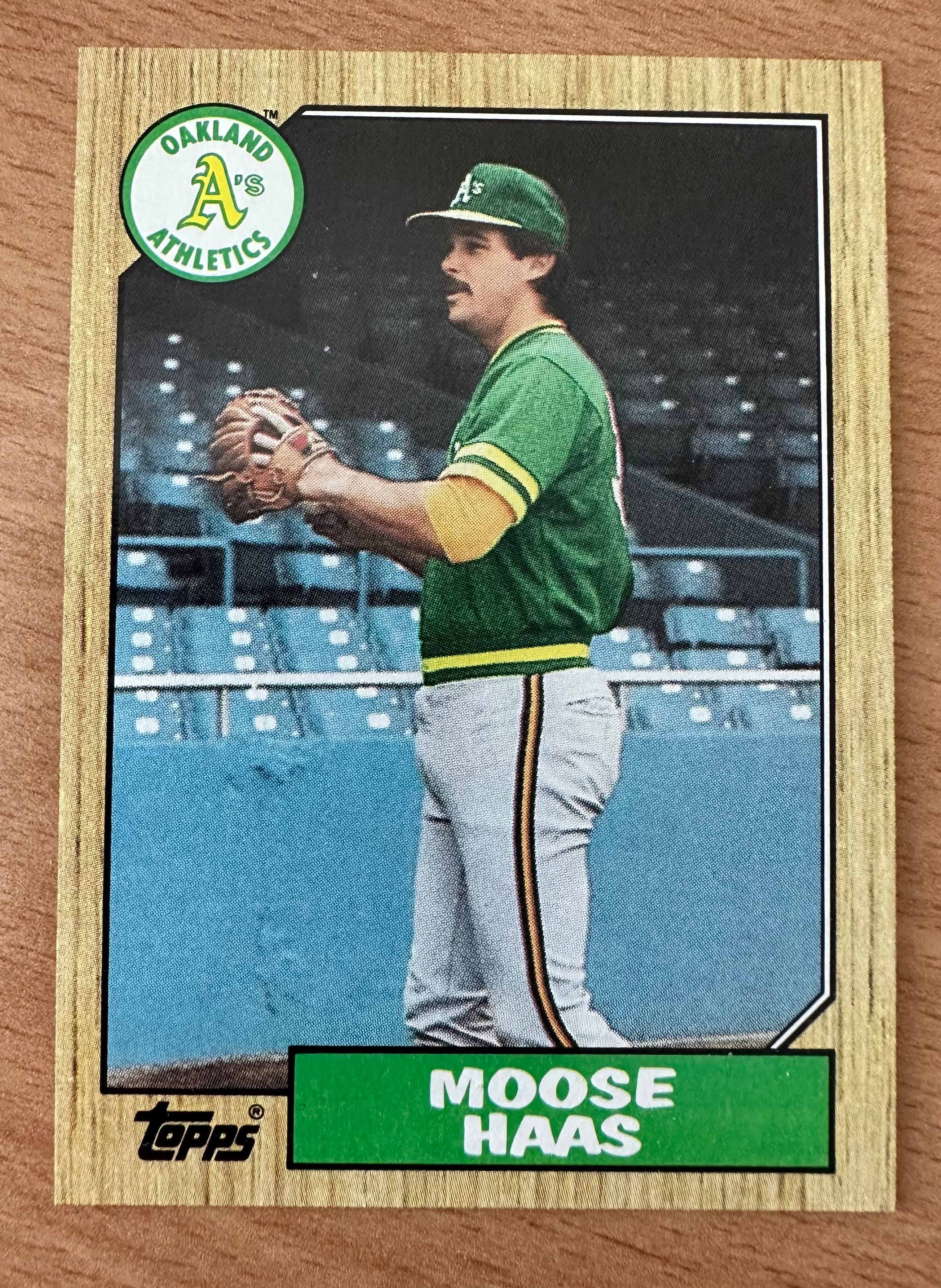
OK, it is serendipity that I pulled this Moose Haas card — it was a topic of much discussion on the PosCast. This is what is written on the back of the card:
Moose has a Black Belt in Tae Kwon Do. He is an amateur magician and a certified locksmith.
Mike felt one hundred percent certain — as certain, I think, as he has felt about anything in his entire life — that all of this was made up. It does, indeed, sound made up. It sounds like the sort of thing you would tell a very green writer from Topps:
Topps writer: “So, uh, tell me three things about yourself.”
Moose Haas: “Well, of course, I’m a Black Belt in Tae Kwon Do. Black Belt is capitalized, by the way. And, um, let’s see, I’m an amateur magician. Yeah. Pretty good at the old magic. And I’m also a certified locksmith.”
But, it turns out: It’s all true.
He was born Bryan Haas, but was given the nickname “Moose” practically the day he was born. His father, Bud Haas, kept saying he would grow up to be as big as a moose. Bud Haas was a police officer in Baltimore. It was Bud who taught Moose how to be a locksmith. Haas said he used the skill to help neighbors who got locked out of their houses.
So that’s one truth.
It’s also true that he was an amateur magician; he began tinkering around with magic around 1980 to “relieve the tedium of the road.” In 1983, after he got a complete game victory over Detroit despite giving up home runs to Chet Lemon and Johnny Grubb, he was asked what kind of magic he performed. Card magic? Coin magic? Rope magic? “Well,” he said, “I can make a baseball disappear.”
And I guess he really did get a first-degree black belt in Tae Kwon Do.
And the card didn’t even mention: He was apparently a trained juggler.
And as a pitcher? He was a fastball/slider guy who picked up a changeup in 1983 and used it to have perhaps his best season, going 13-3 with a 3.27 ERA. He generally had good control and did throw eight shutouts in his career.
For some reason he absolutely owned Jim Essian and Jack Brohamer, who were teammates on the 1976 and ’77 White Sox. Essian went 0-for-16 against Moose and Brohamer went 0-for-13. Must be magic.

JoeBlogs is a reader-supported venture. Free and paid versions are available. The best way to support us here is by taking out a paid subscription. And hey, we do have a lot of fun, so I hope you’ll come along.
Joe

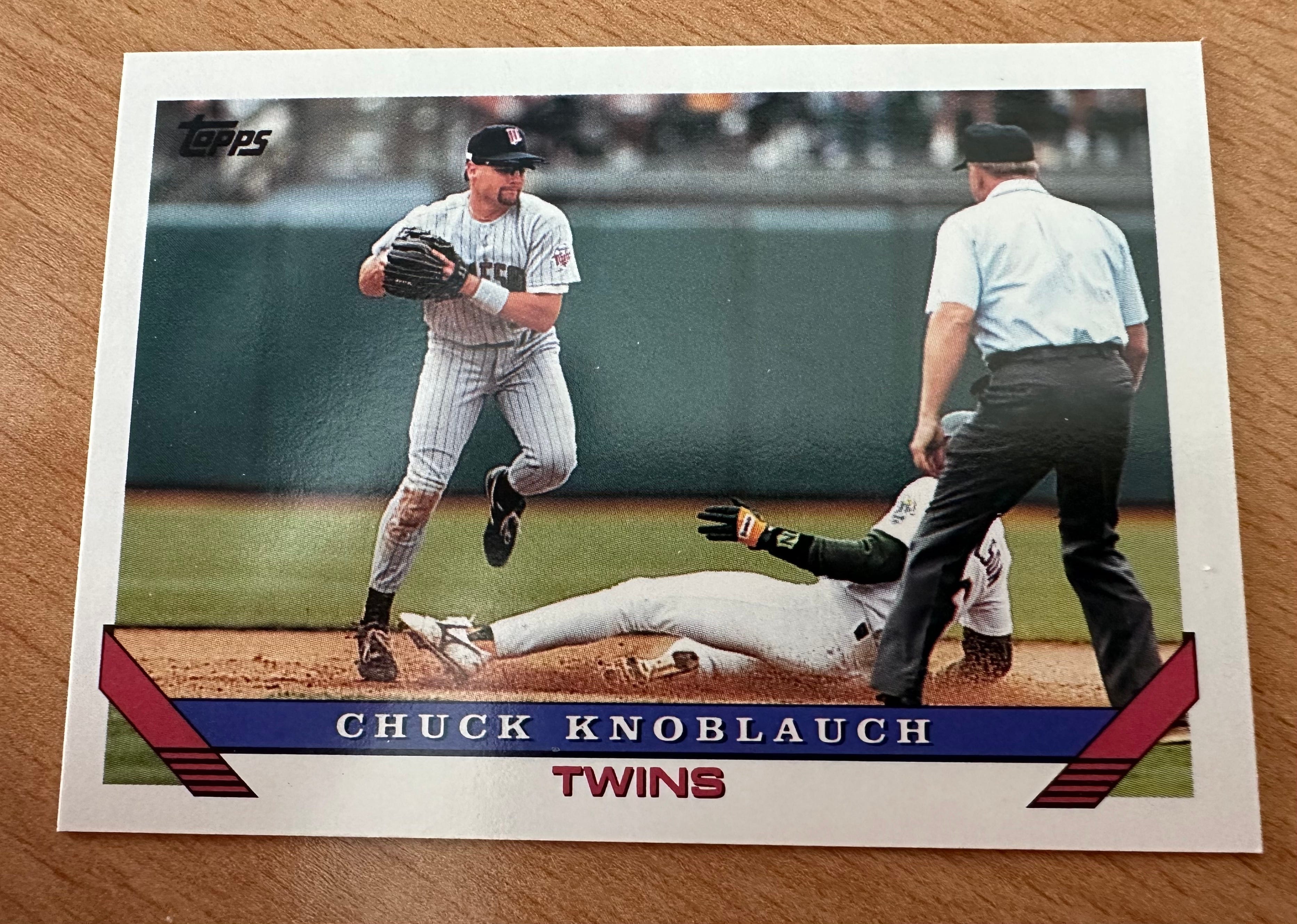
I want to show the stats of two Gold Glove second basemen from ages 22 through 28.
Player 1: .304/.391/.416, 210 doubles, 51 triples, 43 homers, 713 runs, 276 stolen bases.
Player 2: .282/.363/.404, 191 doubles, 22 triples, 57 homers, 492 runs, 163 stolen bases.
You already know Player 1 is Chuck Knoblauch.
Player 2 is Hall of Famer Craig Biggio.
At that stage in their careers, I actually used to confuse them. They were both first-round picks. They were both, at their best, doubles machines. They both seemed candidates to get 3,000 hits — Knoblauch was actually a little bit ahead in that race. Biggio was a little bit different, because he was a converted catcher, but they seemed more or less like the same guy to me.
And then Knoblauch went to the Yankees, he got the yips, every part of his game declined rather quickly and he was done at 33. It was a real shame.
Bill James made a big thing in The New Historical Abstract about the incredible season Biggio had in 1997. That year he hit .309 and led the league with 146 runs scored. He hit 37 doubles and 22 homers, stole 47 bases, was hit by pitch a league-leading 34 times, and he did not hit into a single double play all season. Larry Walker was the MVP that year because he put up an obscenely awesome season, but Biggio was awfully close to being the best player in the league.
Well, let’s take a moment to admire Chuck Knoblauch’s 1996 season. That year he hit .341, walked 98 times, scored 140 runs, led the league with 14 triples, stole 45 bases, and could have won the Gold Glove. He finished a ridiculous SIXTEENTH in the MVP voting, though he probably had at least twice as good a season as the MVP that year, Juan Gonzalez.
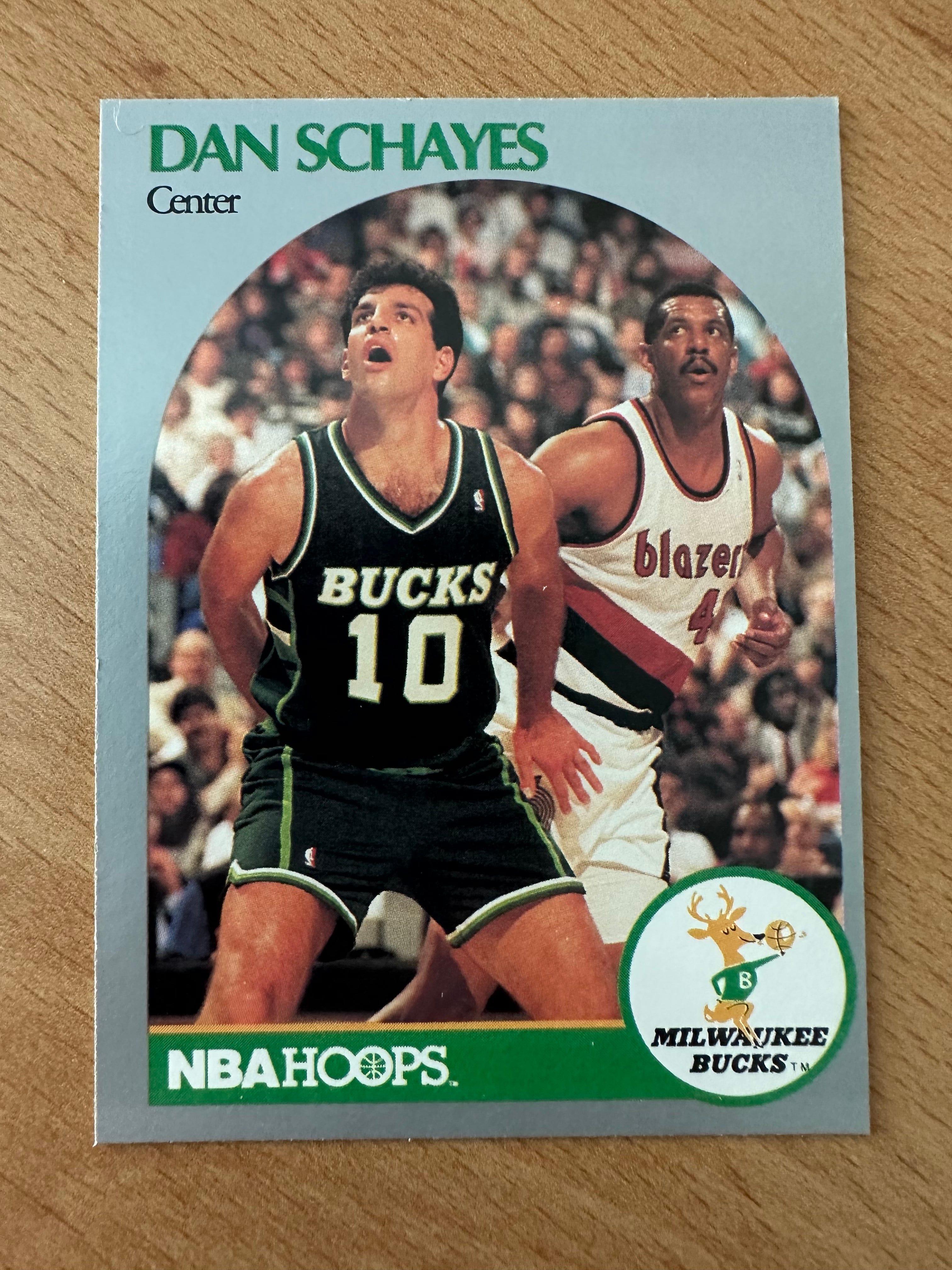
Yikes, apparently there are basketball cards in the box, too. Danny Schayes! I once hosted an event with Danny Schayes and his father, Dolph. My life is weird.
There are a couple of things I remember about Danny: First of all, he was WAY taller than I expected. I mean, I knew he was tall — he was a center in the NBA after all — but it’s one thing to know somebody is 6-foot-11, and it’s another thing to spend some casual time with somebody who is 6-foot-11.
When you do the second of those, you spend a whole lot more time thinking: How does this person live their life? Like: That thought never occurs when you’re watching them play, but Danny was wearing a suit and I thought: How does he get suits for someone his height? He came to Kansas City on a plane, I assume, and I thought: How does someone that tall sit on a plane? He was staying in a hotel, I would guess, and I thought: How does someone that tall sleep on one of those hotel beds?
Plus, you can never hide when you’re 6-foot-11. Wherever you go, people stop to look at you. I would imagine you get recognized a whole lot more than other athletes. I was once on a plane with Wade Boggs, and I felt 99.3% certain it was Wade Boggs, but I wasn’t 100% sure because, you know, I have that thing where I have trouble recognizing people. But when I saw Danny Schayes, I was 100 percent certain it was Danny Schayes.
He was a good player, Danny was, I mean he had an 18-season NBA career, he scored almost 9,000 points, grabbed 5,600 rebounds, blocked more than 800 shots. He had a serious day against Utah in 1989; he went for 37 points, grabbed eight rebounds, dished four assists and blocked a shot. This was literally one day after his Denver coach Doug Moe absolutely obliterated him in the press.
“He has to come around for us to make a move,” Moe told the press. “Right now he can’t catch, can’t make layups and fouls too much.”
Ouch. But it got worse. Moe was asked if he thought Schayes was being distracted by the money; Denver had given him a six-year, $8.7 million contract.
“Hey, he’s been this lousy before when he wasn’t making this much money,” Moe barked. “We ain’t the ones going out there dropping the ball for him and missing layups time and again and being no help on defense. No one said anything to take away his confidence. He just played himself into oblivion.”
Double ouch. Could you imagine what Twitter would do if a coach went off on a player like this now?
Anyway, it couldn’t have been easy being the basketball-playing son of a legend like Dolph Schayes. Dolph was with us that day at the event; he was a very nice man. Dolph was one of the first really big stars of the NBA; he was a rebounding force with a very soft touch (he led the NBA in free-throw shooting percentage three times). That’s a hard legacy to live up to. But Danny seemed to do fine for himself, he did some broadcasting, opened up an investing firm, married Olympic diver Wendy Lucero, and they have a son, Logan, who is a freshman basketball player at Metropolitan State University of Denver.

Hey, if you feel like it, I’d love if you’d share this post with your friends!

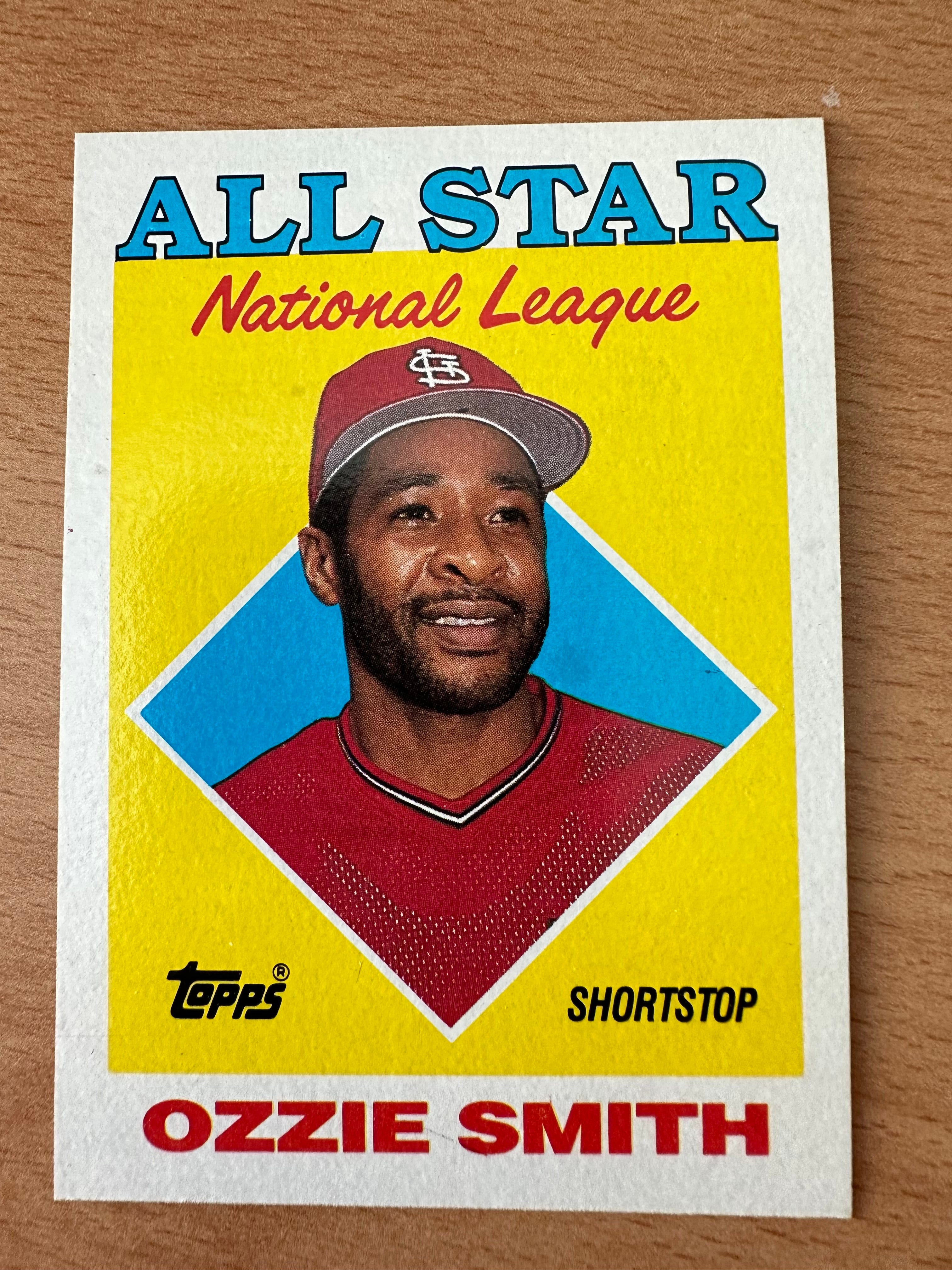
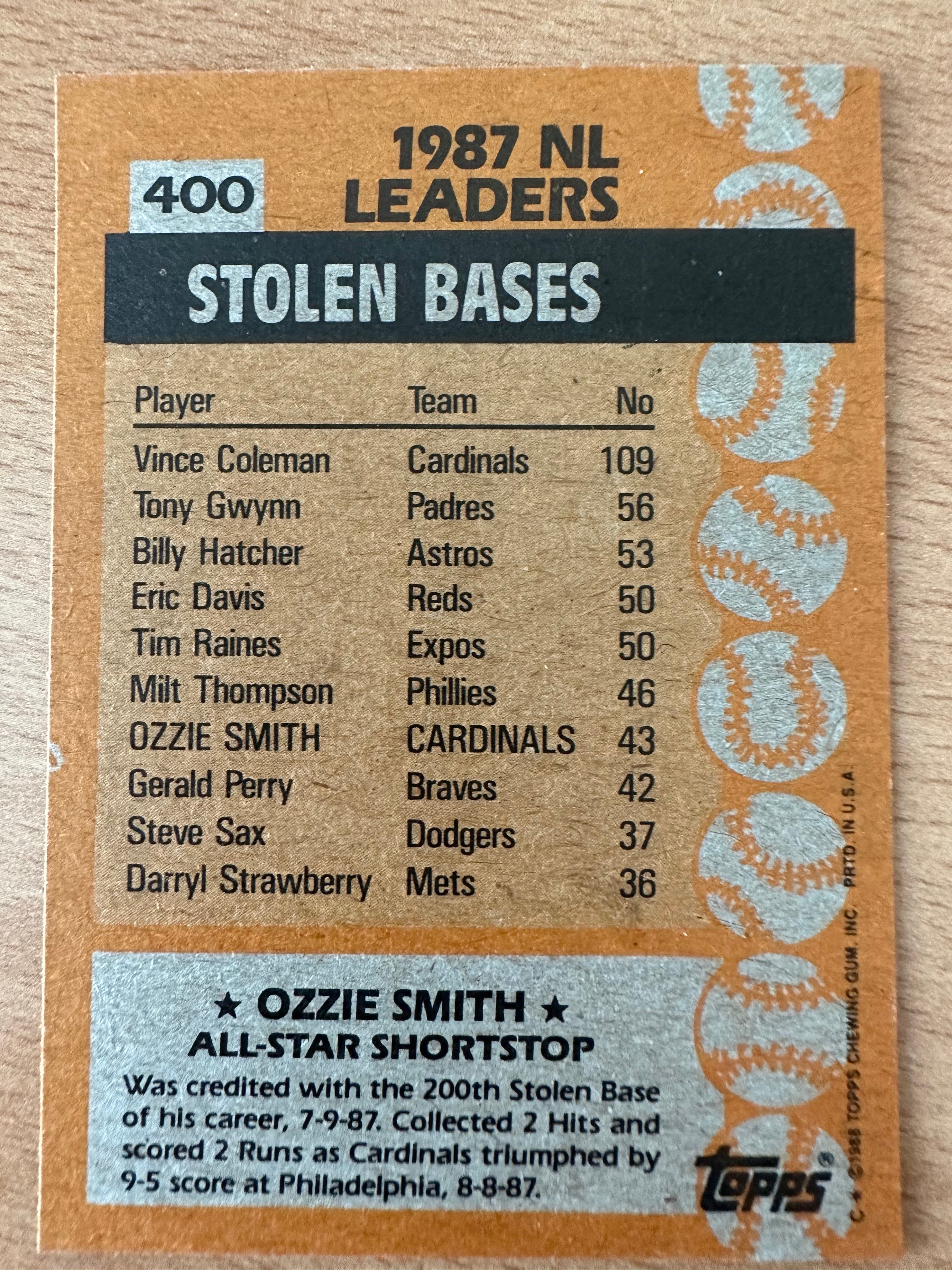
Hey, that’s a cool card to pull — Ozzie was the starting shortstop in the All-Star Game every year from 1983 through ’92 and then again in 1994.
In those days, Ozzie was the first chad you punched on your All-Star ballot. In the later years, you could argue that he was surpassed as an overall shortstop by Barry Larkin … but you WANTED Ozzie in the All-Star Game. He was just the rarest of creatures, a player worth the ticket price entirely because he just might make a defensive play you would never forget.
There are incredible defenders playing today — Nolan Arenado, Nicky Lopez, Jose Siri, Ke’Bryan Hayes, Trent Grisham, Jonathan Schoop — but I don’t know that there’s anybody right now who could draw people to the ballpark simply for their defense.
I do wonder, however, if eliminating the shift will give us more athletic and incredible defensive plays. It’s possible.
Anyway, what I really love about this card is the back: The stolen base leaders in the National League. Oh, man, I look at that list and just smile.
Obviously, seeing Vince Coleman and his 109 stolen bases makes the heart thump. That was the third consecutive 100-stolen base season for Vincent Van Go Go … and there’s simply no telling how many stolen bases he might have had in a season or in his career if he had just been better at getting on base. I mean, in 1986 he hit .232 with a .301 on-base percentage and STILL stole 107 bases.
Let’s pause on that year for a moment, because it’s utterly impossible. If you count the number of times Coleman reached on an error, he reached base a total of 209 times that season. Eight of those were triples, so we won’t count those since I don’t believe he stole home that year. That makes 201 times he reached. I couldn’t tell you how many times he had a runner in front of him — well, I suppose I COULD tell you, but I don’t want to spend all day on this.
What I can tell you is he tried to steal 121 times — successful 107 times, caught 14. That’s an 88% success rate.
That’s some crazy, crazy baserunning.
Tony Gwynn stole 56 bases in 1987; that was by far his career high. Gwynn stole 223 bases between 1984 and 1990, but he was not an especially effective base stealer. He was caught 85 times, meaning his success rate over those years was only about 72%.
There were 15 players who stole 200 bases between 1984 and 1990; Gwynn had the second-lowest success rate, ahead of only Brett Butler, who was successful just 69% of the time.*
*The best pure base stealer those years? I would have guessed Tim Raines, and indeed he was second on the list, stealing bases at an 86% rate. But you know who was on top? Eric Davis, who stole 233 bases and was caught just 35 times, an 87% success rate.
Third on the list was Billy Hatcher, who never LOOKED especially fast, but he stole 30-plus bases four times in his career. Then came Eric Davis — 1987 was his miracle year. In just 129 games, he hit 37 homers, stole 50 bases (getting caught just six times), scored 120 runs, drove in 100 and won the Gold Glove. The MVP that year was Andre Dawson, who banged 49 homers and had 137 RBIs for the last-place Cubs. But the real MVP that year was either Gwynn or Davis, I think.
Down the list, you have Darryl Strawberry with 36 stolen bases. He hit 39 home runs that year, too; he became only the fifth player in baseball history to hit 35 homers and steal 35 bases in the same season.
The other four:
Ken Williams, who did it in 1922 for the St. Louis Browns. He led the league with 39 homers, drove in 155 runs and stole 37 bases.
Willie Mays, who did it in 1956 and 1957. Mays led the league in stolen bases both of those seasons.
Bobby Bonds, who did it in 1973 and 1977. In 1973, Bonds was one homer away from the first 40-40 season.
The aforementioned Eric Davis, who grew up playing with and against Strawberry in Los Angeles.


This is great. I would also love to see a post that is just a list of all the anti-Derek Jeter email subject lines that were sent in for the Poscast raffle :-)
My dad turned 90 last year. He is a Korean war veteran and, upon being discharged in San Francisco, enrolled in San Francisco University, where he met his future wife and my mom; they both just turned 90 and celebrated their 65th wedding anniversary last year. That was the height of San Francisco University's basketball powers, led by Casey Jones and Bill Russel. My dad shared a dorm room floor with Bill Russell and never has said to me "Damn that man was tall!" What dad remembers most is Bill Russell's laugh aka guffaw. Tough year for dad, losing both Russell and Vin Scully; dad id a devout Dodgers fan. Meandering post, agreed. That said, I fly out in two days to see both of my 90 year old parents and will ask dad to describe how tall Bill Russell was. I suspect he will lift his hand to the roof and describe Russell's laugh. I am a blessed man.