

Hi everybody. I’m at the airport super early this Wednesday morning, heading to Los Angeles for a little work and also to see Bruce Springsteen tomorrow night. So far, I haven’t had the experience my friend Brian had at Nashville airport on Tuesday as he flew out to LA.

Yeah, that’s Brian on the right.
He apparently was happy to just shake hands, but Bill Murray was taking selfies with everybody. Can’t blame him. That’s a sweet Chicago Cubs City Connect cap.
Anyway, just as a reminder, I’m writing an ABS Scorecard — along with whatever random thoughts come to mind — each morning while I finish up my next-next book, SEASONS, a countdown of the 50 individual baseball seasons that echo the loudest. We’ve also brought back, by popular demand, Kathleen’s Korner, where our intrepid editor Kathleen gives her own rundown of stuff that’s catching her eye.
Clubhouse members will get one every morning, but there will be plenty for everybody. Of course, if you’d like to become a Clubhouse member, we’d love to have you:
Also, tickets are going fast for our upcoming BIG FAN Tour. Our New York stop is already sold out, but there are still some tickets available in Boston (well, Cambridge), St. Louis, Kansas City, and Los Angeles. We’re starting to announce the guests we’ll have at each stop; happy to say that in LA, we’ll be joined by the amazing Colin Hanks, which will be incredible.
The ABS Challenge Scorecard
Total challenges: 653. Challenges have been successful 351 times (54%).
Batter challenges have been successful 48% of the time.
Fielder challenges (almost always catchers) have been successful 59% of the time.
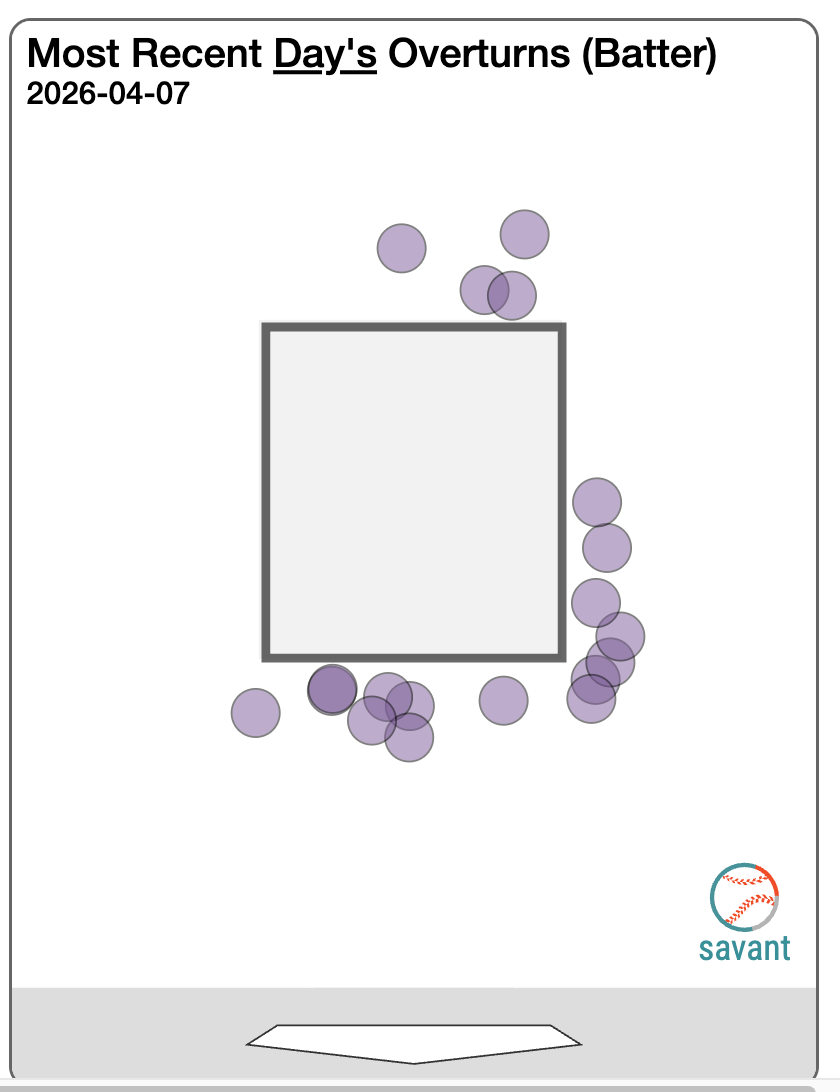
Batters had their best day in quite some time — they challenged 36 pitches, a season high, and were successful 19 times. It was the first time in a week that hitters were successful more than half the time.
Here are the hitters’ successful challenges (ht to Tom Tango for showing me how to make the boxes more specific):
And here were the hitters’ unsuccessful challenges:
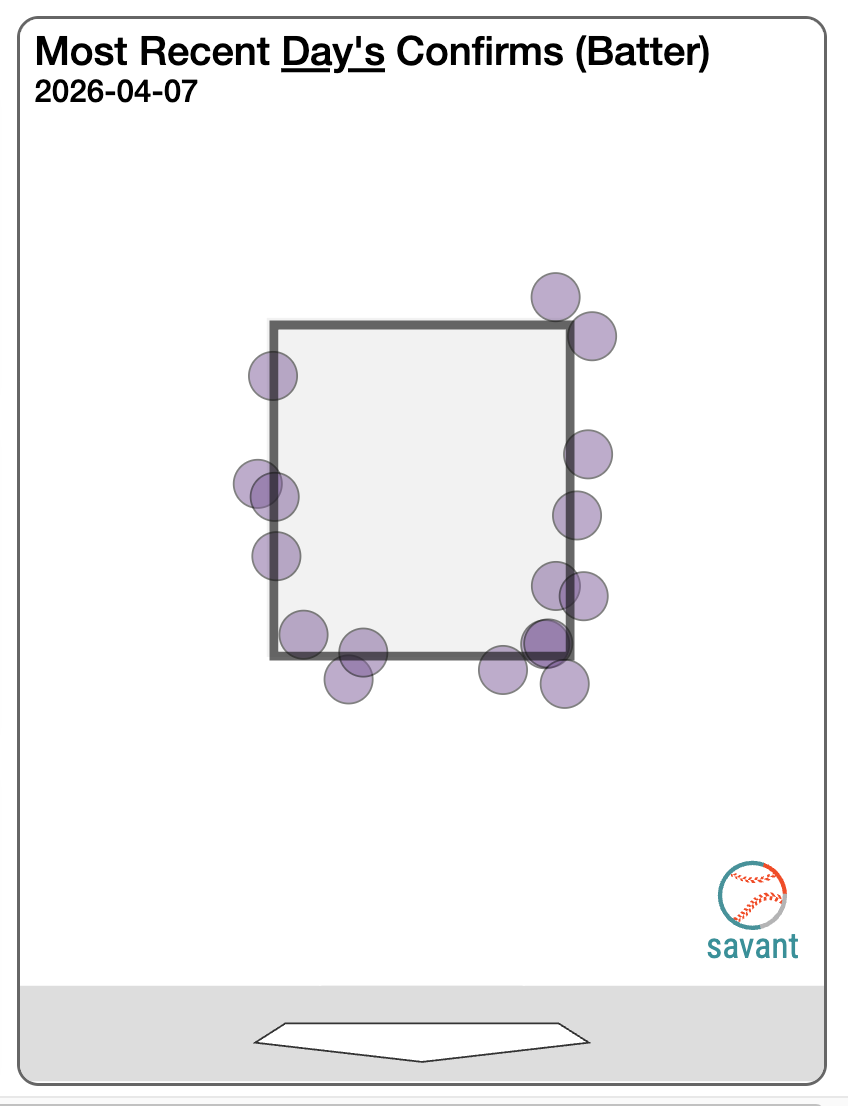
I show you both to point out just how close these pitches are. There are a few stray pitches in the overturned box — particularly the cluster of low pitches — that are relatively clear, but look at that confirmed box. I mean, every one of those pitches is right on the edge. I would say there was not a single bad challenge all day.
I’m coming around more and more to the idea that what we’re really learning here is that baseball pitchers, yeah, they’re REALLY good. They put the ball on the black time after time after time, which doesn’t just challenge hitters, it also challenges umpires.
I mean, look at this strike three pitch by Aaron Civale to Austin Wells. That’s the purple ball right this hovering at the top of the zone in the confirmed box. That pitch, like so many big league pitches, looks absolutely unhittable to me, especially if I’m a lefty hitter like Wells. It’s “only” 93 mph, but it’s moving like the Jeffersons, and it looks too high and too far inside to hit. The umpire calls it strike three. Wells challenges. And the pitch is a strike by a millimeter. We talk about perfect pitches. That’s a perfect pitch. And these guys throw a lot of them.
The Hard Math of Batting .300
Let me say up front that I am — like pretty much everyone else — bullish on the future of Roman Anthony. He’s off to a bit of a rough start in 2026, but it’s just the start, and I feel sure that he will come around and be a star.
That said, I don’t think he will bat .300 or win a batting title, as many predict.*
*This idea came out of a text exchange with Mike Schur, who is the world’s biggest Roman Anthony fan. I love Anthony too, but nowhere near Mike’s level, and when he said that Anthony would be a .300/.400/.500 hitter, I thought, “Well, wait a minute on the .300 part.”
Hardcore baseball analysts would tell you that it doesn’t even matter if he bats .300 or wins a batting title, that those are outdated ways of looking at baseball, and I mostly agree. But as long as we track such things, it seems worth talking about what it actually takes to hit .300 in today’s baseball.
Roman Anthony strikes out a lot. He might cut that down as he goes, but he struck out a lot in the minor leagues, and he struck out a lot in his terrific rookie season, and he’s striking out a lot this year so far. The strikeout thing seems baked into his game. And when I say he “strikes out a lot,” I’m not saying that he’s Mark Reynolds or Adam Dunn or James Wood or anyone that extreme, but it seems like 150 strikeouts a year is baked into his batting style.
It’s hard to hit .300 when you strike out 150 times in a season.
Not impossible. But hard.
How do you do it? Well, in baseball history, there have been 20 players who have hit .300 or better with 150 strikeouts.
Method 1: Hit a lot of home runs. No, a LOT of home runs.
Home runs are hits. That’s obvious, but what I mean is that they are, for the most part, subject to the whim of defense or bad luck. Sure, a Jo Adell might come along and steal a home run from you or the wind might take one away. but in general a home run is a home run is a home run.
The highest batting average in baseball history for a player with 150 Ks is .331 — that’s what Aaron Judge hit last year. He did that in large part by hitting 53 home runs. Second on the list is Sammy Sosa’s .328 in 2001. He hit 64 home runs last year. Sosa and Judge have each hit .300 with 150 Ks three times.
Shohei hit .310 in 2024. That year, he hit 54 home runs.
I don’t think Anthony has that kind of power. I do expect him to develop power as he goes, but not home run champion power. I guess we’ll see.
Method 2: Hit for a very, very high BABIP (Batting Average on Balls in Play).
Last year, in 302 plate appearances as a rookie, Anthony hit .292, which is why Mike and others are so confident that he will be a .300 hitter. Do you know what his BABIP was? I did not: It was .404, the second-highest in baseball behind only Jonathan Aranda.
BABIP involves many factors, including how hard the ball is hit. And Anthony definitely hits the ball very hard, which is why so many of us predict superstardom. But it also involves luck, a lot of luck, and that might explain why Anthony’s actual batting average might have been .292, but his Statcast™ expected batting average was .257.
Anyway, that .404 BABIP is probably not sustainable.
But he won’t need to have quite that good a hitting luck. He could go the Mo Vaughn route. Vaughn hit .300 or better three times with high strikeout totals, and, sure he hit a bunch of home runs (35, 39, 44), but those totals might be in Anthony’s future. The key for Vaughn were high BABIPs, topping out at .384 in 1997. One connection here is Fenway Park; seemingly every ball Vaughn put in play at Fenway in those days was a hit.
1995: .365 BABIP at Fenway
1996: .435 BABIP at Fenway
1997: .420 BABIP at Fenway
So maybe Anthony will follow that route.
Method 3: Cut down the strikeouts.
This is the most likely way for Anthony to become a .300 hitter — he certainly has the batting eye and deep understanding of the strike zone to cut down his strikeouts. And it’s not like he has to cut it down a lot. Only 20 different players have hit .300 with 150 Ks, but 74 players have done it with 125.
There are two issues to overcome. First, I arbitrarily chose 150 strikeouts for Anthony; so far, he looks like a guy who strikes out much more than that. Small sample size, obviously, but he has struck out 100 times in his 82 big league games. And in the minors, he struck out 310 times in 303 games.
Second, I sincerely doubt that it’s Anthony’s goal — or the Boston organizational goal — for Anthony to be a .300 hitter. If it happens, great. But what they want is for him to be a productive hitter, with lots of walks and increased power. And accomplishing that is, in some ways, counter to him becoming a .300 hitter, where he would have to put more balls in play. This, in a nutshell, is the story of the game as everyone knows plays it. Batting averages are all-time lows, and part of that is because pitchers are so darned good, and there are so many of them.
But part of that is that there’s no real incentive to hit .300 anymore. Look at Juan Soto. After he hit .351 in the COVID season and following it up by hitting .313/.465/.513 in 2021, the Ted Williams comparisons were everywhere. But he’s very, very different from Ted Williams. Since then, his strikeouts have gone way up, and his batting average has gone way down — he’s a .269 hitter the last 4-plus seasons.
But when you throw in the walks and added home runs, you get one of the best hitters in the game. That’s the North Star here for Roman Anthony. And that’s why, in the end, I doubt that Anthony becomes a .300 hitter no matter how good he gets.
Kathleen’s Korner
On this day in 1974, Hank Aaron hit home run No. 715 to pass Babe Ruth as the all-time career home run leader.
Last night, the Braves and Angels game was interrupted by a bench and bullpen-clearing fight. Jorge Soler and Reynaldo López were both ejected. Atlanta won 7-2, but whew. That felt like it came out of nowhere.
The Pirates signed 19-year-old shortstop Konnor Griffin to a 9-year extension. Huge vote of confidence by the team right after his debut, but it sure seems like he has the stuff.
The Blue Jays had a baffling sequence last night with two errors that allowed Alex Freeland to reach base.
In a more positive, but still odd sequence, the Blue Jays’ Double-A affiliate, New Hampshire Fisher Cats, scored eight runs without a hit in the second inning. They finished with 10 runs on one hit that inning.
What a great line about the perfect pitch, "It’s “only” 93 mph, but it’s moving like the Jeffersons, and it looks too high and too far inside to hit." Moving like The Jeffersons. I will be thinking about the deluxe apartment in the sky!
The batting charts show exactly what I predicted in yesterday's comments: challenges on pitches high or low are more likely to succeed because umpires are more accurate horizontally than vertically since they have the plate to use as a visual reference for the sides of the zone, but have to guess at what ABS sees as the top and bottom.