

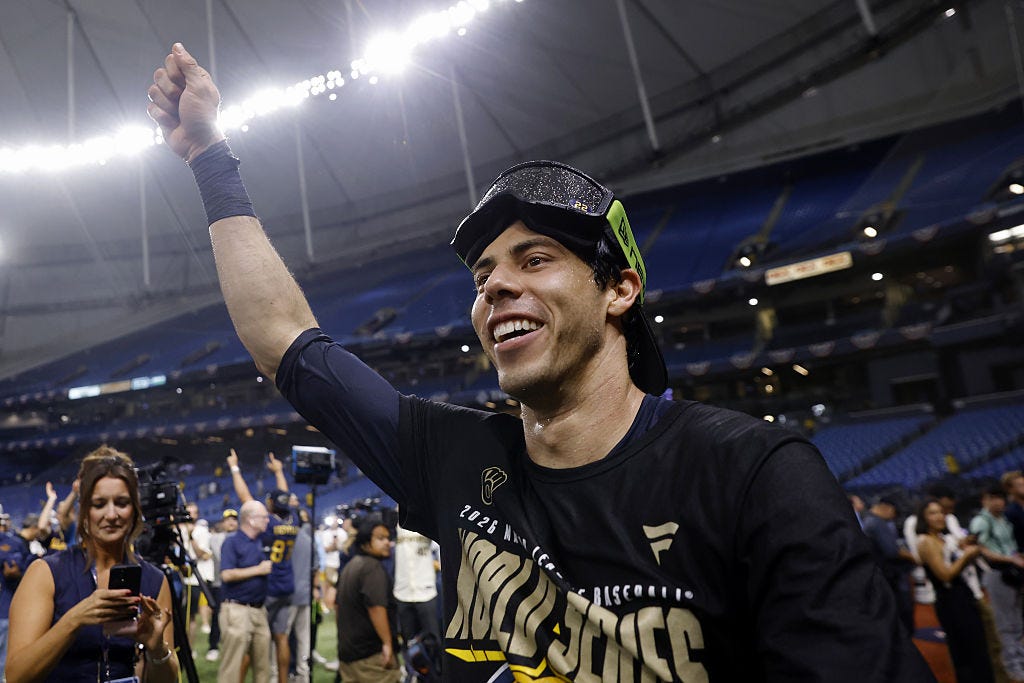
The 2021 Milwaukee Brewers won 95 games and beat out the St. Louis Cardinals by five games in the National League Central. Their ace, Corbin Burnes, won the Cy Young Award, and their No. 2 pitcher, Brandon Woodruff, finished fifth in the voting. Their No. 3 starter, Freddy Peralta, was an All-Star. Their closer, Josh Hader, had a 1.23 ERA and struck out 102 batters in just 58 innings. They allowed 3.85 runs per game. This was one of the best pitching staffs in baseball.
The offense was more middle of the pack, but 25-year-old shortstop Willy Adames did get some MVP consideration after slugging .521 in just 99 games. Free agent Avisail Garcia hit 29 home runs. Christian Yelich was making his way back from injury — he wasn’t the MVP-quality player he had been in 2018 and 2019, but he was still widely respected. Catcher Omar Narvaez made the All-Star team.
Those Brewers were knocked out of the playoffs in four games by Atlanta — they won the first game and then got shut out in each of the next two. In Game 4, they couldn’t hold on to a pair of two-run leads, and lost in the eighth when Freddie Freeman cranked a home run off Hader.
Five years later, the Brewers became the indisputable best team in baseball — winning 103 games (most in franchise history), sweeping the favored Los Angeles Dodgers, and dominating the Rays in the World Series.
Do you know how many players from the 2021 Brewers played regularly for the 2026 Brewers?
Three.
Yelich played 117 games in 2021. He played 118 games in 2026. He posted a 0.1 WAR this year, but was an emotional leader and one of only three team captains in all of baseball.
Woodruff was the workhorse for the 2021 team with a team-leading 179 innings. The Brewers have become famous for limiting their pitchers’ innings and starting them on extra rest. Woodruff made just nine starts this year before he was shut down on July 4 with shoulder inflammation. He returned to pitch one ceremonial inning with a 10-0 lead in the World Series.
Aaron Ashby was a 23-year-old rookie in 2021; he pitched 31 innings. He blew one of the Brewers’ two-run leads in Game 4 of that playoff series against Atlanta. Ashby was Milwaukee’s top lefty out of the pen this year, pitching 89 innings and striking out 116. He was unhittable in the postseason.
That’s it. The 2026 Brewers were, essentially, an entirely different team from the 2021 Brewers. That’s just five years. So how did the Brewers do it? And what does the Brewers’ transformation from a good team to a great team tell us about team building these days? Let’s dig a bit.
Catcher
The Brewers' everyday catcher in 2021 was Omar Narvaez, a 29-year-old Venezuelan they had picked up in a trade with Seattle. He got off to a very hot start that year, and he was hitting .300/.396/.469 at the All-Star Break. That’s why he was an All-Star. He cooled off dramatically after the break, and in 2022 he hit just 206 with a .305 slugging percentage. The Brewers had him split time with another traveled catcher, Victor Caratini, but realized that wasn’t going to get it done.
Before the 2023 season, they traded for Atlanta’s 25-year-old All-Star catcher William Contreras. The Braves got Oakland’s star catcher Sean Murphy in the three-way deal, and they were already feeling good vibes about a Class A catcher named Drake Baldwin, so they saw Contreras as expendable. This was especially true because they wondered if Contreras would be good enough defensively.
The Brewers had no qualms about that. They saw a special bat, and they deeply believed that they could help Contreras become a sound defensive catcher. “That’s a credit to our staff,” Brewers general manager Matt Arnold said then. “Whether that somebody is Manny Piña, Yasmani Grandal, Omar Narvaez — guys that came in here with potentially some bat-first type of reputation were able to really improve defensively.”
Contreras got MVP votes his first two years with Milwaukee; he might get some this year, and he was the World Series MVP.
First Base
The 2021 Brewers didn’t really have a first baseman. Daniel Vogelbach played the most games there. Rowdy Tellez and Keston Hiura played some first base as well. In all, their first baseman hit .234/.326/.390, which, you know, meh. The next year, they gave Tellez regular playing time at first — and he bashed 35 home runs. But he fell off the next year. They tried Rhys Hoskins there in 2024 and 2025.
Somewhere along the way, they picked up a one-time prospect named Jake Bauers. He had shown enough promise to keep getting opportunities — he got chances in Tampa Bay, Cleveland, New York and Seattle — but he just couldn’t hit well enough to stick. He hit .199 with Milwaukee in 2024 and was ready to quit the game. He famously gave it another shot because his wife was pregnant with their second child, and they needed the health care.
Bauers turned himself into one of the best hitters in the league in 2026. He finished second in on-base percentage and was sixth in OPS, not far behind some bigger names like PCA and Shohei Ohtani. He will definitely get MVP votes. Getting Bauers in a minor deal feels more lucky than brilliant, but I always think of the line from The Color of Money: “For some players, luck itself is an art.”
