


Well, my journey to the clock side is now complete. Seven or so years ago, I first wrote about the idea of pitch clocks in baseball … and, looking back, I was basically insulted by the very idea. It was an instinct, a bit of the baseball traditionalism pouring out. I suspect I’m not the only person whose first reaction to new ideas in baseball is like the reaction of a Mama Bear to her cub being threatened.*
*I can only imagine how protective Ryne Sandberg’s Mama Bear was of him.
Here’s what I wrote:
Baseball — it’s an escape from clocks. Baseball is a vacation from clocks. In baseball, there is none of that time anxiety, none of the feeling that every second matters, none of that clock-watching. There’s a certain tranquility, a certain calm in the rhythms of baseball. I don’t want some stupid clock ticking behind a pitcher, people in the stands counting down, pitchers throwing at the last possible second. Baseball is at its best when you can melt into the game. Sure it’s a cliché, but when just right, baseball does feel timeless. Who brings a timepiece to a timeless game?
I look back at that and … yeah, I’m kind of embarrassed. What a bunch of semi-poetic nonsense. I was fully aware that games were moving at too slow a pace, and I had no idea what impact clocks might actually have, but right away, in the most knee-jerk, old-man-yells-at-cloud way, I jumped headfirst into “No! Baseball is the game without a clock! This will ruin the leisurely rhythm of the game! Find another solution!”
The only thing I will say on my own behalf is that a few months later I actually saw the clock in action at a Toledo Mud Hens game … and I was an immediate convert. I believe I’ve written about my least favorite announcer tick (particularly in football), and that’s when the announcer says something like, “that’s a coverage sack, there was nobody open,” and then replay shows that there were receivers running wide open all over the field, and the announcer DOUBLES DOWN on the original statement as if we’re too dumb to see what’s happening in front of our eyes.
Immediately after the Mud Hens game, I wrote how wrong I had been.
It turned out that the digital clock -- which rolled somewhat unnoticed behind the batter -- was absolutely fantastic. It did not distract from the game the way I had thought it might. Instead, it kept the game flowing. It kept the action rolling. After years of watching baseball players stretch out the game the way George stretched out James Spader's sweater on Seinfeld, this was mind-blowing. The pitcher pitched. The hitter swung. The fielder caught. The pitcher pitched again. The game propelled itself. Yes, There was still the nice, relaxed pace of baseball that I worried might be lost, but within that easy pace was a steady drumbeat of action. It was, I must admit, glorious.
Again, that was seven years ago. Over those seven years, MLB games have gotten about 10 minutes longer on average, which is pretty distressing because the pace in 2015 was already Molina-like. There are rules in MLB that give umpires the quote-unquote “authority” to move the game along. Rule 507c, for example, states: “When the bases are unoccupied, the pitcher shall deliver the ball to the batter within 12 seconds after he receives the ball. Each time the pitcher delays the game by violating this rule, the umpire shall call ‘Ball.’” There are other such rules on the books as well.
But for whatever reason — perhaps because umpires don’t feel authorized to invoke those rules, perhaps because umpires have too much else to worry about, perhaps because the players would revolt — the games have just kept getting longer and slower, seemingly without much resistance.
But something interesting — and, again, distressing — was happening in the minor leagues. Even with a pitch clock, the game started getting longer again. In 2021, minor league games averaged about three hours. As J.J. Cooper wrote for Baseball America: “Pitch clocks have been a part of multiple levels of the minor leagues for a number of years. But enforcement has been somewhat lax, and players have regularly figured out workarounds to take more time.”
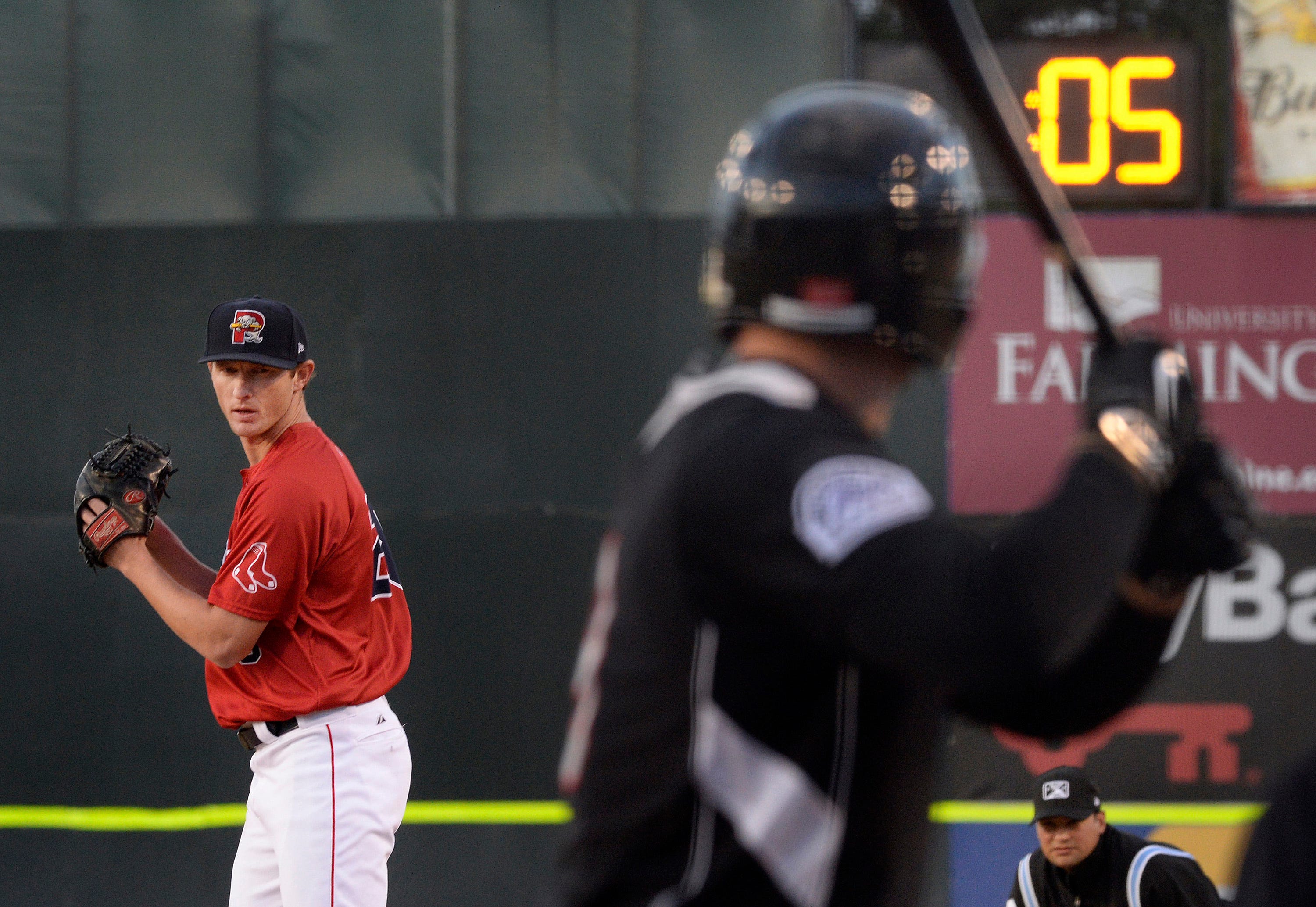
Well, on Saturday, Baseball struck back. On Saturday, a new pitch clock with harsh new penalties was instituted across the minor leagues. This clock was shorter (14 seconds with nobody on, 18 seconds with runners on base) and the burden of getting that pitch off was placed on BOTH the pitcher and the hitter.
The penalty for a pitcher not beating the clock was a ball.
But, at the same time, the penalty for a batter stepping out of the box and not being ready to hit in time was a strike.
This admittedly created a bit of mayhem, as new rules will. In Worcester, for instance, Red Sox pitcher Darwinzon Hernandez struck out the side on eight pitches because two strikes were automatically called on tardy Lehigh Valley batters (the final strike of the inning was actually an automatic strike). This, of course, is not ideal. We’ll get back to this in a minute.
But first, we need to give the headline: The average game time for the 50 nine-inning games in the minor leagues was 2:38. Yeah, that’s right, 2:38 — that was the AVERAGE time of game. That was roughly 25 minutes less than the average time of game for the first week of the minor leagues before the clock was put in.
Only eight of those 50 games lasted three hours, while seven were finished in less than 2:20.
This was just a stunning reversal. Obviously, this was just one night, and even more obviously, minor league baseball is not Major League Baseball. But do you remember the last time Major League Baseball games averaged 2:38 or less? You do not remember this if you are 40 years old or younger, because it was 1984.

JoeBlogs is a reader-supported venture. Free and paid versions are available. The best way to support us here is by taking out a paid subscription. And hey, we do have a lot of fun, so I hope you’ll come along.
Joe

And remember, the thing that the pitch clock does is cut down the dead time between pitches. There might be other unknown benefits and/or consequences with the pitch clock, we don’t know those yet, but we do know that the games with the clock have the exact same amount of action as those games without it. There are still 27 outs, three strikes is a strikeout, four balls is a walk, etc.
This was the revelation that hit me watching that Mud Hens game way back when — all the pick clock did was get everybody to play the game a bit faster.
Now, there are obviously a few caveats. As mentioned, it’s just one day’s worth of games. I did a random scan of games since Saturday, though, and it seems like the trend is very, very real. Here are a few Monday games that I happened to click on:
International League: Syracuse at Columbus, 2:29
International League: Rochester at Buffalo, 2:17
Pacific Coast League: Round Rock at Sugar Land, 2:47
Pacific Coast League: Tacoma at Albuquerque, 2:49 (this was a 12-11 game)
Eastern League: Portland at Harrisburg, 2:17
Eastern League: Altoona at Richmond, 2:45
Southern League: Birmingham at Chattanooga, 2:20
Texas League: Wichita at Northwestern Arkansas, 2:37
Midwest League: South Bend at Fort Wayne, 2:36
Northwest League: Spokane at Eugene, 2:21
South Atlantic League: Greenville at Asheville, 2:26 (this was a 10-9 game)
I mean, those times are kind of mind-blowing in 2022.
Second caveat, the rule is new and the punishments are severe, so you can expect things to slide once everybody gets used to it. Umpires surely will not watch the clock as closely. Pitchers and batters will likely figure out new ways around the clock.
Third caveat, this is the minor leagues. People aren’t really paying attention. It’s one thing to call out a Lehigh Valley batter on an automatic strike, but it will be a very different thing if that batter is Shohei Ohtani or Vladimir Guerrero Jr. It’s one thing to dock a pitcher in Altoona a ball for not pitching fast enough, it’s another if the game is at Yankee Stadium and the pitcher is Gerrit Cole.
I’m sure there are other caveats too … BUT this pitch clock thing is obviously working. I think we all can lament the fact that baseball needs a pitch clock to get us a comfortable but crisp pace, but we are here: 30-plus years of evidence suggests that the umpires and players will not speed up the game without one.
The pitch clock’s time is now.
And as for the penalties, yes, they’re harsh, and there will undoubtedly be an inflexible and not particularly pleasant transition period when everybody will complain that baseball is being wrecked.
But I predict that — assuming MLB doesn’t lose its nerve — everyone will get used to the clock. Batters will naturally understand that they have to be ready, and automatic strike calls will go away. Pitchers will naturally understand that they can’t just stare the batter down for 20 seconds, and automatic ball calls will go away. I don’t think MLB games will average 2:38, but even if they could knock it down to 2:50, that would be an enormous, game-altering difference.
Yes, I’m preaching with the zeal of the converted. I want the pitch clock. And I want it yesterday.

I have to admit: I'm super excited for Angel Hernandez to mix up the punishments.
I'm not convinced the owners/networks won't take these time savings and use them to stretch the game back out in a way that lets them sell more advertising.