

Over a lifetime of talking with many of the greatest hitters in baseball history, I’ve tried to find common ground. What do they share? What connects Aaron and Brett, Gwynn and Votto, Barry and Carew, Sweet Swingin’ Billy and Mr. October, The Man and the Machine?
The best answer I could come up with is this:
They all hated pitchers.
No, they didn’t all hate pitchers with the white-hot fury of George Brett. But when you spend countless hours trying to outthink pitchers, outwork pitchers, outsmart pitchers, outlast pitchers, of course, some of that gets into your bloodstream.
And this is especially true because every hitter who has ever lived knows the nasty little secret about hitting:
The only real chance you have is if the pitcher makes a mistake.
You’ve probably seen Ted Williams’ famous strike zone:
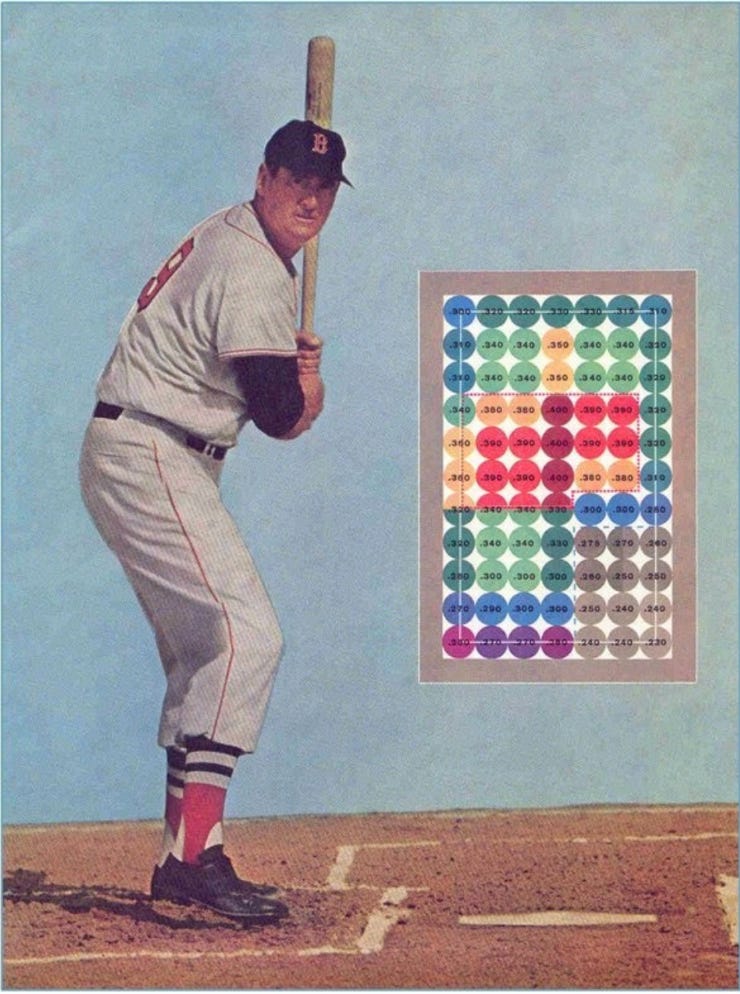
Here, Ted Williams estimates batting average on every pitch in the strike zone. These, of course, are batting averages for HIM, the greatest hitter who ever lived, but even Ted conceded that he couldn’t hit better than .230 or .240 on balls down and away. And that’s IN the strike zone. On pitches outside the strike zone, batters have almost no chance.
True, Ted Williams didn’t swing at many pitches outside the strike zone.
But, you know, he was Ted Williams.
And Ted wasn’t facing an army of pitchers throwing 100-mph fastballs and wiffleball sweepers and exploding sliders and disappearing changeups.
“They say baseball’s a game of failure,” Clayton Kershaw told me. “Well, that’s only true on the offensive side. As a pitcher, you’re supposed to succeed, and you’re not supposed to give up a hit. Hitting’s the hardest thing to do in sports. So I don’t really consider those days when I get hitters out to be a special day. I think that’s just another day.”
So for more than 100 years, batters have been waiting for pitcher mistakes. Maybe it’s a mistake in location — a middle-middle fastball. Maybe it’s a mistake in pitch selection — a changeup when the hitter is sitting on a changeup. Maybe it’s a mistake in execution — a hanging curveball.
The hitter’s job is to pound those mistakes.
But what happens to baseball when hitters can no longer hit mistakes? What happens when pitchers — not just the great ones like Kershaw but ALL of the pitchers, especially the one- and two-inning soldiers — have too much stuff to make mistakes?
You might have seen that the five-game Chicago White Sox-Cleveland Guardians division series featured 63 hits and 56 pitchers. That ratio seems, you know, suboptimal. In Game 3, the White Sox set a postseason record by striking out 19 times in a nine-inning game. In Game 5, the White Sox set a baseball record — postseason or otherwise — by striking out 21 times in a nine-inning game. They put eight balls in fair play in Game 5. Yeah. EIGHT.
Was this against Ryan, Koufax, Feller, and Big Unit?
No. It was against Williams, Sabrowski, Gaddis, and Smith.
Only the best of you will be able to put first names to those four.
But … OK. These were the White Sox, a wonderful story driven by Pope power, sure, but also a flawed team that had two 200-strikeout guys — including Colson Montgomery, who set the Major League record with 227 Ks this year — in the lineup. Yes, pitching dominates the game, we all know that, but things would surely change when the best teams took center stage.
On Sunday, the two best teams in baseball — Los Angeles and Milwaukee — took that stage.
And things didn’t change.
