

Talia and company have picked another amazing nonfiction book for our JoeBlogs book of the month — this one’s by my good friend Wright Thompson, and it’s called “The Barn.” It’s truly incredible. But I’ll let our book editor Talia explain.
Talia is going to interview Wright for our newsletter, so if you have any questions at all for her to ask, please drop them in the comments.

The Panel: Heartbreaking Work of Staggering Genius
The Members: Oliver Gottfried, Mike Stadler, Greg Tamblyn, Mike Baniak, Forrest Brazeal
The Book: The Barn by Wright Thompson
Supplemental Reading:
For books so good they made it to Hollywood: The Right Stuff by Tom Wolfe and Killers of the Flower Moon by David Grann
For music journalism enthusiasts: The Uncool by Cameron Crowe and Sellout: The Major-Label Feeding Frenzy that Swept Punk, Emo, and Hardcore by Dan Ozzi
For when you want to get existential and laugh about it: A Short History of Nearly Everything by Bill Bryson
For a CRIMINAL-y good time: Say Nothing by Patrick Radden Keefe and Poisoner in Chief by Stephen Kinzer
For those who would like to know more about Teddy Roosevelt than what they learned from Robin Williams’ portrayal of him in the Night at the Museum movies: The River of Doubt: Theodore Roosevelt’s Darkest Journey by Candice Millard
Hello again, everyone!
I hope, as we continue sweating our way through the summer, that none of you have fully transitioned into liquid form (I know I’ve come close a handful of times—but we’ve nearly reached the end!).
I also hope you all enjoyed Canyon Dreams! While that was technically our sports pick, it could very well have fit into this month’s theme, too: Great Writing.
As with last month, I won’t take up valuable screen space with a new intro, and instead I’ll refer you to last year’s post, which also came hot on the heels of our Sports Book of the Month!
That’s right—completely by coincidence, we are following the same theme pattern from last year! If anyone is interested in starting a conspiracy theory about nonfiction topics and how they correlate to each month of the year, you know how to reach me.
(It is kinda weird, though…Sports in July during the height of the MLB season…Great Writing in August/September to go along with the start of the school year…I think we need to get some top minds on this ASAP.)
Really, the only reason for this accidental pattern is that I’m selecting the theme based on which panel has had the largest percentage of its members send their submissions.
Oh my gosh, totally random, unrelated thought here: if you’re on one of the remaining panels and you HAVEN’T sent anything in yet, please do so! Otherwise I’ll be forced to move forward without you, and then you’ll end up with crippling FOMO for the rest of your days, and the rest of us will be sad we never received what could’ve been the most incredible, life-changing book recommendation.
Ok, enough housekeeping. Here we go!
You guys didn’t make this choice an easy one, that’s for sure. I mean, scroll back up to the list of runners-up. That’s one heck of a collection.
However, even while I wrestled with the array of marvelous options for this month’s pick, I had an inkling from the very start that I would end up choosing what I did.
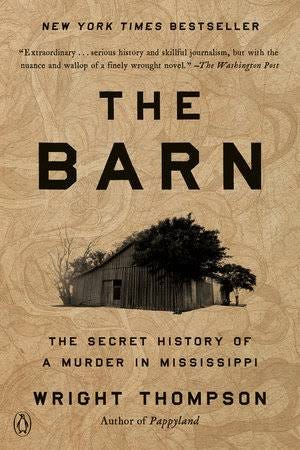
Our Book of the Month for September is The Barn by Wright Thompson, recommended by panel member Oliver Gottfried. If this title sounds familiar to you, it was actually one of our runners-up for last year’s History & Biography panel!
I struggled then, too, to make my final choice, and ended up going with Labyrinth of Ice. While I definitely don’t regret that (I think anyone who read it will agree it was positively gripping), I still felt like I was given a second chance when I saw Oliver’s email come in.
Here we have a repeat recommendation in a different category. That alone is enough to give a submission a little bit of an edge over its competitors.
Then, we have the fact that this book is about Emmett Till.
Emmett Till was an African-American child who, in 1955 at the age of just 14 years old, was kidnapped, tortured, and brutally murdered by white supremacists. Two of his known murderers were tried. They were acquitted. They later openly—proudly, even—confessed to the killing. To this day, we aren’t sure exactly how many people were involved. Thompson believes the number to be around eight.
Eight individuals who were present at the torture and murder of a child.
Oliver wrote along with his submission:
“Obviously the subject matter of this one is difficult…But I was really struck by…Thompson’s ability to really make you feel like you are in a specific time and a specific place, just really evocative writing…also a real hidden history behind a story that many people have a little familiarity with.”
The Barn is definitely not an easy read. However, very seldom are the most important topics easy to cover, much less digest. It’s all the more essential, therefore, that we try.
As Oliver stated, this book brings a lot of “hidden history” to the forefront. Thompson not only reinvestigates the immediate build-up, moment of, and aftermath of Till’s murder, but the entire system that allowed such an event to occur.
In many ways, the flow of the book reminds me of Canyon Dreams. Thompson, like Powell, weaves many different stories together, including the history of the land itself dating back to the 1800s, the impermeable, perpetual stain of racism in the Mississippi Delta, brief biographies of many of the figures on both sides of the murder, and Thompson’s own recent experiences with other activists, scholars, and ordinary people with ties to the area.
It’s a deep dive into the cultural, economic, racial, political, and even the geographical influences that came together to create a twisted world where a handful of bigots could murder a child and get away with it.
The Barn is also not lacking in the beauty of its prose. Thompson’s descriptions create a vivid picture of the Mississippi Delta as he shares his own modern experiences. They simultaneously force us to confront, with sickening detail, the horror of what happened to Emmett Till.
All of these come together to impress on us the sheer significance of Till’s life and death—a topic which is, to this day, suppressed, left untaught, and ignored.
In Thompson’s own words, The Barn is his “attempt to go beyond what is known and explore the unknown registers of a killing that, when seen clearly, illuminates the true history of our country…the tragedy of humankind isn’t that sometimes a few depraved individuals do what the rest of us could never do. It’s that the rest of us hide those hateful things from view, never learning the lesson that hate grows stronger and more resistant when it’s pushed underground.”
I encourage you all to embrace what may be a book of uncomfortable truths and deeply painful history. We’ll all be embracing it together. And the world will be better for it.
Beyond its profound subject matter, the other heartbreaking thing about a book like this is that the people who choose to read it are, on the whole, not the people who most need to.
This is a great book. It is hard to read but worth it because the topic is so important. It’s also one of the best lessons you will find about a society’s collective ability to suppress memories and construct alternate histories around painful and shameful events.